
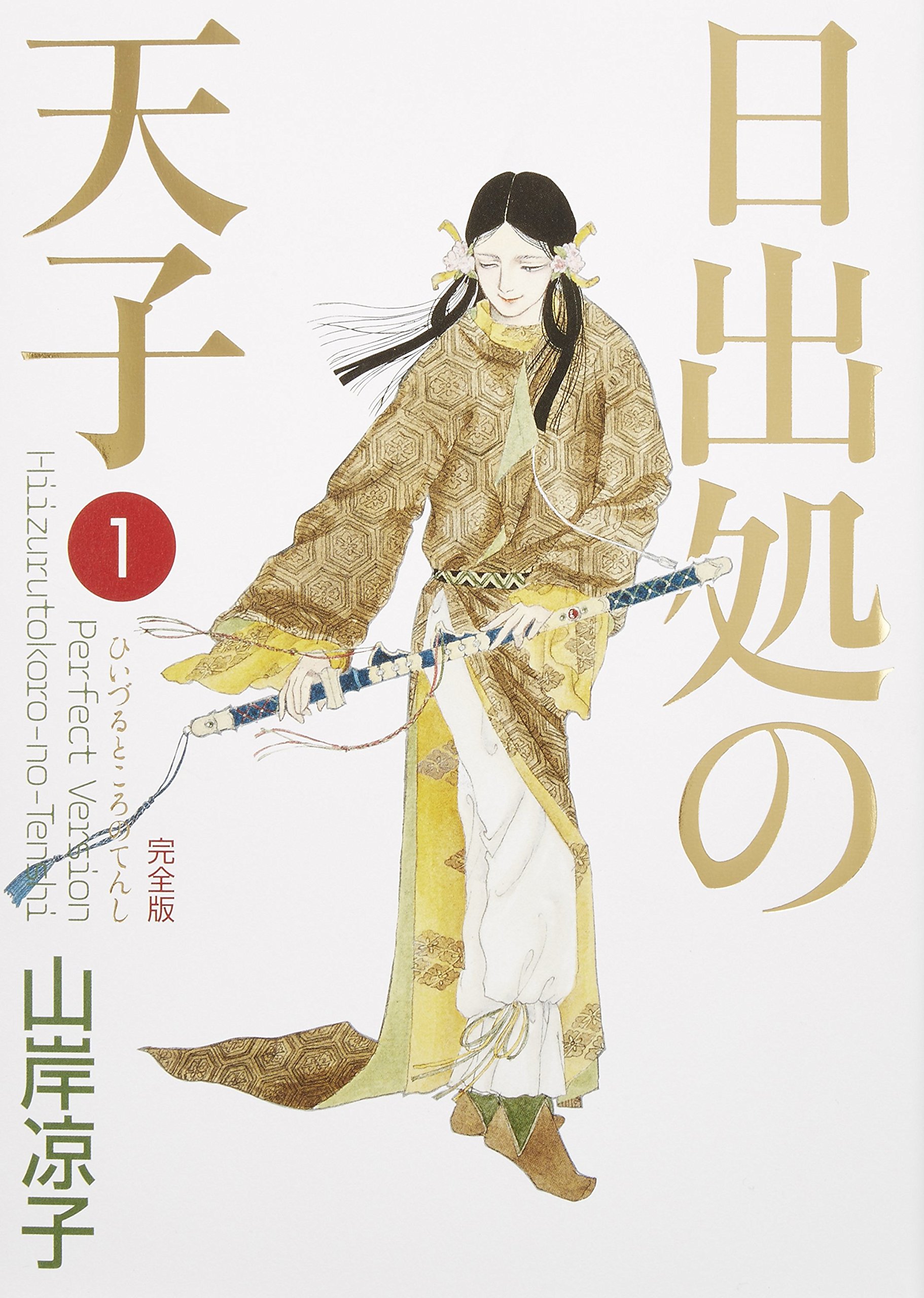
Hinode no Tenko" is a manga by Ryoko Yamagishi. It is set in Japan around the time of the arrival of Buddhism. The story centers on the relationship between Prince Umayado, who later became known as Prince Shotoku, and Soga Motojin, and depicts Prince Umayado from his boyhood to his becoming regent. Prince Umayado is depicted not as a saint, but as a superhuman being with mysterious powers. The "Old Queen Umayato" is a manga by Ryoko Yamagishi that is a sequel to "Tenko of the Rising Sun. Both works are ambitious works that renew the previous image of Prince Shotoku.
pavilion housing the historical archives (in Heian Palace)
In "Hinode no Tenko," Yumedono first appears during a rain-gathering ceremony. Since then, it has been used as a place for Prince Umayado to retreat to when he wants to be alone with his thoughts.
The actual Yumedono is said to have been built in Tempyo 11 (739). The main deity is the Salvation Goddess of Mercy, said to be the same size as Prince Shotoku.
regent
A position created to assist in government when the emperor was a child or a woman.
Prince Umayado is said to be the first regent in history.
Sui (dynasty of China, 581-619 CE)
The name of a dynasty in China from 581 to 618.
In order to establish equal relations with China, which was the most advanced country at that time, and to introduce high culture and technology, Prince Umayado sent envoys to the Sui Dynasty.
Famous quotes, lines/scenes, and scenes from The Sunrise of the Heavenly Child (Queen Umayako)
Prince Stable: "If all my desires from this point forward are fulfilled, then hit me with this arrow!"
A line from Prince Umayado's speech at a betting bow ceremony at the imperial court.
The "betting bow" ceremony is a bow competition among the imperial family, powerful families, and prefects. The "jarai," in which the royal family draws their bows, was originally a magical event, and also had the meaning of making a wish.
Emperor Takaharu, who was always bitter toward Prince Umayado, suddenly ordered him to participate in the event in an attempt to humiliate him, for which he had made no preparations.
He made a wish before shooting his bow, and his wish was: "If all my desires from this point forward are fulfilled, then let this arrow hit me! The arrow hit the target.
The arrow hit the target. Prince Umayado's wish was granted, but the ironic result was that he did not get the man he most desired, Soga no Motojin.
Prince Stable said, "So you appear before those who cannot save themselves? Then I have seen that you do not save anyone.
The Buddha appears before Prince Umato-no-mikoto, who is in the depths of despair after he rejects Soga Motojin, who tells him of his love for her.
He asks, "You mean to say that he appears before those who cannot save themselves? I have seen that you cannot save anyone." This shows that, while he respects Buddhism, he feels more helpless than anyone else.
The Buddhas do not answer, and Prince Umato-ohji does not turn to the Buddhas.
This is a striking line that depicts the realist Prince Umato-no-Oji as far removed from the image of Prince Shotoku who reveres Buddhism as is commonly seen in the world.
Emperor Suiko: "From this day forward, I appoint Prince Umayado of Ikaruga Palace as my senior brother, and entrust him with all affairs.
After the death of Emperor Toshun, Prince Umayado proposed Queen Nukatabe, the previous Empress Daimyo (Empress Toshitatsu), to be the Emperor.
Prince Umayado told the reluctant Queen Nukatabe about his plan.
Queen Nukatabe then made her first announcement: "From this day forth, Prince Umayatobe of Ikaruga Palace shall be the Grand Brother of the Emperor, and all matters shall be entrusted to him.
The nobles were astonished and wondered why Prince Umayato himself had not acceded to the throne.
Soon, the government took the form of the Emperor being assisted by Prince Umayado. It was as if there were two emperors.
The fact that the power of the emperor's family doubled while that of the powerful clans decreased astonished Soga Umako and the other powerful clans.
Backstories, Trivia, and Minor Stories/Episodes and Anecdotes from "The Sunrise of the Heavenly Child (Queen Umayako)"
Horyu-ji Temple is in a Crescent," a false report appeared in a newspaper.
On January 24, 1984, while the manga was being serialized, an article appeared in the Mainichi Shimbun evening edition, titled "Horyu-ji Temple: Kankan: 'What, this is Prince Shotoku? The article was titled "Horyuji Kankan: 'What, this is Prince Shotoku?
The content of the article was, "Horyu-ji Temple is outraged by the blasphemy of the object of faith after reading this cartoon. We would like to request an explanation from the publisher.
However, the article was untrue, and an apology by the Mainichi Newspapers was later published.
It was a fabricated article based on an assumption by a reporter of the Nara Shimbun, who approached Horyuji about the manga but was put off by his attitude.
The original author, Ryoko Yamagishi, was thinking of selling her house to pay for the trial in case the case went to court.
Plague god appearance scene based on the author's real experience
When Prince Umayado's father, Emperor Yomei, collapses, there is a scene in which the god of plague stands at the four corners of the emperor's room.
In fact, the author, Ryoko Yamagishi, had a similar experience.
When Ryoko Yamagishi's father died, she felt as if there was something black in the toilet of his private room in the hospital where he was hospitalized, so she placed salt to purify him.
Mysterious experience that happens every time I visit Nara
Ryoko Yamagishi says she has a mysterious experience every time she goes to Nara. One of the most memorable episodes was when she visited Yumedono and saw a rainbow lying on its side.
This is called hi-gasa, a circle of light that forms around the sun. This phenomenon is seen several times a year, and when colored, it looks like a rainbow.
Three books I read before painting "Tenko of the Rising Sun."
The three books that Ryoko Yamagishi read before painting "Hinode no Tenko" were Takeshi Umehara's "The Hidden Cross," Kojiro Naoki's "History of Japan〈2〉Formation of Ancient State," and Junichi Kikutake's "Japanese Art 91: Shotoku Taishi Eiden".
He said that if he researched too much, the initial enthusiasm he had inside him would cool down, so when he had the power to draw this, he would immediately start working on it at that stage.
The Hidden Cross" is a controversial work that stirred up controversy by asserting the theory that Horyuji Temple was built to appease the grudge spirit of Prince Shotoku.
Ryoko Yamagishi said that when she was in elementary school, she read a newspaper article that a sword was housed in a Buddhist statue in the collection of Horyuji Temple. When she told her friend, manga artist Masako Yashiro, that she was very frightened by the situation of the sword being covered with something so ominous and precious, she was introduced to "The Hidden Cross," saying that this is exactly what it is about. He said that he read the book with a thrill, as if he was reading a horror novel.
He later said that the book made him want to depict what is so powerful that it must be appeased.
Shotoku Taishi E biography" is a picture scroll depicting the life of Shotoku Taishi. The various episodes depicted in the book, which are far removed from those of ordinary people, led him to the idea of what if Prince Shotoku had been a supernatural being.

Related Articles
舞姫 テレプシコーラ(漫画)のネタバレ解説・考察まとめ
『舞姫テレプシコーラ』とは、山岸凉子によるバレエをテーマにした漫画である。雑誌『ダ・ヴィンチ』(メディアファクトリー)にて、2000年11月号から2006年11月号まで第1部が連載された。その後、第2部が2007年12月号から2010年10月号まで連載された。物語は、バレエダンサーを目指す少女たちの成長と葛藤を描いている。主人公の篠原六花は、バレエ教室を営む母とプロを目指す姉と共にバレエを学び、様々な困難を乗り越えながら自分の道を見つけていく。
Read Article
Hana no 24-nen Gumi: Women Artists Who Radically Changed the Shojo Manga Industry
These female artists were active in the 1970s and took approaches that had never been taken in girls' manga before, such as BL and aesthetic expressions, which are not uncommon nowadays, content that included literary elements, and delicate illustrations. Since they were all born in 1949, they are known as the "Hana no 24-nen class. Here is a summary of the artists who are nostalgic for the author's generation.
Read Article
Contents
- Summary of "The Sunrise of the Heavenly Child (Queen Umayako)
- The story of "Tenko of the Sunrise (Queen Umayako)"
- Synopsis and story of "Hinode no Tenko
- era of the Emperor Titatsu
- Meiji period (1868-1912)
- period in the reign of Emperor Shun
- murder of one's own lord or father
- accession of the Suiko Emperor to the throne
- Synopsis and story of "The Old Queen of Banya
- Funeral of Prince Umayado-Oji
- The old queen of Banya who dazzles all around her
- Prelude to the fall of the Shanggu royal family
- Characters and Characters in "Tenko of the Sunrise (Queen Umayako)
- The family of the Prince of Umayado
- Prince Umayado
- Anahobe no Hashinohime
- Emperor Yomei / King Tachibana no Toyohi
- Prince Kume
- Prince Eguri
- Prince Magita
- Prince Tamame
- Sugo clan
- Soga no Emishi
- Soga no Umako
- Toujikou Iratsume
- Toichi no Irazume
- Kawakami Daughter (Kawakami no Iratsuko)
- Sakaimabe no Omimarise
- Sakaimabe no Omaro
- Kuramaro Soga
- the Imperial Family
- Emperor Toshitatsu / Osada no Oki
- Emperor Suiko and Queen Nukatabe
- Prince Anahobe
- Emperor Sushun / Prince Tomarisebe
- Princess Ohime / Princess Uji-no-Kaitako-no Ouji
- Princess Ohonakatsuhime / Princess Oharida
- Prince Takeda
- Prince Owari
- Prince Hikohito Oshisaka
- Prince Yabe
- Mononobe clan
- Mononobe no Moriya
- Mononobe no Hashimaro
- Mononobe Nieko
- Mr. Shiba.
- Tatsuto Shiba
- Tasuna Shiba
- Zenshinni / Island
- Kurazukuri no tori
- Ootan (hereditary title; orig. one of the two highest such titles, later demoted to sixth highest of eight)
- Ootomo no Nukate
- Ootomo no Oteko
- Mr. Abe
- Abeno Uchimaro
- Abenohime
- Other powerful families
- Katsumi Nakatomi
- Kibi-no-Amabe-no-Hashima
- Miwa Kimisakashi
- Eastern Han Naokoma (Yamato no Aya no Ataikoma)
- etc.
- Freshwater/Yusu Yusu (迹見赤檮)
- Tuning Maro
- Princess Futsuhime
- White-haired Woman
- Boki-ki-no-Miratsume/Kashiwade-no-Miratsume
- Hira (Japanese name for the sun)
- Children of the Jomiya Royal Family and Prince Umayado
- Umayakonohime-miko, the ancient queen of Umayakonohime
- Prince Yamashiro-no-Oe-no-Oji (Prince Yamashiro-no-Oe-no-Oji)
- Tsukishine-no-Hime-miko
- King Hatsusebe
- King of the Treasury (Takara no Ouji)
- King Hioki (Heki no Ouji)
- Other than the children of Prince Jomiya and Prince Stable
- Queen Satomi
- King Naniwa (King of Naniwa)
- King Yuge
- Persons outside the Shangguang royal family
- Soga no iruka
- Terms from "The Sunrise of Heaven (Queen Umayako)"
- the Sun Goddess
- Hwarang
- Yamato Court
- powerful family
- (Judaism)
- The Great Lord
- pavilion housing the historical archives (in Heian Palace)
- regent
- Sui (dynasty of China, 581-619 CE)
- Famous quotes, lines/scenes, and scenes from The Sunrise of the Heavenly Child (Queen Umayako)
- Prince Stable: "If all my desires from this point forward are fulfilled, then hit me with this arrow!"
- Prince Stable said, "So you appear before those who cannot save themselves? Then I have seen that you do not save anyone.
- Emperor Suiko: "From this day forward, I appoint Prince Umayado of Ikaruga Palace as my senior brother, and entrust him with all affairs.
- Backstories, Trivia, and Minor Stories/Episodes and Anecdotes from "The Sunrise of the Heavenly Child (Queen Umayako)"
- Horyu-ji Temple is in a Crescent," a false report appeared in a newspaper.
- Plague god appearance scene based on the author's real experience
- Mysterious experience that happens every time I visit Nara
- Three books I read before painting "Tenko of the Rising Sun."