
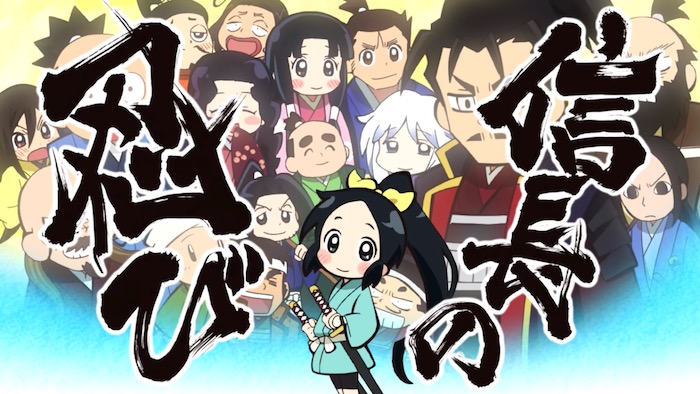
Nobunaga no Shinobi" is a four-frame manga by Naoki Shigeno that began serialization in Young Animal magazine (Hakusensha) in 2008 (issue 12), and an anime based on the manga. According to Shigeno, it is "not a ninja manga, but a warring states manga seen through the eyes of a ninja. While it is basically a gag manga, it also contains anecdotes and poems from the Sengoku period, and the story line is almost faithful to historical facts.
The story is about a young ninja girl, Chidori, who is attracted to the dream of Nobunaga Oda and together they pursue a war under heaven. Nobunaga is portrayed as a man with a super sweet tooth, and the other characters have strong personalities.
Behind the Scenes, Trivia, Small Stories / Episodes and Anecdotes of "Nobunaga no Shinobi"
"Bonus" which can be read by removing the cover of the book of "Nobunaga no Shinobi"
If you remove the cover from the Nobunaga no Shinobi book, you will find a "bonus" on the cover and the back cover of the book. By learning about ninja tools, Nobunaga no Shinobi becomes twice or three times more interesting.
Descendants of Fujitaka Hosokawa are the 79th Prime Minister and Morihiro Hosokawa.
Fujitaka Hosokawa is the ancestor of the 79th Japanese Prime Minister, Morihiro Hosokawa (Hosokawa Morihiro). The Hosokawa Cabinet lasted less than a year, but his ancestor, Fujitaka, was a great man who excelled in both literary and military arts. He studied martial arts at a high level and became a great poet and master of the tea ceremony. He was given an important position by Nobunaga ODA and Hideyoshi TOYOTOMI as a man of culture who knew Kyoto well. He is also known to have been given "Kokin Denju", the secret of the interpretation of "Kokin Wakashu" (A Collection of Ancient and Modern Japanese Poetry) by a court noble, Saneki Sanjonishi. In the "Battle of Tanabe-jo", one of the preliminary skirmishes of the Battle of Sekigahara, the Tanabe-jo Castle protected by Fujitaka was surrounded by a large force of 15000 soldiers of the Western Army, and the siege lasted for two months. Fujitaka had less than 500 soldiers, and there was a concern that if Fujitaka was defeated, the Kokin Denju would be cut off, so at last a peace treaty was concluded by the order of the Emperor at that time, Goyo Emperor Cheng of Jin. The peace treaty was made two days before the Battle of Sekigahara. Since the actual Battle of Sekigahara was settled in just one day, it is not known what happened to the Battle of Tanabe-jo, but the valuable Kokin Denju even moved the Emperor. This is exactly what it is to say that art helps one's body.
Natsume Yoshinobu is the ancestor of Natsume Soseki.
Natsume Yoshinobu, who died in place of Ieyasu Tokugawa in the Battle of Mikatagahara, is the ancestor of Soseki NATSUME, a great writer of modern Japanese literature. Since Soseki was born in Tokyo, it is believed that the family followed Ieyasu TOKUGAWA and moved to the Kanto region even after the death of Yoshinobu. Natsume Yoshinobu received Ieyasu's armor and fought with only twenty five horsemen against the pursuers of the Takeda forces and died on the battlefield, but Ieyasu was able to survive. It is said among Soseki fans that if Soseki had written a historical novel about this, it would have been interesting.
THE ONLY INJURY Honda Tadakatsu, THE INVINCIBLE MAN OF HIS LIFE, HAS EVER SUFFERED.
It is said that Honda Tadakatsu participated in 57 battles of various sizes in his life, but he did not suffer a scratch in any of them. However, in his later years, when he was carving his name on his belongings with a short sword, his hand slipped and he injured his left hand. Tadakatsu muttered,' Honda Tadakatsu, if you get injured, it will be the end,' and he died a few days later. In his later years, Tadakatsu was treated coldly by the Tokugawa family, but he composed a farewell poem for Ieyasu at the time of his death, and his loyalty was outstanding among the Four Heavenly Kings of Tokugawa.
Miyoshi Seikai Nyudo actually existed.
The Miyoshi Sanninshu (Nagayuki MIYOSHI, Nagayuki MIYOSHI, Tomomichi IWANARI, Tomomichi IWANARI, Masayasu MIYOSHI and Masayasu MIYOSHI) are thoroughly treated as mobs in "Nobunaga no Shinobi" (The Records of Ancient Matters), but Masayasu is said to be the model of Seikai Nyudo MIYOSHI, one of the' Sanada Juyushi' (Ten Braves of Sanada), and Masayasu is popular among people who know him.
Irresistible Connection between Ieyasu and the Imagawa Family
After the death of his father, Imagawa Yoshimoto, he was driven out of Suruga, and using his "culture" as a weapon, he managed to move from one feudal lord family to another in various places, finally becoming a vassal of the Tokugawa Shogunate. It seems that Ieyasu treated Ujizane fairly well, but it is said that in his heart, he was disgusted with Ujizane's long story that he did not reveal his true intentions. He came to the castle often and talked nothing but trivial things, so Ieyasu finally moved Ujizane to Shinagawa far from Edo-jo Castle. Even so, the descendants of the Imagawa family after Ujizane were allowed to serve the Shogunate with the treatment of koke (privileged family status). There is a study that when Ieyasu was a hostage of the Imagawa family, he was allowed to learn not only harsh things but also culture and martial arts. This shows that Ieyasu felt indebted to the Imagawa family. Imagawa Ujizane
' Arukimiko' (walking shrine maiden), also known as' Ashinagabozu' (long-legged priest)
The group of women ninja called "Arukimiko" (walking shrine maidens) used by Takeda Shingen was very good at gathering information. Shingen knew in detail the information of various places brought by "Arukimiko" (walking shrine maidens) while he was in Kai (Kai Province). Therefore, he was also called "Ashinaga-bozu" (long-legged priest) because he felt as if he was going around all over Japan on one foot. Shingen also designed and used a "flush toilet". This flush toilet has a writing desk and so on, and it seems that Shingen used it like a study. This "flush toilet" was called "yama" (mountain). It is said that when asked by his vassals why, Shingen answered, "There is no plant (smell) in the mountain."
Theme song and insert song of "Nobunaga no Shinobi"
Theme song: Renka "徒桜" (Chapter 1 to Chapter 13)
Theme song: Valshe "MONTAge" (CHAPTER 14 - CHAPTER 26)
Theme song: Renka "Shirayuki" (CHAPTER 27 - CHAPTER 39)
Theme song: Lily's Blow "Hana no Kage" (Shadow of a Flower) (CHAPTER 40 - CHAPTER 52)

Tags
Contents
- Overview of Nobunaga no Shinobi
- Outline and story of "Nobunaga no Shinobi"
- From Okehazama to the Ishiyama War
- Siege of Mino
- The Oda Family's Idol Oichi Marries Omi
- Chidori to Kōga Shinobi
- Yoshiaki Ashikaga, the new shogun, is already in trouble
- Chidori fighting with Kengo Daimyo
- A desperate retreat at the Kanagasaki Retreat Gate
- From Chikusa Pass to the Battle of Anegawa
- The Battle of Ishiyama
- List of Nobunaga no Shinobi characters
- People of the Oda family
- Chidori (plover)
- Nobunaga ODA
- 助蔵
- Kicho (return butterfly)
- Shibata Katsuie
- Mori Yoshinari (Moriyoshi)
- Mori Nagayoshi
- Mori Ranmaru
- Ota Gyuichi
- Akechi Mitsuhide
- Hiroko
- Ittetsu INABA
- Ando Morinari
- Bokuzen UJIIE
- Toshiie MAEDA
- Takigawa Kazumasu
- Sakuma Nobumori (Sakuma no Bumori)
- Fujitaka Hosokawa (also known as Hosokawa Fujita)
- Araki Murashige
- Hori Hidemasa
- Koheita HATTORI
- Shinsuke MORI
- Oda Nobuhiro
- Ikeda Tsuneoki
- Harada Naomasa
- Nobukatsu KITABATAKE (Oda)
- Tsutsui Junkei
- Kuki Yoshitaka
- Yasushige TSUGE
- People of the Kinoshita family
- Hideyoshi KINOSHITA
- Nene
- Koroku HACHISUKA
- Hanbei TAKENAKA
- Hidenaga KINOSHITA
- Naka
- People of the Tokugawa family
- Tokugawa Ieyasu
- Hattori Hanzo
- Honda Tadakatsu
- Sakai Tadatsugu
- Sena
- Nobuya TOKUGAWA
- Sadamasa OKUDAIRA
- Torii Suneemon
- People of the Azai family
- Nagamasa AZAI
- Oichi
- Azai Hisamasa
- Endo Naotsune
- Todo Takatora
- Isono Kazumasa (Isono Kazumasa)
- Azai Inori
- Azai Manpukumaru
- Akao Kiyotsuna
- People of the Asakura family
- Asakura Yoshikage
- Yoshiie Yamazaki (Yamazaki)
- Makara Naotaka
- Saito Tatsuoki
- Asakura Kageakira
- Kagechika Torii
- Kagenari TAKAHASHI
- Nagashige TOMIDA
- Maeba Yoshitsugu
- People of Honganji
- Kennyo of Hongan-ji Temple
- Nyoshunni
- Kyonyo of Hongan-ji Temple
- Sanmi-dono Palace
- Shimozuma Rairen (Shimotsuma)
- Shimotsuma Rairyu
- Saiga Goichi
- 岡吉 Masa (Okayoshi)
- Shimotsuma Raitan (Shimotsuma Raisin)
- Kennin of Gansho-ji Temple
- Members of the Takeda family
- Shingen Takeda
- Mochizuki Chiyome
- Takeda Nobukado
- Takeda Katsuyori
- Yamagata Masakage
- Masanobu KOSAKA
- Haruno BABA
- Naito Masatoyo (If you don't have it, it's delicious)
- Akiyama no Nobutomo
- Oyamada Nobushige
- Nagasaka Kyokukansai
- MUTO (SANADA) Masayuki
- Tsuchiya Masatsugu
- Anayama Nobutada (also known as Baisetsu)
- People of the Uesugi family
- Uesugi Kenshin
- Uesugi Kagetora
- Kagekatsu UESUGI
- Kanetsugu HIGUCHI (Higuchi)
- Nokizaru Toryo
- Hairy people
- Terumoto MORI
- Kikkawa Motoharu (Kawamoto)
- Kobayakawa Takakage
- Murakami Takeyoshi (Mitake MURAKAMI)
- Motoyoshi Murakami
- Iga Ninja
- Momochi Tanba (Yusuke Momochi Tanba)
- Kanbe no Kominami (Kobe Port)
- Magodayu OII
- Kido Yazaemon
- Tateoka Dojun
- Other people
- Yoshiaki Ashikaga
- Imagawa Yoshimoto
- Imagawa Ujizane
- Matsuna Hisahide
- Matsunaga Hisamichi (Matsuna ga hisamichi)
- Jotei ROKKAKU
- Sugiyatsu Zenjubo
- Luis Frois
- Kitabatake Tomonori
- Kitabatake Tomofusa
- Miyoshi Sanninshu (Miyoshi Triumvirate)
- Kakujo
- Kanesada SEKI
- Manase Dosan
- Gensaku
- Hatano Hideharu
- Akai Naomasa
- Okabe Mataemon (Okabe Mataemon)
- Morishige TSUCHIBASHI
- Kosuzume (sparrow)
- Hotaru (firefly)
- Extra edition
- Saito Dosan
- Motonari MORI
- Yoshiteru ASHIKAGA
- Asakura Norikage
- Terms of the Nobunaga no Shinobi
- The anti-Nobunaga network
- "Frois's History of Japan"
- "Shinchoko-ki"
- Words, lines, scenes from "Nobunaga no Shinobi"
- Chidori "I think it's a sin to be a Sengoku daimyo who does does nothing but not fight or obey."
- Chidori "No matter how hard you get, don't give up. The main purpose of stealth is to' live.'"
- Makara Naotaka' A warrior may be called a dog (or a dog), or a beast (or a beast), but it is a book to win!'
- Chidori "I think it's good,"
- Nobunaga ODA: "You didn't kill anyone, you killed an eagle."
- Behind the Scenes, Trivia, Small Stories / Episodes and Anecdotes of "Nobunaga no Shinobi"
- "Bonus" which can be read by removing the cover of the book of "Nobunaga no Shinobi"
- Descendants of Fujitaka Hosokawa are the 79th Prime Minister and Morihiro Hosokawa.
- Natsume Yoshinobu is the ancestor of Natsume Soseki.
- THE ONLY INJURY Honda Tadakatsu, THE INVINCIBLE MAN OF HIS LIFE, HAS EVER SUFFERED.
- Miyoshi Seikai Nyudo actually existed.
- Irresistible Connection between Ieyasu and the Imagawa Family
- ' Arukimiko' (walking shrine maiden), also known as' Ashinagabozu' (long-legged priest)
- Theme song and insert song of "Nobunaga no Shinobi"
- Theme song: Renka "徒桜" (Chapter 1 to Chapter 13)
- Theme song: Valshe "MONTAge" (CHAPTER 14 - CHAPTER 26)
- Theme song: Renka "Shirayuki" (CHAPTER 27 - CHAPTER 39)
- Theme song: Lily's Blow "Hana no Kage" (Shadow of a Flower) (CHAPTER 40 - CHAPTER 52)
- Theme song: "Goldfish tears" by Renka (CHAPTER 53 - CHAPTER 65)
- Theme song: Valshe "Sou no Ri" (CHAPTER 66 - CHAPTER 78)