
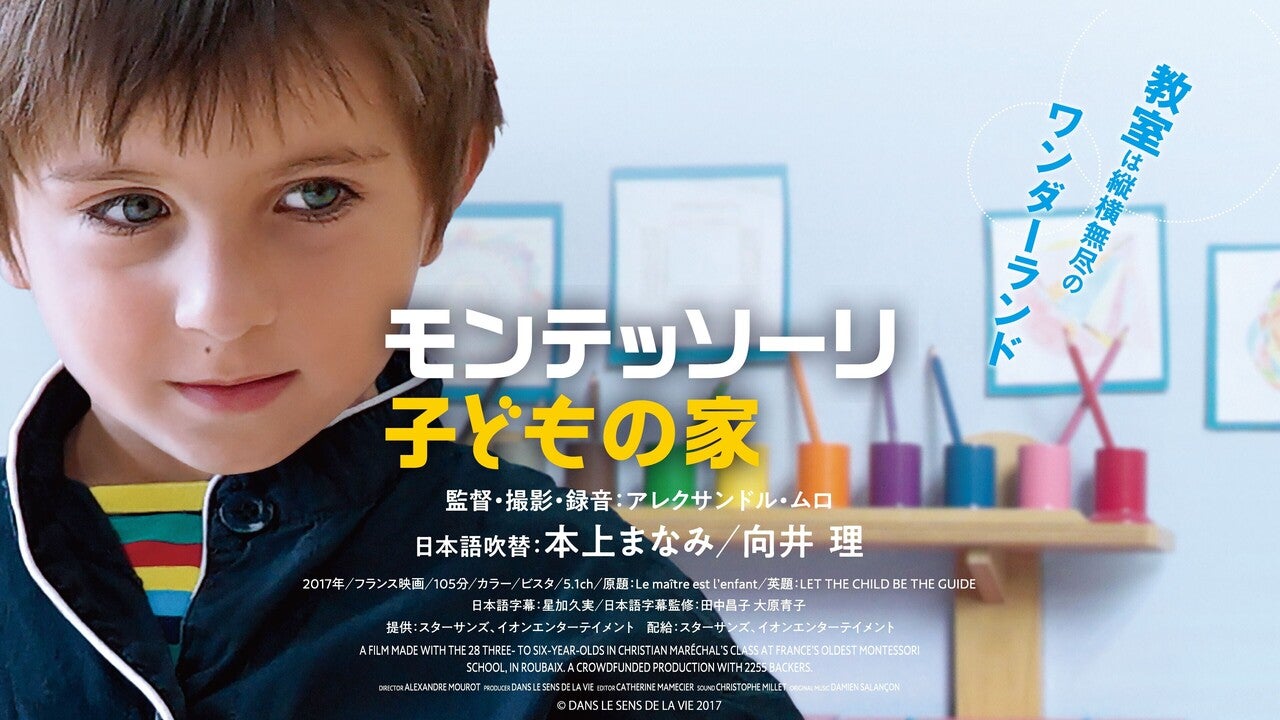
Montessori: A Child's Home" is a French documentary film that portrays the fascination of the Montessori method of education, which is favored by many people around the world, and the growth of the children. The film was shot over a period of two years and three months at the country's oldest Montessori kindergarten in Roubaix, Northern France, and succeeded in capturing 28 children between the ages of 2.5 and 6 learning freely with unique teaching tools, as well as the touching moments that occur as the children grow up. The Japanese dubbed version features Manami Honjo as the voice of Maria Montessori and Osamu Mukai as the director.
Overview of Montessori's House of the Child
Montessori Kodomo no Ie children is a French documentary film about the appeal of Montessori education and the growth of children. The original title was "Le maître est l' enfant," which was produced in 2017. The film covers the country's oldest Montessori kindergarten in the northern French city of, from March 2015 to June 2017 (2 years and 3 months), and succeeds in capturing 28 children aged 2 and a half to 6 years who are learning freely with a unique teaching tool, as well as the touching moments that occur as they grow up. The film not only hints at raising children and the importance of education, but also teaches us that the children who make the future are not just "small adults" but are the bearers of peace. The guide of the film is Montessori's own words quoted from the book and Alexandre Muro, who turns the camera. In the Japanese voice-over version, Manami Honjo is in charge of Maria Montessori's voice and Osamu Mukai is in charge of Alexandre Muro's voice.
The plot and story of "Montessori Kodomo no Ie"
This film was filmed by director Alexandre Muro as an observation film on the practice of Montessori education.
At the beginning of the film, Muro took a picture of the growth of his newborn daughter, Anna, and thought about how to answer her needs. The first lesson he learned when he became a parent was to make her like her. However, at one point, the policy of making her like her came into question. The mother saw Anna on the swing and said, "She wants to get off," but that doesn't seem to be the case with his father, Muro. The mother saw Anna on the swing and thought, "She wants to get off get off." It's not clear whether she really wants to get off because she can't communicate with her verbally. Which is right, "let her like her" or "let the parents think for her?" Maria Montessori answered this question a century ago and led the director to Montessori education.
The director, who had doubts about his own child rearing, asked the "children's house" for the answer, and set up a small camera in the class to quietly and carefully "observe" the children so as not to interfere with their activities. In the class, children are shown arranging flowers, measuring the contents of a pitcher, and stretching a carpet. This is their "work" in the school, and the first thing the director felt when he started filming was that the class was very quiet even though the children were working freely. They never get bored in front of the director and repeat the same "work". Maria Montessori says that the natural desire for this "work" is the essence of human beings.
Children like to "work."
The main purpose of work for adults is to earn an economic income, but children have an important job of raising themselves. In the Children's House, all the activities that children do are called "jobs."
Learning is more effective when children are of different ages and help each other without competition. Children want to read books quietly by themselves in the morning, two or three of them work together to prepare snacks, and sometimes all of them dance or listen to the sound of rain or wind. The Children's Home gives children a lot of freedom and responsibilities. For example, they have the freedom to repeat their favorite activities as many times as they like, in the place they like, but at the same time they have the responsibility to put their chairs back in place for the next person. If they feel thirsty, they have the freedom to drink water by themselves, but if the floor gets wet, they have the responsibility to go and get mops by themselves. These are small arrangements to live comfortably with each other. Every year, when a new child enters the kindergarten, the small seniors carefully introduce the class's usual "work" as if they were waiting for it.
Children who are not jealous
Some children are drawing pictures, cutting apples, building with blocks, or learning math, while others, like four-year-old Jello, are walking around the classroom observing the "work" of other children. The little ones are not jealous; they understand that when they get older they will be able to do it too, and they have a sense of admiration and admiration for the older children. Lost in front of shelves lined with various teaching tools, Jello chooses a set of scissors and paper. Jero's eyes are serious as he tries to cut along the lines drawn on the paper. Jero's eyes light up even more when Christiane Maréchal shows him the "job" of transferring the contents of the jug.
Learning and growing through movement, the children maintain and beautify the class, taking care of the plants and themselves until they are satisfied. All the tools placed on the table are real child-sized tools (knives, irons, jugs, etc.), and as they are used repeatedly, the children's hands and body movements begin to change. The movements become more careful and considerate of the materials and others, and the child's inner self develops a sense of concentration and independence. Here, from an early age, they learn the etiquette of gently watching over someone when they are preoccupied. In the play, the children ask, "Can I watch?" Can I help?" In the play, greetings such as "Can I watch?" and "Thank you" are introduced through natural interactions between children of different ages.
Introduction of the "sensitive period"
Montessori discovered that some of the phenomena observed in biological childhood are also observed in human children. These are called "sensitive periods." Children under the age of six show intense interest in certain elements of the environment. After they acquire knowledge and skills, their interest gradually disappears and they become obsessed with the next object. The natural urge of Naiko to control is a feeling that is almost exclusive to them. Sensitive periods are universal and occur in children of all ages and all social and economic backgrounds. Once they appear, they never return. They can be broadly divided into sensory, verbal, small object, motor, order, and social sensitivity periods. In the play, children engaged in various "jobs" are shown, and especially the sensitive period of sense and language is introduced.
Sensitive period
The sensory training tool organizes the impressions of various five senses accumulated in children, such as color, shape, length, weight, temperature, pitch of sound, taste and smell, and enriches their lives by enhancing their sensory awareness. Children explore a wider world of senses by experiencing the sensory training tool, which is beautifully and precisely designed in basic colors and shapes, in a timely manner, and build the basis of their own intelligence.
In the movie's "O-Shigoto," the Pink Tower, which works on the eyes, and the Bell, which works on the ears, are introduced.
Period of linguistic sensitivity
At Children's House, there are many places where you can experience all the functions of language, such as listening, speaking, writing, and reading, which are the means of communication for all human beings. In this movie, at some point, children realize that they can encode the sounds they have been talking about, and they suddenly begin to get interested in letters. In the movie, "Ogoto" uses a sand clock to trace letters and a teaching tool to match objects with names.
Focus on "Concentration Phenomenon
When a child encounters a job that is really necessary for his / her growth, he / she shows a "concentration phenomenon." When he / she is asked to do a detailed and precise job, he / she shows interest and forgets time to do it. The harder it is, the more intense he / she becomes. This is called a "concentration phenomenon." This phenomenon is not created by teachers, but by children themselves. Children aged 3-4 have the same high level of concentration as people called geniuses, and the attention paid to this "concentration phenomenon" is the origin of Montessori's education law.
Montessori Education Aims
The film is an observational film, and the audience watches the children's trial and error throughout most of the film. There is little dialogue to relive the children's independent growth. The occasional narration conveys to the audience the beliefs that Montessori has acquired from the children's observations.
In 1936, at the European Peace Conference, Montessori stated that "avoiding conflict is the job of politics, but peacebuilding is the job of education." Having experienced three wars in his life, Montessori sincerely wished for permanent peace and preached that peace begins only in childhood when personality is formed. In the play, not only are tips on raising children and the importance of education, the children who make the future are not just "small adults" but are the bearers of peace.
Characters from "Montessori Kodomo no Ie"
teacher (classroom)
Christian Maréchal.
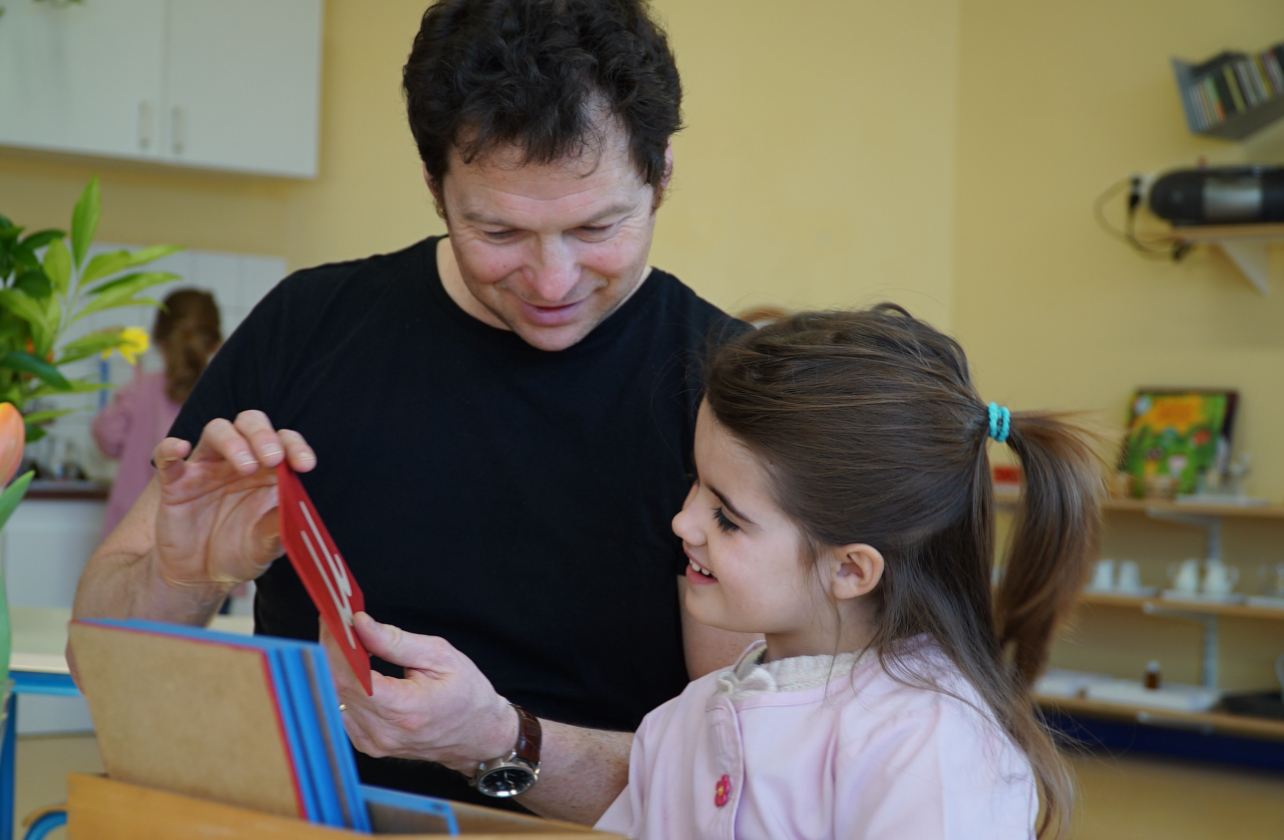
Dr. Kirsty Ann Murray Shal (left)
The role of the teacher (adult) is introduced in the middle of the film. Before the children arrive at school, the teacher begins by preparing the classroom environment and organizing the teaching materials, and then helps the children with their "work" and observes them as needed. It is also the teacher's role to take the initiative, and to respond in a humble manner, without talking down to the children. In Montessori classes, the most important language resource is considered to be the teacher.
Christiane Maréchal has been working in Montessori schools since 1992, and since 1995 in a Montessori school in Roubaix. Since 2002, she has been involved in AMI teacher training at the Maria Montessori Institute in Paris and Geneva, and in 2005, she became a certified AMI teacher examiner for 3-6 year olds.
Children

Tags
Contents
- Overview of Montessori's House of the Child
- The plot and story of "Montessori Kodomo no Ie"
- Children like to "work."
- Children who are not jealous
- Introduction of the "sensitive period"
- Sensitive period
- Period of linguistic sensitivity
- Focus on "Concentration Phenomenon
- Montessori Education Aims
- Characters from "Montessori Kodomo no Ie"
- teacher (classroom)
- Christian Maréchal.
- Children
- Jello
- Gallance
- Charli
- Felix.
- Alix
- Rare
- Montessori Children's House terminology
- Maria Montessori
- Children's home
- Teaching tool
- Words, lines, scenes and scenes from "Montessori Kodomo no Ie" (Montessori Children's House)
- Maria Montessori: "Children's behavior teaches us many things. Children are not powerless; they are full of dignity."
- Maria Montessori "I had this crazy idea that you could raise a child to be a discerning hard worker by rewarding him or her for his or her appetite, self-esteem, etc., but there was no such desire in the child who was about to grow up."
- Director Aleksandr Muro said, "The classroom is a laboratory and a place for observation. Do not interfere with children, do not interfere with their concentration, do not place obstacles, and children will make great leaps."
- "Montessori Kodomo no Ie" (The House of the Montessori Children): Behind-the-Scenes Stories, Trivia, Small Stories /
- The impetus for the production came from the director's own eldest daughter.
- Muro, who decided to shoot alone
- Children photographed as they are