
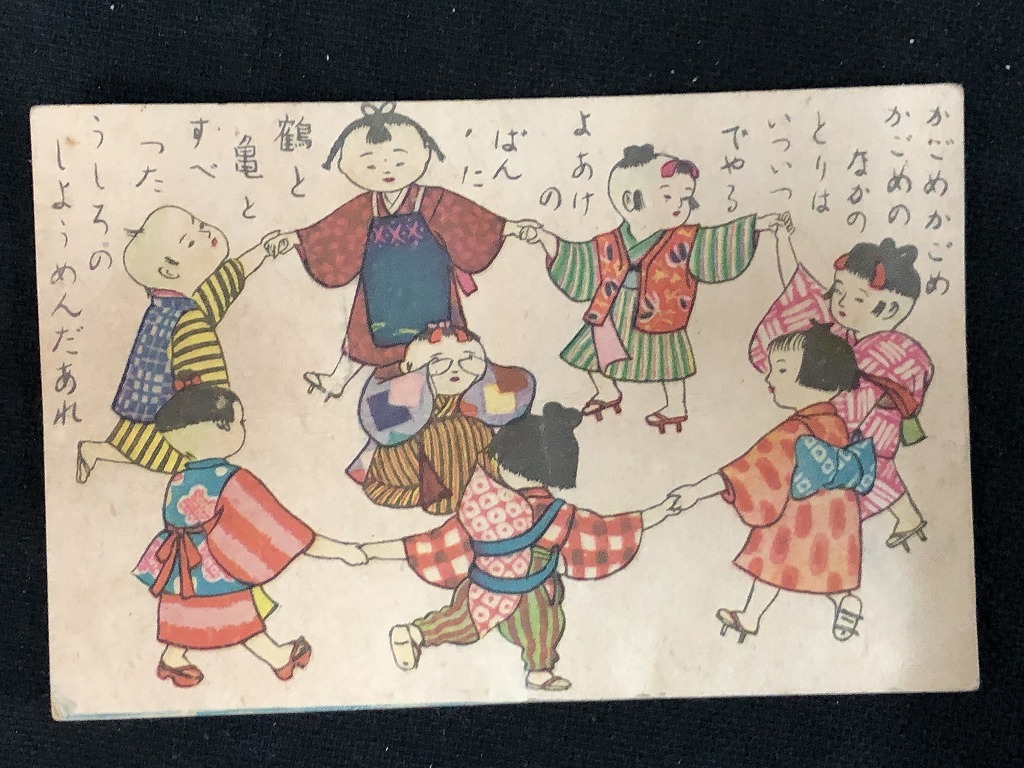
We have compiled a list of scary and mysterious urban legends about the nursery rhyme "Kagome Kagome. The secrets and rumors hidden in the familiar song, such as "Playing the song backwards will result in a cursed message," are also included. We also introduce the lyrics, which have changed with the times, and the theory that the song was popularized by Matsuo Basho.
prostitute
If the kanji for "kagome" is applied to "Kagome" (籠女), "Kagome-kagome" can be read as a song about a prostitute.
There was a time when prostitutes had to live in brothels for the rest of their lives unless they got married. Deprived of their freedom, they were likened to birds trapped in a cage.
Source: amaterasu49.media
From lyrics such as "When will I get out of this basket?" and "Will the next man who comes along set me free?" we can infer the sad and painful thoughts of prostitutes.
Source: amaterasu49.media
Bullying
It is a common interpretation of kagome as "surround," but it can also be taken as a bully saying, "Let's surround, let's surround," rather than simply explaining how to play.
The original way to play is for several people to go around a meditating ogre, but if we look at this situation objectively, it seems more like bullying than play, doesn't it?
Source: amaterasu49.media
If we think of "Kagome Kagome" as a song about bullying, then "Caged Bird" is about a child trapped in a cage, a circle of friends.
The lyrics of the song are about the feelings of a child being bullied: "I wonder when the bullying that continues into the night will end," and "I am too afraid to say who the culprit is.
Source: amaterasu49.media
Child Abuse
There is a theory that this is a child abduction because in the old days, people often peddled their children in poor villages. After singing "Kagome kagome," the child standing behind the child in the center was sold to a peddler when the final song, "What's that in the back front? the child standing behind the child in the center of the stage was sold to a peddler.
Source: pouchs.jp
The child in the center of the circle was said to be a substitute for God, so the chosen child had no right of veto. What God said was considered absolute.
There is another theory that the song is used in a ceremony to pray for the safety of children who have decided to sell themselves.
Source: pouchs.jp
Prisoner Suffering
The word "kagome" in "kagome-kagome" can mean either "basket eyes" or "enclosure" (also pronounced "kagome").
Who exactly is this "surrounded"?
Source: serendipity-japan.com
A sinner surrounded and captured for some crime?
Or perhaps someone who was caught for a crime he did not commit.
Either way, you are in a situation where you don't know when you are going to get out, "I'll do it when and if I have to".
This urban legend has a slightly different atmosphere than the more commonly known one, but from the lyrics, it makes sense.
Source: serendipity-japan.com
buried gold
The theory is that "the lyrics of Kagome-Kagome indicate the location of the Tokugawa family's vast reserves of gold."
Kagome = Kagome = The eye of a Japanese basket is in the shape of a six-pointed star.
If the shrines and temples erected by the Tokugawa family in the Kanto region are connected by a line, they form the shape of a six-pointed star.
Source: serendipity-japan.com
And at the center of it all is Nikko Toshogu Shrine.
Did you know that the city of Edo is actually a "magical city" with elaborate calculations based on feng shui and spellbinding defenses fortified by dragon veins and topography?
It is hard to imagine that the Shogunate, with that much knowledge, would choose that location without any meaning when it allocated a large amount of money to build a shrine and temple, isn't it?
And, Toshogu Shrine has both the "crane" and the "turtle" mentioned in the lyrics.
Source: serendipity-japan.com
The latest geological survey also shows that "something" that is not soil or stone is almost certainly buried in the ground within the grounds of Toshogu Shrine.
However, it is not possible to dig it out.
This is because Toshogu is the location of a national treasure.
And some rumors say ......
Source: serendipity-japan.com
That buried something is something that could change the history of Japan so far, so it cannot be dug out.
From Kagome Kagome to buried gold, and to something significant that is not buried gold: ......
There is a double urban legend hidden in the ground.
Source: serendipity-japan.com
...and cut down on the mouths of the people.
There is a theory that the Kagome-Kagome song is a song that was sung in ancient Japanese farming villages to determine which children would be subjected to oral deprivation. First, when singing "Kagome-kagome," one of the children would sit in the center of the stage blindfolded, while the other children would circle around him or her, a gesture said to have a meaning.
Source: kowabana.jp
The child who sits in the center serves to receive a message from the deity, and the child who is a candidate for sacrifice goes around the center.
The theory is that the child who comes to the "back front" is then sacrificed, which has a ritualistic meaning.
Source: kowabana.jp
channeling
There is also the theory of mouth-to-mouth. The spirit is called in and possesses the person in the middle by surrounding the person and singing as he or she goes around. Similar to the Kuchiyose theory, some believe that the song is used in séance techniques similar to those of the Cockleburger.
Source: pouchs.jp
Cocklebur is a type of divination that originated in table-turning, in which several people would gather around a table and place their hands on it, and the table would tilt and move on its own.
It is said that it is possible to have a conversation with spirits by having them point with their movements over the letters on a board with alphabets written on it. In Japan, the characters are applied as "kitsugu" (狐狗狸).
Source: pouchs.jp

Contents
- ■Kagome kagome
- Kagome Kagome lyrics
- Kagome kagome" in the mid-Edo period
- A collection of children's songs from the late Edo period
- Was it Matsuo Basho who spread the word?
- Theories and Urban Legends of Kagome Kagome
- Miscarriage theory
- prostitute
- Bullying
- Child Abuse
- Prisoner Suffering
- buried gold
- ...and cut down on the mouths of the people.
- channeling
- ■When Kagome Kagome is played backwards, is there a cursed message?
- Your mother abandoned you.
- hate-hate-hate