
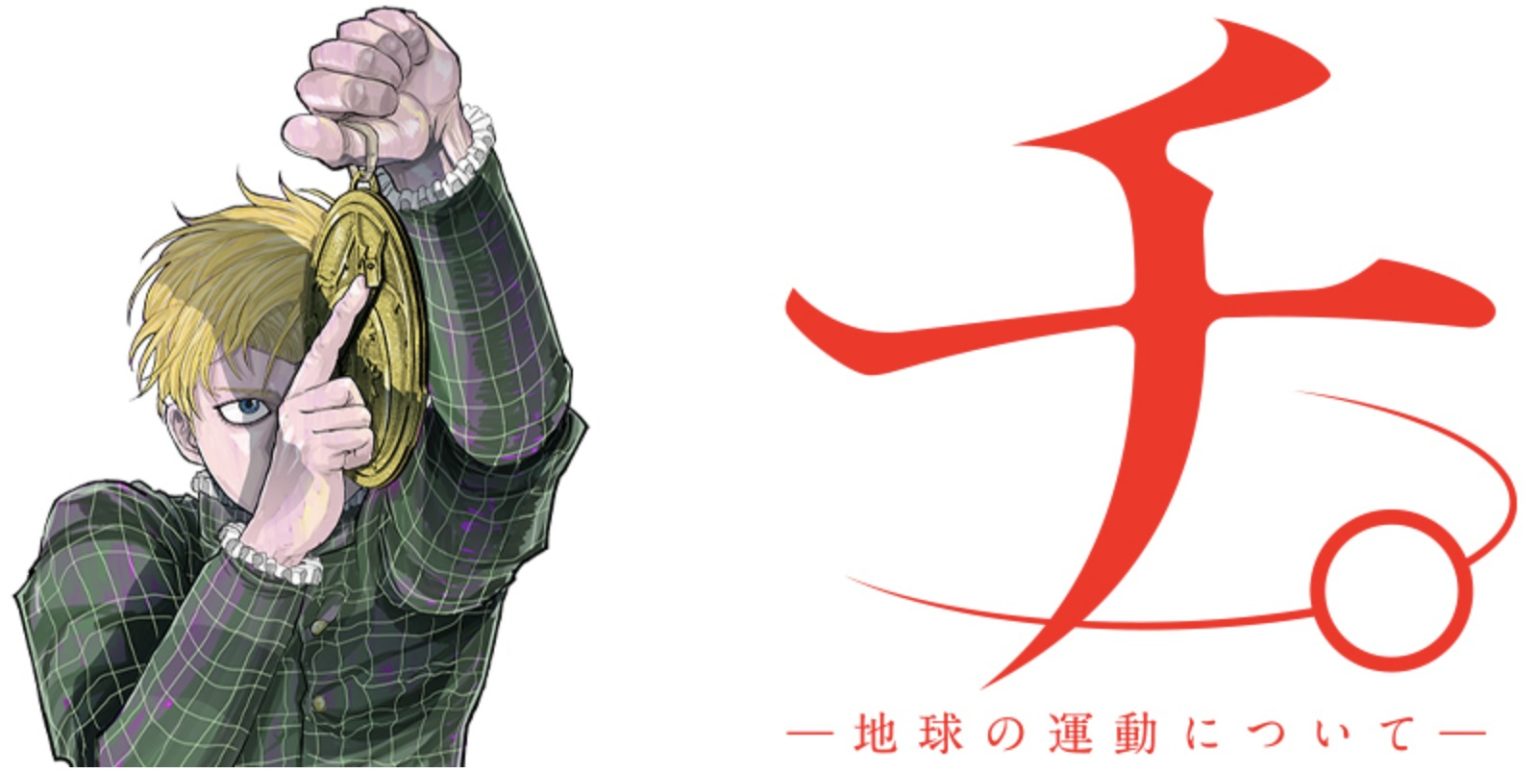
Chi. About the Earth's Motion" is a manga by Yutaka Uo that was serialized in "Big Comic Spirits" from 2020 to 2022. It is a work of fiction about people who risked their lives to prove the "geocentric motion theory" that overturned the "celestial motion theory," which believed that the universe revolved around the earth, in the 15th century. It was also ranked in numerous other awards, and was featured in the media and became a topic of conversation.
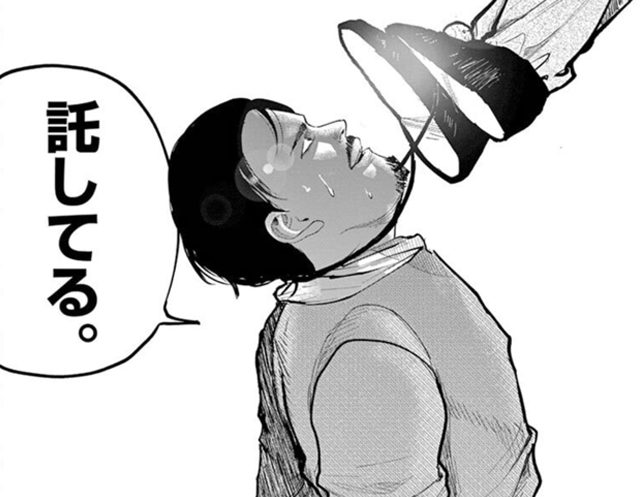
Glass, who found the stone box and was talking to Okzy about what to do in the future, was about to fall from the bridge below. Okzy caught Glass at the last minute, but Glass decided that there was no way for both of them to survive and tried to fall down to the bottom of the bridge. However, once again, Okzy caught Glass and said, "What are you doing!" Glass fell down to the bottom of the bridge by himself, saying, "I trust you." "This world will continue even if I die. If so, I can entrust something to it. That is a kind of hope born from this lost world." When he found the stone box, the contents of the stone box became a hope for Glass to live in this world. Okzy, who had no hope in this world and only wanted to go to heaven after death, entrusted not only the contents of the stone box but also his belief that he would live in the present with hope.
Okzy: "I believe in heliocentric theory."
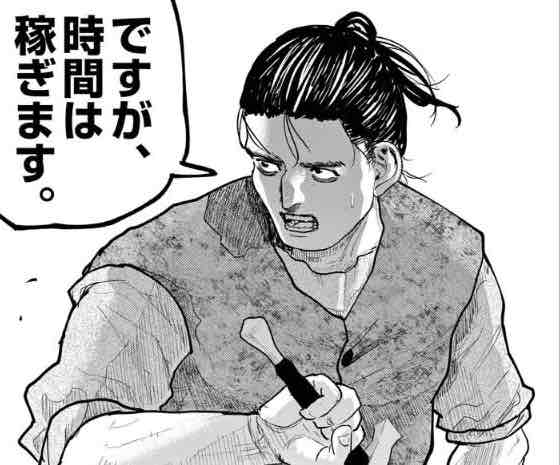
Okzy says to Badeni, who refuses to listen, "If you don't accept the point, it's faith." It resonates with Badeni, who is confronted with the heliocentric theory as a truth-seeking researcher. When it turns out that an inquisitor is on his way to catch Badeni and Okzy, Okzy tries to go out on his own. Badeni tries to stop him, but he doesn't listen. Okzy says, "You said it was important to accept the point. It's wrong to be involved in the academic research of the heliocentric theory." However, Okzy, who is not a scholar, says, "I believe in the heliocentric theory," and leaves the barn. The hope entrusted to him by Glass was carried over, and the belief in the heliocentric theory became the hope for Okzy to live.
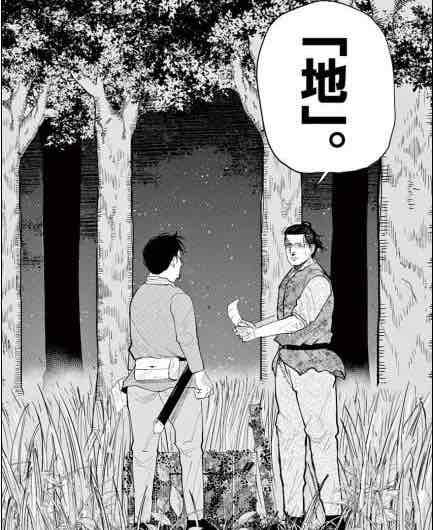
A priest said, "If you offer coins, you can get bread. If you offer taxes, you can get rights. If you offer labor, you can get rewards. So, if you offer anything, you can know everything in this world."
Alberto confides to the priest that he fears knowledge because his childhood wounds do not heal. To Alberto, who says, "God will not open his mouth no matter how much I worry about it," the priest says, "That's why I think forever. I want to think of it as happiness." Then he asks the question, "If you offer coins, you will get bread. If you offer taxes, you will get rights. If you offer labor, you will get rewards. So what do you think you should offer to know everything in this world?" By saying, "Please find the answer to this in order to survive in this world," he revived Alberto's intellectual curiosity and pushed him to go to college.
Behind-the-Scenes Stories / Trivia / Small Stories / Episodes / Anecdotes
Meaning of the title "chi."
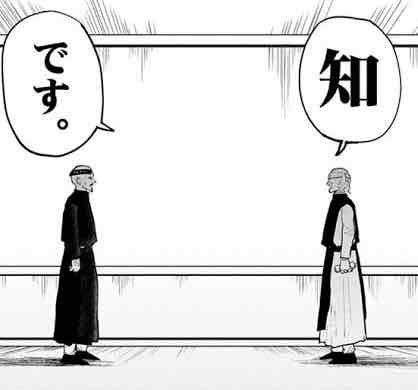
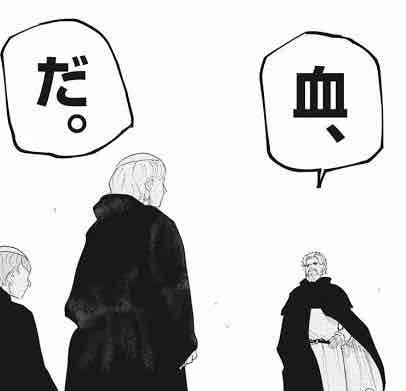
"Chi" in the title has three meanings: earth, blood, and knowledge. The "." in the title means that something that has stopped moves.
Before I decided on the subject of "Heliocentric theory," I had decided to draw a manga about [intelligence and violence], and I wanted to make it "knowledge and blood" with "knowledge of intelligence" and "blood of violence."
In addition, the subject matter was decided to be' the heliocentric theory' and even' the earth' came in, so I thought that there was only' chi'!
At the same time that "." represents the earth, we thought that by adding a locus to the period that means the stop of a sentence, we could express the concept of "things that stopped moving start moving", so we proposed an idea for the title design.
Source: getnews.jp
Works influenced by

In the book, Socrates and others are quoted, but in an interview with the author, Uoto, Seneca's "On the Shortness of Life," Plato's "The Defense of Socrates," and Descartes's "The Introduction to the Method" are cited as the works that were influenced by him. Although the author himself had a fear of death, he was encouraged by the works of his predecessors and became able to accept the fear and catch things in a positive way.
Seneca's "On the Shortness of Life," Plato's "The Defense of Socrates," Descartes's "Introduction to Methods," and so on. I was influenced by books on philosophy and astronomy because they satisfy people's desire for knowledge and also because they are interesting as entertainment. I think it is great that books that remain in history are not old and have universality in their fun.
One night in my first year of high school, I suddenly became like a タナトフォビア, "Huh? Don't you think you're going to die someday? It's been fun, but everything's going to be nothing."
I still have that feeling, but I've also become able to prepare myself to live without regret if I die someday. I'm scared of dying, but it also leads to being able to have the courage to say, "We're going to die someday, so let's jump out and try it."
"If I'm going to die anyway, why don't I aim to be a manga artist?" I was pushed many times.
Source: tsutaya.tsite.jp

Related Articles

2024年10月秋アニメ(今期アニメ)まとめ
2024年10月期に放送される秋アニメを50音順に紹介する。2024年10月秋アニメは、有名シリーズの新作が多数ラインナップされている。アニメの放送情報や配信情報、声優・スタッフ、あらすじなどの情報をわかりやすくまとめた。
Read Article
ひゃくえむ。(漫画・アニメ)のネタバレ解説・考察まとめ
『ひゃくえむ。』とは、ウェブコミック配信サイト『マガジンポケット』(講談社)にて2018年11月6日から2019年8月6日まで連載された、魚豊によるスポーツ漫画、およびそれを原作としたアニメ映画。生まれつき足が速いトガシと、つらい現実を忘れる為にただがむしゃらに走っていた小宮の2人が、100m走に魅せられ成長する物語。才能と努力、ライバル関係、なぜ走るのかという根源的な問いを描いている。映画版は監督・岩井澤健治、トガシの声を松坂桃李が、小宮の声を染谷将太が演じ2025年9月に公開された。
Read Article
Tags
Contents
- Overview of "Chi: About the Movement of the Earth"
- Outline and story of "Chi: About the Movement of the Earth"
- Chapter 1
- Chapter 2
- Chapter 3
- List of characters in "Chi: Chikyu no Undo"
- Chapter 1
- Rafau
- Hubert
- Potwicki
- Novac
- Chapter 2
- Oxie
- Glass
- Badeni
- Yorenta
- Piast
- Professor
- Kolbe
- Anthony
- Krabovski
- Heretic
- Chapter 3
- ドゥラカ
- Schmidt
- Fly
- Levan of Kakheti Drovski
- Volko
- Bishop of Peter
- Ash
- Uncle.
- Albert
- Master
- Father of Albert
- Rafau
- Priest
- Terms in "Chi: About the Movement of the Earth"
- P Kingdom
- Cism
- Heliocentric theory
- Heliocentric theory
- Inquisitor
- Ptolemy
- Aristarchus of Samos
- Albert Brudzewski
- Nicolaus Copernicus
- Famous Words, Lines, Scenes, and Scenes from "Chi: The Movement of the Earth"
- Hubert: "Wrong answers don't mean nothing."
- Glass: "I'm counting on you."
- Okzy: "I believe in heliocentric theory."
- A priest said, "If you offer coins, you can get bread. If you offer taxes, you can get rights. If you offer labor, you can get rewards. So, if you offer anything, you can know everything in this world."
- Behind-the-Scenes Stories / Trivia / Small Stories / Episodes / Anecdotes
- Meaning of the title "chi."
- Works influenced by