
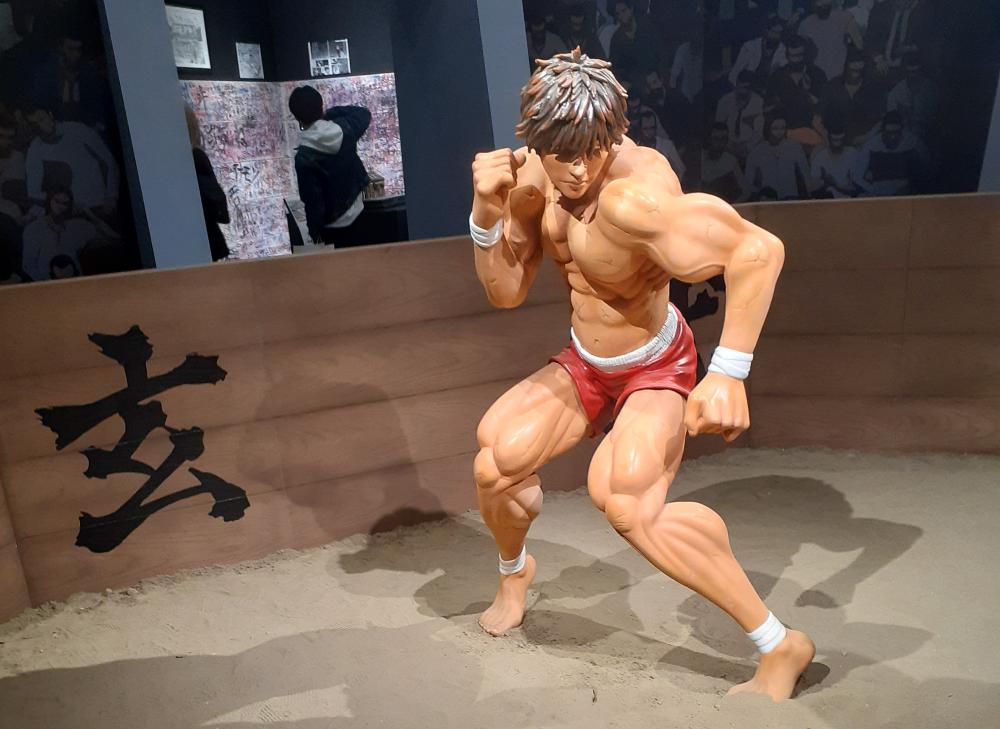
For those who live in the world of martial arts and martial arts, "who is the strongest? The term "real fighters" is a perfect description of these men, whose bodies are so well-trained that they are truly "real fighters! In this article, we have gathered 10 men who are considered to be the strongest in the history of mankind. What will happen to the winners?
He participated in 57 battles of various sizes in his life, and it is said that he did not suffer a scratch in any of the battles.
Source: ja.wikipedia.org
After the subjugation of the Takeda clan, Nobunaga ODA was praised for his extraordinary bravery as' a brave warrior of Kanebi HANAZANE.'
Source: ja.wikipedia.org
He was referred to by Hideyoshi TOYOTOMI as' the greatest warrior of all time and of all time,' and was quoted as a brave general as' just as there is a great general called Honda Tadakatsu in the east, there is a great general called Tachibana Muneshige in the west.'
Source: ja.wikipedia.org
In 1570, he also took part in the Battle of Anegawa and ran single-handedly, seemingly reckless, against 10,000 troops of the Asakura army, which was approaching the headquarters of Ieyasu; at this time, Ieyasu's army, which desperately tried to save Tadakatsu, counterattacked and defeated the Asakura army.
Source: ja.wikipedia.org
In the Battle of Hitokotozaka, which was a preliminary skirmish of the Battle of Futamata-jo Castle in 1572, he served as the rear guard and fought bravely against the troops of Baba Nobuharu, allowing the main force led by Ieyasu to escape and successfully completing the evacuation battle. At this time, Tadakatsu broke in between the enemy and his troops in order to make his troops retreat, and stopped by swinging the Tonbokiri high above his head. He also returned Umakubi several times each time the Takeda troops tried to pursue him, and served as the rear guard with a splendid retreat and retreat. He also participated in the Battle of Mikatagahara in December and the Battle of Nagashino in 1575. Tadakatsu's performance in these battles was praised by both sides, and Ieyasu praised him highly saying,' Indeed, he is a good commander of my family,' and there is an interesting senryu (satirical haiku) composed by Tadakatsu that reads,' When a dragonfly appears, a spider's cubs scatter. A dragonfly is in my hand. The horns of my head are like marbles. An ogre or a person? I don't know if it is a helmet.'
Source: ja.wikipedia.org
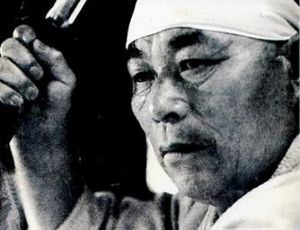
Zen'ya Kunii
Source: nezu621.blog7.fc2.com
善弥 KUNII (January 20, 1894 - August 17, 1966) was a Japanese martial artist and the 18th head family of the Kashimajin school. Born in Fukushima Prefecture
Source: ja.wikipedia.org
It is said that he was undefeated throughout his life as he continued to win despite receiving many matches from other schools under the conditions desired by his opponent. He was nicknamed "Imamusashi" (meaning Musashi Miyamoto of the Showa) for his overwhelming martial ability. Even if he was allowed to take a weapon such as a sword or a stick, or even if he was challenged by a judoka or a karateka who did not have a weapon, Kunii always took a ippon as if there was a match before he fought. He was regarded as a heretic by the martial arts community, but he was a warrior who embodied the strength of Japanese classical martial arts.
Source: ja.wikipedia.org
After the end of the Greater East Asian War (the Pacific War), GHQ proposed a match between a U.S. Marine Corps sword-fighting instructor and a Japanese martial artist. This was a match that depended on the pride and honor of Japanese martial arts, and Kunii could not afford to lose. Kunii held a wooden sword and attended a meeting with a U.S. Marine Corps instructor holding a bayonet. As soon as the match started, Kunii saw through the opponent's attack and took control of the opponent with a wooden sword and put him in a position where he could not move. This was an overwhelming difference in ability and was enough to make the U.S. Marine Corps instructor accept the loss.
Source: ja.wikipedia.org
During his apprenticeship, he became a private pupil of a martial artist named Masanoshin SASAKI, who was a Shinkage-ryu Menkyo-kaiden (full proficiency of the Shinkage-ryu school). The day after becoming a private pupil, Sasaki gave Kunii an instruction: "Bring me what, and take care of anything." He had absolutely no idea what he was told, but this was a training to gain the mind's eye to figure out what the other person was thinking. The teacher's order gradually became more ambiguous, saying, "What are you doing? What are you doing?", but Kunii was able to grasp the teacher's will with considerable probability. This training was utilized by the ability to read the opponent's movements in advance in the presence.
Source: ja.wikipedia.org
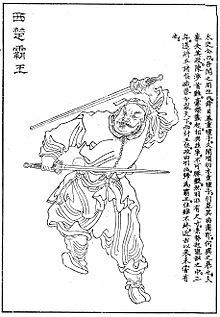
Xiang Yu (Reference)
Source: ja.wikipedia.org
Koseki (232 B.C. - 202 B.C.) was a busho (Japanese military commander) in Chu at the end of the Qin period. His family name was Go, first name was Seki, and his azana (adult male's nickname) was U. The following is the name of Xiang Yu, which is commonly known.
Source: ja.wikipedia.org
He was a big man of 9 shaku (about 207 cm) in height, had a supernatural power and was exceptionally talented, and Wu Zhong's children had already recognized Xiang Yu.
Source: ja.wikipedia.org
At the end of the Qin period, when the Rebellion of Chen Sheng and Wu Guang occurred, Xiang Yu followed Xiang Liang and entered the government office of Huiji County, and killed dozens of subordinates of 殷通 who attacked after deceiving 殷通, the governor of the county, and officials of Huiji prostrated themselves at the strength of Xiang Yu.
Source: ja.wikipedia.org
