
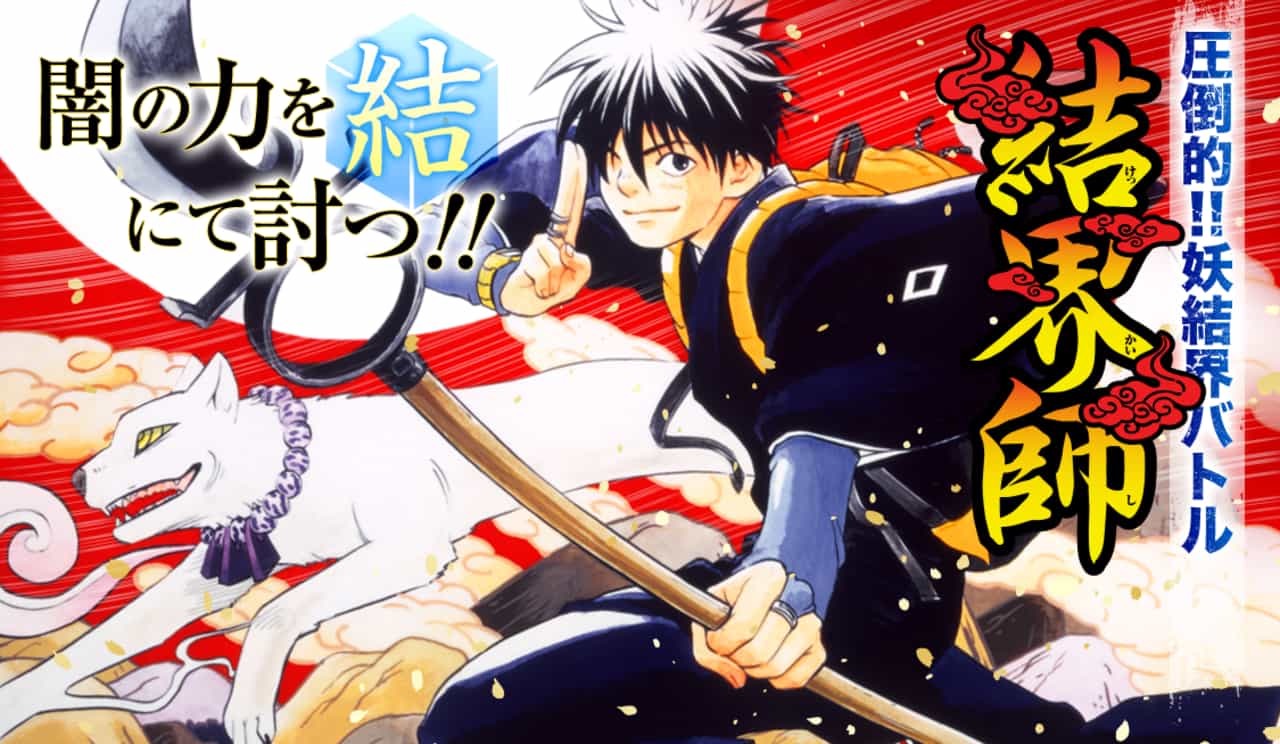
Yugai Shi" is a Japanese manga work by Yeloh Tanabe that was serialized in "Weekly Shōnen Sunday" from issue #47 in 2003 to issue #19 in 2011. It was serialized in "Weekly Shōnen Sunday" from issue 47 in 2003 to issue 19 in 2011, and won the Shogakukan Manga Award 2006 (52nd) in the category for boys. The TV anime was produced by Yomiuri TV and aired from October 2006 to February 2008. The main character, Yoshimori Sumimura, is a member of a family of warders that has been in existence since ancient times. Together with his childhood friend Tokine Yukimura, who lives next door, they use the art of "kaijutsu" to exterminate monsters and protect Karasumori, a place where spiritual energy gathers, from outside enemies at night.
THE AWAKENING OF YOSHIMORI, WHO SHOWED A GLIMPSE OF THE POWER THAT DWELLS IN HIS BODY.
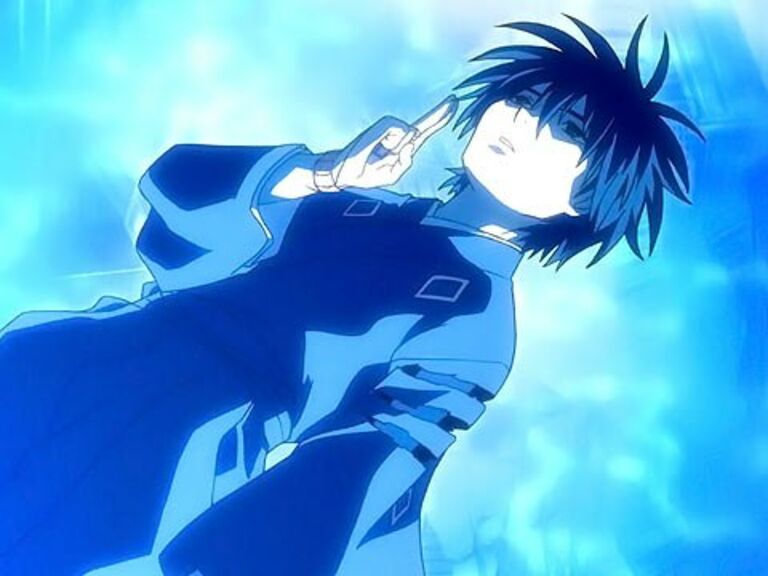
Yoshimori who created the true world
At last, Yoshimori was about to fight a decisive battle with Kakuro. As a result of his training, Yoshimori had an incomplete mastery of a technique called Zekkai. Originally, Zekkai was a technique for expanding the space around him like a circle, and anything hostile could not enter the space. It was a combined offense and defense technique to make anything he touched disappear. However, since Yoshimori's Zekkai was incomplete, he was only able to cover his own body. Kakuro was about to attack Yoshimori's Zekkai, but Sen, one of the night heros, appeared in front of Yoshimori. It was a way of throwing away Sen to make time even for a moment. The moment he was about to be attacked by Sen, Yoshimori's power exploded, creating a huge circle. Kakuro instantly understood that he was going to disappear, and he was satisfied with the tingling sensation of exchanging lives and disappeared.
The space created by Yoshimori was different from the world of destruction. Unlike the world of destruction, it was a space where things other than oneself were taken in, and the wounds sustained in the battle with Kakuro were also reproduced. The name is Shinkai, and it is a space where things that Yoshimori rejected disappear, and it is a high-dimensional space where even things such as wounds, let alone people and ghosts, can be eliminated.
Behind the Scenes, Trivia, Small Stories / Episodes and Anecdotes of "KEKKAISHI"
THE STRONGEST CHARACTER IS YOSHIMORI'S MOTHER.

守美子 WANTS TO BE ABLE TO WIELD HIS POWER LIKE A MONSTER
In the story, there are a variety of characters, including KEKKAISHI, I-no-I-no-Ya, Yoi-mingiri, and Yoi. Among them, 守美子, the mother of Yoshimori, has one of the best abilities. In anime, she appears only in recollections, and even in comic books, she does not appear often. However, there are many scenes that show her unfathomable abilities, such as killing the god of the land, kidnapping the dragon of the earth and Jigami from Kanuuchi to Karasumori, being able to enter the true world of Yoshimori without being noticed, and not being able to realize that the person in front of Yoshimori is Shikigami, who is in the state of power up called Muso.
Anime discontinued
The first episode started with 6.3%, the second episode started with 6.5%, and the third episode started with 6.3%, but the second cool recorded from the latter half of the 7% range to the latter half of the 8% range. However, from June 2007, it was again in the first half of the 6% range, and after July, it was in the 5% range, and in September, it fell below 5%. However, although it was supposed to be broadcast every week, it was not broadcast for a whole month due to special programs, so it seems that there was no intention to make it a success rather than the attractiveness of the work. In the original story, the story about Karasumori, which is the basis of the story, was collected properly.
A life-size hero, Yoshimori, depicted by a female author.
The author Yellow Tanabe talks about the character design of the main character, Yoshimori SUMIMURA as follows:
"As the main character of a boy's comic, he has a lively and straight personality, but he is depicted mainly as a character who doesn't know what to do. When you are absorbed in something, you can only see it, and you move your body without thinking deeply about what the result will be. You may feel a little annoyed by the damage caused by your actions, but I think the reason why you can't hate him is that his principle of behavior is the only thing that you don't want to see someone hurt, and that you can see him growing little by little. His blunt language and tremendous power of action sometimes annoy people around him and sometimes illuminate the road. It is exactly like the main character.
At the beginning of the story, he takes the opposite attitude of favor, but at the end, even though he is embarrassed, he reveals to himself that he cares about the sound of time. He can see his growth not only as a KEKKAISHI, but also as a human being and a man. "
The way in which Yoshimori grows up while confronting difficulties can be said to be exactly the image of the protagonist of a boy's manga.
The heroine 時音 is made with the image of an older and slightly thorny beauty.
Yellow Tanabe talks about the heroine's timing:
"My childhood friend is an template older than I am, and she seems to be always fighting with me, and she knows each other deeply. She is older than the main character, so she has been taking care of her for a long time. As a KEKKAISHI, she is also an older person. At the beginning of the story, the speed and technique of kekkai jutsu was superior to the main character who could only push hard. However, by fighting with many strong opponents and gaining experience, I sometimes feel that I am not strong enough against the main character who is growing at a tremendous speed. However, I still feel beautiful when I try my best to do what I can and worry about the main character who is trying to cross the dangerous bridge.
As for Yoshimori, he didn't want his classmates to make fun of him. However, as the story progresses, he starts to have to support his younger brother, who takes a lot of time. When you compare the beginning and the end of the story, the way he treats the main character is different, and it's very moving. "
As Yoshimori grew up, the relationship between Yoshimori and Tokioto changed from that of an older sister and a younger brother to that of an equal partner who could be trusted. This change in the relationship can also be said to be one of the highlights of "KEKKAISHI."
Hard-working backstage hero Masamori
As for Masamori, the older brother of Yoshimori, who holds the key to the story, the author says:
"He is quite a hard worker. Leaving the Karasumori and entering the enemy territory in the sense of Urae, he seems to be wiping out or following the main character in the broad sense. However, his power is tremendous, and he controls the world which is highly difficult, makes the manager visible, and even rises to the top of the Juninkai of Urae at a young age. The way he advances with his own power and wit into a huge plot looks like a" main character, "but considering that Yoshimori is heading his own way, this may be his own way of following.
He had some thoughts and anguish about Yoshimori, who was a legitimate successor and had too much power, but it seems that he accelerated various things from the thought that he would shine if he could. When I was still at my parents' home, I was forced to face the main character whether I wanted to or not, so I was confronted with the fact that I was not the legitimate successor. In fact, there is a scene where I look at the right-hand side where the Hoin appears many times. I think I felt a kind of inferiority complex. However, it is also true that I don't hate the main character who has a weak sense of himself but can help him only for a moment when he is in a pinch. Is in a pinch. I think that the scene where Ouchokuri makes fun of the main character who is far from his age is an expression of affection for his own main character. "
In contrast to Yoshimori, who appears to be the protagonist of boy's comic books, Masamori, who uses all his tricks to pursue his own goals, may be called the protagonist of youth comic books.
Theme song and insert song of "KEKKAISHI"
OP (opening): Saeka Uura "sha la la - Iakashi NIGHT -"
"sha la la - Ayakashi Night -"
ED (ending): "Akai ito" (The red thread) by Koshi Inaba (Chapter 1 to Chapter 15, Chapter 38, Chapter 40, Chapter 48, and Chapter 52)
"Red Thread"
ED (ending): Aiko Kitahara, "No Matter Where You Look in the World" (Episodes 16-23, 39, 44, 51)
"Look everywhere in the world."
ED (ending): "Maimirai" (Tales 24 to 30, 41, 46, and 49) by Saeka URA
"Maimirai"

Related Articles
結界師の能力・術まとめ
『結界師』とは、田辺イエロウによる漫画、およびそれを原作としたアニメなどのメディアミックス作品。 妖(あやかし)退治の専門家・結界師(けっかいし)の一族に生まれた墨村良守(すみむら よしもり)が、幼馴染の雪村時音(ゆきむら ときね)とともに、夜中の学校に集まってくる妖を退治する姿が描かれる。 良守と時音が受け継いでいる間流結界術(はざまりゅうけっかいじゅつ)をはじめとして、作中にはさまざまな能力や術が登場する。
Read Article
![Hiromu Arakawa] Actually, that guy too! Summary of Female Manga Artists Who Are Often Considered Men [Fumiya Satou].](https://renote.net/files/blobs/proxy/eyJfcmFpbHMiOnsiZGF0YSI6NjQxMjg1NCwicHVyIjoiYmxvYl9pZCJ9fQ==--524fe80ece6dd3d76db56ecac9a97cc41e63511b/56dfbc2294af71ca80f1a153ca402db7.jpg)
Hiromu Arakawa] Actually, that guy too! Summary of Female Manga Artists Who Are Often Considered Men [Fumiya Satou].
Compared to celebrities and actors, comic book artists are not so much in the public eye, so some people may say that they do not know the face of the author. Although many authors include a self-portrait in the introduction of their comics, it is often deformed so that the gender of the author cannot be determined. In addition, there are many female authors who are often assumed to be male because of their style or pen names. This article introduces information on female manga artists who are often assumed to be male because of their pen names.
Read Article
Contents
- Overview of KEKKAISHI
- Outline and story of "KEKKAISHI"
- History of Karasumori
- Origin of good defense
- Return of my brother
- Goal of Yoshimori
- Emergence of strong opponents
- With my friend's death in my heart
- Final battle against the Black Tower
- Kurokabuto and Karasumori no Nazo
- A decisive battle with Mudo, the seventh guest of the Genjyuni-kai
- Kamiyuchi Hunting
- Muso no Shugyo
- Swaying lining
- The Secret of Karasumori
- Settlement
- List of KEKKAISHI characters
- Sumimura family
- Yoshimura SUMIMURA
- Sumimura Shigemori (Governor of 村繁 Province)
- Masamori SUMIMURA
- 利守 SUMIMURA
- 守美子 YUKIMURA
- Shuji SUMIMURA
- Madarao
- Shimano
- Sesson family
- Yukimura 時音
- Tokiko YUKIMURA
- Isabelle YUKIMURA
- Tokio YUKIMURA
- Shiro
- Mikeno
- Other
- Hazama-tokimori (literally, "room 時守")
- Chushinmaru
- Tsukikage (moon shadow)
- Lining
- 逢海 Hinaga
- Suigetsu (Moon and Water)
- No. 0 (0 go) / 0 (0)
- Hiura 蒼士 / Sango
- 逢海 Tsukihisa
- Kakeru
- Michiru
- Ichigo
- Nigo
- Juninkai (Society of the Twelve Devas)
- Hisatomi YUMEJI
- Kido-in Temple (Kido-in Temple) Nara
- Tatsuhime
- 冥安
- 腐部 骸次
- Gin 魅霞 Gen
- Masamori SUMIMURA
- Ichiro OGI
- Okukuni
- Kazuchika TSUMUGI
- Kitsunezuka Kihei
- 咒宝
- Former executive
- Mudo
- Night train
- Miki Hatori
- Shisho-gen (the last day of Shishi 々尾)
- Hakudo (white path)
- Ecliptic
- Sazanami Keiichi
- Kyoichi 翡葉
- Kagemiya Sen
- Akitsu Shu
- Hakoda
- Centipedes
- Hanajima Ajitora
- Yoshiro Takemitsu
- Daigo TODOROKI
- Misao
- Kasuga 夜未
- Yoki
- Laboratory
- Yashiro
- Kiyoteru YUGAMI
- Ayako Kamidera
- Saikaku of Enjo-ji Temple
- Snake eye
- Nozomi
- Saki
- Ogi clan
- Ogi Nizo
- Ichiro OGI
- Rokuro OGI
- Shichiro OGI
- Black Tower
- Princess
- White
- Kaguro
- Gagin (tusk silver)
- Shion
- Aihi
- Hekian (blue darkness)
- Koshu
- Sakon
- Hanroku (green waves)
- Sekia
- Haisen
- 茶南
- Watcher
- Karasumori Gakuen
- Hiromu TABATA
- Tomonori ICHIGAYA
- Yurina Kanda
- Mao Shinohara
- Kurosu
- Mi no Utatsumi
- Soil Jigami
- Urosama
- Mamezo (bean storehouse)
- 繭香
- Madara-sama (Madara-sama)
- Kokuunsai (Black Unsai)
- Tobimaru
- Lord of 緋田
- Other
- Heisuke MATSUDO
- Kagami
- Risa Kagami
- Yo
- Koya (Steel Night)
- Jaren
- Kurokabuto (black helmet)
- "Beholder."
- Terms of the KEKKAISHI
- KEKKAISHI
- Hazama Ryu Kekkai Jutsu
- Nenshi
- Sekkai
- Shishihōjin (Four Master Square)
- Zekkai
- Exploration Kekkai (barrier)
- Shinkai (the true world)
- Other Techniques
- Muso
- Kyogugenmuso
- Hadō
- Utsusemi
- Shikigami
- Repair
- Oni-tsukai (ogre messenger)
- Amulet
- Ayaka shimajiri
- Hako-tsukai
- Administrator
- Tamagura
- Urakai
- Juninkai (Society of the Twelve Devas)
- Yagyo (night procession)
- Tenketsu
- Trick rock
- Hitokawa (human skin)
- Enjoyu-in
- Ikai
- 妖準 Stone
- Shinyu Chichi Gari
- Muso-bako (a box with no thought)
- Soil Jigami
- Place name
- Karasumori (Crow Forest)
- Mushi-kinuma (literally, marsh ")
- Kuro Japanese pampas glass (black awn)
- Aibazan (meeting Mt. Hayama)
- Tanyu no Kamiyūchi
- 緋田 Village
- Arashizaki-jinja Shrine
- Hakuma
- Words, lines, scenes from "KEKKAISHI"
- IN HIS CHILDHOOD, HE HURT THE SOUND OF TIME WITH THE SWEETNESS OF YOSHIMORI.
- 々尾 no Jigen, killed by Kakuro
- THE AWAKENING OF YOSHIMORI, WHO SHOWED A GLIMPSE OF THE POWER THAT DWELLS IN HIS BODY.
- Behind the Scenes, Trivia, Small Stories / Episodes and Anecdotes of "KEKKAISHI"
- THE STRONGEST CHARACTER IS YOSHIMORI'S MOTHER.
- Anime discontinued
- A life-size hero, Yoshimori, depicted by a female author.
- The heroine 時音 is made with the image of an older and slightly thorny beauty.
- Hard-working backstage hero Masamori
- Theme song and insert song of "KEKKAISHI"
- OP (opening): Saeka Uura "sha la la - Iakashi NIGHT -"
- ED (ending): "Akai ito" (The red thread) by Koshi Inaba (Chapter 1 to Chapter 15, Chapter 38, Chapter 40, Chapter 48, and Chapter 52)
- ED (ending): Aiko Kitahara, "No Matter Where You Look in the World" (Episodes 16-23, 39, 44, 51)
- ED (ending): "Maimirai" (Tales 24 to 30, 41, 46, and 49) by Saeka URA
- ED (Ending): Saeka URA, "Break Time 10 Minutes" (Chapter 31 to 37, 42, 43, 45, 47, 50)