
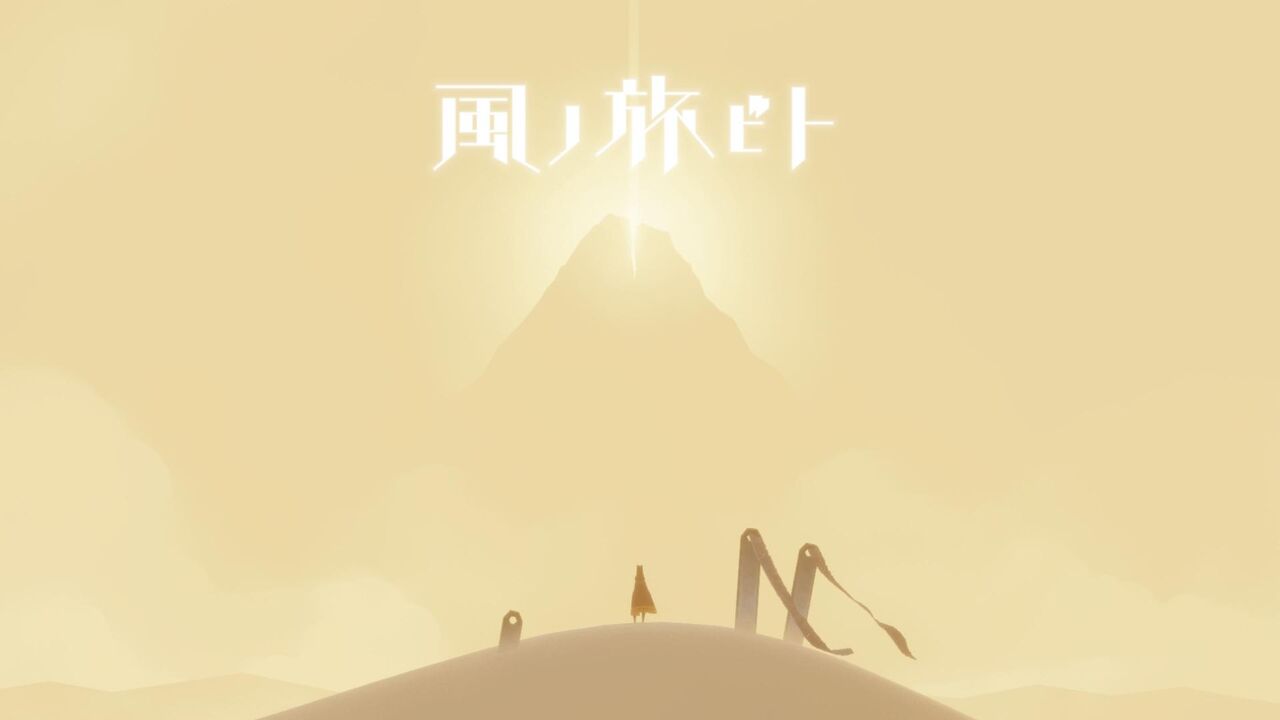
Kaze no Tabibito (JOURNEY) is an adventure game software developed by Thatgamecompany, available for PlayStation 3, PlayStation 4, PC and iOS.
The starting screen begins in a wide, endless desert. The player controls "Tabibito," a character wearing a red cape-like cloak, as he progresses through the game. The player travels through the game world, which is presented only with beautiful visuals and music, while solving various riddles.
Outline of "Kaze no Tabibito"
Kaze no Tabibito (originally titled JOURNEY) is an adventure game developed by Thatgamecompany and SEA Santa Monica Studio, exclusively for online distribution.
The game was released by Sony Computer Entertainment on the PlayStation Store in March 2012 as a PlayStation 3 exclusive game. In July 2015, a PlayStation 4 version of the game was released. Annapurna Interactive distributed the iOS version in August 2019 and the PC version in June 2020 under the original title Journey.
The soundtrack for Kazenobibito was nominated for a Grammy Award in the Soundtrack category at the 55th Annual Grammy Awards.
Previously, this award has been given primarily to film soundtracks, marking the first time ever that a video game has been nominated.
The most distinctive feature of this work is its worldview, which is devoid of any verbal expression.
The player controls "Tabibito," a red cloak-like creature, as he moves through the game.
At first, the area appears to be a vast, empty desert, but as the player heads for the hill in front of him, ruins and a mountain rising high in the distance begin to appear. With no map or instructions for operation displayed, the player becomes the "Traveler," groping his way through the sandy world. A flock of mysterious red cloths fly around the ruins like creatures, and by meeting the right conditions, the murals on the ruins will be restored. What is this world, what kind of civilization existed in the past, and who is "Tabibito"? The solution to these riddles is entirely left to the player's imagination.
The PlayStation version of the game is automatically played online as long as the console is online.
When playing online, players may encounter other "Traveling Beasts" controlled by other players. Even if you are matched online, it does not mean that you will always meet them. When you look in the direction of another player, you will see a white light that indicates the presence of the other player.
You cannot select a matching partner, and you do not know who they are at all during play. Since text and voice conversations are not possible, the only way to communicate is through your own actions.
Whether to cooperate or split up and proceed alone is entirely up to the player's own choice.
First-time players who are new to the game will often find it easier to progress by working with a matching partner.
In addition, although there are some trophies that require cooperation with other players as a condition for earning trophies, cooperative play is not mandatory in clearing the game, so it is up to the individual to decide whether to go together as a pair or act alone.
After the game is cleared, a list of PSN IDs of "traveling beats" met is displayed on the end roll screen. Since it is possible to get lost during the progress of the game, it is only at this point that you will find out that the "Traveling Vito" you met later is actually a different player from the "Traveling Vito" you were with earlier.
If you want to play by yourself, simply sign out and go offline.
You may feel inconvenienced when you have no way to communicate your intentions to your partner other than through your actions.
However, you can express your intentions in various ways, such as showing your partner where to go by walking ahead if he/she is lost, guiding him/her through places that are difficult to walk, or drawing heart marks or other patterns on the ground. Players who are new to the game and have difficulty moving forward will be able to feel the kindness of other players who stop a little ahead and wait for them, even without words.
The plot and story of "Kaze no Tabibito"
Chapter1 Remains
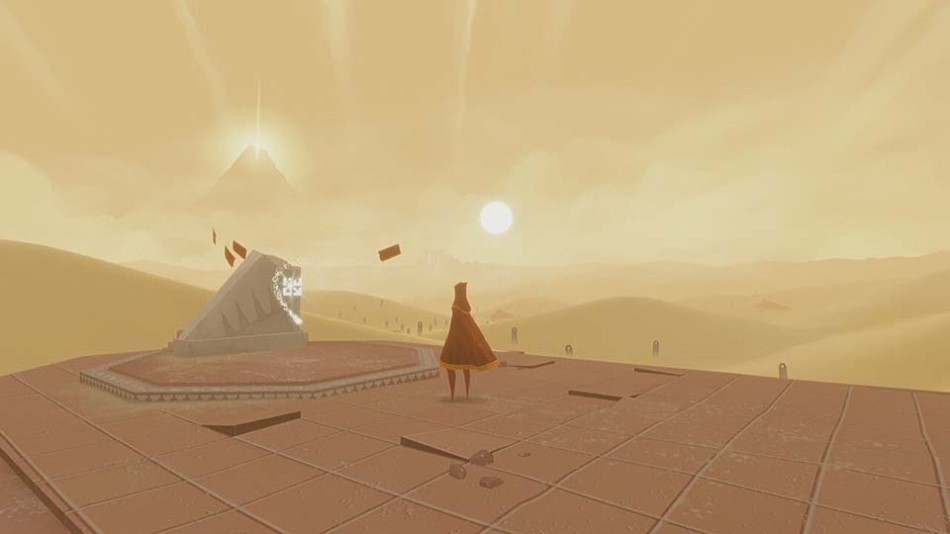
The first ruins to be seen after the game starts.
If you walk through the desert to the hill in front of the player, you will see the ruins. There is a shining symbol on the ruins, so get it.
If you get a glowing symbol, you'll get a longer piece of cloth that looks like a scarf stretching out from the cloak of the TabVito. The longer the cloth, the longer you'll be able to fly, so get a glowing symbol.
Proceed to the building you can see on your right. When you come close to the stone monument, the wall painting inside appears.
The murals show many people dressed in white costumes similar to' tabibito' (hereafter called' white vito') lying in four rows of four vertically and horizontally. From the evenly arranged appearance, it looks like a burial scene.
When you enter a large site surrounded by buildings, there are two glowing symbols. You get the symbols and you jump up to the central building. When you activate the stele, Chapter 1 is clear.
Chapter2 Bridges
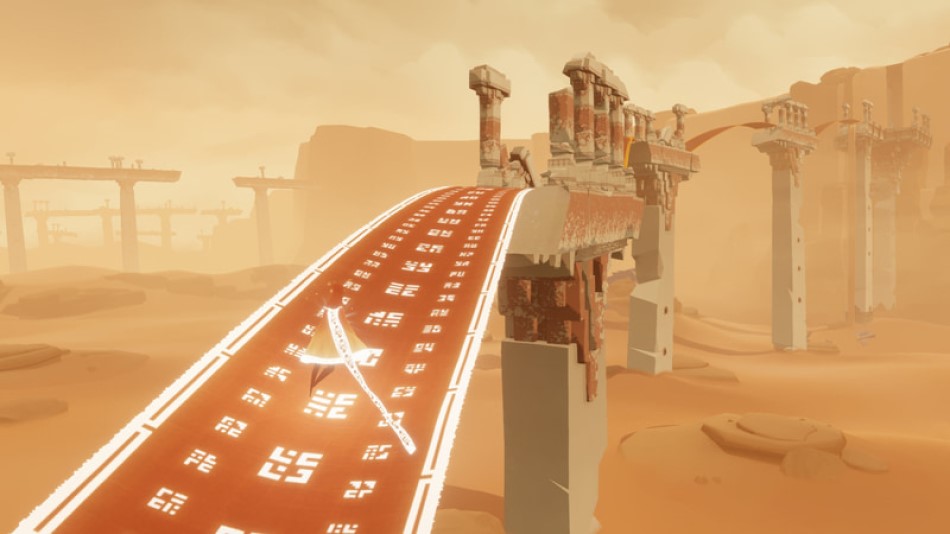
When the dried red cloth is put back, a long bridge is completed.
There is a glowing symbol at the lower left of the starting point. If you go from just below the goal to the other side of the small sand waterfall on the left, there is a glowing symbol. There is a glowing symbol on top of the large sand waterfall on the right side, and there is also a mural inside.
The murals depict a city engulfed in sand.
If you approach a long piece of cloth and press the "0" button (hereinafter referred to as hold), the cloth stretches and the bridge is completed.
Cross the bridge the bridge and activate the stone monument in the back, you will clear Chapter 2.
If you complete Chapter 2 without completing all the bridges, you can win the trophy "Incomplete."
Chapter3 Deserts
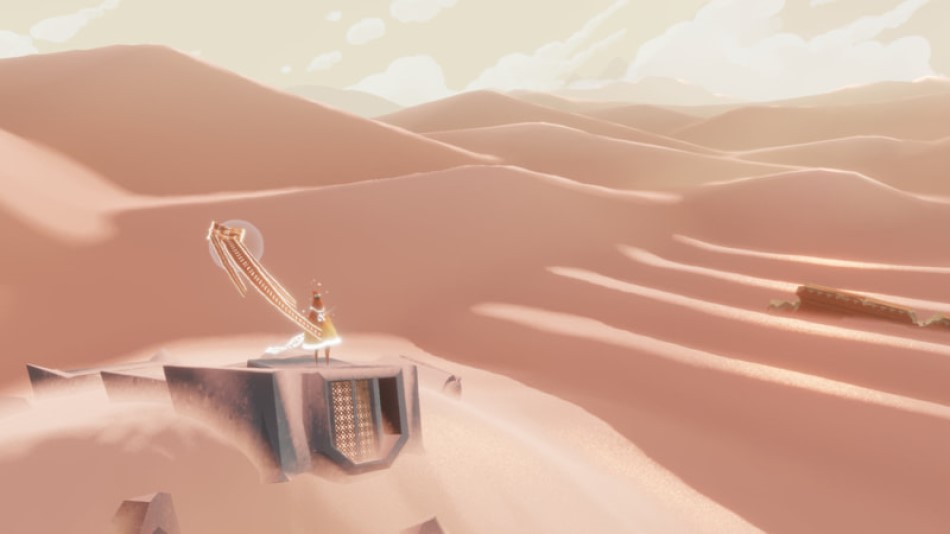
You go through the slightly pink desert. Small ruins are dotted along the way.
Hold the cloth creature in front. Go to the right and you'll see a pillar with a glowing symbol on it.
As you move toward the mountains you can see in the distance, you will be able to get the trophy "illusion" if you see flowers blooming in the hollows along the way.
Also, there are some ruins that were destroyed on the way, so if you hold it, the cloth creatures are released or the wall paintings appear.
There are two murals on the desert stage, and the one found at the first point depicts five "white vito" in the forest and five birds flying in the sky.
The other mural down the road has five birds flying in the same way as the first one, but unlike the first one, the trees in the forest are few in number and the painted "white vito" has been changed to six people.
The picture shows two "White Vito" flying in front of the machine and four remaining White Vito on the ground.
As you go further toward the mountain, you will see a large tower. You climb up to the top and keep holding the cloth creatures along the way.
Activate the stele and Chapter 3 is clear.
If you hold all the cloth creatures in the desert area, you can get the trophy "search".
Chapter4 Submerged Cities
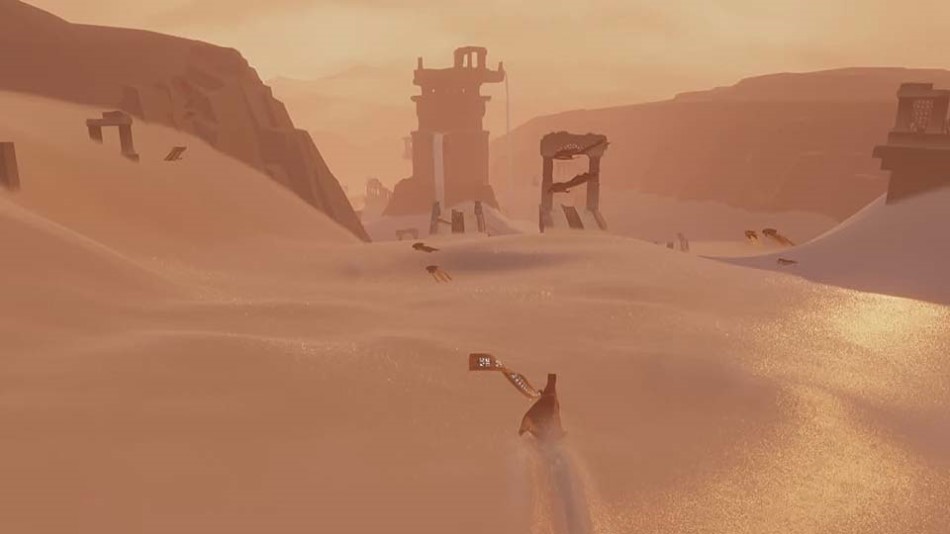
An area where you can ski on the sand slope.
This is an area where you can ski down the slope. The speed is so fast that you will almost miss the shining symbol on the way.
If you can go through more than 15 gates on the gliding route, you can win the trophy "adventure". However, if you give priority to the gate, you lose the trophy "transcendence" that you get when you win all the shining symbols. Therefore, it is impossible to win both trophies in one lap. It is better to give priority to the shining symbols in the first lap.
At the end of the first gliding area, go to a place surrounded by buildings. It is difficult to see because of the backlight, but there is the first mural.
The murals show "white vito" coming and going using the air corridor.
If you hold a long piece of cloth, many pieces of cloth like small cards come out. You move forward using the cards and enter the next gliding area.
You go to a path in the mountains, and there is a mural and a stone monument around the place where you finished sliding.
This wall painting depicts the confrontation between' White Vito' and others.
At the top of the bridge, which is divided into left and right by the collapse of the center, there are "White Vito" who turn their backs to each other. You can see the city behind the "White Vito", so you can tell that they are opposing each other across the camp.
There is a floating cloth above each of' Shiro Bito' (white vito), but it is assumed that the cloth was torn off and' Shiro Bito' conflicted over this floating cloth because it was drawn with a damaged expression like a bridge.
Activate the stele and Chapter 4 is clear.
Chapter5 Underpasses
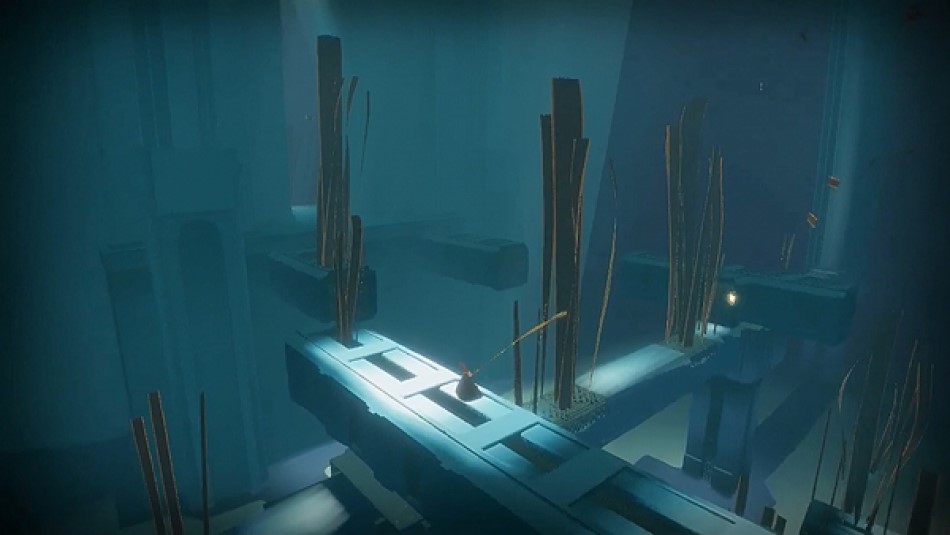
An area of cloth that stretches vertically like kelp.
If you go straight for a while, there is a shining symbol in the cylindrical block.
If you go further, you will come to an area where there is a large piece of cloth like kelp. If you hold the cloth, you can climb up. You will jump on the cloth shaped like a jellyfish and move forward, but if you fail, you will fall down slowly again. Unlike the dry desert we saw earlier, this area is like being in the sea.
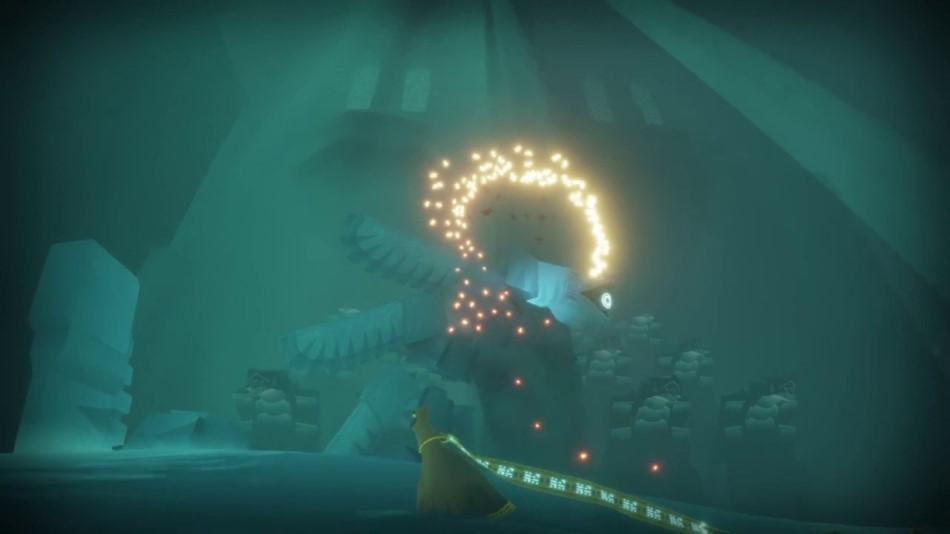
If it hits the monster's light, it will be found and attacked.
As you proceed over the wall, a huge monster emerges from the earth. If you are found by a monster, you will be attacked, but if you are hit, your scarf will become shorter, so you hide from the light of the monster as you proceed.
There is a mural at the end of the passage through the area where the first monster is.
On the left side of the mural is a picture of a huge machine a flying machine that used to carry the White Vito on a "desert" stage appears one after another.
The "White Vito" in this mural stands on top of a huge machine, and the flying machine stops on the ground without starting.
Proceed carefully so as not to find an area with two more monsters.
Finally, slide down the slope all at once, activate the stele, and you'll clear Chapter 5.
Chapter6 Temples
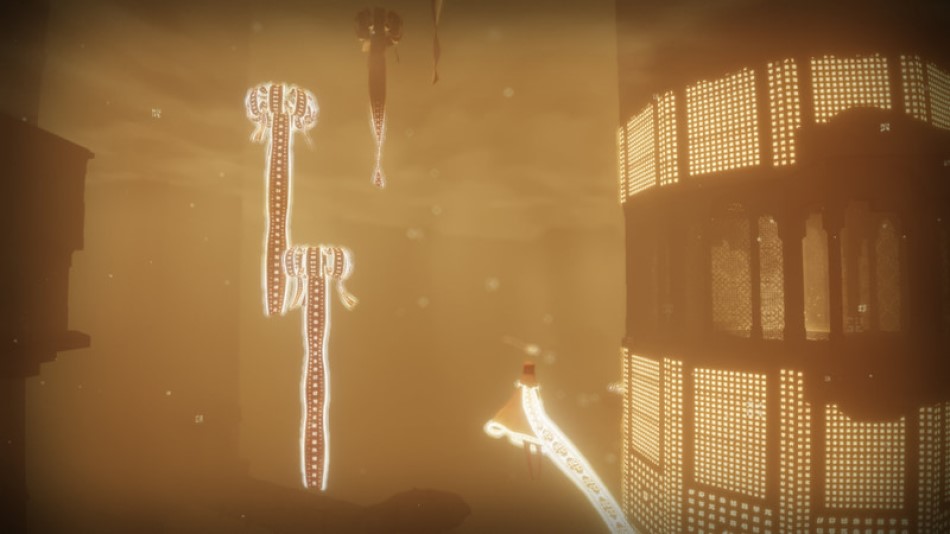
When the murals are released, the temple sinks into the water and can be moved by jumping onto a cloth that resembles a jellyfish floating in the water.
You will come to an area where there are buildings like temple buildings in Southeast Asia.
When you activate the first mural on your left, the area overflows with bright water.
The murals depict a "tabibito" standing on a desert hill, the same figure as the player's own "tabibito." Until now, the "white tabibito" had been drawn in white lines, but the "tabibito" was drawn in the same color as the scenery.
If you use a small tag and move while jumping, there is a second mural, so it will be activated.
The murals here depict a "traveling vito" walking toward the site as if guided by a cloth flying in the sky.
You can see how it depicts the journey of "Tabibito" to get here.
If you use a cloth like a jellyfish to go forward, there is a third mural.
When activated, the murals depict a "traveling vito" walking through the underground passage of the building and a monster on the left.
When the mural is activated, a large cloth creature that swims like a whale appears.
A fourth mural and a shining symbol are hidden in the room where the cloth creature came out.
The fourth mural depicts the history of "White Vito," just like the previous murals on the stage.
The murals are difficult to understand, with different interpretations depending on the viewer.
On the left is a tower-like building with a "white vito" lying at the bottom and a pattern similar to a glowing symbol above.
To the right of the tower are three floating buildings with eight "white vito" standing in a line under them.
From the layout of the building, it is thought to be the same place as the stage of the current' temple.'
Riding on the back of the cloth creature, you will see the fifth mural.
The murals depict a "traveling vito" walking across a fabric bridge. The order of the murals does not seem to be the same as the order of the stages that have been advanced so far.
Activate the mural, go through the path of thin cloth, activate the sixth mural.
On the right hand side is the remains, and the figure of "Tabibito" sliding down the steep sand mountain towards the remains is depicted.
When the sixth mural is activated, there is a mysterious creature in the lower room of the central tower. With the appearance of this creature, the trophy "ancestor" can be acquired.
Go to the top of the central tower, activate the stele, and you're clear of Chapter 6.
Chapter7 Snow Mountain

Related Articles
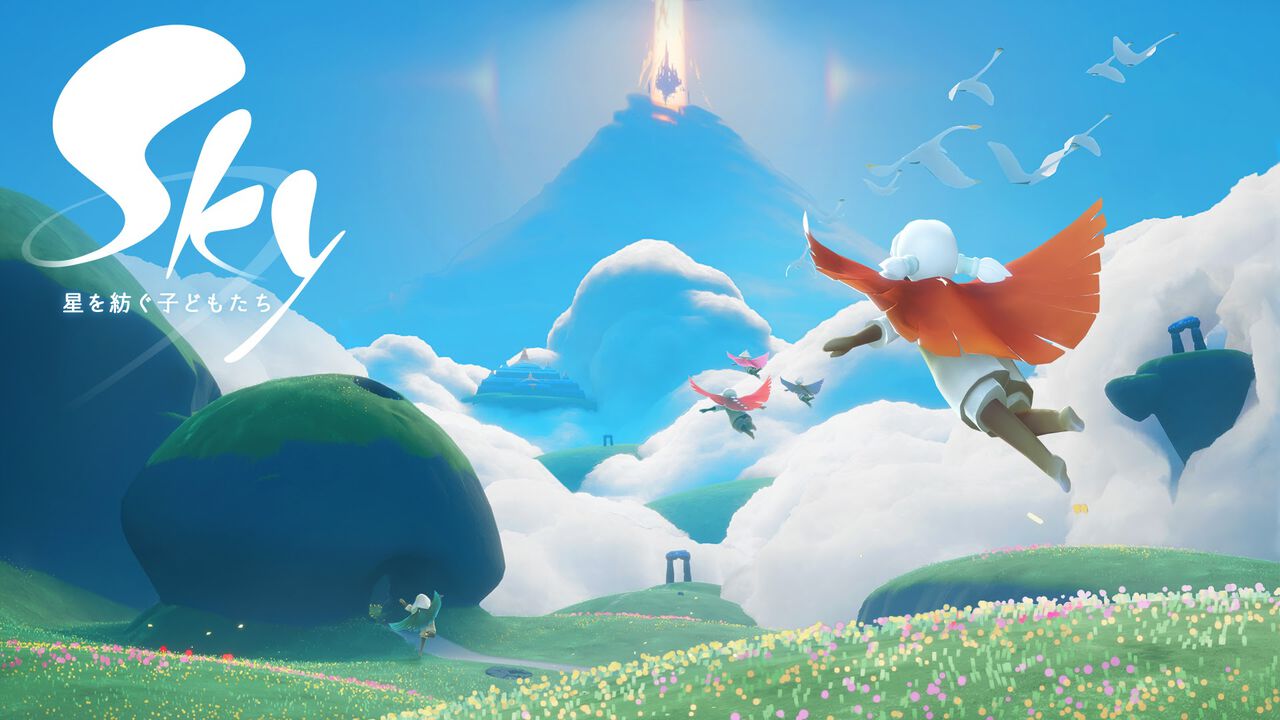
Sky 星を紡ぐ子どもたち(ゲーム)のネタバレ解説・考察まとめ
『Sky 星を紡ぐ子どもたち』とは、アメリカのゲーム会社thatgamecompanyが開発し2019年より配信が開始されたダウンロード専用のオンラインゲーム。美しいグラフィックと音楽、諍いのない平和な世界の中でオンラインゲームならではの他者とのコミュニケーションを育むゲームとして全世界で人気を博している。 星座を作っていた星々が落下した空の世界で星の子と呼ばれるアバターを自由に操作し、全7つのエリアの空を自在に飛び回るアクションアドベンチャーゲームである。
Read Article

Wow... a compilation of games with too beautiful graphics
It's hard to believe it's a game anymore, isn't this a movie? I put together a list of games with beautiful graphics that look like a movie.
Read Article
![ICO] 10 classic games with beautiful images, music, and a sad worldview [Kaze no Tabibito].](https://renote.net/files/blobs/proxy/eyJfcmFpbHMiOnsiZGF0YSI6ODAxNDQ4OCwicHVyIjoiYmxvYl9pZCJ9fQ==--5b5b1b197f8063b8953494257e8a7b4b55708ad6/y_61a8cb275af8d.jpg)
ICO] 10 classic games with beautiful images, music, and a sad worldview [Kaze no Tabibito].
These days, more and more gamers of all ages and generations are playing games. Among the many games available, there are many with beautiful images and music that make you feel as if you are watching a movie. Furthermore, some of them have a world view that makes your heart ache with sadness. In this article, we have carefully selected 10 such wonderful masterpiece games. Please play them as if you were enjoying watching a movie.
Read Article
Tags
Contents
- Outline of "Kaze no Tabibito"
- The plot and story of "Kaze no Tabibito"
- Chapter1 Remains
- Chapter2 Bridges
- Chapter3 Deserts
- Chapter4 Submerged Cities
- Chapter5 Underpasses
- Chapter6 Temples
- Chapter7 Snow Mountain
- Kaze no Tabibito game system
- Basic operation
- Move
- Camera operation
- Make light and sound
- Flight
- Special operation
- Fall
- Meditation
- Online play
- How to communicate in online play
- Offer / Reject to accompany
- Convey a feeling of joy
- Convey gratitude
- Conveying the Loneliness of Parting
- About the trophy
- Incomplete
- Illusion
- Search
- Adventure
- Ordeal
- Ancestor
- Discovery
- Accompanying
- Rebirth
- Best friend
- Meditation
- Menace
- Reversion
- Transcendence
- Characters in "Kaze no Tabibito"
- Tabibito
- "Kaze-no-tabibito" item
- Luminous symbol
- The term of "Kaze no tabito"
- Symbols
- White Giant
- Mural
- Back world
- "Kaze no Tabibito": Behind-the-Scenes Stories, Trivia, Small Stories / Episodes and Anecdotes
- Cloak pattern
- Murals in Chapter 6
- Consideration of the world view