
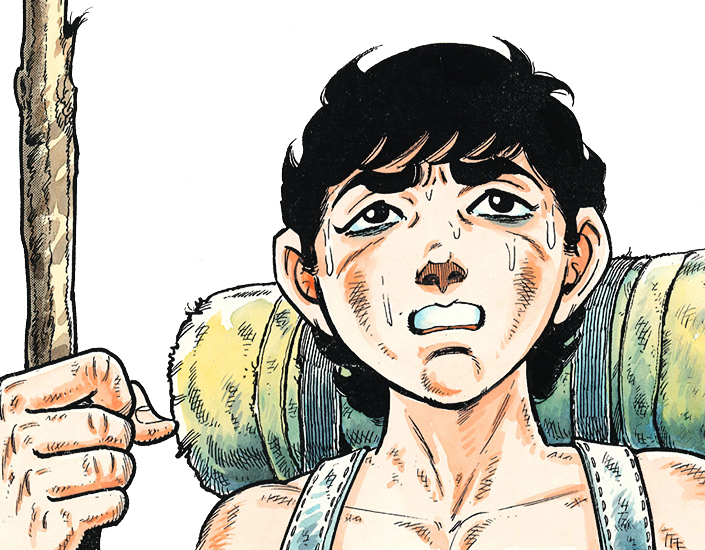
Survival" is a survival fantasy manga (gekiga) written by Tataro Saito and drawn by Saito Productions.
It was serialized in Weekly Shōnen Sunday (Shogakukan) from 1976 to 1978.
The story follows Satoru Suzuki, a Japanese boy who survived a massive earthquake that suddenly hit the world one day, as he fights for his survival in a world where civilization has been destroyed.
The story is highly engaging as the reader follows a man who is thrown into the wilderness, returns to the primordial life of mankind, and gradually attempts to restore civilization with ingenuity and courage.
"What a poor thing! You've been eating beef and pork with no problem?"
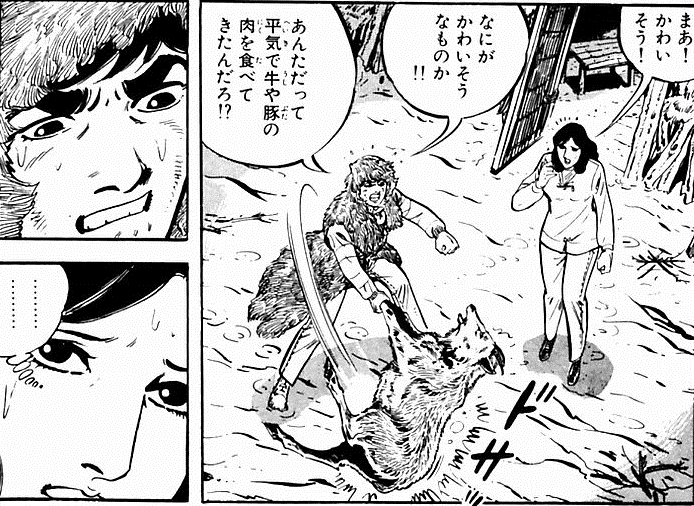
A serow caught by Satoru is in front with Akiko.
Immediately after Akiko said, "I feel sorry for you," Satoru became angry as if he didn't know how much the possibility of surviving would be increased by catching this much meat in the absence of food.
It is also a scene that emphasizes the vulnerability of civilized people who see only processed ones (at this time, Satoru has already become a wild child).
"This is not a concrete jungle. but a real jungle."
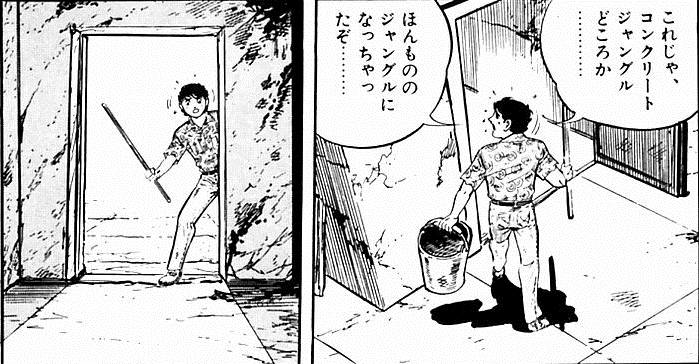
Satoru's monologue after he managed to get rid of a tiger that had attacked him in the rubble of devastated Tokyo.
A fierce animal that had escaped from the zoo found it wandering about, and was frightened. In this world, you have to pay the utmost attention to other beings, or else you will easily die.
Even in the real world, wild dogs and other animals have been found in areas where entry is prohibited due to radioactive contamination. However, there is a undeniable fact that many domesticated animals have lost their lives because they could not become wild, and it is not only human beings that have lost their vitality due to civilization.
"I wonder if I can eat this."
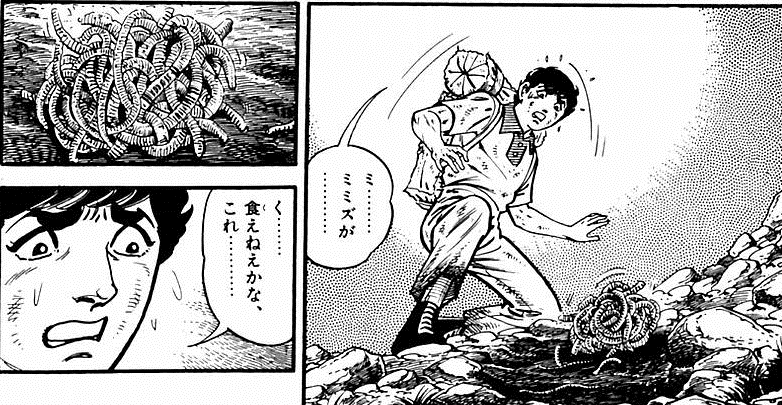
A monologue in front of a swarm of earthworms that Satoru accidentally discovered when signs of starvation appeared.
From the Japanese point of view, earthworms are "food" that they must face with considerable resolve. However, when viewed as food, earthworms are rich in protein and vitamins, are easy to catch, and are excellent emergency provisions.
In fact, there is a culture of eating earthworms, as evidenced by the fact that a contest for earthworm dishes is held in California, USA.
If further research is conducted, certain types of dried earthworms can be used as a material for 地龍, an herbal medicine with antipyretic effects.
"Keep it up! Keep it up! Keep it up! Have hope."
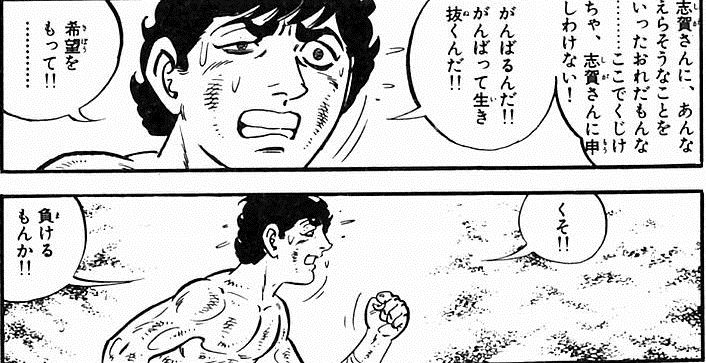
As Satoru, nearly blind from blindness, ruminates on his words to an old man who had also lost his sight.
The scene is a self-inspiring scene with no food, no clothing, no shelter, and no sight, but the commentary on the same piece says that Satoru knew how much disability was caused by lack of physical ability.
It is also a scene that vividly describes the fact that only those who share the same suffering can understand it (even those who have experienced a lot of suffering have less understanding of the suffering they have never experienced).
Behind the Scenes, Trivia, Small Stories / Episodes and Anecdotes of "Survival"
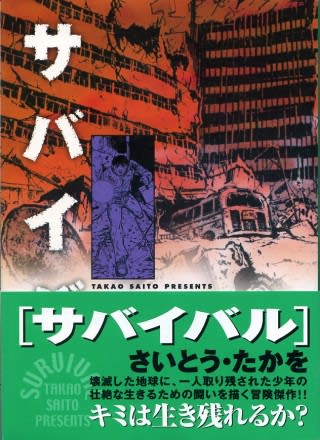
Shōnen manga by Takao Saito
Takao Saito is known as the author and original writer of "Golgo 13" and is strongly recognized as a writer for adults, but "Survival" is a pure boy's comic (gekiga) serialized in "Shonen Sunday," which proves that he is a writer who can produce high-quality works regardless of age.
Major works during the period when the art of gekiga was introduced into manga
As its name suggests, Gekiga refers to comic books in which the movement of a play is depicted in the world of pictures, that is, the depiction of a still picture as if it were watching a moving image is realized on paper, and it does not mean a picture in Takao Saito style. Until the appearance of Gekiga, the depiction in comic books was only a series of frames of' Ichimai-e (single picture) in which the subject was drawn from the front,' which was close to kamishibai (picture-story show) and was distinguished in this way.
Since it was a technique to make remarkable progress in the expression of manga, the technique spread quickly and existing cartoonists also adopted the technique of gekiga one after another.
With this in mind, the time of the "Survival" series coincides with the time when the art of Gekiga was introduced into the world of boy's manga and the way of drawing manga was being revolutionized. Survival is one of the works that became the foundation of Japanese manga, which later grew into a powerful export. (In other words, almost all modern manga artists became Gekiga artists.)
Crayfish Diet (Somehow) Cures Blindness
In the story, Satoru, who suffered from an unexplained loss of vision, continued to eat a crayfish that was on the bank of the river and was easy to catch even if he was blind (the story insists). As a result, the crayfish's bezoars were effective in curing his eye disease, and Satoru's blindness was quickly cured.
It is true that the bezoar of crayfish has been called' オクリカンキリ' or' 蜊蛄 ishi' since ancient times and there is a record that it was treated as a medicine to cure eye diseases, but the clear mechanism of action has not been clarified and there is no guarantee that eating it alone will cure blindness.
(In the case of Chinese herbal medicine, quality control and compatibility between the user and the ingredients are extremely important, so it cannot be guaranteed.)
Even if eating raw food is out of the question, there is a high possibility that people will be infected with dangerous parasites such as lung flukes if they eat half-cooked crayfish.
(This is also mentioned in the story: Satoru is cooked on a stone grill, but apparently it is not cooked enough to eat safely. In the 1970s, when Survival was written, it was common for children in rural areas to catch and eat crayfish, and at the same time, they were often infected with pinworms and tapeworm, so there was a difference in perception that they were not so nervous. However, this was partly due to the free availability of anti-parasite antibiotics, and survival without such medical supplies would be fatal.)
"Survival" is not a dictionary, but a comic book that introduces absurd theories.
I'VE BECOME A WHITE.
After being separated from her, Shiro meets her again and turns into an adult dog that is so muscular that even a fighting dog turns pale.
It is true that a dog can turn into a grown-up dog in a year (several years have passed in the story), but the way it does so before and after is recognized by fans as a famous yet surreal scene of the movie.
Super Bear Killer Satoru
In the early part of the story, there is a scene where Satoru escaped from a bear that attacked him and killed him for food.
Since the place of the disaster was somewhere in Honshu, there is a high possibility that the bear in question was a Asiatic black bear (slightly smaller than a brown bear), but the physical capacity of bears far exceeds that of humans, and in the case of a Asiatic black bear, for example, it can instantaneously move at a speed of about 50km/h at short distances. No matter how much you train it, it is impossible to escape from a bear that is seriously prepared for hunting only by human power.
In the story, Satoru "ran through the trees, ran away, and looked for a pitfall." Running through the trees at such a high speed is what bears do best, and they should not try to use what Satoru did as a reference. The bear is stimulated by an object that moves and escapes. In a moment, it will turn into a mass of blood and meat.
In reality, there are a lot of cases where people die from encountering bears.
Even if there is a hunting gun, ordinary bullets are blocked by thick fur and fat, and it is a creature called a bear that uses a slug or a large-caliber rifle (a bullet or gun that can shatter the head at a single blow if used against a human) to aim at a vital point or shoot a group of people many times and finally falls down. Even in this case, if you fail to kill, the bear becomes a' wounded beast' and there is a possibility that you will try your best to eliminate the threat, in which case the hunter side will be killed.
In the case of the Mt. Towari bear attack in Akita Prefecture in 2016, there was no end to the problem of outsiders receiving phone calls and e-mails complaining, "Don't kill the bear." The reason for this is that, as mentioned above, they do not realize how strong the bear is and how fierce it is once it starts to go on a rampage. In addition, the government and local governments do not enthusiastically publicize the reality of bears, and in addition, some low-level animal rights groups are allowed to blindly make a fuss that non-human creatures should be protected.

Related Articles
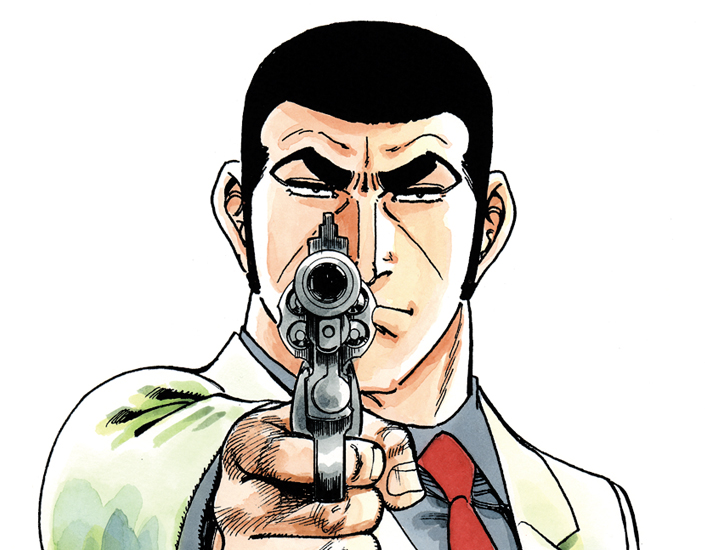
Spoilers and discussion of Golgo 13 (Takao Saito)
A manga series published in Shogakukan's "Big Comic" that is one of the longest-lived manga series and an animated work based on it. Basically, the only major character is Golgo 13 (Duke Togo), and each episode is complete. Golgo 13 (Duke Togo) is a super A-class sniper who takes on nearly impossible requests all over the world, and always manages to accomplish them. How does he make the "impossible" possible? His unpredictable and brilliant sniping and single bullet moves the world.
Read Article
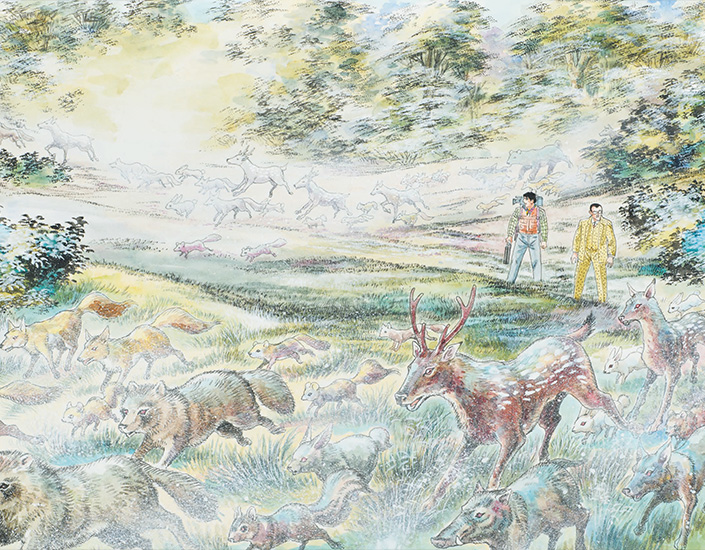
Spoilers and discussion of Breakdown (Tataka Saito)
Breakdown" is a survival fantasy manga by Takao Saito and Saito Productions. It is characterized by its content, which seems to be a reworking of his popular 1970s boys' picture "Survival" as a story for young adults.
Read Article
![Golgo 13] A collection of quotes, rare sayings, and improbable statements in bed scenes [Famous & Lost Lines](https://renote.net/files/blobs/proxy/eyJfcmFpbHMiOnsiZGF0YSI6MzQ1NTM0LCJwdXIiOiJibG9iX2lkIn19--7293f7a359bc77664f0910f449c6e62cfa5d3a51/S40C5ksAUQ8wKW9dSzQwntiG1fAeJ63OMxy68jMcuvI.jpg)
Golgo 13] A collection of quotes, rare sayings, and improbable statements in bed scenes [Famous & Lost Lines
This is a compilation of Golgo 13's quotes, unusual sayings, and improbable statements in bed scenes not found in other compilations. The list also includes lines from supporting characters other than Golgo 13, antagonists, prostitutes, and others. From the cool lines to the funny ones, and from the wet scene lines that you might want to say are a bit exaggerated, we will introduce the lines of Golgo 13.
Read Article

The heroes' trusty sidekick! 4 favorite guns
The heroes of anime and manga pull out their guns in a hard-boiled style! Have you ever been thrilled by such a sight? A black, cold, steel sidekick. This time, we would like to introduce you to the guns used by the main characters of anime and manga.
Read Article
Summary of sniper characters in manga and anime
Manga and anime have a variety of weapon users, but the gunfighter is also an indispensable character. Their calm and cool demeanor as they finish off their opponents has such an impact that it instantly overturns the reputation of even the most normally slovenly of characters. Here is a list of famous gunfighter characters from manga and anime.
Read Article
(2) 《Vol.16〜30》Summary of 《Anime and Manga》Story Performers by DVD of "AMETTOKU
This is a compilation of "Ametalk" DVDs from vol.16 to vol.30. All the DVDs are 2-disc sets, and they also come with special bonus videos that have not been broadcast on TV.
Read Article
The Unknown Production, Birth, and Behind-the-Scenes Stories of Manga and Anime
This article introduces the creation, birth, and backstory of that manga/anime that is rarely known to the public, the industry, and even among fans.
Read Article
![Yuujiro Hanma] Too Cheat! Summary of the strongest invincible character [Golgo 13].](https://renote.net/files/blobs/proxy/eyJfcmFpbHMiOnsiZGF0YSI6NjU5NjQ1MywicHVyIjoiYmxvYl9pZCJ9fQ==--edd1a98010a8c43039d1f8fc15a02eca113b8c18/lqip.jpg)
Yuujiro Hanma] Too Cheat! Summary of the strongest invincible character [Golgo 13].
Here we have compiled a list of the strongest and most invincible characters in manga, anime, and video games. Even in the world of fiction, they have strengths and abilities that are almost illegal. They have strength and abilities that are almost impossible to beat, but their out-of-the-box attitude is so refreshing that you can't help but feel refreshed by it.
Read Article
Tags
Contents
- Overview of Survival
- Outline and story of "Survival"
- The beginning of the Story ~ The Occurrence of a Great Earthquake and the Beginning of Survival
- The middle part of the story ~ Landing on Honshu, the threats that attack Satoru one after another ~
- The End of the Story ~ A Survival Journey in Pursuit of Families ~
- The final part of the story ~ Father's death and reunion with mother and older sister ~
- Characters in "Survival"
- Protagonist
- Satoru Suzuki
- Characters associated with the island
- Akiko
- Friday
- Rat
- Characters involved in the ruins of Tokyo
- The Man I Met in Tokyo
- Shiga
- Characters involved in Mount Fuji's sea of trees
- Shiro and the Mother Dog
- William and Robert
- Characters involved in the journey from Mt. Fuji's escape from the sea of trees to its arrival in the village
- Mali and her father
- Parakeet
- Gen and the Escapees
- Tatsuno
- Tokyo Exiles
- Dr. Komiyama and Assistant Segawa
- Raven
- Characters in Shinto priests' villages
- Kazuo and Matsuji
- Shinto priest
- Washing
- Sub
- Fire Guard
- Characters involved in school ruins
- Shigeo, yuji, and Yoko
- Characters involved in the last village of the trip
- Tune
- 岩造 family
- Other Characters
- Bad friend
- Shin' ichirō Suzuki
- Satoru's mother and sister.
- Term for "survival"
- DANGER - 0
- Crustal movement
- Live
- Food and beverages
- Residence
- Eagles
- Tokyo exiles
- Words, Lines, Scenes, and Scenes from "Survival"
- "THIS IS THE ONLY TOOL I CAN USE TO LIVE. I'M SORRY, BUT. I'M COUNTING ON YOU GUYS!"
- "What a poor thing! You've been eating beef and pork with no problem?"
- "This is not a concrete jungle. but a real jungle."
- "I wonder if I can eat this."
- "Keep it up! Keep it up! Keep it up! Have hope."
- Behind the Scenes, Trivia, Small Stories / Episodes and Anecdotes of "Survival"
- Shōnen manga by Takao Saito
- Major works during the period when the art of gekiga was introduced into manga
- Crayfish Diet (Somehow) Cures Blindness
- I'VE BECOME A WHITE.
- Super Bear Killer Satoru
- Invisible colla image