
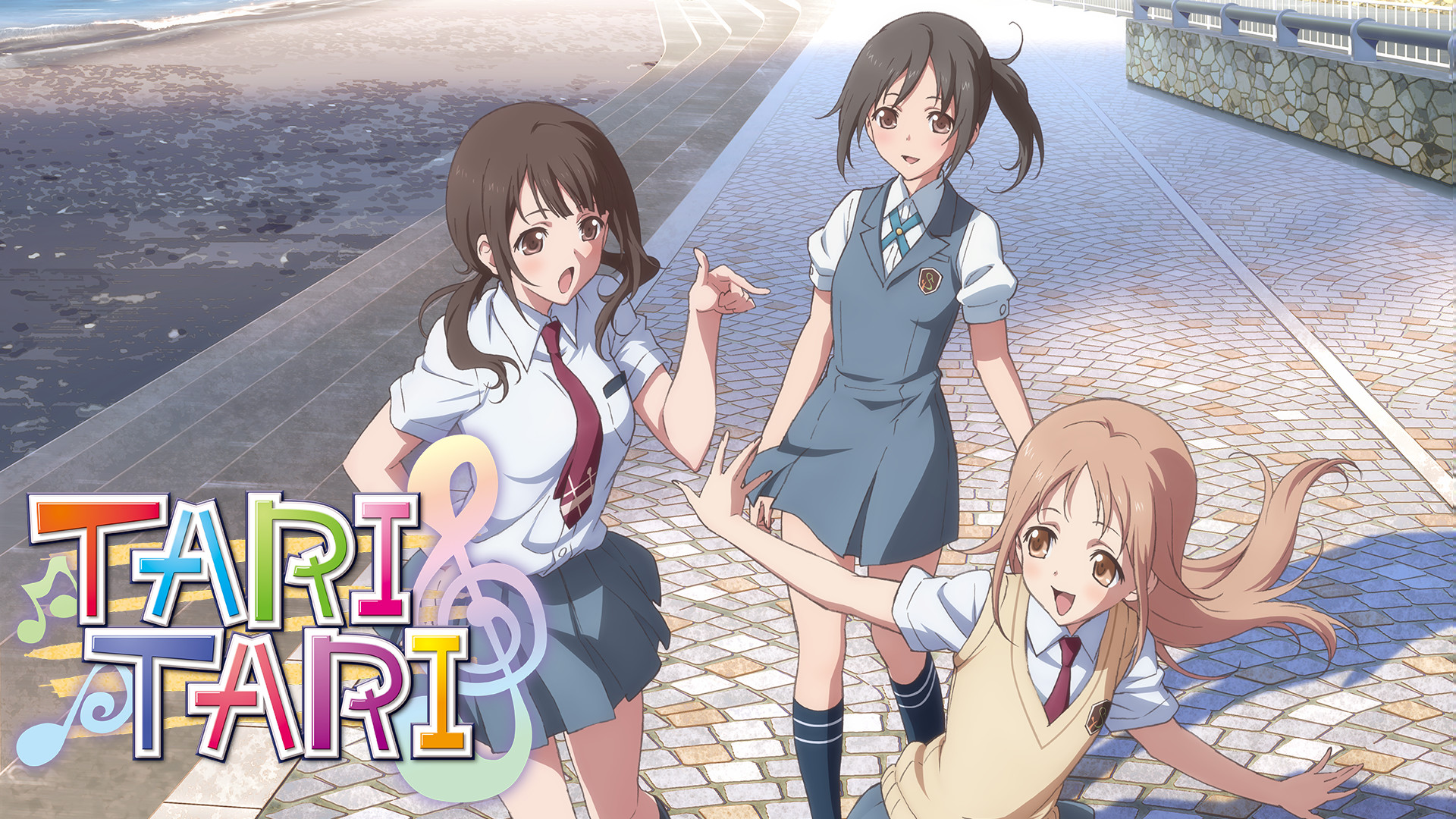
TARI TARI" is an original TV animation produced by P.A.WORKS and a manga based on it that was broadcast in 2012. Set along the Enoden line in Fujisawa and Kamakura cities in Kanagawa Prefecture, the story is about five male and female students at a high school famous for its music department who, each with their own problems, start a chorus club to make their dreams come true and spend their last summer in high school laughing, worrying, sometimes fighting, and even falling in love while growing together with their best friends. Their coming-of-age story has been widely praised and moved, and the Blu-ray released after the broadcast topped the weekly BD ranking.
Overview of TARI TARI
"TARI TARI" is an original TV animation produced by P.A. WORKS as the third youthful film following "true tears" and "Hanasaku Iroha," which was broadcast from July 1 to September 23, 2012 in a total of 13 episodes. Masakazu Hashimoto, whose representative films are "Professor Layton and the Eternal Diva" and "Crayon Shin-chan Movie Series," worked as the first TV anime director and series for this film. Tanu, whose representative film is "AKIBA'S TRIP," worked as the first TV anime character for this film. Kanami Sekiguchi was in charge of character design and animation director, and Shiro Hamaguchi was in charge of music. Many of the staff of the production company's very popular "Hanasaku Iroha" were involved in the production of this film. The setting is Enoshima in Fujisawa City and Kamakura City in Kanagawa Prefecture and along the Enoden Line. The scenery is faithfully reproduced in the film, and the model site is popular among fans as a holy place even after the broadcast, attracting many tourists and contributing to the development of the area. Therefore, tvk, a local broadcasting station, was the first to broadcast the film in the fastest speed, and the production received a great deal of cooperation from public organizations such as Enoshima Electric Railway and Shonan Fujisawa Film Commission as well as local companies in various areas of Fujisawa City and Enoshima.
The main characters of the story are Sakai Wasso, who left music at a high school with a music course and a general course due to some traumas and was transferred to a general course; Miyamoto Rikka, who quit the vocal music club when his advisor told him to give up because he didn't have any talent for music, but he couldn't give up singing; Okita 紗羽, who is kind enough to help and cooperate with his best friend; Daichi Tanaka, who is the only member of the badminton club who is close to being retired; and Viennese (Jun Maeda Haku), a returnee who is a transfer student. In the last summer of his high school life, he sometimes starts a badminton club with a chorus. It is an impressive youth group drama in which people laugh together through the chorus in order to make their dreams come true, and they grow up little by little while suffering, falling in love, and sometimes fighting and bumping into each other. The original choir, which is an insertion song in the story and the highlight of the story, is very complete, and even now it is loved by many people in general and sung at actual choral festivals, etc.
The plot and story of "TARI TARI"
Choral Sometimes Until the Badminton Club is Established
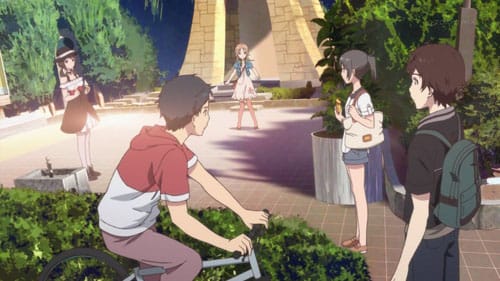
Raikatsu (center) singing on the street, and Saoh (left), Daichi (second from left), Kazunari (second from right), and Vienna (right) meeting by chance.
The story takes place around Enoshima in Kanagawa Prefecture, where Shirahama High School, which is famous for its music department, is located, and Konatsu Hamasaka, who loves singing, belongs to a vocal music club.
Next summer, he had a strong desire to sing, but he was in charge of putting up the piano music because he was too nervous to make a voice at last year's recital. At the next contest, he went to talk directly to Naoko TAKAKURA, the vice principal and adviser, about what he wanted to sing, but he was told, "You don't have anything special to make people move. Give up singing on the stage. Anyone can love music. However, you can't be loved by music." Feeling angry, next summer said, "Well, I'll quit!" and left the club.
However, he could not give up his passion for singing and decided to establish a new choir club, but he needed at least five members.
His best friend 紗羽 OKITA, who belongs to the archery club, and Makoto, who is next summer's younger brother, join the club. Sakai Wasso, a former music major who had been traumatized by music after his mother's death, was also invited, but was rejected.
With the goal of participating in a joint recital with his new choir club next summer, he desperately looked for the remaining two members, but they were hard to find. At that time, his best friend 紗和 begged him to join the Japanese music club, and he agreed to join the club only if it was only his name.
On the day of the performance, various troubles and the traumas of his mistakes made him weak next summer, but his best friend 紗和 reprimanded him and put him back on the stage, and he was able to get on the stage.
When the recital was finished without any problems, the club members quit and there were only three members of the next summer, 紗和 and Wasso, so they could not be recognized as a choir club.
One day, the vice-principal summoned Daichi TANAKA of the badminton club, which had only one member next summer and now. If the club continued to have less than five members, it would be confusing to be told that both club activities would be discontinued. However, next summer, when he could not give up, he invited Daichi and Jun Maeda Masahiro, the so-called Viennese, who was a returnee and a newcomer to the club. Daichi could not give up on the badminton club either, so he respected each other's opinions and established the "Choral Sometimes Badminton Club."
Meeting at the World Music Festival and Mother's Wish
Chorus sometimes The first activity of the badminton club was to participate in the "World Music Festival," an event at a local shopping street.
There, he meets the band Condoklins, who is said to have been taught various things about music by the mother of Japanese music, Mahiru. When I told them that Mahiru had passed away, they were surprised and saddened and gave a memorial performance at the cemetery of Mahiru. In response to the death of Mahiru, they are told the words of their mother, who once said to the Japanese music that had been separated from music, "You can't stop music. It's not like you can't do it or you can't stop it. Music is always with you." They are also given a letter from her to コンドルクインズ.
She rereads a letter from コンドルクインズ at the event the other day, saying, "For me, singing is a word that conveys love. I wish I could sing and listen to the song with the Japanese music." It reminds her of her memories with her mother.
I remember that when I was in the third year of junior high school, my mother was often sick due to the stress of puberty and entrance exams. She did not listen to my mother's wish, "I want to sing a song with her on the piano," and acted coldly. Her wish did not come true and she passed away.
It became difficult to see the piano filled with such memories with her mother, and Waso, who was full of regrets, consulted with her father to throw away all the things she remembered with her mother.
She could not understand why her mother, who was hospitalized at that time, did not tell her about her illness in detail. If she had told her, she could have been more kind to her and she could have kept her promise to write a song together.
My father said to her, "When we compose a song together, I feel that I can leave myself in the other person's heart. So, it's not about sadness, it's about the kindness and strength as a mother. even if I'm gone, that song will always be with the child instead of me. I'm really glad that the Japanese music has become my favorite. It's an important treasure. I will never leave the child alone."
Even if she had told her everything about her illness to the Japanese orchestra and had made a poem together out of the kindness of her sympathy after knowing it, it would be a sad parting song, so her mother really wanted the Japanese orchestra to keep quiet about her illness.
Learning of her mother's true intentions and her love for herself, she wept bitterly, threw away her memories, and regretted that she had left the music.
The father said, "I want to listen to the music made by my mother and the Waso, so I want you to make the music for the Waso," and offered him a key holder that the Waso was supposed to have thrown away as a memory of my mother. Surprised by his father's behavior, the Waso suddenly came to his senses, and when I asked him what had become of the piano, he said, ". there's no way I would throw it away. It's the piano my mother used when she proposed to me."
While crying, he thanked his father and mother and chose to return to the path of music. Choral Sometimes I touched on the kindness of the badminton club members and slowly recovered, and for the first time, all five of them sang "Kokoro no Senritsu" (Melody of the Heart).
New Goal of "Shirosai" and Barriers to a New Future
After officially joining the choir club, she became active in the traditional Japanese music, recognized the joy of the music, and was engaged in fulfilling activities together.
The choir's new goal was to hold a cultural festival called the "White Festival" at Paik Hamasaka High School, but the choir had to pass the main stage selection race, which was led by the vice principal who was an adviser to the choir.
When the choir club successfully won the right to present at the main stage selection race and the whole school became more and more active in preparation for the White Festival, there was a group that showed distaste for the choir club.
It used to be the vocal music club to which next summer belonged, and which the choir club was hostile to. The vocal music club has many students who are working under the daily strict guidance of the vice-principal who is their advisor, looking ahead to the future. The chorus sometimes feels like a game, and the badminton club is cold next summer.
Watching this, Wasso thought that a citizens' musical would be a good reference for the White Festival, and invited 紗羽 to come next summer. It was a time of great joy, but 紗羽 looked worried and looked depressed.
The reason for this was a pamphlet from a horse racing school that arrived at her home in 紗羽. 紗羽 had been seriously dreaming of becoming a jockey since she was a child. However, her father was vehemently opposed to her becoming a jockey, and 紗羽 was also emotionally opposed to her becoming a jockey. As a result, there was a deep rift between her and her father. As a result, 紗羽, who was seriously researching the conditions for applying to a horse racing school, came to know that there was a weight limit, which was a difficult condition for her.
After that, 紗羽 started to go on an excessive diet, such as skipping meals, and sometimes collapsed during the choir practice.
Still, 紗羽 could not give up his childhood dream, so he tried to find out how to get closer to his dream by calling the horse racing school of his choice and telling them about his enthusiasm.
One day, on his way home, 紗羽 turned down the offer of Japanese music and the next summer's invitation, and went to practice his daily routine of yabusame (horseback archery) alone. However, 紗羽, who had become slightly malnourished due to excessive dieting, fell from his horse and was injured, and was taken to a hospital.
To the main stage selection
Fortunately, the injury was not serious, but on the way home from the hospital, my father said to me, "You have caused trouble for others. You need to cool your head. Her father is also very strict with her, telling her that she has to meet weight restrictions and her parents have to be interviewed, and that she cannot take the entrance exam if she seems to be growing taller.
After returning home, Sa-u discusses with her mother and confides her worries so far. Her mother was also worried about her daughter's recent lack of appetite. She had been dreaming of this job since she was a child, and because she had been earnestly pursuing it, she felt helplessly miserable about her failure to meet the application requirements. Mentally exhausted, Saoh became emotional and screamed.
At that time, the club room that the chorus club had been using was going to be used for the vocal music club for the main stage selection of the White Festival, and the chorus club was in trouble because they had lost a place to practice. As if to relieve her stress at home, Saoh raised her voice and raged against the vocal music club.
In order to avoid further conflict between the clubs, the chorus club changes the place of practice to Vienna's house. The choir members, worried about Sa-u's recent emotional instability, mistakenly thought that she was having trouble in love and tried to talk to her. For the first time, Sa-u confides her true worries about her career path, and the club members desperately encourage her.
However, only one member, Kazunade, told her, "Why don't you try to stay away from her until you feel a little calmer?" I heard her words.
When Sa-u heard her words, she said, "What are you talking like you're enlightened? Kazunade is fine. You can say that because you came back to music and are continuing it now! If I leave now, it will be the end for me!" I said strongly.
Kazunade said, "...yes, I'm glad I came back to music. I'm glad I'm back to music...I made a promise. I promised my mother that I would write songs with her. I'm still connected to her through singing. But if I could see her just one more time, I wouldn't mind quitting music. But that won't happen anymore. Saoh could not say anything back to him.
Later that day, Kazunari and Rinkatsu were called by the vice principal regarding the White Festival's main stage selection committee.
The vice principal advised the choir club not to participate, but Rinkatsu desperately appealed to the vice principal that she wanted to sing. However, the vice principal, irritated by Raikatsu's straightforwardness, questioned Kazunari, saying, "The reason I allowed you to transfer to the regular course was not for you to do such a half-hearted thing.
Upon hearing these words, Kazunade replied, "Until I joined the chorus club, I thought that music was a solitary pursuit in which one had to hone one's skills alone. But that wasn't enough. There are all kinds of people, feelings clash and cross each other...it's fun and painful...I can't say it well, but to really play beautiful harmony -" she almost said.
Then, the vice principal's memories of his high school days came back to him, and he remembered what Mahiru, Wakane's mother, who was a member of the same choir club and her best friend at the time, had said, "I can't do it alone if I want to play a really beautiful harmony. It's fun, isn't it? It's nice to have other people around, isn't it?" I remembered these words and connected them to Kazunade's words.
These were the same words that her mother Mahiru had said to the vice principal in the past, and she could not hide her upset at being told the same thing by both parent and child. The vice principal has always been strict with himself and has faced music straight and earnestly. On the contrary, Mahiru was truly loved and enjoyed music and the people around her. The contrasting personalities became a complex, and the vice principal was harsh with his students.
Seeing the vice principal like that, Raikatsu said, "Vice principal, I am loved by music. ...Just a little bit. Do you remember? I told you that I don't have something special to move people's hearts. I can't do it alone, but with everyone's help, I think I can move people's hearts just a little bit. So please let me stand on stage!" He earnestly conveyed his feelings and bowed his head hard with Kazunari.
The vice principal was moved by their enthusiasm and said, "...Then prove it. Prove that your growth is not just talk. The chorus club was happy to finally be able to participate in the selection committee, but Saoh was nowhere to be found, absent from school and unreachable.
At the same time, at her home, her father took an unexpected action regarding her career path. He personally called the horse racing school to which she wanted to apply, and was yelling at them about the application conditions.
As she watched silently from behind, Sa-u's mother said to him, "For what it's worth, your father is just too important to Sa-u. He is still too bad at conveying his feelings, though," she said gently. Knowing her father's true feelings, which she had never been able to gauge, lifted her depressed mood as she continued to worry about her career path.
In response to an incoming call from a fellow member of the choir club that rang at the right time, "I'm on my way, so you wait for me! in her usual Sa-chan tone of voice, and hurried to the school on her beloved horse, Sable. Just in time to make it to the main stage selection for the White Festival, all five of us were able to sing together without incident.
The chorus club, which had been selected to participate on the main stage at the White Festival, was to perform a musical play.
The members were divided into different sections, and Kazunari, who was in charge of composing the music, wondered how she should complete the piece. She visited her mother, Mahiru, and Saoho's mother, Shiho, who was a junior in the same choir club in high school, but could not get the answer she was looking for.
Seeing Kazunade's troubled state, Shiho, Saoh's mother, tells her that Kazunade's mother, Mahiru, and the vice principal used to work together to compose music.
The other choir members were also making their own preparations, but they needed money to create something more serious. When they were worried that the funds provided by the school were not enough, Saba's mother, Shiho, recommended a part-time job at a local hero show at a shopping district event. Because the income was good and it sounded like fun, Raikatsu and Vienna agreed to participate with the whole group and soon began practicing for the hero show with the whole chorus club at Vienna's house.
However, the school rules forbade part-time work in principle, except under certain circumstances. When we all visited the vice principal to ask for permission to work part-time, we found that the vice principal was in a dispute with the principal.
The content of the dispute was about the business plan that the headmaster was promoting, which was that the traditional music department would be eliminated. The vice principal was angry and raised his voice against the principal, who did as he was told by the chancellor and did not express his own will.
In such an atmosphere, the choir club showed up and the vice principal easily signed the application for permission to work part-time without any time to think deeply, and soon obtained official permission.
Later, when Kazunari asked the vice principal about composing music as advised by Saba's mother Shiho, the vice principal traced her memories of her youth spent with Kazunari's mother Mahiru. In contrast to Mahiru, who played music for fun in a cheerful and positive manner, the vice principal, who was serious and strict with himself, told Kazunade, "...it's because I don't enjoy it. It is impossible while you think you have to make it. It is work. A song is something that naturally overflows from the depths of your heart.
Despair over the cancellation of the White Festival and hope for its holding
The students were able to earn money through part-time jobs, and the Hakusai Festival was approaching.
While everyone was absorbed in full-scale preparations, Kazunari, who was in charge of composing music, was making great progress in her composition after receiving advice from the vice principal, as if she had realized something important.
On the other hand, Daichi, who is in charge of props, lacks confidence in his own drawings and desperately refuses, but is persuaded by Raikatsu to accept the project. While he was struggling, Toru Hamada, a classmate and member of the art club, approached Ochi and said he would draw a picture for him. He was happy to be saved by an unexpected helping hand, but Hamada put a condition on his offer. The condition was that he wanted a picture of Sa-u.
When Daichi returned to the club room, he found Sa-u alone practicing her choreography. He thought that now was a good time to take a picture, so he set up his camera, but he was fascinated by the dancing Sa-u in front of him. That was the moment when Daichi felt a strange sense of wonder for Sa-u.
While all the students were getting excited for the White Festival, a special staff meeting was held at the school, and a problem arose.
It was a project plan to build condominiums for high-income retirees on the school grounds. Since the construction would start soon and the school building would be covered, it was decided that the school would be closed after the current students graduated and that this year's White Festival would be canceled.
When the vice principal learned of this fact, he was deeply hurt and saddened by the fact that the school building, where he had spent much of his time as a student and teacher, and where he had many memories of his high school days with the late Mahiru, Kazunade's mother and once best friend, would be destroyed. She was also burdened by the pain of having to tell the students about this fact, which she did not want to admit to them. He went to the clubroom of the vocal music club for which he was the advisor and told the students, "This year's festival has been canceled.
And soon the whole school and parents were informed, and the chorus club spent the next few days on their own, as the enthusiasm they had recently shown had waned.
The four members of the chorus club gathered in the clubroom for the first time in a while, but the atmosphere was awkward, having suddenly lost their goal. When Saohu called it was time to go home, Kazunari came in and cheerfully said, "It's done! A song!" She said with a smile.
I want to sing the song I wrote with my mother with everyone! We can't do anything about the school disappearing, but that doesn't mean it's the end of us! Let's do it! The White Festival!" He said cheerfully.
The choir members immediately agreed to the plan, and the five members' hearts were reconnected and united once again by Kazunari. They discussed how the White Festival should be held while listening to the completed song.
We had laughed, gotten angry, fought, and fought, but all of it was a good memory and a precious one. This led to a positive enthusiasm to sing this song together at the end of the festival and to have as many people as possible listen to their song.
Kazunari then said, "If many people come to listen to this song and share our happy thoughts, I feel that someday when we encounter hardships again, we will remember the support we received from so many people and we will be able to do our best. Once again, all of us were convinced that we had met a good and important group of people, and we all strongly determined to sing together and to hold the Hakusai Festival once again.
Raikatsu attends the club meeting and proposes the cancellation of the White Festival. They cannot do anything about the school's situation that has already been decided by themselves. However, she complained that the White Festival, which all the students had looked forward to and put a lot of effort into preparing for, was cancelled without warning, and that their efforts had been wasted, and she wondered if they were really satisfied with the decision. As a result, even with a majority vote, there were few students who agreed with Raikatsu, and the vote was rejected, but it was not so light-hearted that they would give up there.
Meanwhile, Kazunade went to visit her mother's grave and found the vice principal there.
The vice principal seemed to have informed Mahiru that her alma mater, where she spent time with her mother Mahiru, was to be closed and said, "In the end, I couldn't give shape to anything on my own. Nothing more than the songs I made with you and the chorus club I made with you.... That school was my last connection to music, and even that..." He said darkly.
Kazunari was hesitant at this appearance, but she approached the vice principal and asked him to listen to a song she had written with her mother, which had just been completed.
The vice principal listened to the song and commented that he could feel Mahiru, although there were some quirks. When Kazunade thanked him for his advice to "enjoy the sound," the vice principal replied, "Those are Mahiru's words. I am not qualified to give you advice," he replied pessimistically.
Hearing these words, Kazunade was a little puzzled and said, "I needed the help of my friends as much as I needed to enjoy myself. They called on me even when I was in pain, and although they were all very different from me, they worked hard, were frank, fought, and joined forces...I think my mother must have had friends like that. Someone who enjoyed and worried with me." The vice principal shed tears at Kazunade's words.
When Kazunari went to her mother's gravestone, she said, "Mom, I've finished the song I promised you. It's a little late. I wrote this song with my mother and my friends. This song connected everything together. It's my treasure. Thank you, mother," Kazunade told her mother.
At that time, Sa-u attended a meeting in the shopping arcade and appealed to hold the White Festival in front of all the people gathered there, asking emphatically for as many people as possible to listen to their song. At first, the adults were surprised and hesitant at Sa-u's enthusiasm. However, since there were many Shirahama-zaka High School graduates around, they agreed to put up posters in their stores, hoping to see the festival one last time if the school was going to be closed.
Also, at a recent club meeting, Raikatsu, who had proposed the cancellation of the Shirahama Festival and had been voted down, gave a song and sheet music written by Kazunari to one of the members of the vocal music club and asked him to play the accompaniment.
Seeing this, Hirohata, the head of the vocal music department, with whom she had been at odds many times before, again defiantly refused, saying, "Don't involve others in your selfish satisfaction at a time when the school is in trouble.
In response to Hirohata, Raikatsu asked, "Why are you singing, Hirohata-san? I don't like you, Hirohata-san, but I know you love to sing. So, let's sing together!" She expressed her feelings straightforwardly. Hirohata was overwhelmed by the sincerity of Raikatsu's ability to express herself so honestly, and the chorus club and vocal music club began to work together.
Then, on the day before the festival, the chorus club members were worried about holding the festival tomorrow in the heavy rain. Their past efforts had given them confidence, and all of them were determined to have fun, no matter how small the audience and how uncool it might be.
From the long-awaited cultural festival to graduation
At last, it was the day of the White Festival. It was raining continuously from the previous day. When all the students came to school with high expectations, the school gate and bicycle parking area were blocked by the president, and the gymnasium was locked and guarded.
The president of the choir, who was angry about this situation, appeared in front of the choir and all the members of the choir tried hard to persuade them to enter the school gate, but the president did not raise his head.
When he felt frustrated and couldn't do anything about it, the principal, who had been at the president's mercy until then, protested to the president and allowed the white festival. He apologized to the choir club, asking them to forgive him for not being able to do anything for him.
The president was enraged by this attitude, and when he pointed out that the principal's education was wrong, the principal shouted, "What is education? You don't know how weak people are, or how great songs are to heal their weaknesses! This is just an asset for you, but an important place for the students! Why don't we get together and sing a song!" The president was even more enraged by this attitude, and told the principal that he was fired.
Seeing him as a headmaster trying to protect his students, the vice principal changed his mind and became cooperative. Next summer, he said, "Mr. Miyamoto, would you let me lead this stage that you have been moving?"
However, when next summer was confused because the gym was not available and there was no stage, the rain that had been falling for a long time came to an end and General Visitors came one after another at the call of 紗羽 to make a sunny day.
After that, the vocal music club became cooperative and had a meeting, the outdoor stage was gradually completed, and finally the musical play started. The play progressed smoothly, and at the end of the stage, all the members sang the song composed by the Japanese music, and the stage ended safely.
After that, the season passed and he was about to graduate. Next summer, he was busy studying for an entrance examination. In order to study music, he decided to go on to a college of the arts. Daichi had already passed the university by sports recommendation. He was reunited with his Austrian friends back home.
紗羽 had a dream of becoming a jockey that he could not give up, so he decided to go abroad to study and leave before graduation.
At the graduation ceremony, the four, excluding 紗羽, took a video and sent it to 紗羽. Even if they were separated, if there was a song, everyone would connect. If there was a song, they would talk that they would be okay even if they had a hard time. With the words of next summer, "Well then, the chorus of Shiro Hamasaka High School and sometimes the badminton club, let's sing one song at the end!" as a sign, the four sang together and the story ended.
Characters of "TARI TARI"
Chorus occasional badminton club
Konatsu MIYAMOTO
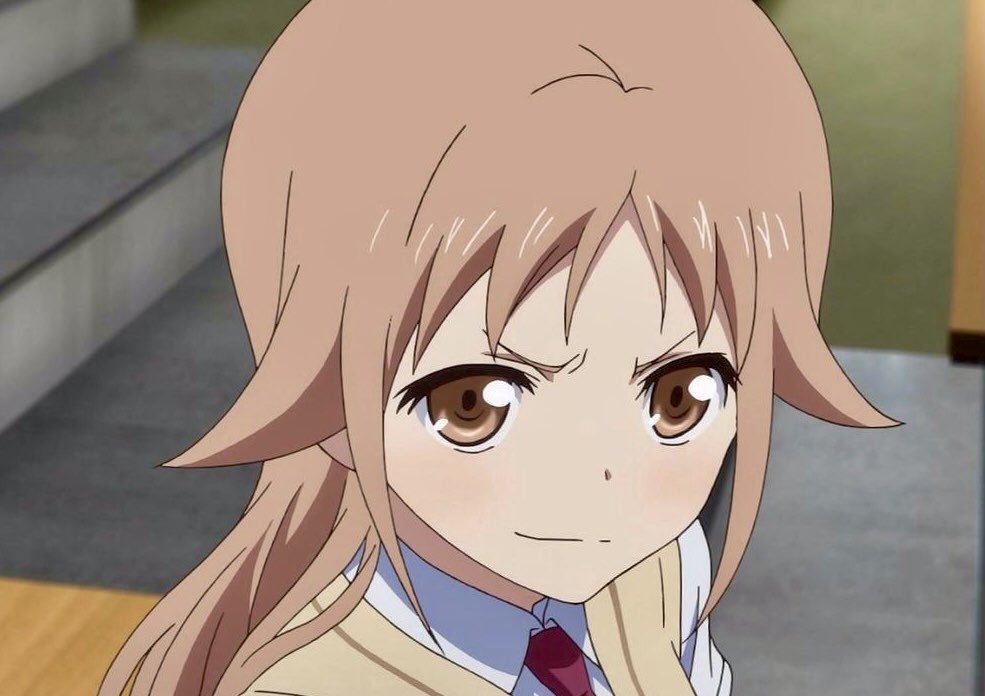
CV: Asami Seto
Choral He is sometimes the head of the badminton club. He always loves to sing cheerfully and has a forward-looking and aggressive personality. His younger brother, Makoto, is a member of the student council of the same school. He is now an enthusiastic fan of コンドルクインズ who has memories of his late grandfather. At the beginning of the story, he was a member of the vocal music club, but he was not allowed to sing because of his failure at the recital last year when he lost his voice due to tension. He got angry and was told by his advisor that "you don't have anything special to move people," so he left the club and established the choir club, and later merged with the badminton club and became the head of the choir and sometimes badminton club. He lost the opportunity to make a presentation at the White Festival, which was his goal in the latter half of the story, and although he became weak for a while, he took the lead and involved the people around him, and continued to appeal for holding the event in cooperation with the students of other clubs. Many people were moved by the passion of next summer and held the event safely, and all of them could sing together. After graduation, he goes on to university.
Sakai Wasso
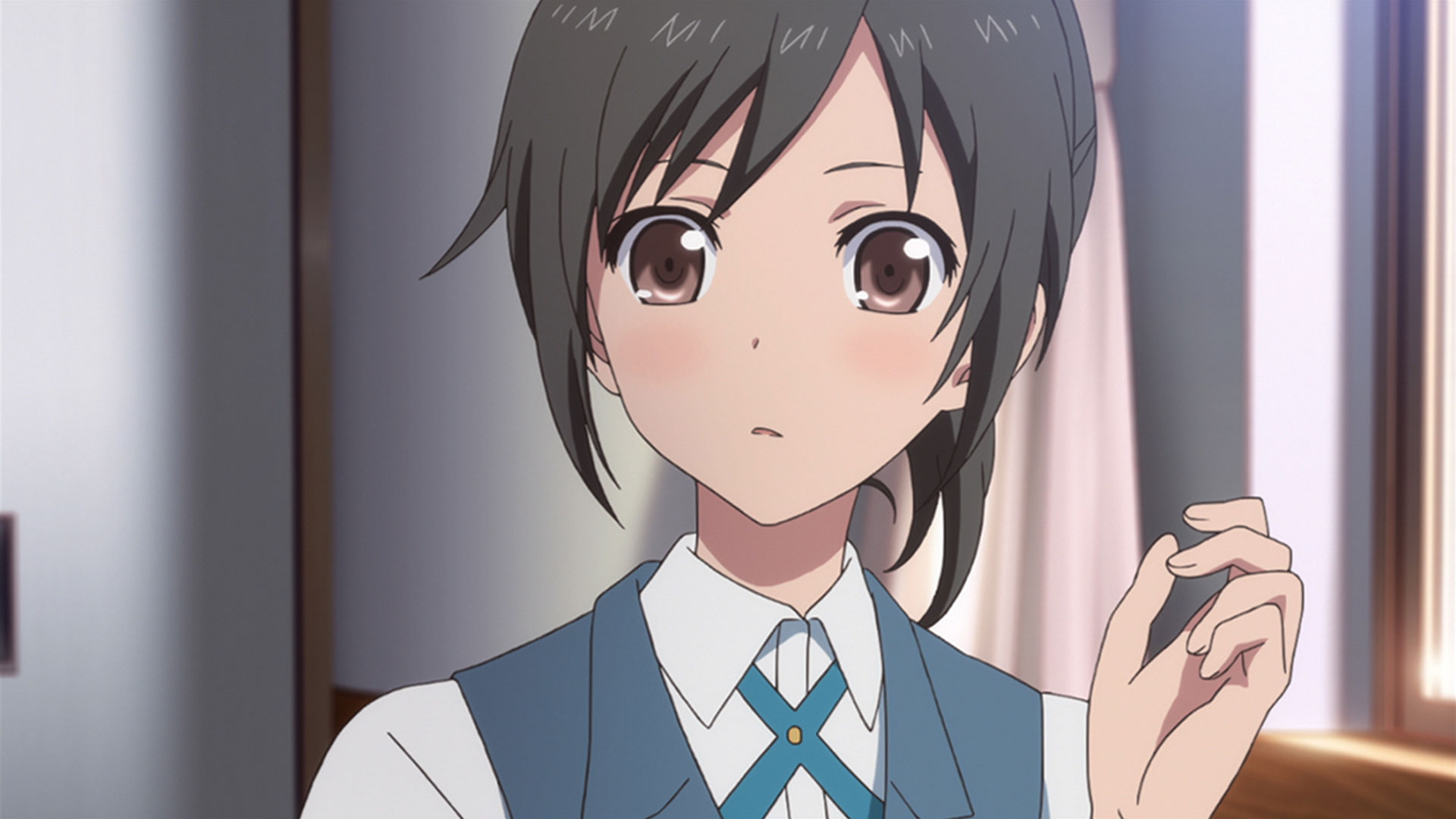
CV: Ayahi Takagaki
She is the only daughter of a souvenir shop in Enoshima. She lives with her father and her cat, Dora. She loves cakes and vegetable juice. She has a caring and gentle personality. When she first entered the school, she was in the music department, but she was traumatized by losing her mother to a disease, so she moved away from music and moved to the general department. She had been worried that her mother had not told her about her illness in detail, and for a while she was trying to throw away all her memories with her mother. However, her father told her the truth about why she had not told her about her illness. She cried bitterly knowing how much she really felt for her mother. After that, she was able to return to the path of music. When she first joined the chorus club, she was in charge of the piano, but after she started studying composition, she actively taught her practice in order to solve her worries and fulfill her late mother's wish to "compose a song with my mother in the form of Japanese music." When the White Festival, which she had been aiming for, was canceled and the other members of the chorus club became weak and separated, she completed the song with her mother, held the hearts of the members of the chorus club, and started to move toward holding the festival again with the Japanese music playing a central role. After that, the White Festival was held safely and everyone was able to sing in chorus. After graduating from high school, she went on to study music at an art university.

Contents
- Overview of TARI TARI
- The plot and story of "TARI TARI"
- Choral Sometimes Until the Badminton Club is Established
- Meeting at the World Music Festival and Mother's Wish
- New Goal of "Shirosai" and Barriers to a New Future
- To the main stage selection
- Despair over the cancellation of the White Festival and hope for its holding
- From the long-awaited cultural festival to graduation
- Characters of "TARI TARI"
- Chorus occasional badminton club
- Konatsu MIYAMOTO
- Sakai Wasso
- 紗羽 OKITA
- Daichi TANAKA
- Viennese / Maeda 敦博
- Vocal club
- Hirohata Tanae (Hiroha)
- Ueno Midori
- Masami OTANI
- Student council
- Fumiko MATSUMOTO
- Makoto Miyamoto
- Art club
- MIZUNO Yoko
- Toru Hamada
- White Hamasaka High School faculty
- President
- Principal: Yori Ikezaki
- Vice Principal: Naoko TAKAKURA
- Tomoko TAKAHASHI
- Chorus sometimes family members of the badminton club
- Keisuke SAKAI
- Mahiru Sakai
- Shoichi OKITA
- Shiho OKITA
- Haruka Tanaka
- Other characters
- コンドルクインズ
- Jan
- TARI TARI terminology
- Bai Hamasaka High School
- Chorus occasional badminton club
- Vocal club
- World Music Festival
- Hero Gunbariger
- Hakusai
- "TARI TARI" I TARI "
- Okita 紗羽 "Are you going to leave without doing anything with all these people involved! Don't you have any regrets! There's no more!"
- Sakai Wasso: "I couldn't say. I'll go. I'm sorry. Thank you. I can't sing with you anymore."
- 紗羽 Okita "Don't make me laugh, will you? What are you talking about when you're just running on the rails that the vice-principal laid out for you? Do you think you can't do anything just because you don't know? Why don't you stop thinking with that happy head? Why do you think it's impossible when it's still like this? It might work! And you won't even get a chance. Why don't you be crazy!"
- Gamballed: "Dreams and hope act as a force to move people and turn the earth. Tomorrow doesn't come because the sun rises. It rises because people live with hope! We turn the earth!"
- Mahiru Sakai: "Music means' enjoying the sound'! We have to enjoy it!"
- Next Summer MIYAMOTO: "I can't do without singing!"
- The principal said, "What is education? You don't know about people's weaknesses or the music that cures them. It may be just an asset for you, but it's an important place for the students! Why don't you get together and sing?"
- "TARI TARI" Inside Stories, Trivia, Small Stories / Episodes and Anecdotes
- Stamp rally held all over Enoshima
- The casting of voice actors focused on singing
- The theme choral song "Kokoro no Senritsu" (Melody of the Heart) is loved by many people and is actually sung in chorus. For example, the score is sold.
- Aburaya, the Holy Land, Remains Popular Years After Anime Broadcast
- The story of 10 years later is novelized.
- Theme song and insert song of "TARI TARI"
- OP: AiRI "Dreamer"
- Ed Ending: Shirayuki Hamasaka High School Choir Club "Shiokaze no Harmony" (Episode 1, Episode 3-5, Episode 7-12)
- ED (ending): Yuka MIYAMOTO (Asami Seto) & 紗羽 OKITA (Saori Hayami) "Kokoro no Senritsu (#2 ed Ver.)" (Episode 2)
- Ed Ending: Shirasu Hamasaka High School Choir Club "Kokoro no Senritsu (#6 ed Ver.)" (Chapter 6)
- Ed Ending: Shiro Hamasaka High School Choir Club "Shiokaze no Harmony (#13 ed Ver.)" (Chapter 13)
- An inserted song: "The school song of Shiro Hamasaka High School" by all the students of Shiro Hamasaka High School (the first and thirteenth episodes)
- Inserted song: "Reflexia (chorus version)" (the first episode) by the vocal music club of Shiro Hamasaka High School
- Insert: "goin' my way!" (Episode 1) by Asami Seto
- Inserted song: "goin' my way! (chorus version)" (Episode 2) by the vocal music club of Shiro Hamasaka High School
- Insert: コンドルクインズ (Ricardo Cruz and his friends) "Amigo! Amigo!" (Episode 2 and 4)
- Inserted song: "Shiro Hamasaka High School Song (Latin Ver.)" (Chapter 3) by the chorus club of Shiro Hamasaka High School
- Inserted song: Hakurei Hamasaka High School Choir "Hau' oli ♪" (Chapter 4)
- Insert: Nishino Bata Hero Shotenger "Netto Hero Gambaraiger" (Episode 9 and Episode 10)
- Inserted song: "radiant melody" (Chapter 12 and 13) by Shirayuki Hamasaka High School Choir & Vocal Music Club