
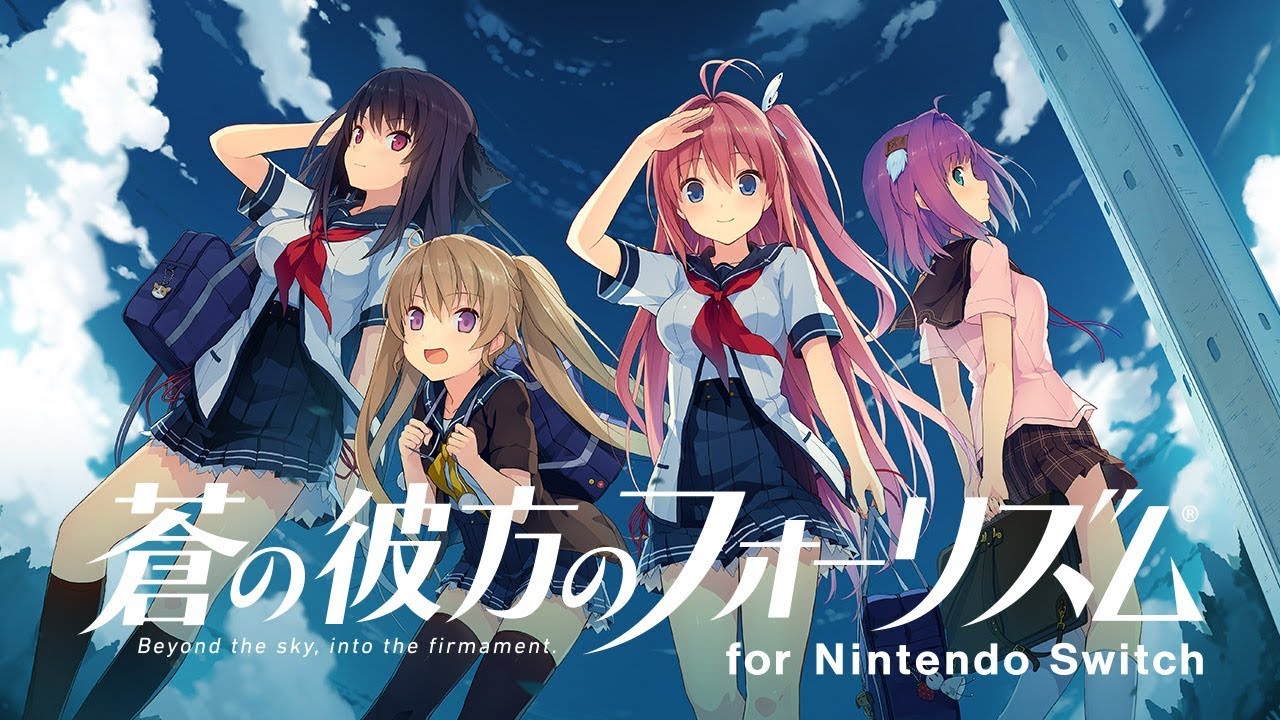
Ao no Kanata no Forhythm" is a bishojo game released by sprite in November 2014, as well as an anime, manga, and other media mix works based on the game. Set against the backdrop of nature-filled islands modeled after the Goto Islands in Nagasaki Prefecture, the story follows the love lives of boys and girls who are passionate about an imaginary sport called Flying Circus (FC), which takes place in the sky. The story is about Masaya Hinata (the protagonist), who was once a promising FC player but has fallen behind, and how he himself grows and gets back on his feet by watching the heroine work hard in FC practices and matches as a coach.
Worldview and terminology of "Ao no Kanata no Forhythm
Story Background
In recent years, "anti-graviton" particles, which repel gravity, were discovered, and "anti-graviton shoes" (glash) equipped with a semi-gravity generating device were developed using these particles. The story takes place on the Shishima Islands (modeled after the Goto Islands in Nagasaki Prefecture), where the ban on the daily use of glash has been lifted and the sport of flying circus using glash is flourishing.
antigravity device
A device mounted on anti-graviton shoes (glash) that generates anti-gravity to levitate objects. When the device is activated, an anti-gravity membrane called a "membrane" is generated around the mounted object, or in the case of Glash, around the human body, enabling it to levitate. Membranes generated by different devices have the property of repelling each other. The total amount of membranes that can be generated by a single device is fixed, and even if multiple anti-gravity devices are installed to float a large object, the membranes will repel each other, and objects larger than a certain size will not float.
For this reason, the technology to float large objects was not developed in the film, and the technology progressed in the direction of miniaturization, leading to the development of glasch production technology to float the human body.
The Four Island Archipelago (Shitto Raito)
The main stage of the story. Located in the South Seas of Japan, the island consists of four large islands, Fukurujima, Kunashima, Kasamatsujima, and Kamidorijima, as well as surrounding smaller islands, totaling more than 30 islands. The FC clubs are located in each of the high schools on each island, and the FC regional qualifying rounds held in the four island cities are said to be comparable in level to the national championships.
Anti-Graviton Shoes (Grasch)
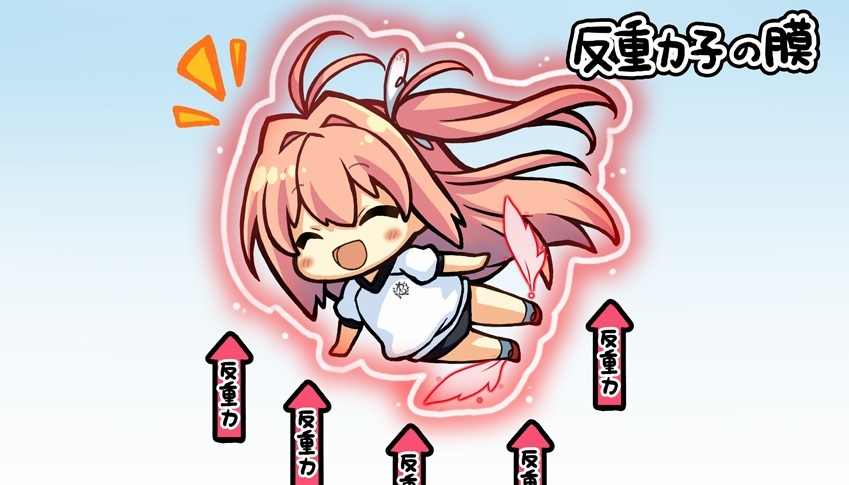
Shoes equipped with an anti-gravity generator, which generates an anti-gravity membrane called a membrane around the wearer to enable flight. There are two types: general use for daily life and competition use for FC. The main difference between the two is the sensitivity of the surrounding membrane, with the competition version being more sensitive. The competition version is more sensitive, and a light band (contrail) is formed after the flight, which is an element that enhances the FC game. There are many restrictions on their use in the private sector due to a combination of laws and regulations, but in Sindo City, the restrictions on their use are less restrictive, and they are said to be the most widespread in the country. The mechanism of movement is based on the partial thickness of the membrane around the body adjusted by the posture of the body, and the combination of the anti-gravitational force of the glash and the force due to the earth's gravity.
Flying Circus (FC)
basis
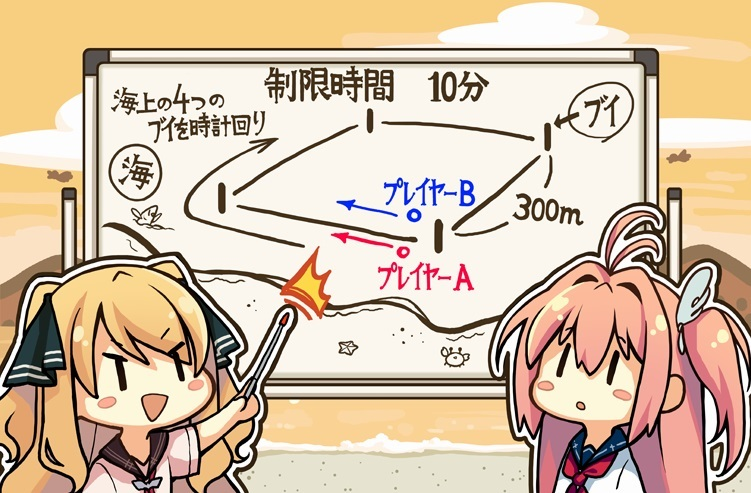
It is a one-on-one sport using a glash, and is played on a 300m square airspace field, and is a sky sport similar to beach flags or tag. Basically, two players start from the same position and fly clockwise around the airspace while touching buoys placed at the four corners of the airspace.
Field Name
A square with four buoys at the top and 300 m on each side. The starting position of the two competitors in a match is the first buoy, from which the second buoy, third buoy, and force buoy are named in a clockwise direction. Similarly, the distance from the first buoy to the second buoy is called the first line, and from there the names of the second, third, and force lines are given clockwise.
Scoring Method
There are two types of buoys
1. touch the buoys before the opponent.
Score points by going clockwise around the field and touching the buoys in sequence.
A player who determines that his opponent will touch a buoy can take a short cut to the section between the next buoy and the next buoy. However, the short-cut athlete must cross or make contact with the opponent once near the air in order to touch the next buoy and score a point.
2. touch the back of the opponent.
The short-cut skier can score points by touching the opponent's back when he or she is out of position and has slowed down. Immediately after the start of the game, the fighter has superior initial speed, so any contact, including touching, is considered a foul.
The fighter can score points in either of the two ways, and the side with the higher score than the opponent after the time limit wins the game.
time limit
At the end of 10 minutes, the side with the higher score wins. 5 minutes of overtime will be played if the score is still tied at 10 minutes. If the score is still unsettled, the game will go to sudden death, in which the first team to score a goal after that will win.
second
In FC, players often lose sight of their opponents as they move and exchange positions in the air so intensely. For this reason, players and coaches from the same school give instructions to players in the air from the ground via headset communication.
Seconding by players from other schools is allowed with the consent of the players.
playstyle
Because there are two types of scoring methods, there are a total of three styles of play for the players: two styles that specialize in scoring methods and a style that uses both styles. The glash used in the competition is also selected according to the style of play.

Contents
- Overview of "Ao no Kanata no Forhythm" (Forhythm Beyond the Blue)
- Synopsis and story of "Ao no Kanata no Forhythm" (Forhythm Beyond the Blue)
- common route
- Episode 1: Please teach me how to fly.
- Episode 2: Circus in the Sky
- Episode 3: Rivals
- Episode 4: I Want to Fight, Too
- Episode 5: Before the Storm
- Episode 6: The Decisive Battle, and
- Asuka Kurashina route
- Episode 7: Dream of Flying
- Last Episode: Beyond the Sky
- Tobisawa Misaki route
- Episode 7: I'm Quitting FC
- Last Episode: Feelings to Deliver
- Arisaka Mashiro route
- Episode 7: Small but Courageous
- Last Episode: Thanks, Senpai
- Rika Ichinose route
- Episode 7: The Honors Student Who Toughens Up
- Last story: Things that never change
- For Rhythm Beyond the Blue EXTRA1
- Game System of "Ao no Kanata no Forhythm
- Choice Adventure Games
- Love Adventure
- Features unique to this work
- Characters in "Ao no Kanata no Forhythm
- protagonist
- Masaya Hinata
- heroine
- Asuka Kurashina
- Misaki Tobisawa
- Mashiro Arisaka
- Rika Ichinose
- Kunahama Gakuin FC Club
- Aoi Kagami
- Shion Aoyagi
- Madoka Aoyagi
- Takato Gakuen Fukurushima Branch FC Club
- Kazunari Shindo
- Reiko Satoin
- Shijima Fisheries Academy FC Department
- Arika Okoze
- Mayu Ganeko
- Kairyo Gakuen FC Club
- Saki Inui
- Irina Avalon
- Dogaura Technical Academy FC Club
- Kasumi Kurobuchi
- Kamitsusha Academy FC Club
- Mystery masked players
- Other Characters
- Minori Hosaka
- Botan Arisaka
- Hayato Shirase
- Minamo Shirase
- Worldview and terminology of "Ao no Kanata no Forhythm
- Story Background
- antigravity device
- The Four Island Archipelago (Shitto Raito)
- Anti-Graviton Shoes (Grasch)
- Flying Circus (FC)
- basis
- Field Name
- Scoring Method
- time limit
- second
- playstyle
- speeder
- fighter
- all-rounder
- Basic technique to use the direction and trajectory of flight
- low yo-yo
- hi-yo-yo
- scissors
- Technique by membrane manipulation
- air kick turn
- cobra
- Angelic Halo
- Techniques classified as rough play
- Swissdar
- crab scissors
- Tactics using flight trajectories
- birdcage
- smoke
- Pentagram Force
- Theme song and insert song for "Ao no Kanata no Forhythm
- Ao no Kanoho no FOURISM (For Rhythm Beyond the Blue)
- Opening theme: Mami Kawada "Wings of Courage - Beyond the Sky
- Grand opening theme for PS Vita version: Mami Kawada "crossing way
- Insert song: KOTOKO "INFINITE SKY
- Insert song: Mami Kawada "Wing of Courage - Beyond the Sky - -piano style-" (Japanese only)
- Asuka Kurashina Ending theme: Asuka Kurashina "Sorakoi
- Misaki Tobisawa ending theme: Misaki Tobisawa "Sense of Life
- Arisaka Mahaku Ending theme: "Millions of You" by Arisaka Mahaku
- Rika Ichinose Ending theme: Rika Ichinose "NIGHT FLIGHT
- Grand ending theme: Mami Kawada "Sky is the limit
- Image song, PS Vita version Insert song: Mami Kawada "rays of the sun
- Forhythm Beyond the Blue -ETERNAL SKY
- Theme song: "Believe in the sky" by Mami Kawada
- For Rhythm Beyond the Blue EXTRA1
- Opening theme: KOTOKO "One Small Step
- Ending theme: Shinshiro Arisaka "Happy Tomorrow
- For Rhythm Beyond the Blue EXTRA2
- Opening theme: riya (eufonius) "one of a kind
- Forhythm Beyond the Blue -ZWEI
- Image song: KOTOKO "Way to fly~to the blue beyond
- TV anime version of Ao no Kanata no Forhythm
- Opening theme: Mami Kawada "Contrail - Trajectory" (episodes 2 - 12)
- Ending theme: Ray "a-gain" (episodes 2 - 11)
- Ending theme: Ray "Kimi to ita Sora" (Episode 12)
- Insert song: Mami Kawada, "Wings of Courage - Beyond the Sky" (Episode 12)