
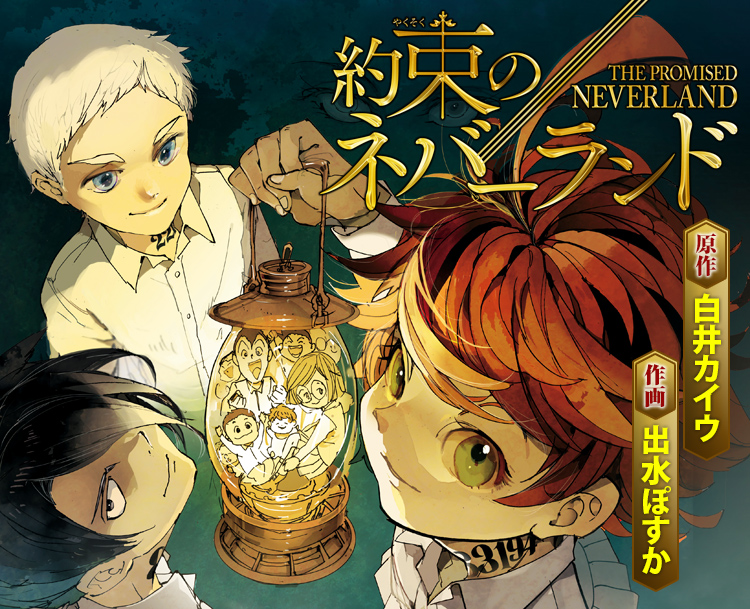
Yakusoku no Neverland" is a Japanese dark fantasy suspense manga written by Kaiu Shirai (original story) and illustrated by Posuka Demizu (artwork) that began serialization in Weekly Shonen Jump in August 2016, telling the story of Emma, the main character raised in an orphanage called GF House, and her friends who struggle to change their harsh destiny with their own hands. The story is about Emma and her friends who struggle to change their harsh destiny with their own hands. The series has gained popularity for its unique worldview and storyline, which includes elements of mystery, as well as for its depiction of the Jump theories of "friendship, hard work, and victory" from a different angle.

The luxury plantations are places where food crops are grown for aristocrats who value quality over quantity. There are four types of farms: Grace Field (GF), Glory Bell (GB), Grand Valley (GV), and Goodwill Ridge (GR).
Grace-Fieldhouse (GF)

Grace-Field House is one of the high-end farms that are called orphanages and raise food children for the aristocracy. There are five plants in total, and the third plant, where Emma and her family live, has around 37 edible children. The frequency of shipments is about one every two months at the earliest. A five-digit recognition number is placed around the necks of the edible children in the house. The age of maturity is 12 years old, after which they are unconditionally shipped out. The children at this plantation are educated as gifted children on a daily basis, and their brain development is remarkable. The edible children classified as "special" are special beings that even the royal ogres are not allowed to eat.
Glory-Bell (GB)

Glory-Belle is one of the most exclusive farms in the village disguised as a village. Edible children have a six-letter recognition number on their bellies that includes a number, which from left to right consists of three letters of the alphabet, a number, an alphabet, and a number. The age at maturity is 15 years old; like the edible children at GF House, many of the farm's children are quite highly capable.
Grand-Valley (GV)

Grande-Vallée is a plantation disguised as a school. Because it is a plantation under the control of Lord Bayon, the edible children raised there are sent alive to the GP's secret hunting grounds. The number of the edible child is written on the chest and consists of, from left to right, an alphabet, a Roman numeral, three digits, a hyphen, and three digits. Unlike Grace-Field, this farm, where the breeding supervisor is called a teacher, appears to be a large farm, with monthly shipments exceeding several dozen people. The age of maturity is at least 15 years old.
Goodwill-Ridge (GR)
Goodwill-Ridge is a farm disguised as a school; a significant amount of food children were sent from this farm to Λ7214.
breeding agency

It is believed that each house is a breeding facility for incoming infants. This was inferred from the fact that the infants sent to the houses were all at least one year old and had been implanted with transmitters in their ears.
mass-production farm

Mass-production farms are inexpensive mass-produced human farms. The human farms consist of hundreds of these mass-production farms. Unlike the edible children in the high-end farms, the edible children are simply kept alive and fattened up in a poor environment and lack advanced intelligence and physical strength. They have intravenous drips in their arms and breathing apparatuses in their mouths, and it is difficult to maintain their lives without them. The edible children on mass-production farms are not individually identified like those on high-end farms, and each farm has its own stamp on them.
Λ (lambda) 7214

Λ (lambda) 7214 is a test farm that was mentioned in the memory chip left by Minerva. It appears to be a new farm funded by Lord Bayon, with some edible children raised at Λ and others sent from high-end farms. Norman was made to undergo tests here that were more difficult than those at the GF House. Human experimentation was also conducted here, but the edible children were treated worse than things.
New mass-production farms
Unlike conventional mass production farms in the Λ7214 series, the new mass production farms are said to be capable of breeding edible children with high intelligence and physical ability.

Related Articles

Oni's summary of Neverland of Promise (about Neva)
The Yakusoku no Neverland" is a Japanese manga work written by Kaiu Shirai (original story) and illustrated by Posuka Demizu (artwork). Emma was having a good time at an orphanage with her mom and other orphans. One day, an orphan named Connie is sent to a foster home. Emma tries to deliver the doll that Connie left behind, but what she finds there is a dead Connie and an ogre. Emma discovers that the orphanage was a plantation for raising humans, the ogre's food. Emma and her friends escape in search of a safe place to live. A society is formed among the ogres, and various types of ogres appear.
Read Article

Summary of the Routley family in Neverland of Promise (about Neva)
The Yakusoku no Neverland" is a Japanese manga work written by Kaiu Shirai (original story) and illustrated by Posuka Demizu (artwork). Emma lives happily in an orphanage. One day, however, she discovers that they are not in an orphanage, but in a "farm" where humans are raised as food for ogres. Emma escapes from the plantation with her friends and sets out for the human world. The Rattley family is a family with the role of "gatekeeper" and "mediator" between ogres and humans.
Read Article

Summary of Gramma Mama Sister in Neverland of Promise (about Neva)
Isabella, who appeared in the popular manga "The Neverland of Promises" written by Kaiu Shirai and drawn by Posuka Demizu, was a kind "mother" of children and took care of them, but in reality she was a "breeding supervisor" who managed and shipped children, who were products of the "farm". In addition, there were "aides (sisters)" to support the "breeding supervisor," and Krone was engaged in assisting activities at Grace-Field House. The Mama Sisters consisted of all women, who were implanted with chips that electrified their hearts if they took even one step outside the House.
Read Article

Summary of farms in Neverland of Promise (approx. Neva)
The "farm" plays a very important role in the popular manga "The Neverland of Promises," written by Kaiu Shirai and drawn by Posuka Demizu. The farm is disguised as an orphanage, village, or school according to the policy of the headquarters, but in reality it is a system for supplying "human flesh" to demons who are no longer able to hunt humans due to the "promise" and for governing the demon society. In addition to the four "high-class farms," there are more than 100 "mass-production farms" and "test farms" where children with special abilities are raised through medication and human experimentation.
Read Article

Summary of the Five Settler Families of the Promised Neverland (about Neva)
The "Gosekke," the top of the aristocratic class, appeared in the popular manga "The Promised Neverland," written by Kaiu Shirai and drawn by Posuka Demizu. The five members, Lord Iverk, Lord Bayon, Lord Dossa, Lord Noum, and Lord Pupo, serve Queen Regulavalima, who is entrusted with the management and operation of the plantation. Among the five regal families, the Ewerk family in particular has held an important position in the reign for 1,000 years, and was given exceptional power among the five regal families. On the other hand, Sir Dotza, who is an upstart from a single vassal, has a bad reputation because of his arrogant attitude toward the other five regent families.
Read Article

Summary of Evil Blood in Neverland of Promise (about Neva)
Mujika, a demon girl who appeared in the hit manga "The Neverland of Promises" written by Kaiu Shirai and drawn by Posuka Demizu, is a survivor of the "Evil Blood Clan," which has the extremely rare property of "not losing human form and intelligence without eating humans. Because the effects of "evil blood" can be easily spread to others simply by drinking blood, the royal family and the Five Settler Families, who "rule their people by the amount of meat they supply," regarded her ability as dangerous, and the "evil blood clan" was destroyed. Mujika was saved by Sonju just before his execution, and since then he has been on the run from the royal family for the past 700 years.
Read Article

BEYBLADE X(ベイブレードエックス)のネタバレ解説・考察まとめ
『BEYBLADE X』は、2023年10月よりテレビ東京系列ほかにて放送されているテレビアニメ。ベイブレードを題材としたアニメで、第4世代にあたる。漫画版は『月刊コロコロコミック』にて2023年7月号から連載され、原作を河本ほむらと武野光、作画を出水ぽすかが担当している。キャッチコピーは「"X"(見えないもの)を見せてやる。」。Xシティにやってきた風見バードは黒須エクスと出会いチーム「ペルソナ」を結成する。七色マルチもチームに勧誘し、3人はXタワーの頂上を目指していく。
Read Article

Neverland: The Promise of Neverland is finally complete! How did it end? Summary of everyone's impressions and thoughts *spoiler alert
The Yakusoku no Neverland serialized in Weekly Shonen Jump is finally complete! It was made into an anime and a live-action movie, and became a topic of conversation. Here is a summary of everyone's impressions and thoughts about the ending of "The Promised Neverland". Spoiler warning!
Read Article
Contents
- Overview of "The Promised Neverland
- The story behind "The Promised Neverland"
- GF House Jailbreak (Episodes 1 - 37)
- Exploring Minerva (Episodes 38 - 64)
- Goldie Pond Edition (Episodes 65 - 95)
- The Seven Walls (Episodes 96 - 145)
- The Battle of King's Landing (Episodes 146 - 181)
- Characters in The Promised Neverland
- key people
- Emma.
- Norman.
- ray
- Grace-Field (GF) Edible Children Deserters
- polite suffix used after a person's name (often humble, derogatory or familiar)
- Gilda.
- Anna.
- nut (as in nut and bolt)
- Thomas.
- runion
- Dominic.
- Jemima
- lossy
- ibet
- Christy.
- Alicia.
- mark
- Grace-Field (GF) Edible Children Other Friends
- coney
- fill
- sherry
- Naira (former name for Beta Centauri)
- carol
- Leslie.
- Simon.
- Jackie.
- Helen.
- Cecil.
- Glory-Bell (GB) Edible Children Deserters
- yugoslavia
- Lucas.
- Nicholas
- John.
- Dyna.
- Edible children in Grand-Valley (GV)
- theo
- Monica.
- Jake.
- violet
- Oliver.
- Sandy.
- sack
- Nigel.
- Sonya.
- untalented person
- Gillian.
- poral (type of 'summer' fabric with large 'pores')
- Λ7214 series other edible children
- Adam.
- Barbara.
- cislo
- zazi
- Vincent.
- chayat
- gin
- eiche
- Intelligent Demon's Relation to Society
- Mam Isabella/Mom
- Sister Krone / Sister
- Granma Sara/Granma
- Related to the Rattley family
- William Minerva / James Rutley
- Peter Lartley.
- Andrew.
- Society of Intelligent Demons King
- reglavalima
- Society of Intelligent Demons Five Settler Families
- Ewerk.
- notium (Nm)
- dosa (Cervus nippon yesoensis)
- Bayon (current generation)
- papo
- Plantation officials
- Boss of GF farm
- mantis
- fat
- pursuit or chase demon
- Poachers in GP (Goldie Pond)
- Lord Bayon
- Grand Duke Leuwis
- luce
- NOUS
- llama (Lama glama)
- Other Oni
- Ano Kata / Oni no Apex (tentative)
- Oni no siblings (tentative)
- Believers in the primordial faith
- musica (esp. mountain musica, Musica domestica)
- ancient Korean kingdom (Paekche or Kudara)
- virck (esp. the Virgin Mary)
- Guilan family
- Lord Geelan.
- Terms for The Promised Neverland
- Oni related
- ogre
- stray demon
- intelligent demon
- Gupna
- Rituals (Tifari)
- primitive religion
- Evil Blood Girl
- Plantation Relations
- edible child
- breeding director
- head farmer
- assistant commissioner (UK, Aus. etc.)
- human plantation
- exclusive plantation
- Grace-Fieldhouse (GF)
- Glory-Bell (GB)
- Grand-Valley (GV)
- Goodwill-Ridge (GR)
- breeding agency
- mass-production farm
- Λ (lambda) 7214
- New mass-production farms
- item
- transmitter
- Tip.
- test
- pen
- Ugo Adventures
- geography
- shelter
- Goldie Pond (GP)
- the seven walls of Heian's palace
- Kvitidala.
- Other Terms
- Little Bernie.
- Famous quotes, lines/scenes and scenes from "The Promised Neverland".
- Connie: "When I leave the House, I'm going to be a mom like my mom."
- Ray: "Waiting outside is a society of demons. There's no place for humans to live, or worse, anywhere else."
- Norman: "I can still smile and pass away."
- Norman: "I won't let you die, and that's what I'm going to use me for."
- Ray: "Hey, Mom, why did you have me?"
- Norman: "If not here, you can still die. I'll show you something good, so shut up and come."
- Mam Isabella/Mam "Hopefully, there is light ahead."
- Emma: "How beautiful and caustic freedom can be."
- Emma: "If you don't have it, let's build it, outside, a place for humans to live, and change the world."
- Hugo: "Trust your judgment, Emma, and whatever the consequences of it, move on."
- Backstories, trivia, subplots/episodes, and anecdotes from "The Promised Neverland".
- law of numbering heads
- Ray is the child of GF House mom Isabella.
- Works that have been decided to be serialized from the submission of a story
- Theme song and insert song for "The Promised Neverland
- Television broadcast version 1st season
- OP (Opening): UVERworld "Touch off
- ED (Ending): Co shu Nie "Zettai Zettai
- ED (ending): Co shu Nie "Lamp" (episodes 9-11)
- live action film
- Theme song: I wish it was always midnight. I Can't Get It Right.
- TV broadcast version 2nd season
- OP (Opening): Akiyama Yellow "Identity
- ED (Ending): Myuk "Magic