
Cities: Skylines is a city-building simulation game developed by Colossal Order in Finland in 2015.
Players take on the role of the mayor of a new city and can build it to their liking.
Three years after its release, the game is still attracting attention with new DLC available for the PC version, and it was released on PlayStation 4 and Xbox ONE in April 2018 and on Nintendo Switch in September 2018.
Overview of Cities: Skylines
Cities: Skylines is a city-building simulation game for PC developed by Colossal Order in Finland in 2015.
It is marketed by Paradox Interactive and can be purchased from steam.
The consumer version of the game was released on PlayStation 4 (PS4) and Xbox ONE in April 2018 and on Nintendo Switch in September 2018.
On PS4 and Xbox ONE, the game is available in both packaged and downloadable versions, while the Switch version is only available as a downloadable version.
Also, only the PS4 version is sold by Spike Chunsoft.
The objective of the game is to become the mayor and grow the city.
At first, you can only build roads, waterways, power plants, utility poles, residential districts for residents, commercial districts for shopping, and industrial districts for making goods (in SimCity terms, industrial districts), but as the number of residents increases, public facilities such as police, fire stations, schools, and public transportation such as buses, subways, and railroads are unlocked. As the number of residents increases, public facilities such as police, fire, schools, and public transportation such as buses, subways, and railroads are unlocked, and you can build your own city to meet the needs of your residents.
There is no clear concept of completion in this game.
If we had to say so, we would say that the game is completed when there is no more room to build more cities, or when you have built a city that you are satisfied with.
Another interesting feature of the game is that each resident is assigned a final education, a house to live in, a place to work, and where he or she is headed.
This is not limited to people. Cars and other vehicles that come and go in the city also have destinations, and you can track where they are going, making it a fun way to leisurely watch people move about.
Differences between PC and CS versions
As of September 2018, Cities: Skyline has a PC version that can be purchased from steam and a consumer (CS) version for PS4, Xbox ONE, and Nintendo DS, the differences being the type of DLC and the ability to install player created mods and assets.
Mods are useful features that are not officially implemented and that you wish you had.
For example, they can automatically destroy buildings that have been abandoned for some reason, or allow you to walk around your own city from a first-person perspective.
In addition, the PC version of Cities: Skyline has been on the market for more than three years, but still does not officially support the Japanese language, and mods to convert various notations into Japanese are also a must.
However, mods are unofficial tools.
Introducing them may cause problems in the game or malfunctions when upgrading the game itself, so it is your own responsibility to install and manage them.
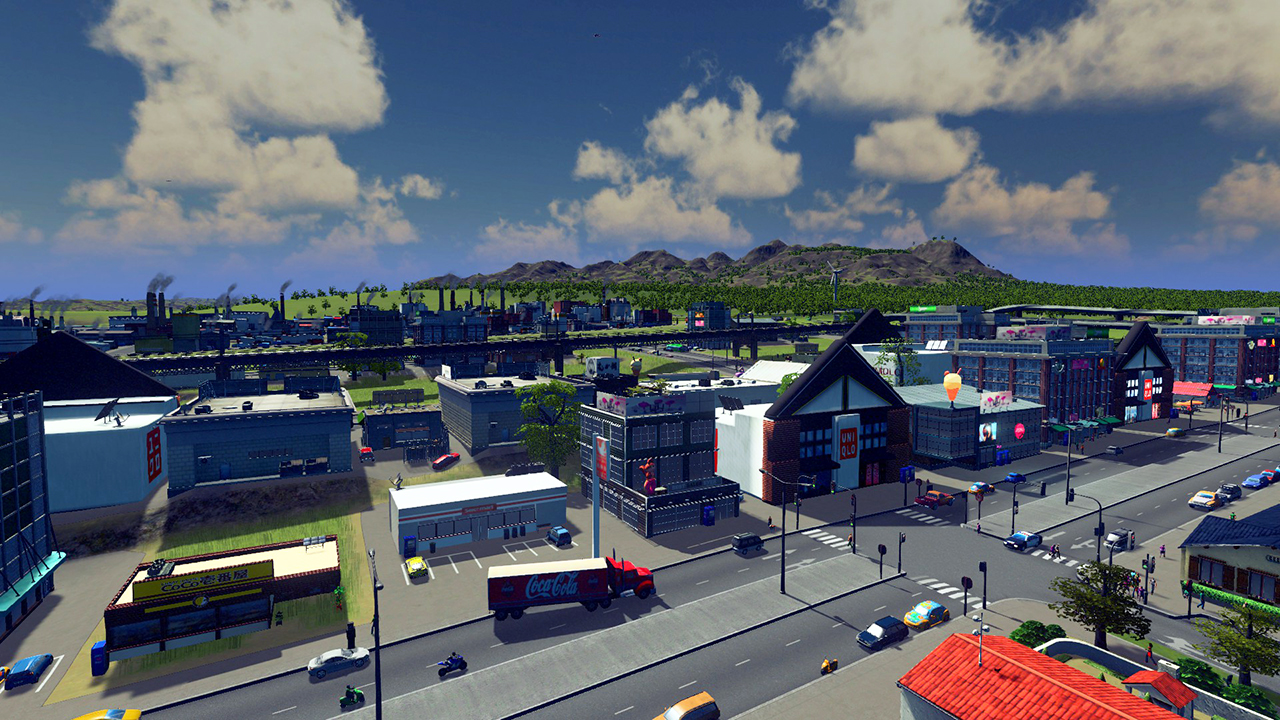
Assets are functions that allow you to add buildings and change their exteriors.
This allows the user to add Japanese-style houses, cars, and trains, as well as beef bowl chain restaurants and convenience stores in the commercial district.
Only the Xbox ONE version of the CS version can install assets at this time.
However, you can't download the PC version as is, but rather, you can put in assets made for the Xbox ONE, and there is a limit to the amount of space available.
PS4 and Nintendo Switch versions cannot install either.
Should I buy the PC version or the CS version?
If you have a computer with specs that allow you to play Cities: Skyline, we recommend the PC version, which allows you to install mods and assets.
The officially listed specs are as follows
■Minimum System Requirements
CPU : Intel Core 2 Duo, 3.0GHz or AMD Athlon 64 X2 6400+, 3.2GHz
Memory : 4GB
Graphics card : GeForce GTX 260, 512 MB or Radeon HD 5670, 512 MB
Hard disk space : 4 GB or more
Recommended System Requirements
CPU : Intel Core i5-3470, 3.20GHz or AMD FX-6300, 3.5Ghz
Memory : 6GB
Graphics card : nVIDIA GeForce GTX 660, 2 GB or AMD Radeon HD 7870, 2 GB
Hard disk space : 4 GB or more
Although these specifications do not seem to be very high, in reality, even with the recommended system requirements, the game becomes heavier and heavier as the city progresses, and it is no longer possible to play it comfortably.
In addition, adding mods and assets will make the game even slower, so it is recommended to use a gaming PC, a home-built PC, or a BTO PC instead of a PC sold at electronics retailers that is not equipped with a graphics board.
DLC Type
Currently, Cities: Skyline offers six different DLCs for the PC version and five for the CS version.
After Dark
DLC that must be bought separately on PC, but is adapted from the beginning on PS4, Xbox ONE and Switch.
It features the ability to turn a commercial district into a city dedicated to leisure and tourism.
Facilities that can be created include prisons, cabs, port hubs, bike lanes, and bus terminals.
Snow Fall
As you can imagine from the title, this DLC is winter themed.
It is sold separately on PS4 and Xbox ONE, but is included from the start on Switch.
The snowy map that is added with the purchase of this DLC allows the player to make the city snow, the roads freeze unless you drive a snowplow, the heating system can be reinforced by running hot water through the water pipes, and a sauna is added to the medical section, perhaps because the company that makes this game is Scandinavian.
Another highlight of the game is the ski slopes, curling plazas, and cross-country parks that can only be set up on the winter map.
Streetcars (streetcars) will be added as a mode of transportation, so those who want to build a city with streetcars are required to use them.
Natural Disasters
DLC that will allow natural disasters such as earthquakes, tsunamis, and hurricanes to occur.
It is offered on PC, PS4, and Xbox ONE, except Switch.
Although it is possible to turn the occurrence of disasters on and off in the settings, many people do not install it because they do not want to see the city they have built destroyed.
Additional facilities include a disaster headquarters, reconstruction facilities, and shelters, but these are not necessary if a disaster does not occur in the first place, so they may not contribute much to city planning.
Facilities that use helicopters for firefighting, police, and transporting sick people can be built, so those who want to see them may introduce them.
Mass Transit
If asked to introduce just one DLC, I would definitely choose this one, the DLC that adds public transportation.
It is offered on all but the Switch, PC, PS4, and Xbox ONE.
Mass Transit adds cable cars, ferries, monorails, and airships to the public transportation that was previously limited to buses, trains, and subways.
In addition, the addition of combined stations such as bus and monorail, train and subway, and train stations with multiple platforms will surely increase the range of city planning.
Green Cities
As of September 2018, the DLC is available only on PC.
It allows the creation of nature-friendly buildings such as recycling centers, self-sufficient housing, and commercial areas.
It also features the ability to create IT-focused districts.

Contents
- Overview of Cities: Skylines
- Differences between PC and CS versions
- Should I buy the PC version or the CS version?
- DLC Type
- After Dark
- Snow Fall
- Natural Disasters
- Mass Transit
- Green Cities
- Parklife
- Content Creator Pack
- Game System of "Cities: Skylines
- mission mode
- Items from Cities: Skylines
- Buildings and facilities that can be created in the development of the city and their conditions.
- Small village
- A fine village
- Tiny Town
- Fast-growing city
- Busy City
- Big City
- small city
- large city
- Magnificent City
- major city
- megacity
- metropolis
- megalopolis
- Backstories, trivia, subplots/episodes, and anecdotes from "Cities: Skylines".
- When funds are insufficient, "leave it alone."
- Extra income at soccer stadiums
- Inevitable mass deaths of residents
- Multi-level crossing and underground