
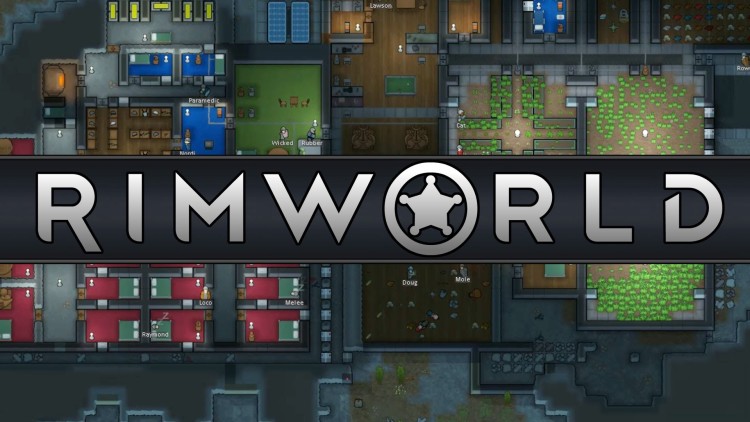
Rimworld" is a sandbox science fiction colony sim game by Ludeon Studios, an independent Canadian game developer. Each colonist has his or her own skills and stats, and the player directs construction, cultivation, medicine, research, and combat to develop the colony while improving food, clothing, and shelter. The game's objective is to eventually build a rocket and escape the planet, but there is no compulsion to do so, and the game allows the player to operate the colony on a permanent basis.
RimWorld settlers have a parameter called "sentiments".
Thoughts arise in the mind in relation to desires such as "eating" and "sleeping," or in response to changes in the surrounding environment.
The "feelings" gauge goes up and down depending on the thoughts, such as "I ate something delicious," "I was insulted by another settler," "My room is dirty," "I had a good time through entertainment," and so on.
Depending on the talent or personality of the settler, there may be a bonus or reduced value effect on the "Thoughts" value.
The ease or difficulty of generating thoughts also depends on the talent and personality, for example, a settler with a "pessimist" personality has difficulty generating thoughts that are positive to the sentiment.
If the "emotional" parameter falls below a certain value, a "mental breakdown" occurs and the settler goes insane.
The colonists who go insane engage in various delinquent behaviors, such as destroying things, wandering around the colony with their clothes undone, eating and drinking heavily, and staying in their rooms and not coming out.
In serious cases, the behavior can be fatal, such as killing other colonists, so players must be attentive to the colonists' emotional state on a regular basis.
trade (foreign)
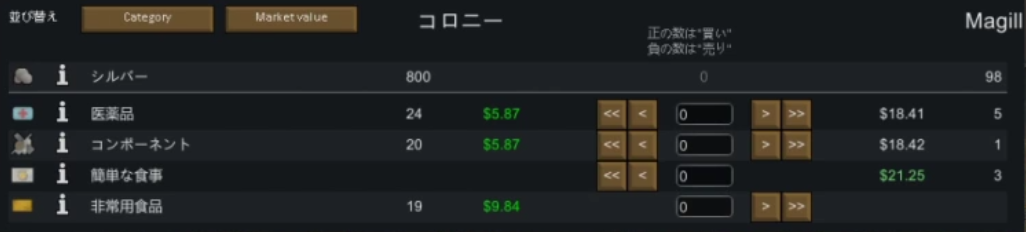
Trade allows for the buying and selling of items.
Caravans from other settlements visit the colony irregularly and stay for a while.
Most caravans will appear on the map with a few armed NPCs and their goods for trade in cattle, such as muffalos.
Each caravan has a representative, and goods can be bought and sold by right-clicking on the caravan representative to bring up the trade menu.
Bartering is basically done using silver as the currency, and silver is used to make up for any overages or shortages in the goods being purchased or sold.
For example, when selling an item with a value of 100 and buying an item with a value of 50, the transaction is made by exchanging an item with a value of 100 for an item with a value of 50 + 50 silver.
The number of items that can be bought and sold is not unlimited, and the caravan cannot trade more than the amount of items they own plus silver.
In addition to waiting for the caravan to visit irregularly, you can call a caravan from a nearby colony by setting up a communication device and paying some silver.
In addition to caravan visits to the colony, you can also trade with trading ships that fly around the universe. When a trading ship passes near a planet, a system notification is generated, and the two parties can trade goods with each other.
Starting with the A16 version, it is also possible to form a caravan to visit other settlements. In addition to trading with other settlements, it is also possible to raid and destroy them.
The caravan is formed by selecting settlers to be organized into a caravan and setting food and trade goods for the settlers along the way, and then specifying another settlement to travel to that point.
When the caravan arrives at its destination, a trade screen will appear, just as in the normal trading process, and the caravan can be settled in that settlement.
Settlers who settle in other settlements will rarely appear in caravans from those settlements.
Caravans can be organized into multiple units, which can be split up or joined together.
About the Colony
architect
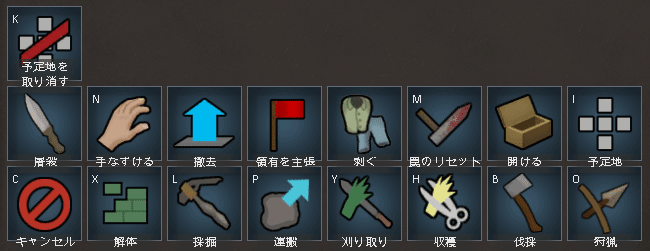
The Architect is a menu that allows the settlers to issue commands regarding the colony.
Various commands are available, such as building facilities, transporting supplies, mining ore, etc. By directing these commands, the colonists perform their work.
Each colonist can be assigned a priority for each task, and the colonist will perform the indicated tasks in a priority order of 1→2→3→4.
Assigning work priorities according to the individuality of the colonists is the key to better colony management.
a building
As long as it is on the ground, players are free to construct buildings as they wish.
Walls and doors can be constructed with the Architect's "Build" option, and colonists will perceive the space enclosed by walls, including doors, as a room.
The space perceived as a room is roofed and becomes like a house or a hut.
The player can specify the building material, such as wood or stone made from rock.
Different materials have different durability and are flammable or non-flammable. Basically, walls made of stone are sturdier and less flammable than walls made of wood.
In addition to walls and doors, building materials can also be specified for equipment.
Here, too, the differences in materials are the same as for walls and doors, with stone workbenches being sturdier and less flammable than wooden workbenches.
The differences in sturdiness and flammability affect when the workbench is subject to destruction by marauders or deranged settlers; there is not much difference in the speed of work or the quality of the finished product.
electric power
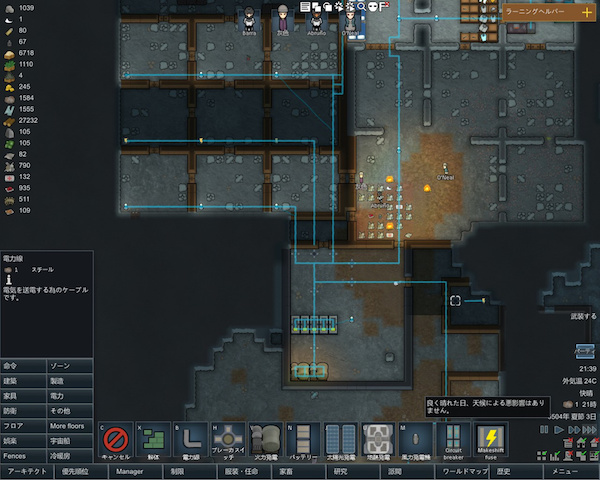
The research described below will enable the construction of generators using iron as the material when electronics technology is unlocked.
Electricity has become essential for advanced production facilities and heating and cooling operations.
In order to use electricity, it is necessary to first build some kind of power generation facility and then connect the power lines to it and to each facility.
There are several types of power generation facilities, including thermal power and wind power, each of which generates different amounts of electricity; geothermal generators generate the largest amount of electricity when no MOD is used.
If the power consumption by the connected facilities exceeds the amount of electricity generated, there will be a shortage of power and some equipment will stop functioning.
By installing batteries, excess power can be accumulated and stored.
zone
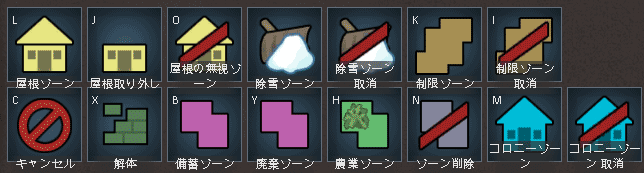
Zones are used to set up a built space as an appropriate location.
A particular space can be used as a stockpile, a field, or roofed or unroofed, for example, by setting up zones.
Select "Zones" from the "Architect" menu, then drag and drop the area into the zone.
The space set aside for a stockpile zone becomes a warehouse for storing supplies, and settlers will transport supplies to the stockpile zone.
Zones can be used in different ways, such as "a larder to store only food" or "a warehouse to store only building materials," as it is possible to set in detail what (items such as meat, vegetables, ores or materials) will be stored in that zone.
Roof zones can be set up so that settlers can put a roof over their heads.
A roof will keep out the rain, and the settlers will not have negative feelings such as "working outdoors" because they are considered to be indoors.
Conversely, the roof can be removed by setting up a "roof removal zone.
Other zones can be set up to restrict the movement of colonists and their pets, such as a grazing zone that directs that "animals kept in the colony are only allowed in this area," or a restricted zone that "colonists are only allowed in this area" (outside the zone area is off-limits).
item
Items range from food to raw materials to processed goods.
These can be modified to add or remove additional elements, and are the most customizable part of the game.
Therefore, the variety of items varies from player to player.
Items have HP and quality, and if the HP reaches 0, the item is considered a total loss and will be lost.
The quality of the item is related to the ease of HP loss and the size of the effect that the item has.
foodstuff
General food items of the settlers, including ingredients for cooking, animal feed, pet food, and snacks.
Food items are divided into raw ingredients and cooked items. Raw ingredients become cooked food when they are prepared on the cooker.
Raw ingredients are categorized into three categories: raw meat, raw vegetables, and raw eggs. The raw meat category is divided by animal, such as "hare meat," "squirrel meat," and so on. The same goes for the raw vegetable category, which includes various types of vegetables such as potatoes and corn. Raw eggs can be either fertilized or unfertilized, and if they are fertilized, a baby is born over time.
Raw vegetables can be eaten as is, but there is a risk of coming down with food poisoning.
Therefore, it is necessary to cook them into ready-to-eat foods at the kitchen table.
Foods classified as prepared foods can be prepared as "simple meals," "elaborate meals," or "luxurious meals" depending on the type of ingredients used, the latter being more nutritious and more likely to satisfy the colonists.
These prepared foods will spoil and be lost in three days if not refrigerated, but "pemmican," a preserved food that can be stored for a long time, can be kept for more than three days.
raw materials
Items classified as raw materials are materials for various processed products and construction materials.
They include plant materials such as "heal root" and "psychoid leaves," which are used to make medicinal herbs and drugs; building materials such as "granite," "marble," and "sandstone" stone and wood; metal materials such as "iron," "uranium," and "silver;" and fur such as "hare skin" and "alpaca fur.
Even within the same subcategory, there are detailed differences depending on the material. For example, although they are in the same fur category, hare skin and alpaca fur differ in terms of heat retention and durability when processed into clothing.
Items classified as raw materials also include items that have not yet been processed.
Granite blocks," which are processed into building materials, are also classified as raw materials.
processed goods
Items created from raw materials.
Clothing made from fur, medicines and drugs made from plant materials, weapons made from metal materials, and furniture made from building materials are included in the category of processed goods.
Even within the same item, there are detailed distinctions based on the material from which it was made.
For example, the same "coat" may be made of hare skin or alpaca hair, depending on its warmth and durability.
The quality of the finished product is determined by its quality, and the effect of the finished product depends on the quality of the finished product.
For example, a good quality alpaca coat will be warm and durable, while a poor quality coat will not retain its warmth and is easily damaged.
Artificial limbs, artificial organs, and "artifacts," which are spiritual weapons that existed in super-ancient times, are also in the processed goods category, although not necessarily in terms of quality.

Contents
- Overview of "RimWorld
- Game Objectives
- The world view of "RimWorld
- Game System of "RimWorld
- biome
- story teller
- settler
- skill
- Talents & Personality
- health
- sentiment system
- trade (foreign)
- About the Colony
- architect
- a building
- electric power
- zone
- item
- foodstuff
- raw materials
- processed goods
- body
- battle
- research
- Backstories, Trivia, and Small Stories/Episodes/Anecdotes from "RimWorld".
- I can also do the act of eating people.
- static character
- Abundant mods