
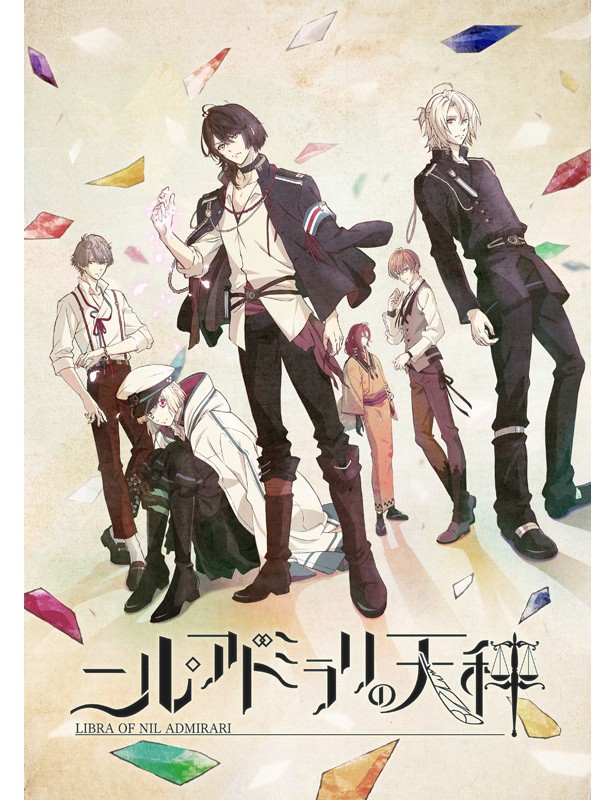
The Scales of Niru Admirari" is an anime based on the romance adventure game for women "The Scales of Niru Admirari: The Imperial Capital Fantasy Kitan". The story follows the heroine, Tsugumi Kuze, as she confronts the mystery surrounding a book that causes death in the Imperial Capital in 1925.
sailor suit
From around 1921, it became popular nationwide as a uniform for schoolgirls.
ballad
The year of publication of the songs in the work is as follows
The Doll with the Blue Eyes, 1921 (3 episodes)
The Goldfish's Nap" 1919 (Episode 5)
The Gondola Song" 1915 (8 episodes)
your (female) world
A magazine for young unmarried women, "Reijo-kai", to which Tsugumi subscribed, and which is believed to be a model for the magazine.
Historically, it was published from 1922 to 1950. It was rich in a critical spirit, and included love stories and a nude consultation section, which some girls' schools had banned for fear of disturbing public morals. It is thought that the magazine was open-minded in its production.
marriageable age
Tsugumi's schoolmates had wives from birth, and in some cases, they were married immediately after graduation from girls' school.
In the late Meiji period, girls' schools usually lasted four or five years, from the age of 12 to 15 or 16 (17 upon graduation).
According to the King James Constitution, women could marry at the age of 15. In the Meiji era, the legal age for marriage was around 17 to 19 (15 to 18 years old). It was not uncommon for women to drop out of school and get married if a match was arranged while they were still in school at the Hakei Jogakko (Gakushuin Women's School). (See "The Ladies of the Meiji Era," Kuroiwa Hisako)
noble system
Since the revision of the nobility ordinance in 1907 (Meiji 40), those who were considered nobility were those who had a family governor and those who were on the same family register; even if born into a noble family, those who were divided by marriage with a commoner were treated as commoners. The nobility had various preferential treatment and ways to escape from claims.
Tokyo Traffic Conditions
The first subway in Asia opened between Asakusa and Ueno in 1927. The Ginza Line between Asakusa and Shimbashi was fully completed in 1934.
Tokyo's streetcars covered the entire city center, starting with the Shinagawa-Shinbashi service in 1903, and the golden age of streetcars lasted until the Great Kanto Earthquake. After the earthquake, bus and rail transportation networks developed.
assassination
The disarmament policy put in place by the Ukai administration is what Army Lieutenant General Owashi complains about every time he appears on the show. And the following two terrorist attacks are associated with the assassination by crows.
The May 15 Incident is outlined as the murder of Prime Minister Tsuyoshi Inukai by a group of military officers, mainly naval officers, in 1932. The incident occurred during the administration of Inukai's predecessor, Reijiro Wakatsuki, when there was a split within the Navy over the ratification of the London Conference on Naval Disarmament.
The Blood League Incident occurred a few months before the May 15 Incident. It was a plot by the extreme right, including military personnel, to assassinate politicians and businessmen, and two people lost their lives. The murdered man, Junnosuke Inoue, was a former minister of finance, and the Navy had a grudge against him because of budget cuts. The naval officers in the execution group had asked for cooperation from army supporters and had been turned down.
cinema
The division of seats for men and women in movie theaters was determined by regulations. In Tokyo, the regulation was enforced in 1917 and abolished in 1931, but the distinction in seating was still observed in the late 1940s. In 1923, the Tokyo Metropolitan Police Department issued a regulation stating, "In activity photo studios, there shall be a distinction between men's and women's seats, and seats for those who are accompanied by a male or female photographer. The police considered photo booths to be the same thing as prostitution.
Theme song and insert song for "The Balance of Nir Admirari
OP (Opening): kradness "Indulgence Miraajuisme
ED (Ending): Hiro Shimono "Black Thunder

Contents
- Overview of "The Balance of Nil Admirari
- Synopsis and story of The Balance of Nil Admirari
- Encounters with Rare Objects and Owls
- Kagutsuchi and Crow
- The Secret of Jade
- betrayal
- truth of the case
- Characters in The Balance of Nil Admirari
- Owl (Imperial Library and Information Assets Management Agency)
- Tsugumi Kuze
- Hayato Ozaki
- Akira Kogami
- Hoshikawa Jade
- Shiori Tokimiya
- Motofumi Mashiko
- Yutaka Nabari
- Shizuru Migiwa
- Shogo Ukai
- Arata Kijitani
- Owl collaborators
- pile nagi (species of nagi, Nageia nagi)
- peri
- Tarou Tsubame
- Takuma Yoshikiri
- Koruri Masaki
- Tsugumi's relations
- Kuse Hitaki
- Keizaburo Ouchi
- Progressive Sagisawa
- Nahatigarh officials
- Takashi Shiginuma
- Shoko Shiginuma
- Shiro Mozuyama
- Toichiro Sasagoi
- Hideki Owase
- Terms in The Balance of Nil Admirari
- rare item (esp. food)
- aura
- Imperial Library Information Assets Management Bureau
- owl (esp. the Ural owl, Strix uralensis)
- crow
- Kagutsuchi
- Famous quotes, lines, scenes, and scenes from The Balance of Nil Admirari
- Thrush: "I have to walk."
- Backstories, trivia, and small stories/episodes/anecdotes about "The Balance of Nil Admirari".
- direction
- title call
- aban
- Names of characters
- preview of next installment (TV shows, podcasts, etc.)
- 1925 and historical facts
- The Teito Earthquake and the Great Kanto Earthquake
- erotic and grotesque nonsense
- sailor suit
- ballad
- your (female) world
- marriageable age
- noble system
- Tokyo Traffic Conditions
- assassination
- cinema
- Theme song and insert song for "The Balance of Nir Admirari
- OP (Opening): kradness "Indulgence Miraajuisme
- ED (Ending): Hiro Shimono "Black Thunder