
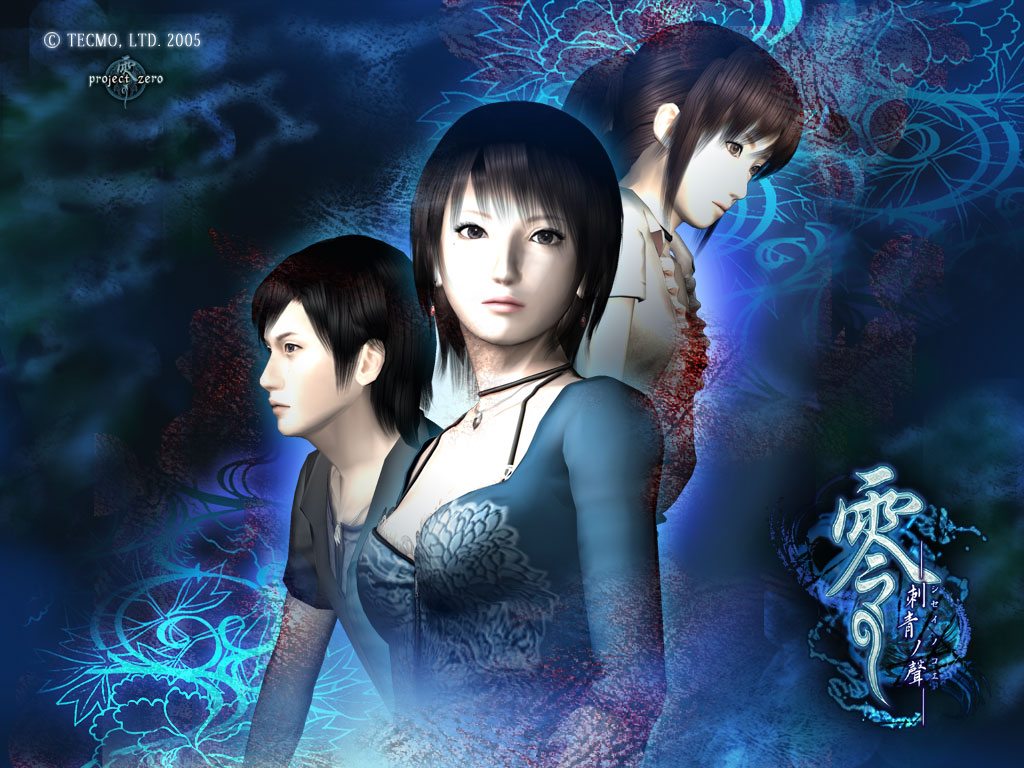
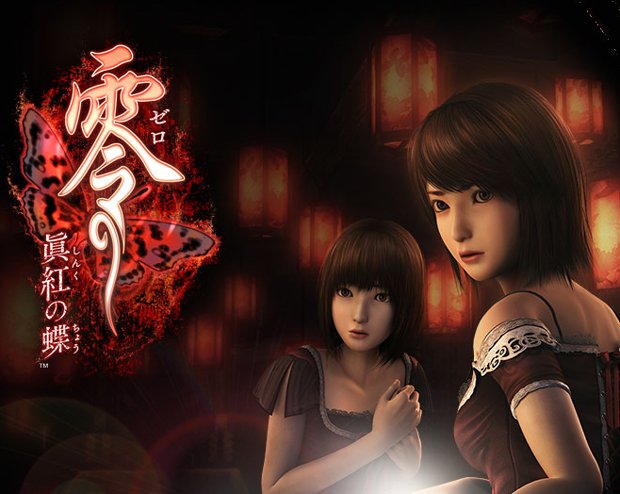
Zero: Shisei no Shouhou" is the third title in the "Zero" series, a Japanese horror game released by Tecmo in 2005 for the PlayStation 2.
In this game, the player must use a "projector," a camera with spirit-removal capabilities, to solve the mystery of a curse that gradually prevents the player from waking up from sleep, while traveling between the real world and a haunted house in a dream.
The main characters from the first and second films in the series also make appearances in the film, and the film is a highlight of the film as we learn what happened to them afterwards.
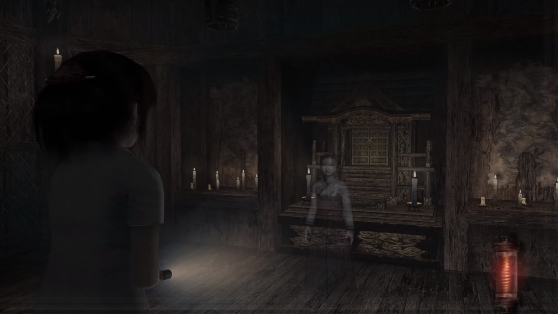
The next night, Rei was in Fukaben's dream.
She was guided by the spirit of a child that her brother had told her was in the mansion, where she discovered a diary left by a child priestess.
According to the diary, the children dressed in miko costumes were called shinjo, girls who were supposed to calm down the miko who performed the ritual to seal the chasm, and also took care of the miko's personal needs. One of the Shizune, "Ame", learns that her brother "Kaname Otsutsuki" is in love with the tattooed miko "Reika", and in order to see Reika before she is locked up in the palace for performing the ritual, she lets Kaname sneak deep into the palace, which is forbidden for boys.
He then sneaks Kaname and Ame into the back of the palace, which is forbidden to boys, and both Ame and Kaname are killed for violating the law.
Deep Red learns of this past event from his diary.
When Rei wakes up from her dream, she receives a document from Fukabeni about the lullaby that Fukabeni and Rei heard in the dream. The lullaby is called "Nemuri Miko (Sleeping Miko)," and the title "Miko" suggests that it is a kind of lullaby called "Odoji Uta," which may have originated from an indigenous folk religious ritual.
Hachinokoku "Kyoumu - Utsuroyume" (The False Dream)
The next night, Rei dreams of Hotaru chasing after his niece Mio.
He wanders around the house of sleep in search of the key to the house of sleep in order to join Mio, who has locked herself in the tatami room. Although it was a house of sleep, it was a space that reproduced a village called Minakami Village, which had disappeared from the map, where Mio had once wandered with her sister Mayu ("Zero - Red Butterfly"). Hotaru is guided by a red butterfly that she has seen somewhere in the house, and finally finds the key to the cell and returns, but Mio is no longer there.
Hotaru thought that there was a space in the back of the cell, and as he proceeded, he learned about the "Red Sacrifice Festival" that Mio had experienced, a ritual in Minakami Village in which twin sisters were sacrificed, and the reason for Mayu's disappearance.
Mio went behind a door that was tightly closed, and a spirit appeared that was too strong to be sealed by the projector, so Hotaru turned back to look for another way.
When Rei woke up from Hotaru's dream, she found a telephone ringing in her house. The caller was Hotaru, who was still investigating about the house of sleep. Hotaru, who did not know about Yuame's death, promises to meet with Rei, partly because she wants to say goodbye to Yuame.
That night, Rei hears from Fukaben about the results of his investigation into the tattoos on the bodies of himself, Takigawa, and the tattooed woman.
It is said that there is a folk tale about a girl who carved a tattoo of holly on her body to remember the pain of losing her lover, and a tattoo of a snake, a messenger of God, to deliver her lover's soul to God. The tattoo on the tattooed woman was the same holly and snake as in the folklore, suggesting the relationship between the woman and the folklore.
Ninth Hour "Breaking - Hagai
Rei's dream resumes when she tries to enter the door through which Yuu entered. After breaking the seal on the door, Rei finally steps beyond the door. There was a huge courtyard with a shrine leading to the innermost part of the house of sleep.
However, Rei wakes up in the middle of proceeding to the end of the courtyard.
Ten-minute "Sashikon-no-gi - Shikon-no-gi
Rei was in Hotaru's dream.
In order to chase after Mio, who had disappeared behind a hard-closed door, Hotaru finds another way. Then, he opens the door leading to the innermost part of the house of sleep, which Rei had just unsealed. The courtyard where the shrine was built is filled with miasma, and Hotaru uses the "exorcism light," which dispels the miasma, to proceed. However, he was unable to enter the shrine itself, so he jumped from the top floor of the book storehouse next to it and entered the shrine by jumping across the roof.
Hotaru discovers a document inside the shrine that reveals some of the details of the rituals that were performed there. It is said that strong feelings for the dead are connected through dreams, and can destroy the Everlasting Sea (a place believed to be connected to the afterlife). The ritual was called "Sashitama-no-gi" (ritual of the soul).
Eleventh Hour "The Road to the End - Tsuinomichi
The next night, Rei was in Fukaben's dream.
In the hanging prison where the tattooed priestess had been held before her death, she found a mirror that was the key to go deeper into the shrine, and went to the deepest part of the shrine. At the back of the shrine, there is a huge cave that leads underground, and Fukahong descends to the lowest level, but Rei wakes up there.
Upon awakening, Rei is worried about Fukabeni and visits her in her room. She confesses to him about her brother and how she had always regretted having left him behind and saved him. Rei encourages her that she is not alone.
Rei goes to sleep and dreams about Fukahaku again.
Although she had almost reached the deepest part of the house of sleep, the next place where she was was the Himuro mansion where she had once left her brother. She followed her brother who appeared in front of her and went deeper into the Himuro mansion, but on the way, she remembered Rei's encouragement and turned back on the road. However, in the process, she was caught by a tattooed priestess.
When Rei wakes up and goes to check on her, she finds that most of her body is covered with tattoos and she has been unable to wake up from sleep.
Meanwhile, Hotaru, whom Rei had promised to meet, comes to her house. Rei has lost her hope for life as she is about to lose even Crimson, who had been her emotional support since Yuu's death. Hotaru tells Rei that there may be hope for her and the results of the research she has been doing.
What Hotaru brought was the "Kai-no-gi no Shoin" and the data on the original song of the lullaby "Nemuri Miko". Based on these documents, Hotaru predicted that the curse could be lifted by performing a ritual called "Kai-no-gi," in which a stake called "shin-aoki" is driven into the miko's limbs to pacify her. Hotaru then said that she would try to find Sashi-Aoki that night and puncture the miko, who was supposed to be deep inside the shrine, with the stake.
Rei also hears from Hotaru that Yuame must have a tape recording of the sleeping miko, which he gives to Hotaru who says she will look for it in Yuame's room for reference.
Twelve Nocturnes "Kai-no-gi - Kainogi
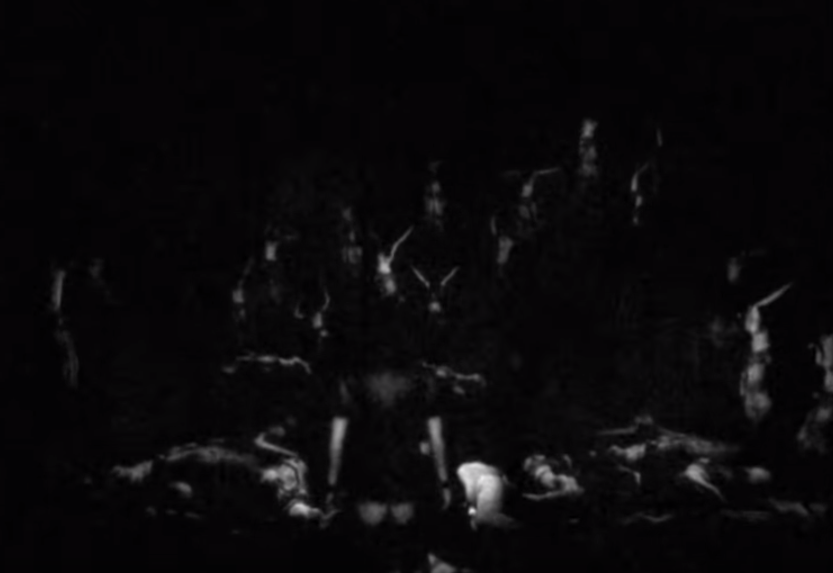
As Hotaru told Rei before going to sleep, he tries to perform the "Kai-no-gi," a ceremony to pacify a miko by piercing her limbs with a stabbing tree.
After wandering around the house of sleep, Hotaru finds the four stabbing rods and goes down to the basement of the shrine to reach the "thorn prison," the ritual site of the "Kai-no-ki" ceremony. The place is filled with many tattooed priestesses who have performed the ritual, and the strong miasma causes Hotaru's body to become immobile. Then, Hotaru finds that the body of Reika, whom he was about to perform the ritual, has already been pierced by the tattooed tree.
Hotaru realizes that he was wrong and tries to escape in a panic, but he is trapped in the ritual hall, where Rei wakes up.
When Rei wakes up and goes to check on Hotaru, she finds that Hotaru has disappeared as a black stain.
In Hotaru's bag, which was left behind, was a notebook, in which Hotaru had written her ideas on how to appease the miko other than piercing the stabbing tree.
The tape that Rei had given to Hotaru the day before contained the third verse of the Sleeping Miko, which, unlike the oshidori songs up to the second verse, was interpreted to have the meaning of mourning for the sending off of the miko. And some of the documents related to the house of sleep depicted a space like the sea, and Hotaru expected that the miko would be "sent out" there, as in the third verse of the Sleeping Miko.
There was also another tape in Hotaru's bag, which contained the last tattooed miko, Kaname Otozuki, who was the love of Reika's life. On the tape, Kaname was recorded talking about how he had seen Leika at the back of the house of sleep in his dreams, and about the tradition that there was a place where he could meet the dead in the area where he grew up. He then told her that she would be tattooed and eventually killed. He then told her that she had to go to the shrine and meet with her.
After listening to the tape, the reishi (spirit stone) radio found in the ceiling of Yuu's room starts to react. Rei picks up the reishi radio and searches for the place where it reacts, and finds a Hibikiishi earring that belonged to Kaname in his house. At the same time, from the journal of a researcher of the "other world" that was kept with it, he learns that there is a huge pit at the back of the company and that there is an underground water vein at the bottom that looks like an ocean.
13th no koku "Shisei no koe" (The voice of a tattoo - Shisei no koe)
Rei, like Hotaru, heads for the deepest part of the house of sleep in order to practice the method of channeling the miko into the water vein at the back of the shrine, which was discovered by the notebook and other documents left by Hotaru. Rei searches the house for the piece of "Toki no Kagami" (mirror of time), which is the key to the depths of the shrine, and proceeds onward to break the curse placed on her, even though she intuitively feels that she cannot go back there.
End of time "Ganenohuchi - Hate-no-Fuchi
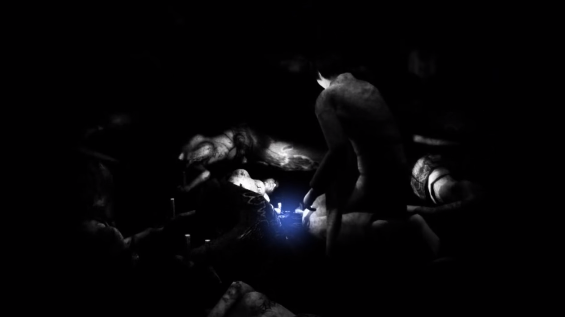
Rei finally arrives at the room "Thorn Hell" where "Kai-no-gi", a ceremony in which tattooed priestesses are pierced through their limbs, was held. Then, Rei has a vision of what happened to the last tattooed priestess, Reika.
Kaname Otozuki, who had been in love with Reika, is guided by his sister Ameon to reunite with Reika, who has already been prevented from leaving the Thorny Hell by the ritual. Although she had always wanted to meet Kaname, she had kept her feelings for him bottled up in her heart to ensure the success of the ritual. That is why she was so happy to see Kaname in front of her.
However, when the head of the Kuze family learns that Kaname has entered a place where boys are forbidden, he becomes angry and kills him in front of her eyes. The murder of her beloved in front of her eyes causes Reika to feel a strong sense of sadness, and she causes a "breaking of the commandment" that spreads the miasma, a miasma that emanates from the other world.
Rei, who has finished her vision, rises as a vengeful spirit and attacks Rei, who has entered the prison of thorns.
Having eliminated the spirit of Reika's grudge, Rei proceeded to a space further inside the prison of thorns. There exists an underground water vein that is really like an ocean, and Rei sings the third verse of Sleeping Miko while sending a boat carrying the corpses of Kaname and Reika, who had been trapped in the thorn prison for a long time, out to the sea.
Then, the far shore of the sea begins to glow, and a large number of spirits trapped in the mansion begin to head toward the far shore. It was because Rei succeeded in the ritual hidden in the song of the Sleeping Miko and was able to cure the "breaking" that occurred in the house of sleep. Rei spots Yuu among the spirits and chases after her.
Yuu notices Rei calling out to him and comes back to him. However, Yuu says, "If you die, I will really disappear. As long as you live, a piece of me will live on. So, that is why I want you to live," he tells Rei. He accepts the curse of the tattoo on himself and goes to the other shore, leaving Rei behind.
Like Rei, Fukaboku was also freed from the curse and was able to survive. Then, they talk as those who are left behind.
Deep red: "I survived. I thought so for a long time. But we were left here, weren't we?"
Rei "So, I am here. With the pain."
jump
After the second week, if you have the "Kagayohana earrings" in the house of sleep, Hotaru, who disappears in the twelfth hour, is just sleeping.
If you enter the ending in that state, several pictures will appear during the staff roll. The main change is that Hotaru, who has disappeared before the branching, survives, and Mio, who also survived, is introduced to Shinken and Rei by him (this is considered to be the true history of the game).
The game system of "Zero - Shisei no shouhou" (Zero - Shisei no shouhou)
basic system
Basically, the camera position is fixed during the game or moves automatically according to the movements of the main character. Therefore, there is no need to control the camera, but instead, you can always move the direction of the flashlight in your hand.
When the player holds up the projector, which is the main selling point of the game system, the camera enters a subjective mode (viewfinder mode) and the viewpoint can be moved freely, but the field of vision is restricted, making it difficult to spot the spirits. In addition, a filament, which emits light in response to the type of spirit, its direction, and proximity, is always displayed on the screen, so you can rely on it to find spirits and hidden doors.
Because of the limited number of items available, the player often runs out of film and recovery items needed for the projector due to the nature of "using the projector," which affects the difficulty level of the game. In particular, the game now has three characters, and once a powerful film is picked up by one character, it cannot be picked up by other characters.
Each of the characters has its own unique characteristics. Rei has "Flash," which makes her temporarily invincible; Fukaben has "Goshinseki no Amulet," which slows her down, and a charge shot called "Shige," while Hotaru can crouch to "hide" from the spirits of the grudge. In the storyline, Fukaben can hide in low and narrow places, while Hotaru can move away from heavy obstacles and jump across rooftops, and other character traits can be seen.

Related Articles
Zero - Nurekasuno Miko (Fatal Frame V) Spoiler Commentary and Discussion Summary
Zero: Nurekasunomiko" is the sixth title (ninth in total) in the "Zero" series of Japanese horror games released by Nintendo. The catchphrase of the game is "Mountains of death, ghostly weddings, and godforsakenness, all connected by water." . The three characters are Yuri Furikata, Fukaha Hinasaki, and Ren Housho. The story takes place on Mount Nikkoue, a sacred mountain where water is worshipped as a deity. Yuri is in pursuit of a missing benefactor or client, Fukahane is in pursuit of her mother, and Ren is in pursuit of mourning photos of the dead. The beautiful graphics and gloomy atmosphere of the film have attracted fans.
Read Article
Zero - Red Butterfly and Zero - True Red Butterfly (Fatal Frame II) Spoilers and Discussion Summary
Zero - Red Butterfly" is the second title in the "Zero" series, a Japanese horror game released by Tecmo in 2003 for the PlayStation 2. While the game utilizes the strengths of the previous title "Zero", such as the ability to repel spirits by projecting them onto a projector and solving mysteries from a folkloric perspective, the setting has been changed from a single mansion to a single abandoned village, giving the player a wider scope for action. Many of the characters have ties to the previous work, and the setting of the previous work, which is revealed in this work, is also a highlight of the game.
Read Article
Zero - ZERO (Fatal Frame / Project Zero) Spoiler Commentary and Discussion Summary
Zero" (Fatal Frame / Project Zero) is the first title in the "Zero" series, a Japanese horror game released by Tecmo in 2001 for the PlayStation 2. The game gained popularity due to its game system in which the player must face the object of his/her fear, and enemies, who are spirits, can be repelled by projecting them onto a "projector," which has a special ability. The game's detailed setting is also one of its charms, with mysteries to be solved from an ethnographic point of view, and each enemy's spirit is carefully crafted.
Read Article
Zero - Mask of the Lunar Eclipse (Fatal Frame IV) Spoilers and Discussion Summary
Zero: Mask of the Moon" is the fourth installment in the "Zero" series of Japanese horror games. The game's catchphrase is "Experience the horror. is the catch copy. The game takes place in Japan in the 1980s. The game consists of 12 chapters and is played from the viewpoints of four characters: Ryuka Minazuki, Umisaki Aso, Enka Tsukimori, and Choshiro Kirishima. The setting is a remote island called Oborozukijima. The main focus is on exploration of a decaying, abandoned hospital and a Japanese-style mansion, as well as battles with ghosts.
Read Article
Zero - Murasaki's Diary (Psychic Camera - Possessed Notebook) Spoiler Commentary and Discussion Summary
Zero - Murasaki no Nikki (Diary of Murasaki)" is a game software for 3DS released by Nintendo in 2012. The game is based on an urban legend that anyone who has seen the impossible words in a "purple diary" will be found dead with their face shaved off. The game uses the 3DS as a projector and the AR notebook as the purple diary, blurring the boundary between the real world and the game and allowing the player to experience the invasion of fear.
Read Article
![ZERO series] Images of beautiful and pretty characters [FATAL FRAME, PROJECT ZERO].](https://renote.net/files/blobs/proxy/eyJfcmFpbHMiOnsiZGF0YSI6NTQwMjY0LCJwdXIiOiJibG9iX2lkIn19--84ef9f54b1baedb89020578c35416c662b8f16be/zero6-23-5.jpg)
ZERO series] Images of beautiful and pretty characters [FATAL FRAME, PROJECT ZERO].
The "Zero series" is a survival horror action-adventure game that has continued since the first game "Zero zero". The "Zero" series is characterized by a system in which the player can see and hear the past and expel spirits by shooting them with a projector, a camera that can capture impossible objects. In the "Zero" series, the main character is often a young girl, and we can see the dainty girls boldly stand up against the ghosts of their past.
Read Article
Internal Affairs or Warfare? Summary of recommended titles of "Nobunaga's Ambition" by gamer type [Event or character-oriented?
A popular work that has appeared in several titles, "Nobunaga's Ambition" has various characteristics for each title. This summary divides gamers' tastes into four categories: those who want to play internal politics, those who want to fight wars, those who focus on events, and those who focus on characters, and introduces titles that can be recommended for each type.
Read Article
A selection of recommended horror games to enjoy slowly
A variety of horror games available for play in Japan. They are all wonderful. Among them, we would like to introduce mainly horror games with action elements.
Read Article
Selected horror games compilation! Includes masterpieces such as the ZERO series, SIREN, Ao-oni, and more!
Here we have compiled a list of selected masterpiece horror games & free horror games. We have introduced only the best of the best, such as "Zero" series, "Siren" series, and "P.T.", which are well known as masterpieces of horror games, and "Aoki" and "Ib" from free horror games distributed on the Internet.
Read Article
Contents
- Outline of "Zero: The Form of a Tattoo
- Synopsis and story of "Zero: The Story of a Tattoo
- Programming in Logic
- Ichinoki "Chou - Shirushi
- Ni-no-koku "Kakuma-no-ie ~Hazama-no-ie~" (The House of the Narrows)
- San-no-koku "Chinme Uta - Shizume Uta
- The Fourth Hour "Kakamu -Magayume-" (The Dream of Disaster)
- Five-note "Kamikakushi - Kamikakushi".
- Rokunokkoku "Abominable Pillar - Imibashira
- Seven Nocturnes "Floating Hell - Fugoku".
- Hachinokoku "Kyoumu - Utsuroyume" (The False Dream)
- Ninth Hour "Breaking - Hagai
- Ten-minute "Sashikon-no-gi - Shikon-no-gi
- Eleventh Hour "The Road to the End - Tsuinomichi
- Twelve Nocturnes "Kai-no-gi - Kainogi
- 13th no koku "Shisei no koe" (The voice of a tattoo - Shisei no koe)
- End of time "Ganenohuchi - Hate-no-Fuchi
- jump
- The game system of "Zero - Shisei no shouhou" (Zero - Shisei no shouhou)
- basic system
- Finder Mode
- Toughened Lens
- "Late."
- "Pressure."
- "Time."
- "Zero."
- "Shoot."
- "kan"
- "Ren."
- "Perish."
- Characters in "Zero: The Tattoo
- Rei Kurosawa
- Yuu Aso
- blue-and-white flycatcher (Cyanoptila cyanomelana)
- Miku Hinasaki
- Mafuyu Hinasaki
- Kei Amakura
- Mio Amakura
- Cocoon of Amakura
- Yoshino Takigawa
- Reika Kuze
- Kyoka Kuze
- Akito Kashiwagi
- Kaname Ototsuki
- KUZE Yashu
- KUZE Amane
- KUZE Hizame
- Shigure Kuze
- Kuse Minamo
- Narumi Tengai
- Makie Kuzuhara, Kozue
- Kiriko Asanuma
- Kunihiko Aso
- Terms for "Zero: The Shisei no Shouhou
- emperor's temporary place of sojourn
- ceremony to consecrate a newly made Buddhist statue or image by inserting the eyes (thereby investing it with soul)
- rite of commandment
- virgin consecrated to a deity
- sleeping woman
- Himuro Residence
- Minakami Village
- projector
- ghost rock radio
- spirit
- apparition
- wandering ghost
- ghost bound to a specific physical location (usu. where death occurred)
- sealing spirit
- Backstory, trivia, subplots, episodes, and anecdotes about "Zero: The Tattoo".
- First male playable character
- Voice actor of the child's spirit
- Theme song for "Zero - Shisei no Shouhou
- Tsukiko Amano "Unamplified