
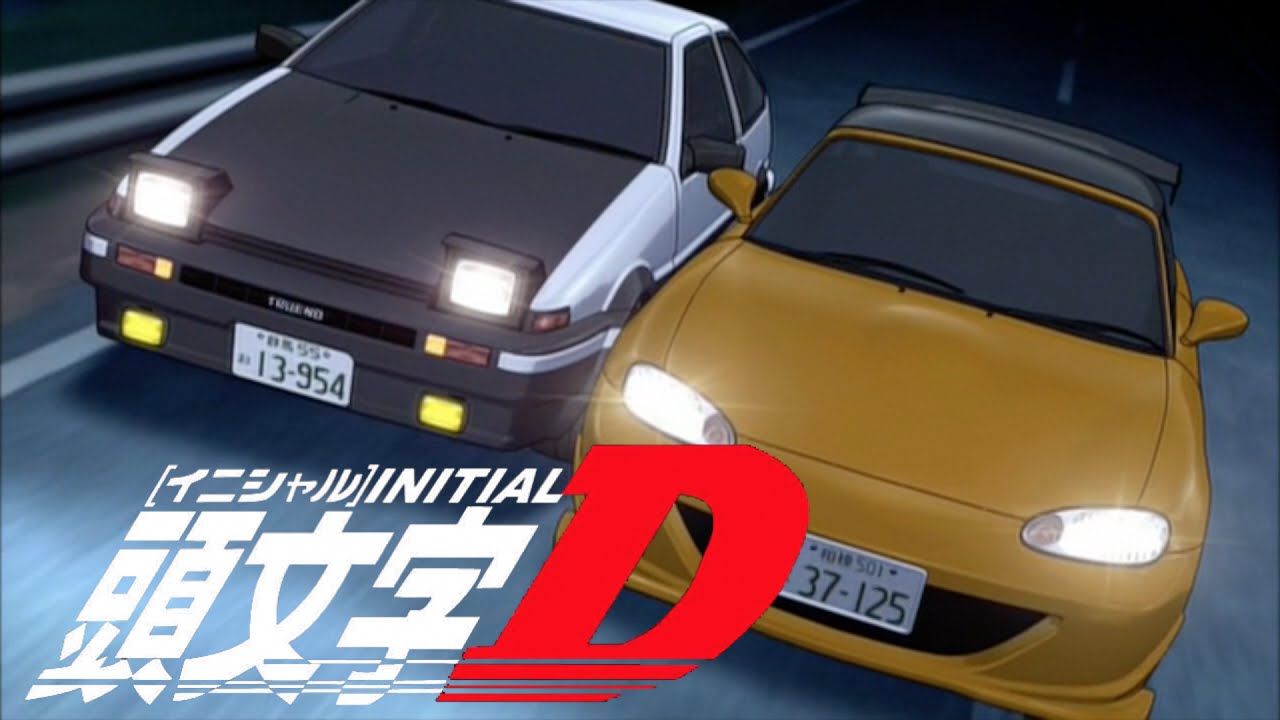
Initial D" is a manga series by Shuichi Shigeno that ran in Weekly Young Magazine from 1995 to 2013, as well as an anime series based on the manga. The story is set on a real-life mountain pass in Japan, and tells the story of a group of "runners" who drive their cars at high speeds to attack the pass. The story follows Takumi Fujiwara, a driver of a Toyota Sprinter Toreno (Hachi Roku), as he uses his superior driving techniques to battle with a number of "runners".
In a match against Takumi, who has excellent braking sense and is one of the best in Todo Juku, Ryosuke instructed him not to look in the rearview mirror, rev shibari. In the match against Takumi, Ryosuke instructed him not to look in the rear-view mirror and to keep the revs low, which caused him to put more stress on the tires than he expected. As a result, he was overtaken by Takumi when heat sagged and grip performance dropped.
The defeat was the result of overconfidence in their own abilities and underestimating their opponent, Toudou Juku, but Takumi was so good that without Ryosuke's precise instructions, he might have lost the competition.
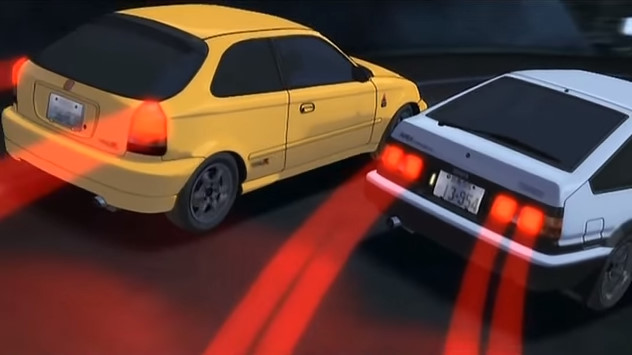
Tomoyuki Tachi EK9 Civic TYPE R VS Takumi Fujiwara AE86 (Kai)

In his battle with Takumi, he used his professional skills to make Takumi suffer until the end of the race. He used his technique to penetrate the opponent's line in the shortest possible distance by taking advantage of the blind spots in the mirrors, and he used a line that disappeared from the sight of the car in front, passing Takumi, blocking Takumi's running line, and, as he said is common in the racing world, lightly hitting the car to make it lose its balance. He overwhelmed Takumi with his professional skills and real-world techniques. However, in the end, he narrowly lost the race when he reflexively avoided a wild animal that looked like a weasel that ran out onto the road, and when he vacated the line he was blocking, he was lined up with Takumi, who was using a blind attack where he turned off his lights and ran without seeing himself from the rear view mirror.
This was because Tomoyuki Tachi, who had his lights on, could see the wild animal that had jumped out, but Takumi, who was blind attacking with his lights off, could not.
Kyoko Iwase FD3S RX7 vs Keisuke Takahashi FD3S RX7
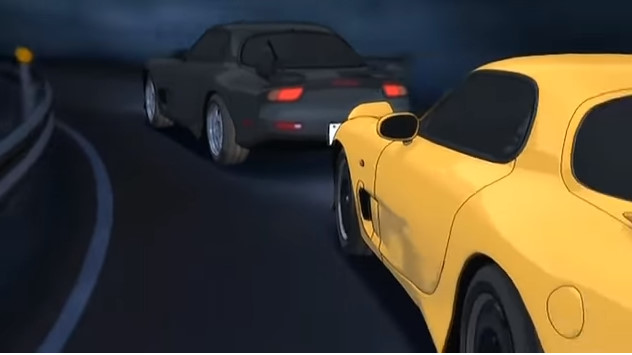
His favorite car is the same FD as Keisuke's, but its turbo structure was a single turbo, and its power output suited the mountain pass where they battle, causing Keisuke to suffer more than expected. However, understanding the difference in turbo lag, a characteristic of both turbos as instructed by Ryosuke, he overtook Kyoko's FD, which had stalled due to a drop in boost pressure once, and won the battle due to the lack of turbo lag, a characteristic of his twin turbo.
Sakamoto EA11R Cappuccino VS Takumi Fujiwara AE86 (Kai)
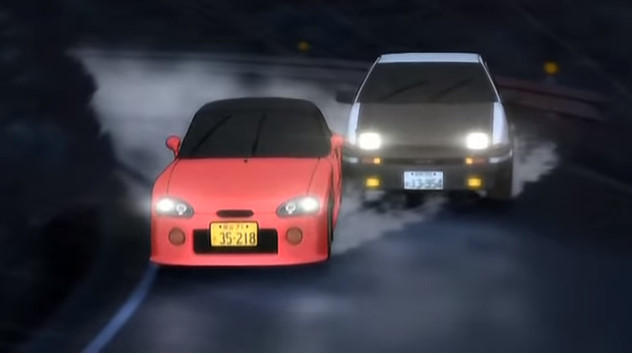
He joins the team at the request of Nobuhiko Akiyama and battles in the Cappuccino that Nobuhiko prepared for the HACHIROKU. The unprecedented drifting by Sakamoto with the Cappuccino, which is even lighter and smaller than the Hachi Roku, became the opponent that Takumi could not win in the corner that he was to experience for the first time, and the unprecedented battle made Takumi struggle so much that he was forced to stop thinking. Ryosuke even remarked that he would have lost if it had not been raining. However, the Cappuccino was overtaken by the Hachi Roku on a flat straight due to the inefficient engine of the light car, and although it blocked the line due to the small size of the car, when Takumi made a blind attack, the Hachi Roku overtook and defeated it when it unexpectedly moved to the inside.
Sakamoto himself had driven a HACHIROKU in the past, and we asked Takumi about the motivation behind his high level of motivation in spite of the rain.
Toshiya Johjima S2000 VS Takumi Fujiwara AE86 (Kai)
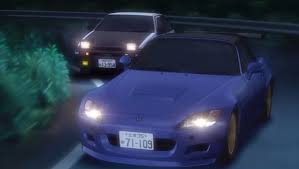
In battles, his motto is to win only smartly, the way adults win.
He confuses Takumi by running a different line at each corner, but keeping his times almost the same, and then, just as he said he would finish the race on the seventh run, he succeeds in overtaking HACHIROKU by taking advantage of a momentary lapse in the schedule.
Jojima decides to stop conserving his tires and run all the way to the finish line to win the race, but is overtaken by Takumi, who uses a combination of a deformed groove drop and a blind attack in the final stages of the race. Takumi, who had never been separated from his rival by any other competitor, showed his speed to such an extent that he was still able to pull away even after using the deformed groove drop. Takumi failed to escape from the ditch with the last deformed ditch drop, damaging the HACHIROKU's suspension. Takumi realized that he had completely lost the race, but at the very end, JOJIMA became nauseous from the fatigue caused by the endurance battle and his deteriorating health due to the intense heat that had continued for several days, and he spun the car to a stop and vomited on the side of the road, retiring.
However, Takumi admits that the battle itself was in fact a defeat, since Jojima had pulled away from the HACHIROKU after giving it his all, and the HACHIROKU's suspension was damaged due to the failure of the deformed groove drop.
Yoshizo Hoshino R34 GT-R VS Keisuke Takahashi FD3sRX7

In his battle with Keisuke, he suggested setting up a hill climb, in which the GT-R with better traction would have the advantage, and a downhill, in which the lightweight FD would have the advantage.
In the first run, he was ahead of Keisuke's FD, and despite the large size and weight of the GT-R, he was able to pull away from Keisuke's FD by taking advantage of its agility and high traction, but he was caught up in the downhill section and the battle was on to the second run. In the second run, Hoshino took advantage of his good traction to run behind Keisuke to poke him from behind, and lined up to overtake him, but by the time they entered the downhill section, Hoshino decided that he had no chance to win unless he got in front, so he turned to line up with FD at the turn at the top and took advantage of his GT-R's traction to get one step faster! He succeeded in getting into the turn course. Keisuke, caught off guard, was one step behind Hoshino's response and slowed down. The two cars then engage in a downhill drift battle, but the GT-R's tires are already overheated and the car bulges outward, causing Keisuke to pass him from the outside at the right corner.
Satoshi Omiya Roadster RS VS Takumi Fujiwara AE86 (Kai)
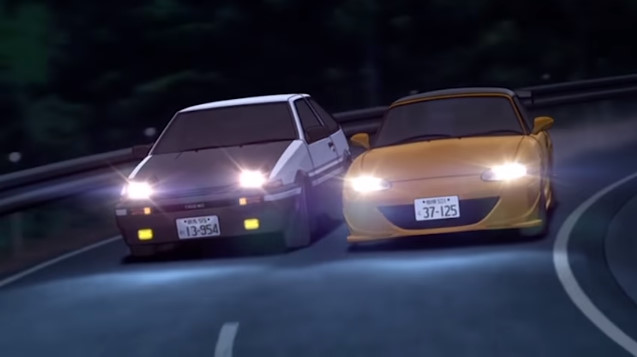
He chose to go ahead in the downhill to make up for what Kobayakawa had done to him in the hill climb. However, during a blind attack by Takumi, the two cars ran side by side and hit the rear wing on a sign, damaging it. The dislodged rear wing became an obstacle that made the car unstable, but he continued to drive, and at a right-angle corner where it was physically impossible for two cars to drive side by side, he moved ahead, but lost his balance and spun out of the car.
Although he lost the battle, he did not seem to regret it, saying, "A life without competing is the same as being dead.
Kobayakawa Lancer Evolution VII GSR vs Keisuke Takahashi FD3S RX7
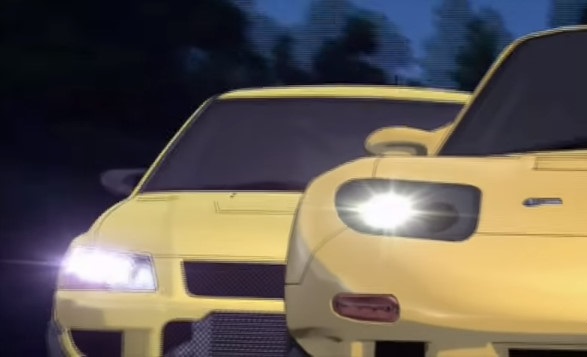
Kobayakawa, who thought that he would not be separated from Keisuke in his hometown where he had a 4WD advantage, chose to follow Keisuke in the battle to see how well he could keep up. However, he was unable to keep up with Keisuke, who was planning to settle the battle in a short period of time, and as a result, he was unable to keep up with Keisuke and lost the battle.

Related Articles
Summary of cars owned by Initial D characters and characters [Initial D].
Initial D" is about a group of young scribes whose goal is to drive cars at high speeds, and fans are interested not only in the story but also in the cars owned by the characters and characters. Here we have compiled a list of cars owned by each character.
Read Article
Introduction of the home version of the game Initial D!
Based on the racing game Initial DARCADE STAGE, which has been running in game arcades to rave reviews, three home-use titles have been released so far. These works will be introduced in this issue.
Read Article
A compilation of famous quotes and lines from "Initial D" that you can use in your daily life.
Here we have compiled a list of famous quotes and lines from Shuichi Hashigeno's manga "Initial D". Examples of their use in daily life are also included. Please be careful to follow the traffic rules when using them while driving.
Read Article
A selection of good works! Top 20 Animations of the 90's that were highly acclaimed overseas! Kindaichi, Ini D, etc.
Animation is a culture that Japan can be proud of in the world. Japanese animation is highly regarded by people overseas for its stories, characterizations, and drawing skills. It is not uncommon for people to make "pilgrimages to sacred places" in order to catch a glimpse of the places where the anime took place. This article introduces 20 carefully selected Japanese anime titles from the 1990s that are particularly well-received overseas.
Read Article
Contents
- Outline of "Initial D
- Synopsis and story of "Initial D
- High School Age 1st Stage of Animation - 3rd Stage of Animation
- Initial D" (The Birth of a Genius Scribbler)
- Initial D Second Stage" (Takumi Fujiwara and Evolution of Hachi Roku)
- Initial D Third Stage" (participation in Project D and battle between Nisei)
- Project D version 4th Stage of Animation - Final Stage of Animation
- Initial D Fourth Stage" (effectively defeated)
- Initial D Fifth Stage" (Project D, which never loses)
- Initial D Final Stage" (Victory and the dissolution of Project D)
- About AE86
- Differences between AE86 and AE85
- Characters and their car models in "Initial D
- Fujiwara Tofu Shop
- Takumi Fujiwara (voice: Shinichiro Miki) / Car: AE86 Sprinter Toreno GT-APEX 3door (early model)
- Bunta Fujiwara (voice: Unsho Ishizuka) / vehicle: GC8 Impreza WRX type R STi Version V (Initial D Fourth Stage-)
- AKINA SPEED STARS
- Koichiro Iketani (voice: Kazuki Yao) / Car: S13 Silvia K's (1800cc, first model)
- Tatsuki Takeuchi (voice: Mitsuo Iwata) / Car: AE85 Corolla Levin SR (early model)
- Kenji / Voice: Wataru Takagi / Car: 180SX (mid-term model)
- Akagi Red Suns (RedSuns)
- Ryosuke Takahashi (voiced by Takehito Koyasu) / Ride: FC3S Savanna RX-7 ∞ (Anfini III)
- Keisuke Takahashi (voice: Tomokazu Seki) / Car: FD3S RX-7 Type R (Type 1)
- Kenta Nakamura (voice: Kosuke Okano) / vehicle: S14 Silvia
- Fumihiro (voice: Osamu Hosoi)
- Shuichi Matsumoto / Voice: Butaro Nishi
- Miyaguchi (voice: Ryokichi Takahashi)
- Myogi Night Kids (Night kids)
- Takeshi Nakazato (voice: Hiyama Shuyuki) / Car: BNR32 Skyline GT-R V-specII
- Shingo Shoji (voiced by Keiji Fujiwara) / Car: EG6 Civic SiR-II (early model)
- impact blue
- Mako Sato (voice: Michiko Netani) / on-board vehicle: Sil-AITI
- Sayuki (voice: Yumi Kakazu)
- People related to Takumi Fujiwara / Other people
- Natsuki Mogi / Voice: Ayako Kawasumi
- Miki (voice: Wataru Takagi (First Stage) → Takumi Yamazaki (Third Stage)) / vehicle: Celica GT-FOUR (ST205)
- Former running mate of Bunta Fujiwara
- Yuichi Tachibana / Voice: Tomomichi Nishimura
- Masashi Suzuki (Voice: Yasutsugu Ishii)
- Tsuchiya (Tsuchiya/Voice - Keiichi Tsuchiya)
- Characters and their car models in "Initial D Second Stage".
- EMPEROR
- Kyoichi Sudo (voice: Masahiko Tanaka) / vehicle: CE9A Lancer Evolution III GSR
- Seiji Iwaki (voice: Kazuhisa Kawahara) / vehicle: CN9A Lancer Evolution IV RS
- Saitama Northwest Area United Team / Akiyama Siblings
- Wataru Akiyama (voice: Yasunori Matsumoto) / vehicle: AE86 Corolla Levin GT-APEX 3door (early model)
- Kazumi Akiyama / Voice: Ryoka Yuzuki
- Characters and their vehicles in "Initial D Third Stage".
- little grebe (Tachybaptus ruficollis)
- Kai Kogashiwa (voice: Nobutoshi Kanna) / vehicle: SW20 MR2 G-Limited (Type III)
- Ken Kogashiwa (voice: Kinryu Arimoto)
- Characters, characters, and car models in the Project D version of "Initial D Fourth Stage
- Seven Star Leaf (SSR)
- Toru Suetsugu (voice: Hiroki Nakamura) / Car: NA6CE Eunos Roadster S-Special
- Atsuro Kawai (voice: Seiji Sasaki) / Car: ER34 Skyline Coupe 25GT-TURBO (early model)
- Naho (Nao/Voice: Nagasawa Miki)
- Todo Juku
- Daiki Ninomiya (voice: Tomoyuki Morikawa) / vehicle: EK9 Civic Type R
- Sakai (voice: Takase Ukimitsu) / vehicle: DC2 INTEGRA TYPE R (early model, 96 spec)
- Tomoyuki Tachi (voice - Kazuhiro Nakata, Daichi Endo (Final Stage)) / vehicle: EK9 Civic TYPE R (late model, 98spec) SPOON spec (Todo Shokai demo car)
- Two people from Tokyo
- Deb (voice - Yasutsugu Ishii) / vehicle: S15 Silvia Spec-R (early model)
- Glasses (voice: Makoto Higo)
- Nobuhiko Akiyama's Team
- Kyoko Iwase (voice: Megumi Toyoguchi) / Car: FD3S RX-7 Type R (Type 1)
- Nobuhiko Akiyama (voiced by Hitoshi Horikawa) / Car: Altezza Z-EDITION, first model
- Saitama Northwest Area Coalition Team
- Sakamoto (Sakamoto / voice: Yoshino Hiroyuki) / vehicle: EA11R Cappuccino (early model)
- Wataru Akiyama (voice: Yasunori Matsumoto) / vehicle: AE86 Corolla Levin GT-APEX 3door (early model)
- Tsuchisaka's Lancer Evo Team (name unknown)
- Aikawa (Lancer Evo V man / voice - Masuo Amada) / vehicle: CP9A Lancer Evolution V GSR
- Ichijo (Lancer Evo VI man / voice - Mitsuaki Madono) / vehicle: CP9A Lancer Evolution VI Tomi Makinen Edition GSR
- biker gang
- Former biker gang leader (voice - Tomoyuki Shimura)
- purple shadow
- Toshiya Johjima (voice: Masashi Ehara) / vehicle: S2000 (first model)
- Kozo Hoshino (voice: Ryuzaburo Otomo) / Car: BNR34 Skyline GT-R V-specII
- Characters and their vehicles in "Initial D Fifth Stage".
- Fake Project D
- Nise Takumi (voice: Anri Katsu)
- Nise Keisuke (voice: Hirokazu Miura)
- People related to Takumi Fujiwara / Other people
- Mika Uehara / Voice - Saori Hayami (from Fifth Stage)
- Team 246 (Two Four Six)
- Satoshi Omiya (voice: Hiroki Higashiji) / Car: NB8C Roadster RS
- Kobayakawa (voice: Kenji Hamada) / vehicle: Lancer Evolution VII GSR
- Racing Team Katagiri Street Version
- Hideo Minagawa (voice: Katsuyuki Konishi) / vehicle: JZA80 Supra
- Kai Kogashiwa (voice: Nobutoshi Kanna) / Car: ZZW30 MR-S S EDITION (early model)
- Characters and boarding vehicles in "Initial D Fifth Stage - Final Stage".
- Team Spiral
- Ryuji Ikeda (voice: Kazuya Nakai) / Car: Z33 Fairlady Z Version S (early model)
- Hiroya Okuyama (voice: Shuhei Sakaguchi) / vehicle: S15 Silvia Spec-R (early model)
- sidewinder (missile)
- Go Hojo (voice: Hidenobu Kiuchi) / vehicle: NA1 NSX (early model)
- Shinji Inui (voiced by Atsushi Abe) / Car: AE86 Sprinter Toreno GT-APEX 2door (late model)
- Eiji Kubo / Voice: Yasuyuki Kase
- Shinji's mother (voice: Hirose Yuka)
- Reaper GT-R
- HOJO Rin (voiced by Yuichi Nakamura) / Car: BNR32 Skyline
- Kaori (Voice: Aya Endo)
- 『頭文字D』の車種・所有車
- Famous Scenes and Scenes from "Initial D" Looking Back with Strong Rivals
- Keisuke Takahashi FD3S RX7 VS Takumi Fujiwara AE86
- Keisuke Takahashi FD3S RX7 VS Takumi Fujiwara AE86
- Tsuyoshi Nakazato R32 GT-R VS Takumi Fujiwara AE86
- Shingo Shoji EG6 VS Takumi Fujiwara AE86
- Mako Sato SILATEY VS Takumi Fujiwara AE86
- Kenta Nakamura S14 VS Takumi Fujiwara AE86
- Ryosuke Takahashi FC vs Takumi Fujiwara AE86
- Seiji Iwase Lancer Evo IV vs Takumi Fujiwara AE86
- Kyoichi Sudo Lancer Evo III vs Takumi Fujiwara AE86
- Takumi Fujiwara AE86 Revival and Wataru Akiyama AE86 Corolla Levin
- Kyoichi Sudo Lancer Evo III vs Takumi Fujiwara AE86 (Kai)
- Kogashiwa Kai MR2 VS Takumi Fujiwara AE86 (Kai)
- Miki Senpai Celica GT4 VS Takumi Fujiwara AE86 (Kai)
- Toru Suetsugu Roadster VS Takumi Fujiwara AE86 (Kai)
- Atsuro Kawai ER34 Skyline Coupe 25GT-TURBO vs Keisuke Takahashi FD3S RX7
- Daiki Ninomiya EK9 Civic TYPE R VS Takumi Fujiwara AE86 (Kai)
- Tomoyuki Tachi EK9 Civic TYPE R VS Takumi Fujiwara AE86 (Kai)
- Kyoko Iwase FD3S RX7 vs Keisuke Takahashi FD3S RX7
- Sakamoto EA11R Cappuccino VS Takumi Fujiwara AE86 (Kai)
- Toshiya Johjima S2000 VS Takumi Fujiwara AE86 (Kai)
- Yoshizo Hoshino R34 GT-R VS Keisuke Takahashi FD3sRX7
- Satoshi Omiya Roadster RS VS Takumi Fujiwara AE86 (Kai)
- Kobayakawa Lancer Evolution VII GSR vs Keisuke Takahashi FD3S RX7
- Hideo Minagawa JZA80 Supra vs Keisuke Takahashi FD3S RX7
- Kai Kogashiwa MR-S VS Takumi Fujiwara AE86 (Kai)
- Ryuji Ikeda Z33 Fairlady Z Version S VS Keisuke Takahashi FD3S RX7
- Hiroya Okuyama S15 Silvia VS Takumi Fujiwara AE86 (Kai)
- Go Hojo NA1 NSX VS Keisuke Takahashi FD3S RX7
- Shinji Inui AE86 VS Takumi Fujiwara AE86 (Kai)
- Dissolution of Project D
- After Hachiroku
- m.o.v.e "Rage your dream
- Special Edition AE86 Takumi Fujiwara vs GC8 Impreza WRX Type R Sti Version V Bunta Fujiwara
- Special Edition Ryosuke Takahashi FC VS Rin Hojo R32 GT-R
- OVA work of "Initial D
- Special Edition OVA Initial D Extra Stage Beyond the Impact Blue...
- Initial D BATTLE STAGE
- Initial D to the Next Stage - Toward Project D
- Initial D BATTLE STAGE 2
- Initial D Extra Stage 2 - Green for Departure
- Terminology for Initial D
- Atesa ET-S System
- foot (animal)
- Load transfer (Kajidou) Paper cup filled with water
- Left foot brake
- groove drop
- blind attack
- Straddling a ditch
- Fujiwara Zone
- Drifting using guardrails
- Retractable headlights
- Biting
- LSD (EERESDI) Limited Slip Differential Gear
- kumquat (Fortunella spp.)
- OH (OH-hole)
- heel and toe
- Turbo supercharger
- hairgrip
- tear to shreds
- Side (Saturday)
- NA Naturally aspirated
- VTEC (VTEC)
- Displacement (displacement) Tenroku
- drift
- Bolt-on turbo
- Horizontally opposed engine
- 4G63 engine (Yonjirokusan Enjin)
- RB26DETT engine (ARB26DETT engine)
- ABS
- DOHC (dee-oh-eh-chee)
- SOHC (Seth-Oh-Eh-Ch-Ch-Ch)
- FR (ef-ar)
- FF (FF)
- MR.
- 4WD/AWD (Yondaburudei)
- Oversteer and understeer
- engine blow
- tachometer
- overrevving
- MT (manual)
- Summary of "Initial D" Pass
- Akina Mountain➡Shibukawa City, Gunma Prefecture, modeled after Mt. Haruna (Gunma Prefectural Road 33 Shibukawa-Matsuida Line)
- Akagi ➡Seta-gun, Gunma-ken (Gunma Prefectural Road No.4 Maebashi Akagi Line)
- Myogisan ➡Gunma Prefecture, Amaraku-gun (Gunma Prefectural Road No.196 Kamikosaka Yotsuke Myogi Line)
- Usui Pass ➡Matsuida Town, Gunma Prefecture, Usui Pass, National Road No.18
- Iroha Slope ➡Nikko Daiichi Iroha Slope (Route 120), Nikko City, Tochigi Prefecture
- Shomaru-Toge ➡Shomaru-Toge (old road on Route 299), Hanno City, Saitama Pref.
- Momiji Line ➡Nichio Momiji Line, Nikko City, Tochigi Prefecture (Tochigi Prefectural Road No. 19 Fujiwara Shiobara Line)
- Happogahara ➡Yaita City, Tochigi Prefecture, Japan
- Sadamine Pass ➡Saitama Prefecture Sadamine Pass (Saitama Prefectural Road No.11 Kumagaya Ogawa Chichibu Line)
- Mase Pass ➡Mase Pass, Chichibu-gun, Saitama-ken (Saitama Prefectural Road No.287 Nagatoro-Kodama Line)
- Tsuchisaka Pass ➡Tsuchisaka Pass, Yoshida Town, Saitama Prefecture (Gunma Prefectural Road, Saitama Prefectural Road No.71 Takasaki Kaminryu Chichibu Line)
- Tsukuba Purple Line ➡Tsukuba City, Ibaraki Prefecture (Ibaraki Prefectural Road No. 236 Tsukuba Park Nagai Line)
- Yabitsu Pass ➡ Hadano City, Kanagawa Prefecture, Yabitsu Pass (Kanagawa Prefectural Road No.70 Hadano Kiyokawa Line)
- Nagao Pass ➡Hakone-cho, Ashigarashita-gun, Kanagawa Prefecture / Gotemba City, Shizuoka Prefecture, Nagao Pass (Shizuoka Prefectural Road No. 401, Kanagawa Prefectural Road No. 736 Gotemba Hakone Route)
- Nanamagari ➡Hakone-cho, Ashigarashita-gun, Kanagawa-ken, Nanamagari Kanagawa Prefectural Road No.732 Yumoto-Moto Hakone Line
- Tsubaki Line ➡Yugawara-cho, Ashigarashita-gun, Kanagawa Prefecture, Tsubaki Line Kanagawa Prefectural Road No.75 Yugawara Hakone Sengokuhara Line
- Hakone Turnpike ➡Hakone Town, Ashigarashita-gun, Kanagawa Prefecture / Odawara City, Kanagawa Prefecture, Hakone Turnpike
- Fujiwara Tofu Shop ➡Shibukawa-shi, Gunma
- 『頭文字D』の名言・名セリフ
- 『頭文字D』のゲーム作品
- Theme song and insert song for "Initial D
- Initial D" (26 episodes)
- Opening theme 1 "around the world" Song: move (ACT1-ACT19)
- Ending theme 1 "Rage your dream" Song: move (ACT1-ACT14)
- Opening theme 2 "BREAK IN2 THE NITE" Song: move (ACT20-ACT26)
- Ending theme 2 "Kiseki no Roses (Miracle Roses)" sung by Galla (ACT15-ACT26)
- Initial D Second Stage (13 episodes)
- Opening theme "Blazin' Beat" Song: move
- Ending theme "Kimi ga iru" sung by Galla
- Initial D Third Stage" movie
- Theme song "Gamble Rumble" Song: move
- End Roll "THE RACE IS OVER" Song: Dave Rodgers
- Initial D Fourth Stage (24 episodes)
- Opening theme 1 "DOGFIGHT" Song: move (ACT 1 - ACT 10)
- Ending theme 1 "Blast My Desire" Song: move (ACT1-ACT10)
- Opening theme 2 "Noizy Tribe" Song: move (ACT11-ACT24)
- Ending theme 2 "Nobody reason - Noah's Ark" Song: move (ACT11-ACT24)
- Initial D Fifth Stage
- Opening theme 1 "Raise Up MV featuring Keiichi Tsuchiya" Song: m.o.v.e (ACT1-ACT14)
- Ending Theme 1 "Clutcho Flyleaf PV HD Ending Theme 1 'Flyleaf'" Song: CLUTCHO (ACT1-ACT6)
- Opening theme 2 "Outsoar the Rainbow" Song: m.o.v.e
- Ending theme 2 "Yuushou Souka" sung by m.o.v.e (ACT7-ACT14)