
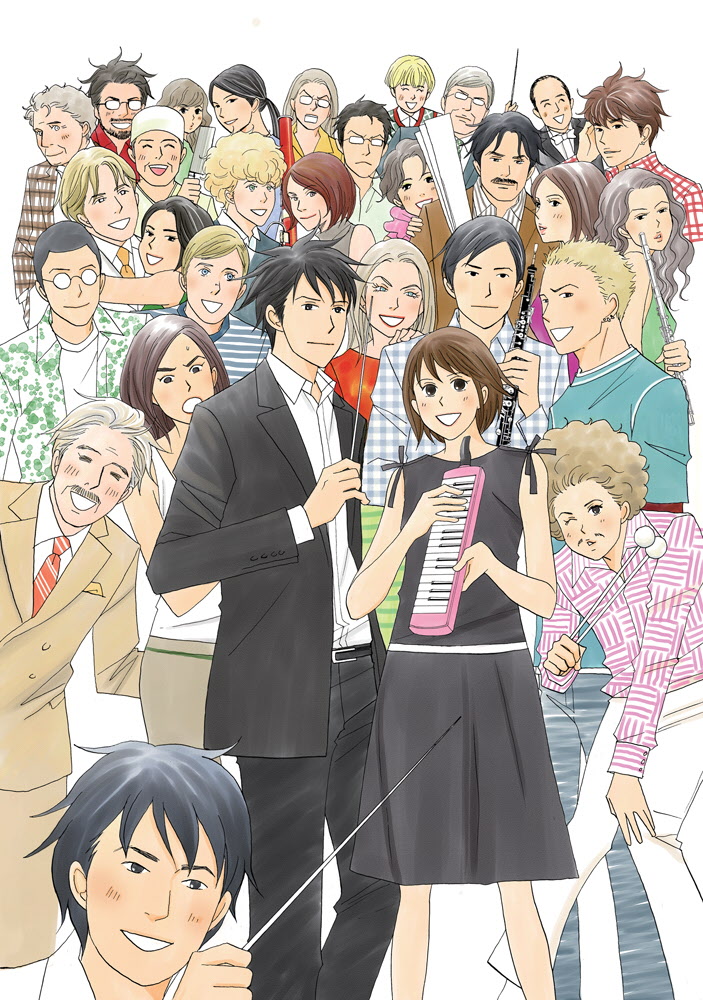
Nodame Cantabile" is a Japanese manga by Tomoko Ninomiya. It is based on the theme of classical music and was serialized in Kodansha's "Kiss". It won the 28th Kodansha Manga Award for Girls. It has been adapted into a wide variety of media, including dramas, animations, movies, novels, video games, CDs, and dramas in Korea, and has created a classical music boom among the public. The work depicts Chiaki and Nodame's growth through their interactions with the people they meet through music. The film depicts the main character "Nodame" Megumi Noda and elite music student Shinichi Chiaki as they interact with and grow up with the people they meet through music.
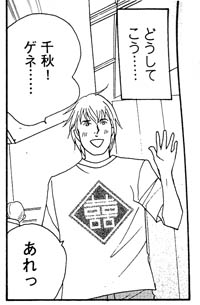
CV: Kazuyuki Okitsu
Marleoke's only office staff member and livelier. He is quite careless and often forgets to prepare scores, arrange performers, etc., but he has overcome many a pinch with his good sense of timing and luck. He recognizes Nodame as Chiaki's wife. She often wears strange T-shirts.
Nina Lutz.
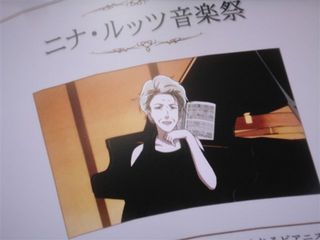
CV: Takuko Tsuda
A world-renowned pianist. She holds the "Nina Lutz Music Festival" in Nagano every year. When Nodame attended her lesson, she was so disgusted by Nodame's attitude that she had not even prepared for the lesson that she ordered her to leave. On the last day of the festival, he heard Nodame playing in an empty music room and ran to her, but Nodame was already gone and he did not know who the person was who played the piece.
The family has known each other since Chiaki was a child. Chiaki, who had to play the piano at the Marleke, was under Nina's tutelage.
Roland Chevalier
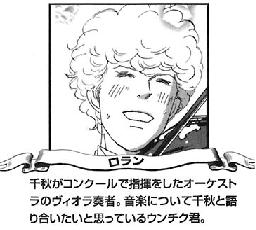
CV: Makoto Ishii
A French viola player in the Wiltour Orchestra. She has fluffy hair. A member of the orchestra for the conductor competition Chiaki was participating in. He took an interest in Chiaki at that time. He claims to have hallucinations when he hears great music. When Chiaki conducted, he saw black feathers, and when Jean conducted, he saw white roses. He loves to talk about crap and wants to discuss it with Chiaki.
Her grandmother is a member of the Marle orchestra, and when it was decided that Chiaki would be the permanent conductor of the Marle, she joined the Marle extras in order to infiltrate the orchestra to get an insider's view.
Manabu Sakuma (played by Mitsuhiro Oikawa)

CV: Keiji Fujiwara
Music critic. He is in charge of the "Yumeiro☆Classic" section in the magazine "Classic Life. Invited by magazine reporter Keiko Kono, she heard Chiaki and Stresemann play a piano concerto at the Momoka Music College's school festival, was fascinated by the beautiful music, and published a poem in "Yumeshiki☆Classic.
After that, he fell in love with Chiaki's talent and began to give her advice on her musical activities.
He cooperates with Chiaki when she goes to study abroad.
Keiko KAWANO (Actress: Hiroko HATANO)
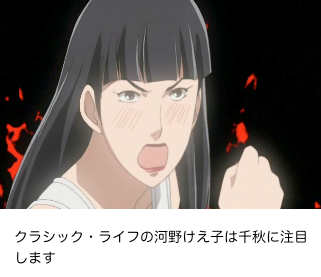
CV: Takako Honda
Editor of the magazine "Classical Life. She saw Chiaki conducting as a substitute for Stresemann at the Nina Lutz Music Festival and noticed his talent. He brought Chiaki to Sakuma and succeeded in spreading the word about his talent. When Chiaki started the activities of the RS Orchestra, he also extended his cooperation and contributed to the activities of the RS Orchestra by publishing numerous articles in "Classical Life".
Glossary of "Nodame Cantabile
S-oke (S-oke)
The orchestra was formed for one year by Franz von Stresemann, who was appointed as a teacher at the Momoka College of Music. The official name of the orchestra is "Stresemann Special Orchestra". Originally, Stresemann's role was to teach the A orchestra (the regular orchestra of the College of Music at Momoka) and the conducting department, but the orchestra was formed at his request. The members were found by Stresemann himself as he walked around the campus. The members are all students who have strong personalities and are considered dropouts at the university.
Nodame, a piano player, does not originally belong to the orchestra, but is a mascot girl.
By taking Chiaki as her apprentice and appointing her as the assistant conductor of the S orchestra, she helps Chiaki understand the role of a conductor, etc. In reality, he often leaves practice to Chiaki, the assistant conductor, while he himself spends all his time playing at cabaret clubs. When Chiaki went to a cabaret club to pick up Stresemann, who did not show up for practice, Stresemann left the S orchestra because Chiaki was more popular than him. Chiaki became the regular conductor of the S orchestra. Thereafter, the members of the S orchestra grew in ability as Chiaki continued to practice hard.
In order to win back Stresemann, who had left the S orchestra and devoted himself to the A orchestra, Chiaki set his sights on the subscription concert with the goal of "defeating the A orchestra.
At the subscription concert, the orchestra performed with Chiaki conducting, including a flamboyant performance conceived by Mine, and received high acclaim, albeit with a mixture of laughter.
In the end, Stresemann did not attend the subscription concert due to poor health. The performance of the A orchestra was in tatters because the conductor was hastily given to Ohkouchi, a member of the conducting department who has a rivalry with Chiaki.
Although Chiaki did not participate in the school festival, they performed a Japanese big band performance, which enlivened the festival.
Nodame and other piano students also participated in this performance on the pianica.
The S orchestra was disbanded upon Chiaki's graduation. Some members joined the RS Orchestra, which Chiaki later founded.
R☆S Orchestra (Rising Star Orchestra)
The Nina Lutz Amateur Orchestra was founded by Kiyoyoshi Miki, who had served as the festival's converse conductor, and was led by Chiaki, Kuroki, Kikuchi, and other members of the Nina Lutz Music Festival. Chiaki served as the first conductor, and Yukihisa Matsuda, who had been the conductor of the Paris R Orchestra and the M Philharmonic Orchestra, served as the second. The R☆S Orchestra (Rising Star Orchestra) was named after Mine and his son.
The orchestra's debut performance received great acclaim from music critic Sotaro Okawa for its wonderful music.
The second and third performances were also highly acclaimed. However, the RS Orchestra attracted much attention in Japan, and young musicians began to apply to join the orchestra one after another.
Rue Malle Orchestra
A part-time orchestra founded in Paris in 1875 by Lou Mallet. It used to be popular with German duo such as Stresemann and Kai Dune.
Music director James Depriest heard Chiaki's debut performance in Paris and liked it, which led to Chiaki's appointment as Marleauquet's permanent conductor.
The quality of MARLEOKE had been gradually declining in recent years, and the individual musicians were of low caliber, with little time for rehearsals and not enough members.
Chiaki, who had infiltrated the group as an extra and learned the inner workings of the group, decided to become the permanent conductor himself and started recruiting new members to replenish the group and raise its level.
Since Chiaki became a permanent member, the troupe's performances have been well received.
Deschamps Orchestra (Deschamps Orchestra)
A private orchestra in Paris. When the orchestra invited Chiaki and Jean in succession as candidates for the new permanent conductor, and had them swing the orchestra, Jean was chosen.
The orchestra had previously been led by a staid and serious conductor, so the more modern and flamboyant Jean seemed to be the one chosen.
Orchestre des Concerts de Lucères (Lucère Orchestra)

Related Articles
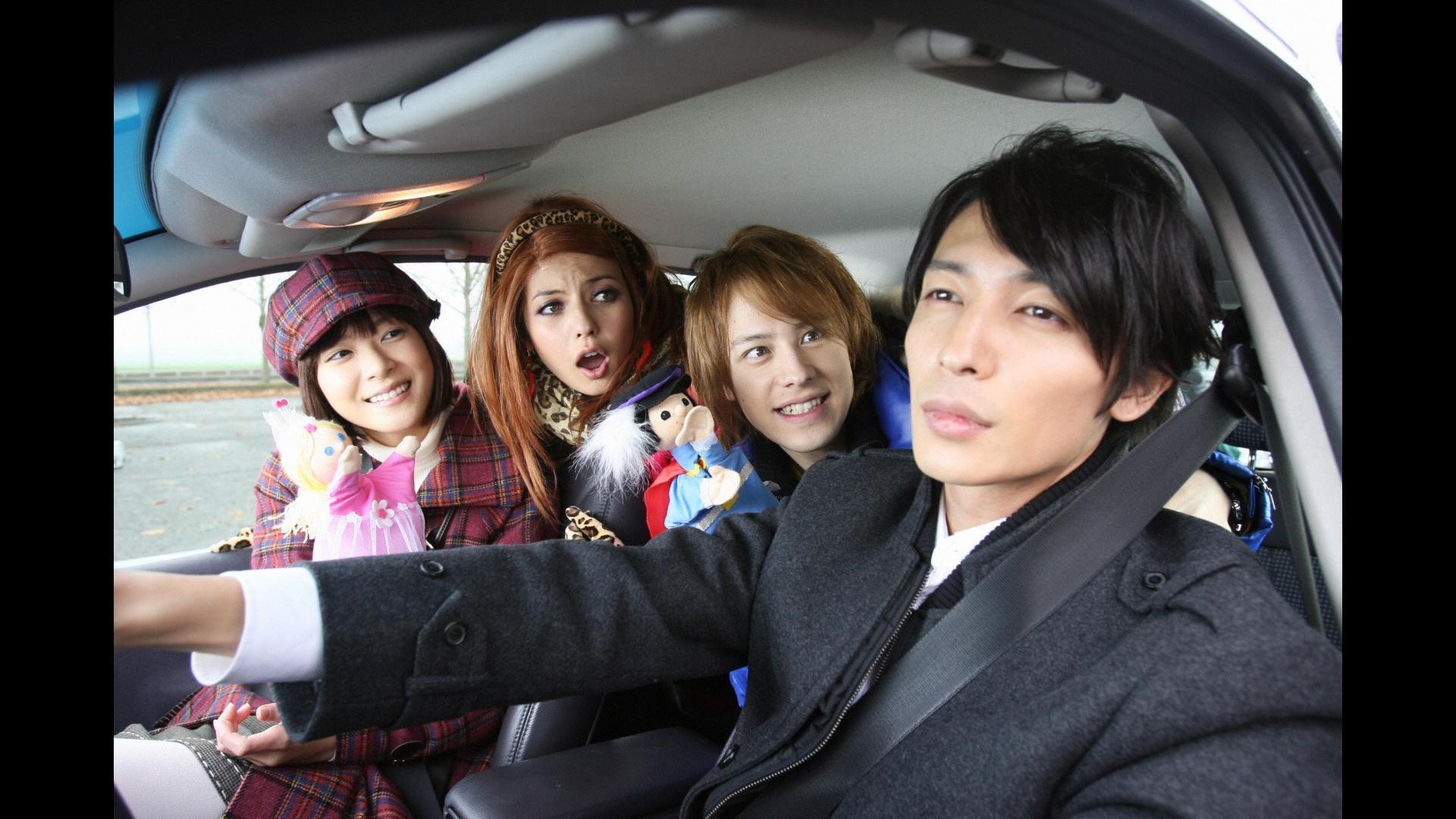
Summary of the superb cast of the drama "Nodame Cantabile" [Osamu Mukai, etc.
This is a summary of information on the cast members who appeared in the popular drama "Nodame Cantabile. This drama is too gorgeous to look at now, with starring actors Juri Ueno and Hiroshi Tamaki, as well as Osamu Mukai, Eita, Asami Mizukawa, Michiko Kichise, and other members who make up the supporting cast. Here are profiles of the gorgeous cast members, along with some of the more memorable scenes from the film!
Read Article
87CLOCKERS (Eighty-Seven Clockers) Spoilers and Discussion Summary
87CLOCKERS" is a Japanese manga work by Tomoko Ninomiya. It was published in Shueisha's "JUMP KAI" from its first issue in June 2011 to the November 2014 issue. After "JUMP KAI" stopped publication, the manga was serialized in "Weekly Young Jump". Kanade, a music college student, jumps into the world of overclocking, the F1 competition of the PC world, in order to make a connection with Hana, a beautiful woman he fell in love with at first sight. The story is about his growth through encounters with the unique people of that world.
Read Article
Spoiler commentary and discussion of Manga Gohan Nisshi (manga).
Manga-ka Gohan Nisshi" is a comic book featuring 50 cartoonists' episodic drawings about their own food. It was published by Shodensha on May 8, 2015. Each of the 52 manga artists draws two pages in a rough style about the food they eat on a daily basis and the manga artist's thoughts on food. It is a book that provides an insight into the daily eating habits of popular manga artists and a chance to think about what food is all about.
Read Article
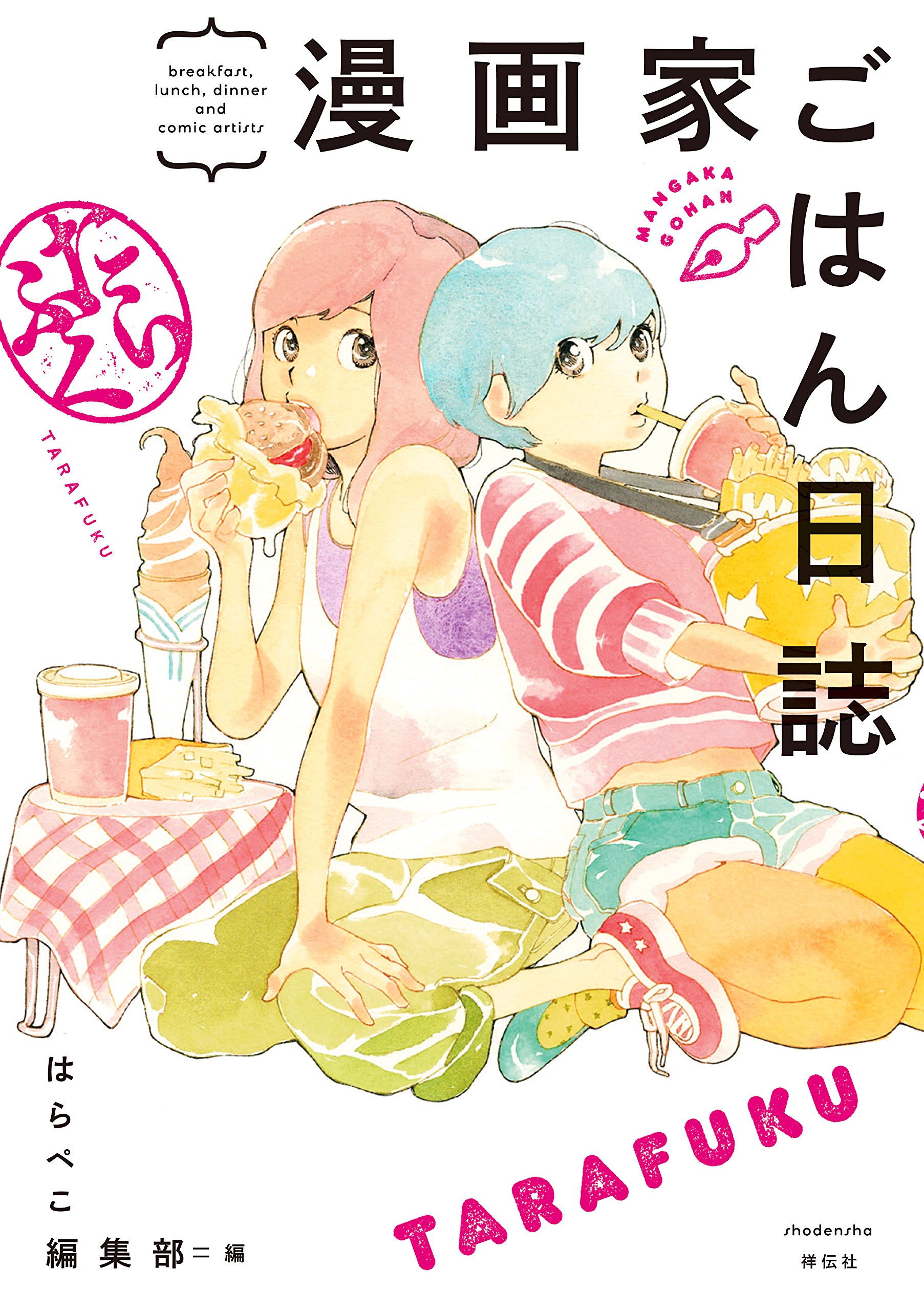
Manga Gohan Nisshi Tarafuku (Manga) Spoiler Commentary and Discussion Summary
Manga-ka Gohan Nisshi Tarafuku" is a comic book featuring cartoons drawn by 50 cartoonists based on their own episodes about food. Each of the 50 cartoonists draws two pages in a rough style, describing the food they eat on a daily basis and their own thoughts on food. The second half of the book contains a special interview and a special dialogue. It is a book that gives readers an insight into what the popular manga artist eats on a daily basis, and furthermore, it is a work that encourages readers to think about what food is all about. This book is a sequel to "Manga-ka Gohan Nisshi" published in May 2015.
Read Article
Improve your skills! A compilation of informative animations
In recent years, there are many anime that you can not only watch and enjoy, but also learn many things by watching them! From sports to art, culture, and other minor jobs to business, the scope is vast. In this issue, we have compiled a list of anime that you can learn from and benefit from.
Read Article
Contents
- Outline of "Nodame Cantabile
- Synopsis and story of "Nodame Cantabile
- Encounter - Momoka College of Music
- Paris (France)
- Opera Edition
- Characters from "Nodame Cantabile
- key people
- Megumi Noda (played by Juri Ueno)
- Shinichi Chiaki (played by Hiroshi Tamaki)
- director
- Franz von Stresemann (played by Naoto Takenaka)
- Sebastiano Viera
- Yukihisa Matsuda
- Jean Donadieu.
- Hajime Katahira
- James DePriest.
- Momogaoka College of Music
- Ryutaro Mine (played by Eita)
- Masumi Okuyama (played by Keisuke Koide)
- Kiyora Miki (played by Asami Mizukawa)
- Yasunori Kuroki (played by Seiji Fukushi)
- Toru Kikuchi / played by Osamu Mukai
- Noriyuki Takahashi (played by Ryo Kimura)
- Kozo Eto (played by Kosuke Toyohara)
- Hajime Tanioka / played by Masahiko Nishimura
- Ayako Tagaya (played by Misa Uehara)
- Saya Suganuma
- Kai Doong
- Chiaki's parents
- Seiko Miyoshi
- Masayuki Chiaki
- conservatoire
- Charles Auclair.
- Sun Rui
- Frank Lantwane.
- Tatyana Vishnyova / Tanya
- Yun Long Li
- Other
- Thomas Simon
- theo
- Nina Lutz.
- Roland Chevalier
- Manabu Sakuma (played by Mitsuhiro Oikawa)
- Keiko KAWANO (Actress: Hiroko HATANO)
- Glossary of "Nodame Cantabile
- S-oke (S-oke)
- R☆S Orchestra (Rising Star Orchestra)
- Rue Malle Orchestra
- Deschamps Orchestra (Deschamps Orchestra)
- Orchestre des Concerts de Lucères (Lucère Orchestra)
- Wiltour Symphony Orchestra (Wiltour Orchestra)
- pre-colored polyester foil or gauze blanket worn by soldiers, students, etc. (coloured)
- La suite mojamoja
- farting exercise
- rear tenement
- Famous quotes, lines, scenes and scenes from "Nodame Cantabile
- The scene where Chiaki and Dame played together for the first time.
- The scene where Chiaki conducted the S orchestra for the first time and failed badly.
- Franz von Stresemann "Come on, it's time for some fun music!
- Megumi Noda: "God is calling me, I have to go."
- Megumi Noda: "What's wrong with playing the piano freely and joyfully!"
- Manabu Sakuma: "Musicians who leave their mark on history have not only talent but also important encounters with people, and I want to be one of those people.
- Megumi Noda: "People grow up after losing! Just like Nozome."
- The scene in which Dame, who has been rejected, takes her revenge on Dr. Eau Claire.
- Megumi Noda: "Please listen to me as I enjoy playing.
- Thomas Simon: "The essence of music lies in 'harmony. It is the true 'musician' who expresses it."
- The scene where Nodame loses her motivation and takes Stresemann's hand.
- Shinichi Chiaki: "Even so, I still want to take him to that stage as many times as I can."
- Shinichi Chiaki: "No matter how painful or daunting the lonely battle ahead, it's joy like this that makes me willing to face it again and again."
- Backstory, Trivia, and Small Stories/Episodes/Anecdotes from "Nodame Cantabile
- Nodame and Chiaki's love story that captured the hearts of fans
- A work of classical music to be enjoyed.
- Theme and insert songs for "Nodame Cantabile
- Animation 1st season
- OP (Opening): SUEMITSU & THE SUEMITH "Allegro Cantabile
- ED (Ending): Crystal Kay "This Close... (Episodes 1 - 12)
- ED (ending): SUEMITSU & THE NODAME ORCHESTRA "Sagittarius" (episodes 13 - 22)
- Animation 2nd season
- OP (Opening): "Sky High" by Gospellers
- ED (ed.): Shori Miyamoto x solita "Tokyo et Tomari
- Third Fiscal Period
- OP (Opening): Yuu Sakai "Manazashi☆Daydream
- ED (Ending): Real Paradis with Nodame Orchestra "Ballad of Wind and Hill
- Drama & Film
- OP (Opening): Beethoven, "Symphony No. 7, 1st and 4th Movements
- ED (Ending): "From Rhapsody in Blue" by Gershwin (original arrangement by Grofe)