
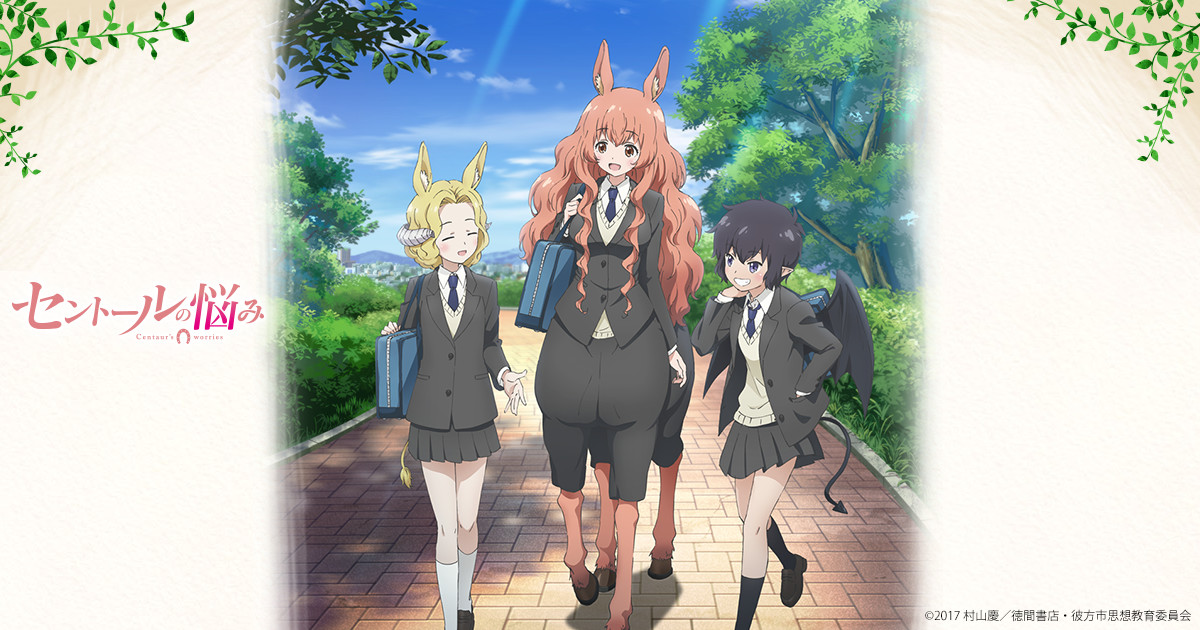
The Sentor's Trouble" is a manga work by Kei Murayama, serialized in the monthly COMIC Ryu magazine since 2011 and animated in 2017 by E Joy Production. Set in a world where six-limbed creatures have evolved into humans, the story depicts the daily life of the main character "Kimihara Haino," a "human horse" whose upper body is human and lower body is horse. The work mainly depicts daily life and has many healing and moe elements, but it also includes themes such as discrimination and war, and has a dystopian style that leaves a dystopian impression.
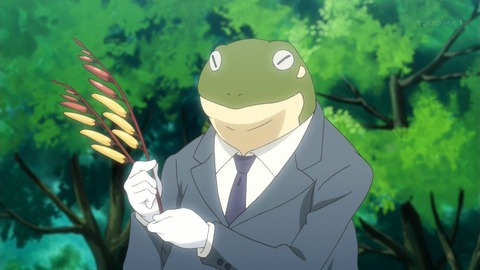
CV: Nobuo Tobita
Amphibian of French nationality. Male.
He was picked up by a French missionary and educated together with mammals, becoming the first amphibian to be a student at the Higher Normal School.
He then worked for a small trading company, acquired a conglomerate, and worked for the protection of ethnic minorities.
He is a celebrity, sometimes appearing on television, and gave a lecture at the school of Himeino and her friends.
He also interacts with the amphibian people of his homeland, but he has mixed feelings about the discrimination that amphibians have against mammals.
chairman
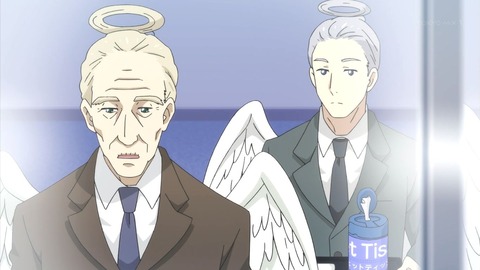
CV: Atsuyoshi Miyazaki (Boyhood CV: Airi Otsu)
Rousseau's business partner. A winged man. Jewish.
He was involved in the war when he was a child, taken prisoner by a political party believed to be the Nazis, and forced to do hard forced labor in a prison camp.
There were people of the same race who quarreled with each other, and people of a different race who shared their food with him.
He was rescued by American soldiers and continues to the present day.
Because of his tumultuous past, he has thoughts about discrimination against different forms, and when he sees Rousseau, an amphibian, try to shake his hand while wearing gloves, he tells him to take off his gloves.
Later, when he saw his subordinate bring him a wet wipe to wipe his hands, he said that my hands were not dirty and was appalled by the discriminatory attitude of his subordinate.
Highlights, famous scenes, and famous moments from "The Sentor's Trouble"
Various species
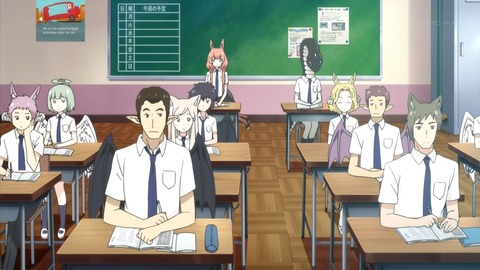
In the classroom picture alone, there are classmates in various forms.
Various forms of humanity coexist in this work.
In addition to creatures that have evolved as humans, there are also pets such as six-limbed dogs and cats.
Hime-no, a man-horse, is surrounded by family members and cousins who are also man-horse, as well as friends such as dragon people, horned people, winged people, long-eared people, and Antarctic people.
In particular, the human-horse wears a different form of clothing than bipedal humans because of its physical characteristics, and its weight, arm strength, and running ability are decidedly different from those of other forms.
Antarctic sasusurs are momentarily frightened of other forms because their faces are snakes, and they eat food differently because of their physical characteristics.
Mermaids do not have the custom of wearing clothes, so they are basically naked, even their upper bodies, but this is normal for them.
There are also other half-mermaid characters who have characteristics of more than one form.
The interaction between characters with many different forms is one of the highlights of this work.
Dystopian worldview with occasional glimpses
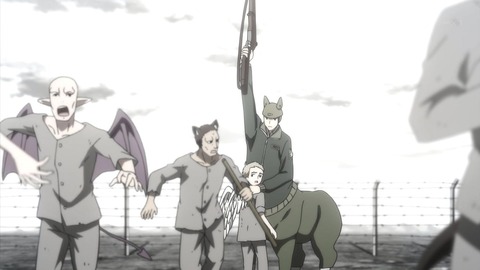
Due to the history of strong discrimination in this work, children are educated that they must never discriminate.
In this world, equality is sometimes prioritized over human rights and life, and those who discriminate are sent to a correctional facility, where they are practically executed.
The dystopian worldview was particularly apparent in the ninth episode, in which Jean Rousseau appeared.
Rousseau is an amphibian with French nationality who was protected by a French missionary when he collapsed and was educated like other humans.
He was the first amphibian to be admitted to a higher education school and to work for a trading company.
He became famous for his activities to protect ethnic minorities, and gave a lecture at the high school attended by Himeino and her friends.
The chairman of the company, with whom Rousseau had a business meeting, was dismayed by the discriminatory attitude of his subordinates toward Rousseau.
The Chairman had experienced war when he was a child and had been captured by the enemy as a prisoner of war and subjected to severe forced labor.
There, some people quarreled with each other over the amount of food they had, even though they were of the same race, while others shared their own food and protected them, even though they were of different races.
Some of them were protected by the American soldiers, and they are still there today.
Because of this, he has a lot of feelings about the discrimination that occurs because of differences in form.
In Himeino's class, it was said that if there were a world where there were no differences in form, at best, people would fight over the color of hair, eyes, and skin.
However, the chairman's fellow prisoners of war asked him if there were a world without differences in form, would there really be no discrimination?
He said that discrimination would always occur with the slightest difference in nationality, ethnicity, skin, hair, eye color, height, body size, clothing, and so on.
This film depicts the discrimination that occurs due to extreme differences in form, but these depictions raise issues that can be understood in the real world as well.
Episode 9 was a dystopian worldview that left a strong impression on the audience, as it depicted Rousseau's life, the discrimination against mammals by the same species in Rousseau's hometown, and the tragedy of the Chairman's life and war.
Although the world is different from the real world, it has a similar history of war, indicating that the worldview is delicately crafted.
For Himeino and her friends, the war is a thing of the past, and their strong sense of discrimination is only something they learned about in class, but for Rousseau and the chairman, this is their "everyday life.
Ancestors of Himeino
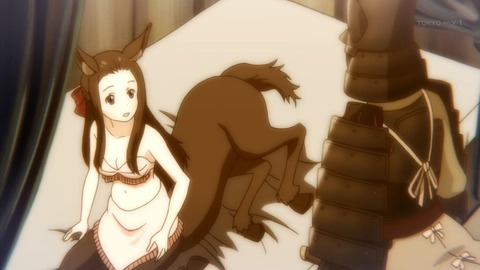
Hime-no has red hair, which was unusual for a human-horse Japanese.
In junior high school, she was suspected by her teacher of dyeing it, and that teacher was caught as a form discriminator.
Hime-no's mother's side of the family had red hair, and there was a tradition about it.
Hime-no's ancestor (with black hair) was kidnapped by red-haired savages, and her brothers chased after her to rescue her sister.
The brothers searched all over Europe and finally found and rescued her.
However, the sister was violently attacked by the savages, and it is said that red-haired children have been born for generations.
This story is also a famous anecdote in the work. The brothers raided everywhere to bring back their sister, sinking ships with a single arrow, and some of the slaves they freed along the way followed them and became like an army.
Her father's side of the family is a samurai family and a former feudal lord's family, and because of this influence, Hime-no is fond of horseback archery.
Although Hime-no is a descendant of a warrior family, she does not have a very good family background and is just an ordinary high school girl raised in an ordinary family.
Quetzalcoatl Sassu Sulu's arrival.
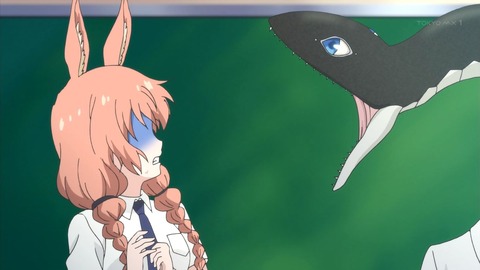
Sassus Soule meant to smile....
In the last part of episode 4 and into episode 5, Sassus Sulu transfers to Himeino's class.
The school has a different, slightly heavier atmosphere than usual, as Sassus Sul, an Antarctic man, is guarded by a public safety officer.
Hime-no is traumatized by the Antarctic man due to a horror movie she saw long ago, and she faints when she sees Sassus SUR's mouth.
Sassus Sulu opened his mouth wide with the intention of smiling, but when Hineno looked at him, it seemed as if he was trying to eat her.
The Qiang-Chiangs are worried about HIMENO's dislike of SASSASSUR because it is a form of discrimination, but HIMENO says that it is because of the movie "Fear of the South Pole".
In order to overcome the trauma, HIMENO, Qiang Tzu, and Nozomi decided to watch "Fear of the South Pole" together with Sassu Sulu.
Not only HIMENO but also SASSASSUR were scared by the movie in which the Antarctic man appears as a villain.
In the movie, the Antarctic man swallowed a human whole, but the actual Antarctic man does not have jaws that spread out like a snake, nor do they have poisonous fangs.
Their jaws are said to be so weak that even if one were bitten by an Antarctic person, it would be nothing more than the bite of a kitten.
At first glance, the film seems to be discriminatory, but Sassoon Sassoul said he learned that the mammals had this wrong perception of them and that he had come to change it.
Himeino is relieved to learn that the Antarctic people are not the threat they appear to be in the movie, and she and Sassus Sulu become friends once again.
Interaction between sisters
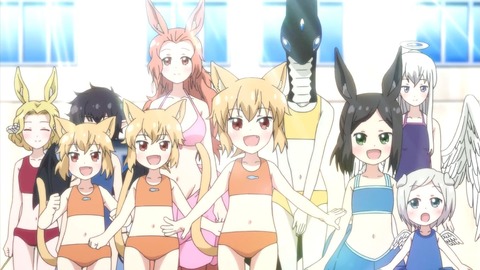
Himeino has a cousin, Shino, and Manami has four younger sisters: triplets Chigusa, Chinami, and Chiho, and a youngest sister, Mitsumi.
Shino loves Himeino and wants to be alone with her, so she does not like the triplets' approach to her.
However, the triplets recognize Shino as a friend of their own age, and despite their quarrels, they become friends.
In episode 6, Hime-no, Nozomi, Qiang-Qiang, Sassu Sassu, Manami, and Shino, the triplets, and Mihatsu go to the swimming pool.
The energetic and curious triplets try to swim at the same depth as Shino, who is a human-horse, and are stopped.
Shino, being a man-horse, could not swim in a standard kiddie pool because it was too shallow, so she went to a deeper pool with Hime-no.
In the end, everyone played in the kiddie pool, with Mimitsu staying by the poolside because of her frailty, happily watching everyone play.
On the way home, the children were so tired that they fell asleep, and Himeino carried Shino, Manami carried Mitsumi, and Nozomi, Qiangzi, and Sasusur carried the triplets in their arms.
The times when the younger sisters appear in the series have a particularly strong everyday color, and the content is heartwarming.
arm wrestling match
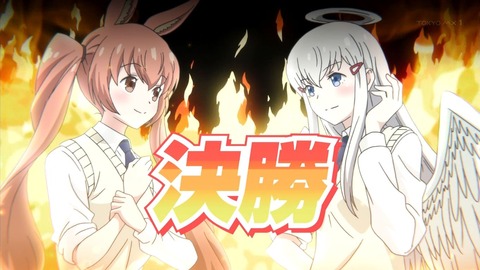
In the final part of the last episode of the anime, an arm wrestling tournament was held among the girls in Himeino's class.
Qiangzi and Sasusur, who have no arm strength, lost early, and Nozomi, whose family is a karate dojo and trains herself, Manami, who is trained by raising her children, Inuyo, who is a member of the softball club, and Himeno, who is a human horse, won the competition.
Nozomi and Manami fight and Manami wins, and Inuyo and Himeno play a match and Himeno easily wins.
The final match is between Manami and Himeno, and after a fierce battle, Himeno wins.
Manami's arm strength comes from carrying and carrying her younger sisters on her back.
Manami feels depressed that she has lost not only to Hineno, but also to her younger sisters, and Hineno consoles her, saying that they weigh differently.
However, as a result, Hime-no's weight is almost completely revealed to Manami.

Tags
Contents
- Overview of "The Sentor's Trouble"
- Synopsis and story of "The Sentor's Trouble"
- The World of "The Sentor's Trouble
- Winged/Dragonian type
- Long-eared/horn/pastor type
- Man-horse/Human-tiger type
- mermaid-like
- Antarctic person
- Antarctic intelligence
- Antarctic battle species
- amphibian
- space alien
- Characters and characters in The Sentor's Trouble
- key people
- Hime-no Kimihara
- Nozomi Goraku
- Qiang-Chiang Tzu Naraku
- Quetzalcoatl Sassafras
- Manami Mitama
- Classmates at Shin Kongo High School
- Mitsuyo Akechi
- Michiru Inukai
- Makoto Omaki
- Relatives of key players
- Shino
- Chigusa Mitama, Chinami Mitama, Chiho Mitama
- Mitsumi Mitama
- Other
- Jean Rousseau
- chairman
- Highlights, famous scenes, and famous moments from "The Sentor's Trouble"
- Various species
- Dystopian worldview with occasional glimpses
- Ancestors of Himeino
- Quetzalcoatl Sassu Sulu's arrival.
- Interaction between sisters
- arm wrestling match
- Theme song for "The Sentor's Trouble"
- Opening theme "Teach me Darwin
- Ending theme "Edelweiss
- Comic based on "The Sentor's Trouble"
- Blu-ray of The Sentor's Trouble
- Official website for "The Sentor's Trouble"