
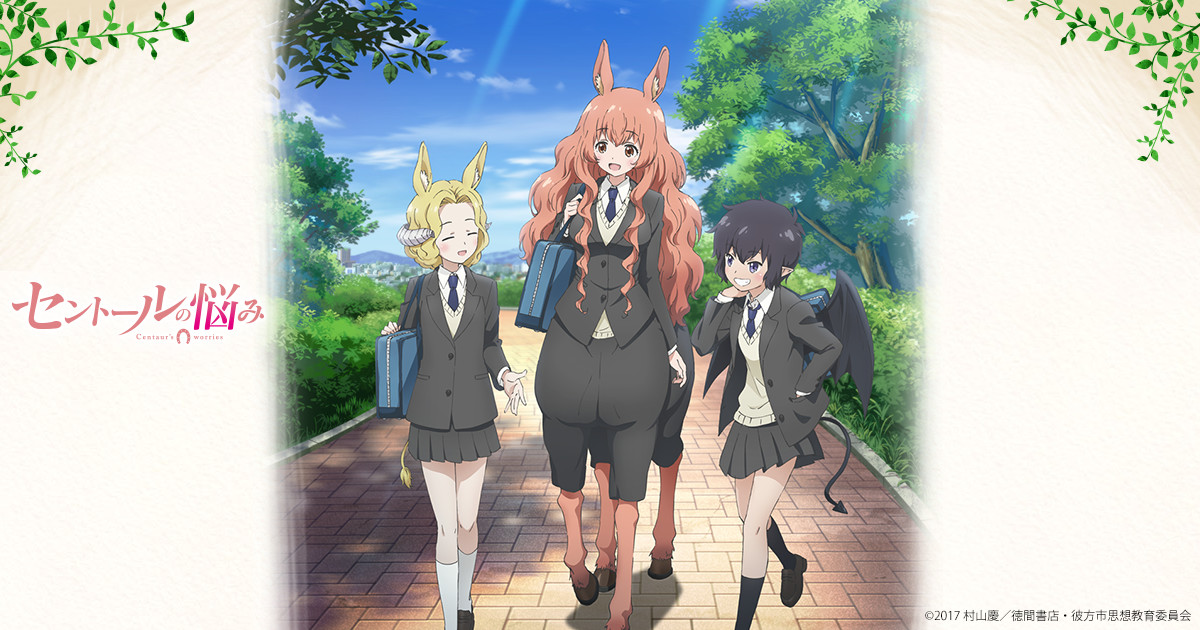
The Sentor's Trouble" is a manga work by Kei Murayama, serialized in the monthly COMIC Ryu magazine since 2011 and animated in 2017 by E Joy Production. Set in a world where six-limbed creatures have evolved into humans, the story depicts the daily life of the main character "Kimihara Haino," a "human horse" whose upper body is human and lower body is horse. The work mainly depicts daily life and has many healing and moe elements, but it also includes themes such as discrimination and war, and has a dystopian style that leaves a dystopian impression.
Overview of "The Sentor's Trouble"
The Sentor's Troubles" is a manga work by Kei Murayama.
It won the 8th Dragon God Award (Silver Dragon Award) and began serialization in "Monthly COMIC Ryu" in 2011.
It was adapted into an anime in 2017, produced by the Chinese animation company E Joy (HAOLINERS STUDIO).
The week before the first episode aired, a special program "The Trouble with Sentor: The Great Dissection Special" was aired just before the broadcast.
The title "Centaur" is an English reading of the word "centaur," a race in Greek mythology in which the upper body is human and the lower body is horse.
The protagonist of this work, "Kimihara Haino," is a high school girl who is a centaur.
The world of this fantasy work is a bit different from modern Japan, where six-limbed animals evolved into human beings instead of four-limbed animals.
It is a fantasy daily life work that is a little different from modern Japan. It also contains a little sexual and homosexual expression.
The work is not what one would call a "healing" type of daily life story, as it contains dystopian descriptions in places.
Synopsis and story of "The Sentor's Trouble"
Humans evolved from pectoral, anteroventral, and posteroventral fins to legs when they were fishes, and the six-limbed ecology, which is more dominant in supporting body weight, survived.
In ancient times, there were four-limbed creatures, but they became extinct without offspring when they evolved from fishes to amphibians.
They were then classified as dragon- and winged-people, pastoralists, long-eared- and horned-people, man-horse and tiger-people, mermaids, Antarctic-people, amphibians, and others.
The dragon and winged man are forms in which the midlimbs have been replaced by wings; the winged man has feathers on its wings and a ring of hair on its head, while the dragon man has membranous wings, pointed ears, and a tail.
The long-eared, long-horned, and horned have ears growing out of their heads, the long-eared have tails, the horned have horns, and the long-horned have horns and tails and hooves on their feet.
The long-eared man has a tail, the horned man has horns, and the herdsman has horns and a tail and hooves on his feet. The man-horse and man-tiger are thought to have become extinct.
Mermaids have a form in which the middle and hind limbs are fins, and they live in the water.
Antarctic peoples live in the Antarctic and have a head like a snake.
Amphibians are a race that looks like amphibians and have four arms and one tail.
In this world of various forms, the human-horse protagonist "Kimihara Himeno" attends "Yoritsu Prefectural Shinigami High School.
Classes are monitored and physical, and Himeino and other students are taught the history of human evolution and learn that they must not discriminate based on differences in morphology.
Sometimes equality takes precedence over life and human rights.
HIMENO was running at the end of the marathon in class, together with her classmates and friends, "Goraku Nozomi" (a dragon) and "NAGARA Qiangzi" (a horned human).
Hime-no, who is a human horse and Nozomi, who is athletic, were not tired, but the Qiang Tzu, who is not athletic and has no physical strength, was exhausted.
The three of them proceeded at the pace of the Qiang Tzu, but the Qiang Tzu was exhausted, and Hime-no, who could not see her, asked her if she would ride on her own back (the part of horse), but the Qiang Tzu answered that it was not good.
The human and horse used to be made into a cavalry slave in the past, and nowadays the act of riding astride a human and horse is caught as a form of discrimination.
As the three of them are making slow progress, a teacher on patrol comes riding a bicycle and warns them that they will lose their lunch break if they don't reach the goal quickly.
With Nozomi leading the way, they take a shortcut off the marathon course back to the school, but their cheating is in vain as they arrive at the school just as the chime for the end of lunch break rings.
Manami Mikon, the class president and wingman of Himeino's class, lives with her four younger sisters and father, and is in charge of the household chores.
One day, Manami and Manami's younger triplets "Chigusa," "Chinami," and "Chiho," along with Himeino and Himeino's cousin "Shino," bump into each other on the street.
Chigusa and the others and Shino are the same age and became friends.
Manami also has another youngest sister, Mimitsu, who is weak from birth and has trouble sleeping.
The triplets take care of Mitsumi when Manami is away at school, and the family cooperates with each other.
Manami is serious and a perfectionist, but she values her family more than her work as the committee chairperson, and has the air of a mother even though she is a high school girl.
One day, an Antarctic "Quetzalcoatl Sassus Sul" transfers to Himeino's class.
It is only recently in history that Antarctic people started interacting with mammals, and it is very rare for them to come to Japan, and Sassus Sulu is surrounded by public security guards.
Hime-no had a dislike of Antarctic people due to a horror movie about them, but she overcomes this dislike when she becomes friends with Sassus Sulu.
Manami and Sassus Sulu also spend a lot of time with Himeino and her friends, and Himeino and her friends go about their normal, uneventful daily lives.
The World of "The Sentor's Trouble
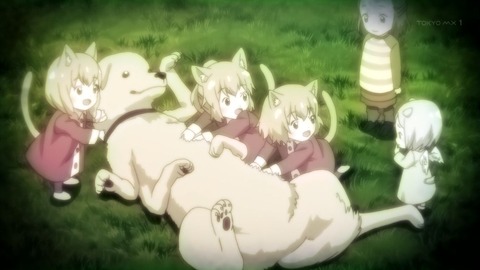
Since the world evolved from six-limbed creatures, dogs also have six legs.
In this film, there are humans who have evolved in their own unique way, slightly different from real humans.
However, there are many places that are roughly the same, such as the Jewish people, a supposed Nazi army, and Japan.
Japan also has a military atmosphere, with the national anthem sung at the end of classes and before movie screenings, etc. Some countries have the same names as countries in the real world but have different cultures and histories.
In the past, there is a history of morphological discrimination arising from physical differences, such as human and horse slaves being used as vehicles and amphibians being targeted for extermination, as well as wars between countries and nations, and between countries and terrorist organizations.
Therefore, there is an extreme proactive disparity correction policy (remedial measures taken to improve the disadvantageous situation of the weak in light of their history and social environment) in ecological discrimination, and equality is prioritized over human rights and life.
In schools, supervised classes are held, where students learn about the different forms of humanity, with emphasis on how discrimination against different forms is wrong.
Mermaid neighborhoods are guarded by the military, and illegal dumping of garbage is shot without warning.
Those who commit crimes of discrimination are sent to the "Thought Correctional Center," which is practically the same as the death penalty.
The Thought Correctional Center is a rehabilitation facility where people are detained for "crimes against equality and humanity. However, it is said that those who are sent to this facility have a strong sense of discrimination and a discriminatory religion, and that once they enter, they will never come out again.
In the work, Hime-no asked Qiang-chi, who was tired during the marathon, if she could ride on her back, but she was told that the act of riding on a human horse is an act of discrimination and that she would be sent to a correctional facility.
The history and culture are so deeply rooted in their daily lives that even ordinary high school girls talk about such things in their conversations.
Although this is an everyday work, these elements are the reason why this work is said to be dystopian.
Winged/Dragonian type
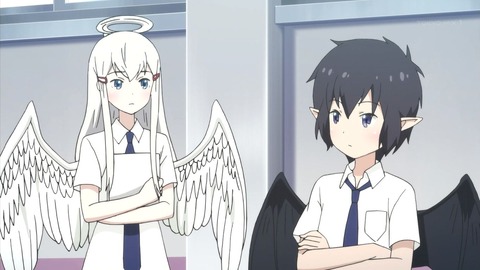
Winged (left), Dragon (right)
A form in which the middle limb becomes a wing.
The winged person has feathered wings and an angelic ring of hair on its head.
If this ring of hair is cut off, the form is discriminated against and the person is captured.
Dragon people have featherless wings, elongated tails and pointed ears.
At first glance, the forms look like angels and demons.
Long-eared/horn/pastor type
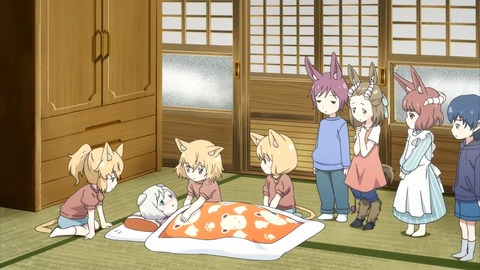
Long-eared Man (leftmost), Horned Man (second from right), Pastoralist (third from right)
Ecology in which the middle limbs degenerated to only traces and ears grew out of the head.
Horned people have horns, long-eared people have tails, and pastoralists have tails, horns, and hoofed feet.
Incidentally, the word "pastor god" comes from the Greek myth of the pastor god Paan, a half-man, half-beast whose upper body was a man and whose lower body was shaped like a two-legged but hoofed horse.
Man-horse/Human-tiger type
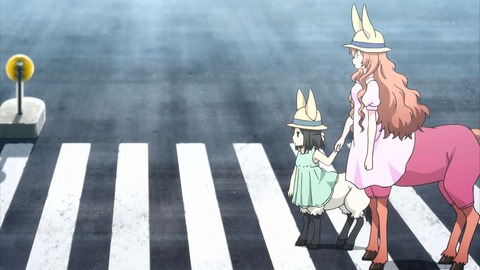
men and horses
This form has a human upper body and a horse/tiger lower body, with ears growing out of its head.
The human-tiger is believed to be extinct, but in comics, there is a human-tiger revived by the Antarctic people.
The man-horse had high physical capabilities and was a warrior in Japan, but in Western Europe, it was a slave instead of a mounted beast until the French Revolution.
Therefore, the act of riding a man-horse is now considered ecological discrimination and is strictly forbidden.
mermaid-like
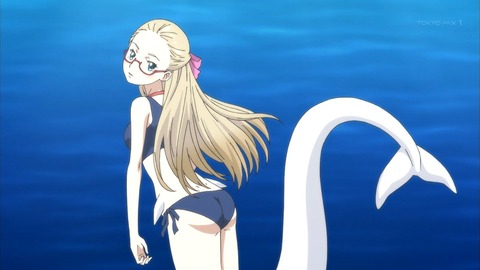
mermaid
The middle and lower limbs become fins, a form specialized for life in the water.
Both male and female mermaids keep their upper bodies uncovered when they are alone, and male mermaids do not think anything of it when they see the upper bodies of female mermaids of the same species.
However, when they appear in front of people living on land, they wear clothes.
Mermaids call all other land-dwelling creatures "mountain people.
Many of the women are glamorous with large eyes.
When a female character's upper body is exposed, it is restricted by a mysterious white light.
Antarctic person
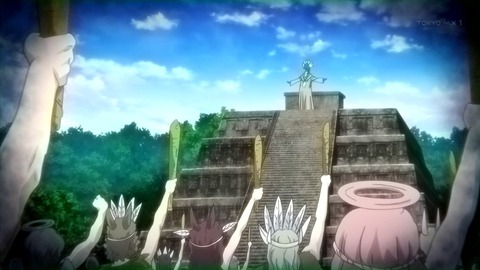
A form with a serpent-like head that lives in the Antarctic. There are intelligent species and fighting species.
The term "Antarctic serpentine" is discriminatory.
The Antarctic people lived around the Aztecs, fought off conquistadors during the Aztec Empire, and were considered near-gods by the Aztecs.
Conquistadors means invaders in Spanish, and refers to the Spaniards who attempted to invade the Americas across the sea during the Age of Discovery.
In reality, although the Antarctic people provided knowledge and technology to the mammals, they were non-interventionists in politics and were simply revered as symbols.
Although they had not interacted with other mammals for a long time, they began to interact with other mammals in the mid-20th century.
According to tradition, its ancestors resembled a snake with three pairs of six legs, and it crawled and noticed underground cities.
They socialized like ants, and all presently active Antarctic peoples are sisters born of a single queen.
Since mammals have never dissected Antarctic man, much remains unknown to this day.
Antarctic intelligence
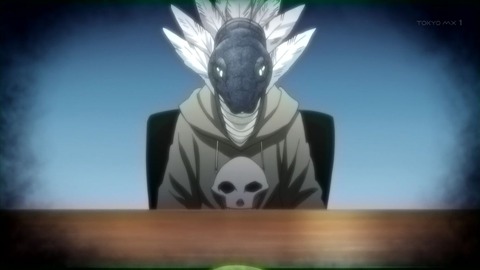
intelligence species

Tags
Contents
- Overview of "The Sentor's Trouble"
- Synopsis and story of "The Sentor's Trouble"
- The World of "The Sentor's Trouble
- Winged/Dragonian type
- Long-eared/horn/pastor type
- Man-horse/Human-tiger type
- mermaid-like
- Antarctic person
- Antarctic intelligence
- Antarctic battle species
- amphibian
- space alien
- Characters and characters in The Sentor's Trouble
- key people
- Hime-no Kimihara
- Nozomi Goraku
- Qiang-Chiang Tzu Naraku
- Quetzalcoatl Sassafras
- Manami Mitama
- Classmates at Shin Kongo High School
- Mitsuyo Akechi
- Michiru Inukai
- Makoto Omaki
- Relatives of key players
- Shino
- Chigusa Mitama, Chinami Mitama, Chiho Mitama
- Mitsumi Mitama
- Other
- Jean Rousseau
- chairman
- Highlights, famous scenes, and famous moments from "The Sentor's Trouble"
- Various species
- Dystopian worldview with occasional glimpses
- Ancestors of Himeino
- Quetzalcoatl Sassu Sulu's arrival.
- Interaction between sisters
- arm wrestling match
- Theme song for "The Sentor's Trouble"
- Opening theme "Teach me Darwin
- Ending theme "Edelweiss
- Comic based on "The Sentor's Trouble"
- Blu-ray of The Sentor's Trouble
- Official website for "The Sentor's Trouble"