
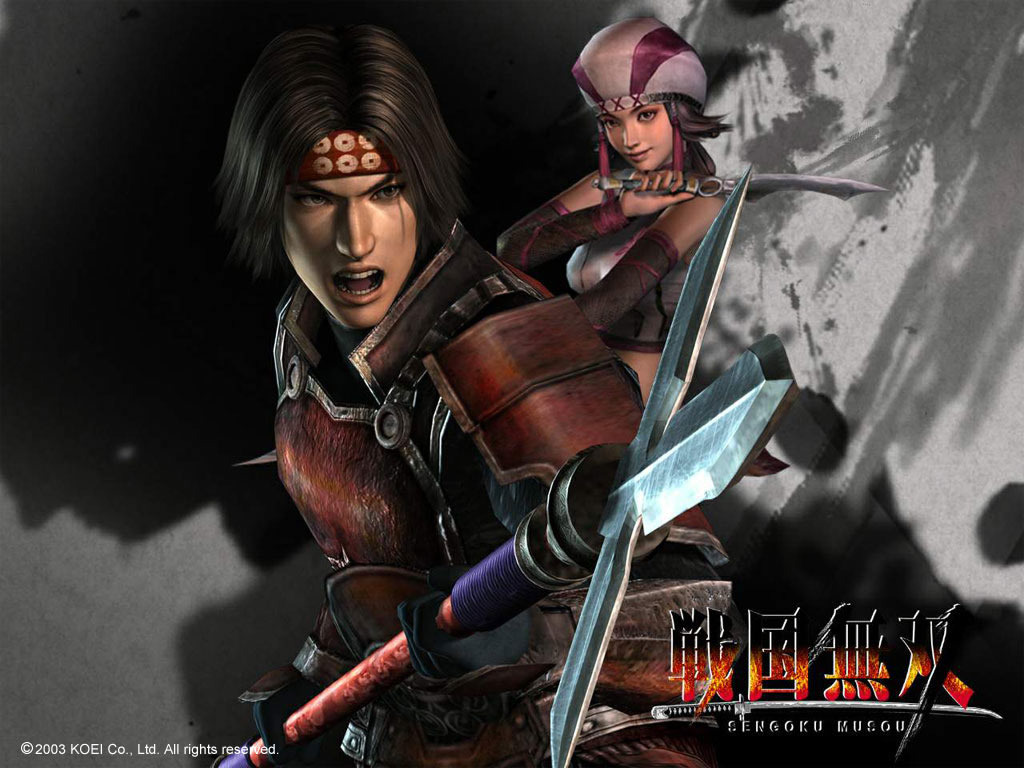
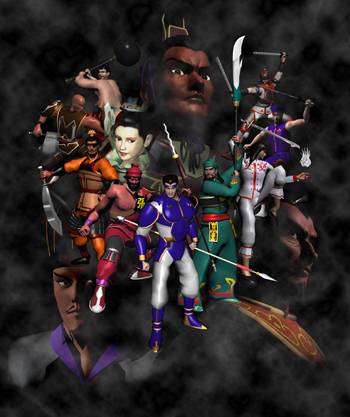
Sengoku Musou" is the first game in the "Sengoku Musou" series, released by Koei on February 11, 2004. It is also a sister title to "Shin-Sangoku Musou" series. The game takes place during the Warring States Period in Japan, where warlords who have left their mark on history run through various battlefields. The game features a multi-ending system in which the story of each general has a different ending, and a new history can be spun out depending on the player's actions.
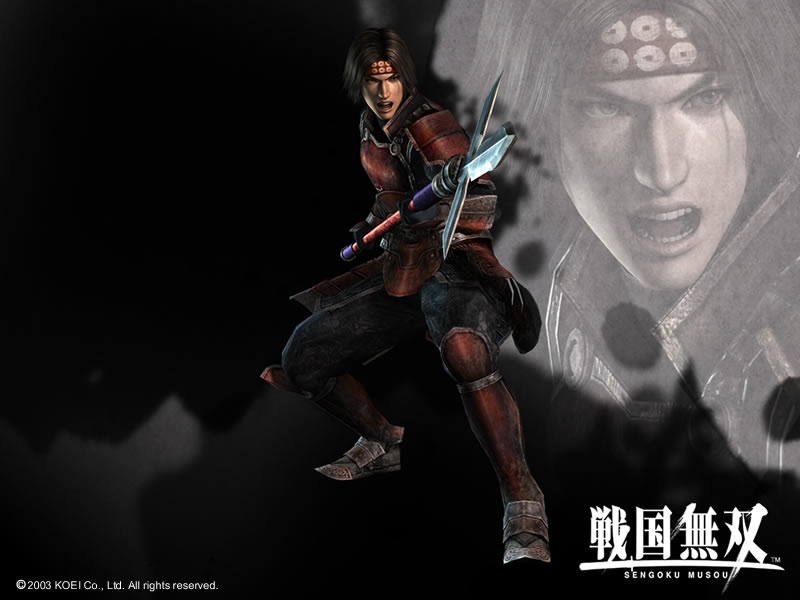
Height: 185 cm Weapon: Jumonji Spear Musou Okuyoshi: Courage Musou Secret Okuyoshi: Flame CV: Takeshi Kusao
The second son of Sanada Masayuki, a local lord in Shinshu who served under Takeda Shingen and Katsuyori. His real name is Sanada Nobushige, but he is more widely known as Sanada Yukimura.
He fought against the Tokugawa forces as a general in Toyotomi's army during the Winter and Summer Campaigns in Osaka. In the summer campaign, he even attacked Tokugawa Ieyasu's headquarters, but was finally defeated by the Tokugawa forces, who outnumbered him in strength. He was 49 years old at the time of his death, but he was described as "the best soldier in Japan" for his tremendous warfare, and became the subject of many stories and novels in later years.
He is the main character in this game. In the early stages of the game, he appears as a subordinate of Shingen Takeda and participates in the Battle of Kawanakajima. He is a serious and sincere character who values faith, and is brave and resolute on the battlefield, but is usually a gentle and soft-spoken young man. He is a gentle, soft-spoken young man, and he calls Shingen "Otate-sama," or "Lord of the House," as he struggles to realize Shingen's ideal of peace in the land. Yukimura's "Musou Enbu" scenario can be divided into two routes: one leads up to the Osaka Summer Battle as in historical fact, and the other has Shingen survive and the country is pacified by the Takeda family.
In the "Osaka Natsu no Jin" route, there are two endings: the main ending, in which Shingen attacks Ieyasu's main camp and is killed in a fierce battle, and the "real" ending, in which Shingen survives the battle.
The former is particularly popular among the Yukimura endings in the "Sengoku Musou" series, with many fans declaring it to be the best.
Keiji Maeda
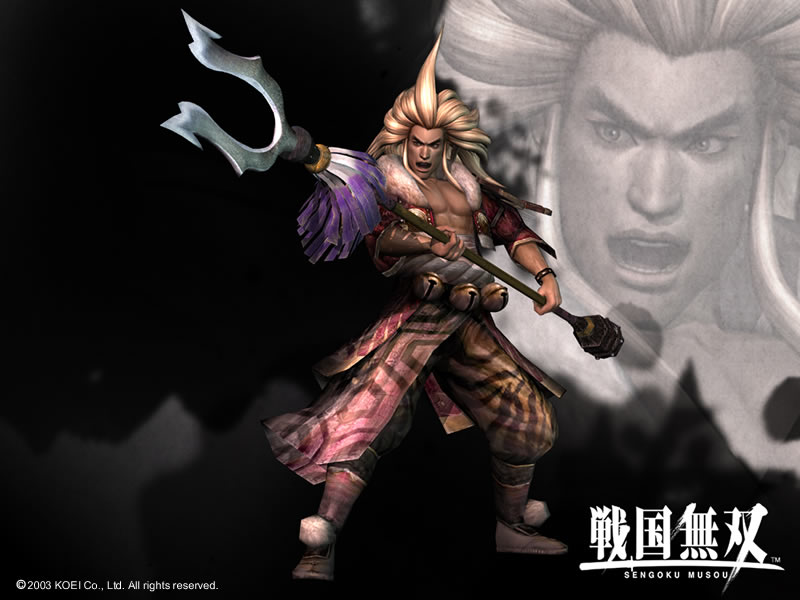
Height: 210 cm Weapon: Nimata Koko Muso Okuyi: Gou Muso Secret: Tiger CV: Ueda Yuji
His real name is Maeda Hitoshi, but he is better known as Keiji or Keijiro due to the manga "Hana no Keiji" featuring him. Other names include Sohei, Rita, Rita Dai, Risada, Kokuzoin Hyottokosai, and Ryusaiken Fubensai, and other names that vary depending on the time period. He was a nephew of Toshiie Maeda, and is said to have originally come from the family of Kazumasa Takigawa, an important vassal of the Oda family. He later served in the Uesugi clan and distinguished himself in the Battle of Hasedo Castle. Due to the scarcity of reliable data, the current portrayal of Maeda Keiji is largely based on novels and manga.
In video games, Maeda Keiji is known as "the most eccentric and eccentric person under heaven," and is one of the most powerful characters in terms of both his position and performance. His personality is bold, open-minded, and without a trace of arrogance. He is a free spirit who loves to fight and live in a turbulent world, but at the same time, he has very strong convictions and will never deviate from them.
At first, he was a member of the Oda Army, but he ran away from the army because he found Nobunaga's methods difficult. After that, he wanders around the country, getting into numerous fights and battles, and meeting many different people along the way.
Nobunaga Oda
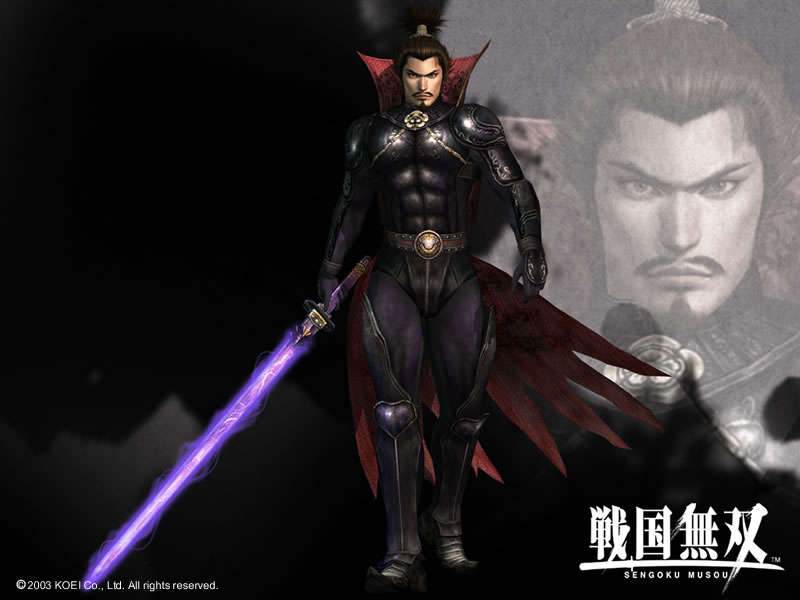
Height: 190 cm Weapon: Yohkou Musou Oukyoku: Ten Musou Secret: Ha CV: Jurota Kosugi
Kosugi Jurota is a feudal lord in Owari, and is known as one of the "Three Great Masters" along with Toyotomi Hideyoshi and Tokugawa Ieyasu. As a child, he was known as the "Great Usoke of Owari" because of his bad behavior and eccentricities. In the Battle of Okehazama, he defeated Imagawa Yoshimoto, a feudal lord of Suruga and Omi, and later defeated Saito Tatsuoki, a feudal lord of Mino, to become a feudal lord of two provinces, Owari and Mino. After that, he made great strides, and although he ended up making enemies of many powers, he defeated them one after another with his skillful tactical leadership.
Finally, he effectively destroyed the Muromachi Shogunate and paved the way for the end of the turbulent Warring States period. However, in 1582, he was rebelled against by Akechi Mitsuhide, a vassal of the Oda clan, and committed suicide at Honnoji Temple.
In the game, he calls himself the "Sixth Heavenly Demon King," and is a rationalist who seeks supremacy under heaven. He is feared by both friend and foe alike as a demon king because of his harsh strategies and tactics, and his ruthless character that shows no mercy to those who defy him. He has a transcendent mindset that is not bound by existing social structures, ideologies, or moral concepts, and dismisses them with a single word, "worthless," if he deems them unnecessary. He is also a man of few words, which further strengthens the impression that he is difficult to understand.
Before the first stage of the battle of Okehazama, there is a scene in which he chants the Kowaka dance "Atsumori," which was also performed in historical fact. Also, because of his position as the Demon King of the Warring States, he appears as the last boss in most of the scenarios of the generals.
Mitsuhide Akechi
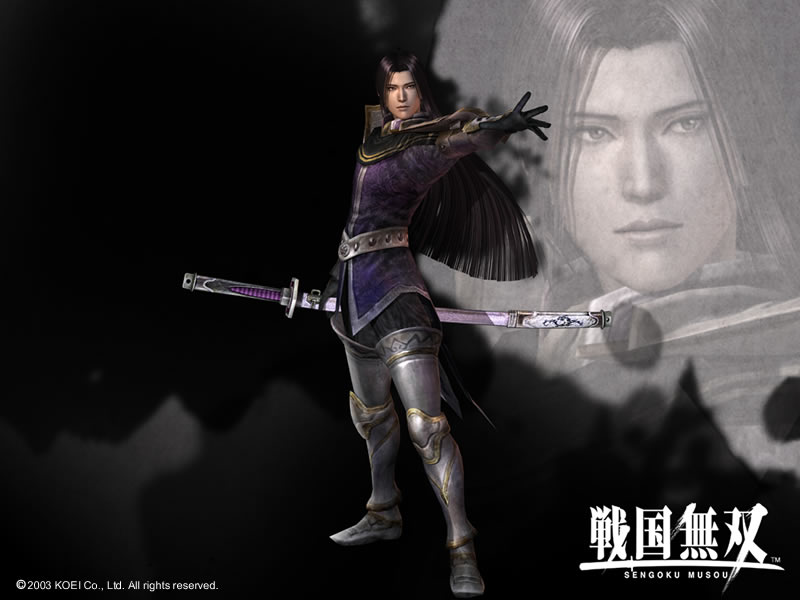
Height: 175 cm Weapon: Japanese sword Muso Okugi: Sen Muso Secret: Chimu CV: Hikaru Midorikawa
He was discovered by Nobunaga and made a vassal of the Oda family, but later committed a rebellion known as "Honnoji no Hen" and forced Nobunaga to commit suicide. Later, he was defeated by Hashiba Hideyoshi in the Battle of Yamazaki, and it is said that he was killed in a hunt for fallen warriors on his way to the capital, or that he committed suicide after receiving a fatal wound. There are various theories about his first half of his life and the motive for his rebellion, but in the end, there are many unknown points, and he is a military commander with many mysteries.
Although he has a strong negative image as a rebel, he was a military commander with both military and political skills, as well as a well-educated and well-versed man of letters and the martial arts, and was adored as a great lord in his domain. He was a man of both literary and military prowess who was highly educated and well respected in his domain. For this reason, even today there are areas where Mitsuhide is enshrined as a deity, and he is being reevaluated in recent years.
In the game, Mitsuhide is portrayed as a sincere and kind-hearted warlord who aims for a "world without war. He is also elegant and courteous, using polite honorifics even to his subordinates. On the other hand, his gentle and overly earnest nature makes him prone to fretfulness and mental fragility. Her beautiful black hair and fair face give her a delicate and fragile atmosphere.
In the beginning of the game, she serves the Saito family, which seems to be based on the historical fact that the Akechi family served Dosan Saito. Later, he is invited by Princess Nohime to serve Nobunaga, but their differences in ideology and Nobunaga's harshness lead to a deepening conflict.
Incidentally, white feathers are used in Mitsuhide's Muso no Okugi and victory moves, in stark contrast to Nobunaga, who uses black feathers in his moves.
Ishikawa Goemon
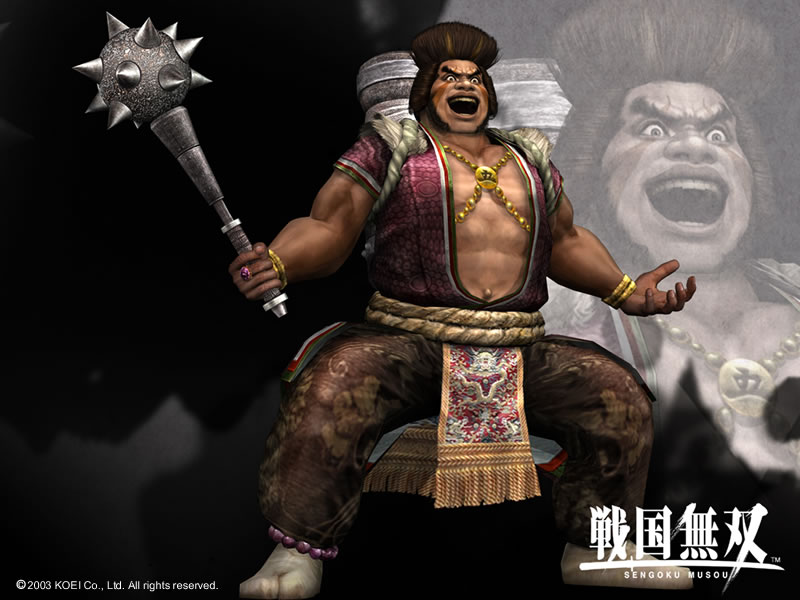
Height: 195 cm Weapon: Golden club and cannon Musou Oukyoku: Break Musou Secret Oukyoku: Explosion CV: Hisao Egawa
A bandit who actually existed in the Azuchi-Momoyama period, he was captured in 1594 and sentenced to be boiled in a kettle at Sanjo-kawara in Kyoto. After the Edo period (1603-1867), he became widely known as a "legendary thief" as many works featuring him as a righteous bandit who was after the life of Toyotomi Hideyoshi began to be produced.
There are a great many works based on him, such as kabuki, joruri (traditional Japanese puppet play), and rakugo (comic storytelling). However, there are few reliable historical records, and for a time his actual existence was questioned.
In the game, he is a giant of a man who prides himself on being "the greatest thief under heaven. He is a flamboyant and dynamic man with a funny and good-natured personality that is hard to dislike. He is in love with Aguni and considers Keiji, who is close to Aguni, to be his one-sided love rival. Keiji is also famous for his eccentricity, which is said to be another reason why he sees her as his rival. In fact, he is a loose ninja from Iga, and Hattori Hanzo is trying to kill him.
His "Musou Enbu" scenario is a story of a rampage in search of the "Chidori no Korou," a treasure under heaven.
Kenshin Uesugi
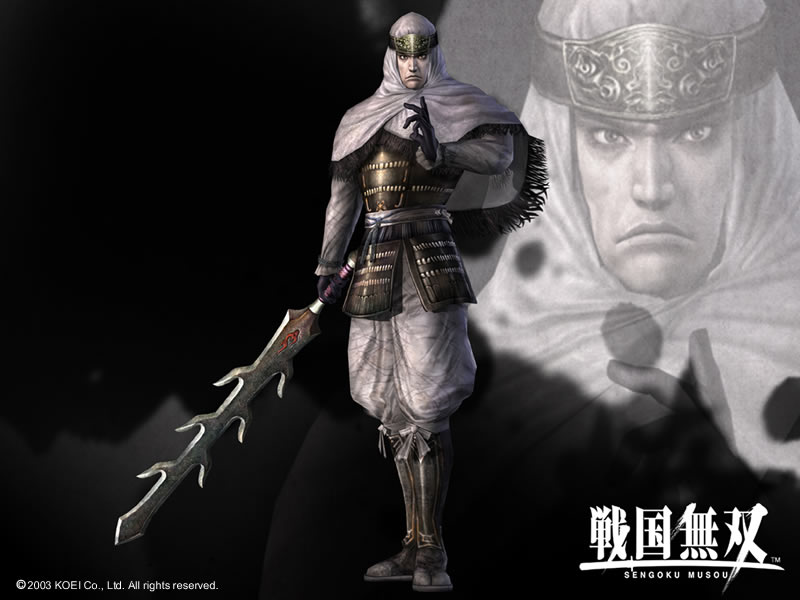
Height: 198 cm Weapon: Nanashikatana Muso Okuyoshi: Buddha Muso Secret: Bi CV: Joji Nakata
A feudal lord of Echigo. He was a skilled fighter and called himself an incarnation of Bishamon (a god of war), which led to his being called "Echigo no Ryu" (Echigo dragon), "Echigo no Tora" (Echigo tiger), "Echigo no Shishi" (Echigo lion), "Gunjin" (military god), and many other names in later generations. He is famous for the Battle of Kawanakajima, fought five times against Shingen Takeda.
It is said that even Nobunaga feared Kenshin because he was so strong in warfare that he fought about 70 battles in his lifetime and was never defeated in a major battle. On the other hand, he was also known as a man of honor and a man of his word. He also made many unprofitable missions, including requests for help from other countries.
In the game, he is portrayed as a stoic seeker who worships Bishamonten and pursues warfare. He has a calm and cool-headed personality, and his taciturnity gives him a strong impression of being out of touch with the world. He calls warfare a "struggle," has no desire for money or territory, and shows no interest in anything other than his own victory.
He takes great pleasure in fighting with powerful enemies, especially with Shingen Takeda, whom he considers to be his sworn enemy. He is a great lover of sake, and even compares his struggle with Shingen to a beautiful drink. However, because he has his own aesthetics in fighting, he is not a fan of wars that desire destruction like Nobunaga's.
Oichi.
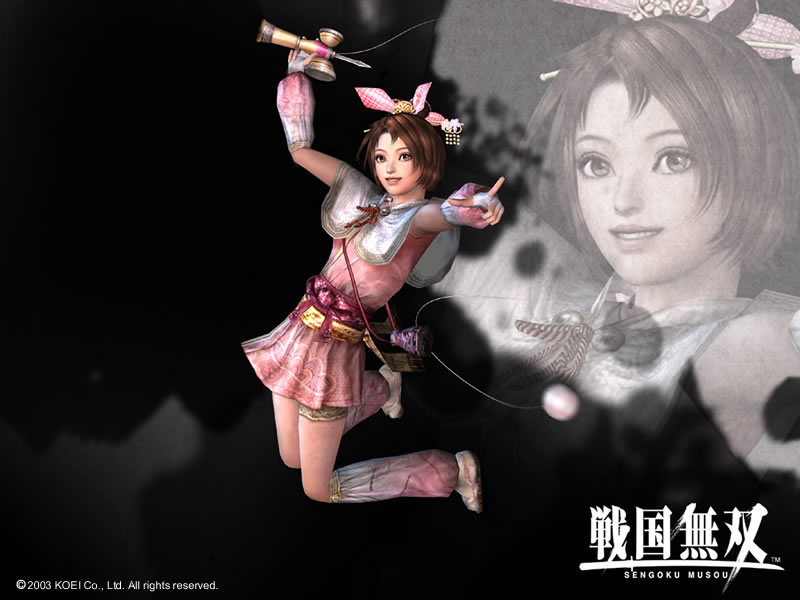
Height: 158 cm Weapon: Sword ball Musou Okuyi: Ren Musou Secret: Butei CV: Maeda Ai
Nobunaga's younger sister, she is said to have been a brilliant woman in addition to being praised as the most beautiful woman in the Warring States period. She was first married to Nagamasa Asai, a feudal lord in Omi. Nagamasa and Asai Nagamasa were married by political intrigue, but it is said that they got along very well. However, Nagamasa turned against Nobunaga and committed suicide after his defeat at the Battle of Anegawa. Oichi herself and the three daughters she had with Nagamasa were protected by the Oda family. After Nobunaga's death, she remarried to Katsuie Shibata, a vassal of the Oda family, but Katsuie fell out with Hideyoshi Hashiba and was defeated by Hideyoshi at the Battle of Dokogedake. Oichi committed suicide together with Katsuie at Kitanosho Castle in Echizen. Oichi's daughters were protected by Hideyoshi, and each of them had their own strange destiny.
In the game, Oichi is portrayed as a naive girl. She is honest and firm, but she also has a side that is prone to violent outbursts of imagination. She cares for both her brother and her husband, and works hard to reconcile the two adversaries. Throughout the series, the costumes are characterized by gentle colors such as pink and white, but the costumes in this work are designed in a cute way that brings the younger sister character to the forefront.
Okuni
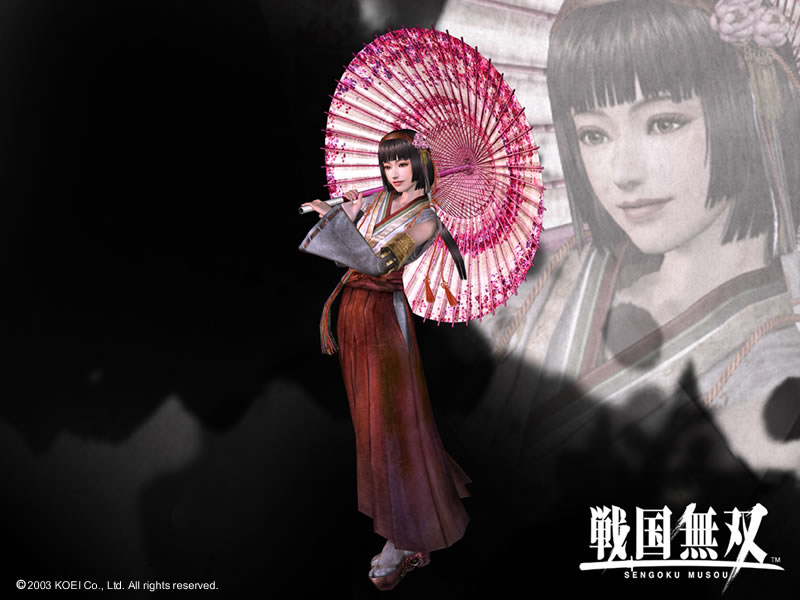
Height: 172 cm Weapon: Bangasa Musou Okugi: Mai Musou Secret: Rei CV: Wakana Yamazaki
A female performer known for founding the Kabuki dance. She is commonly known as Izumo no Okuni. It is said that the Kabuki dance developed through various changes, resulting in today's Kabuki. Although Izumo Okuni is an important figure in the history of the performing arts, he is also a man of great mystery, as many of his stories are legendary and there are very few reliable historical documents.
Perhaps because she is said to have been a priestess of Izumo-taisha Shrine in historical fact, the game's Akuni is also a priestess of Izumo-taisha Shrine, and she travels around the country to promote the shrine. She is a gorgeous beauty who excels at dancing, and Goemon falls in love with her at first sight, but she herself seems to be devoted to Keiji. On the other hand, she is very infatuated and has a bad habit of immediately taking back to Izumo anyone she likes, regardless of gender.
This bad habit has a lot to do with the ending of her story. In addition to the main route, there is another route in the scenario of Aguni where she takes her favorite Musou warriors back to Izumo, and together they face the real ending. The number of Musou warriors that can be brought back to Izumo is 11, excluding Kunoichi, Date Masamune, and Oichi. In other words, there are 11 endings for Aguni. Needless to say, this is the largest number of endings in this title.
female ninja

Related Articles
An in-depth look at the hot new Musou series, "Arslan Senki x Musou"!
The newest addition to the Musou series, "Arslan Senki x Musou". The Musou series has collaborated with various works such as Hokuto Musou, Pirate Musou, and Zelda Musou, and now they have decided to collaborate with "Arslan Senki"!
Read Article
Spoiler commentary and discussion of MUSOU OROCHI (Mujiru / The Second Coming of the Demon King / Z)
Musou OROCHI" is an action game released by Koei to commemorate the 10th anniversary of the "Musou" series. The game is a crossover between the "Shin-Sangoku Musou" series and the "Sengoku Musou" series, and the main feature of the game is that players can control more than 70 warriors, including the original characters from this game. The co-starring of the Warriors and the Sengoku was so well received by fans that a sequel, "Warriors OROCHI: The Second Coming of the Demon King," was later released. The worlds of the Three Kingdoms and the Warring States are fused together by the sudden appearance of the Demon King Enrochi. The warlords of the Three Kingdoms and Sengoku fight together and against each other, but eventually unite to overthrow Toorochi.
Read Article
Spoiler commentary and discussion of Sengoku Musou - Sanadamaru (game)
Sengoku Musou: Sanadamaru" is a game title released in November 2016. It is part of the "Sengoku Musou" series and is also an official tie-in with the 2016 NHK historical drama "Sanadamaru". Based on the "Sengoku Musou 4" series, the main feature of this game is that the story focuses on the Sanada family. The drama of the turbulent Sengoku period unfolds with father and son Masayuki and Yukimura Sanada as the main characters. In addition, the game features a number of new challenges, such as long-term battles, the concept of day and night, and changes in appearance with the passage of time.
Read Article
Spoiler commentary and discussion of Sengoku Musou 4 (4-II / 4Empires / 4DX)
Samurai Warriors 4" is the fourth PS3 game in the "Sengoku Musou" series, released in March 2014. It is also the 10th anniversary title of the series, which is set in the Sengoku Period and features a number of warriors in action. A PS4 version was later released. Various dramas unfold in the turbulent Sengoku period, centering on the bond and rivalry between Yukimura Sanada, the main character of the series, and Yukimura's elder brother Nobuyuki, who joins the series for the first time in this title.
Read Article
Spoiler commentary and discussion of Sengoku Musou 2 (2Empires / 2Takeshouden)
Sengoku Musou 2 (Samurai Warriors 2) is the second title in the "Sengoku Musou" series of action games set in Japan's Warring States period. In contrast to the previous game, which focused on the age of the rivalry between the warring factions, the story of "Samurai Warriors 2" centers on the battle of Sekigahara. Later, "Empires" and "Takerushoden" were also released. It is also highly regarded as the work that established the "Sengoku Musou" series in all aspects, including action and systems.
Read Article
Spoiler commentary and discussion of Sengoku Musou 3 (3 Resshouden / 3Empires)
Samurai Warriors 3" is a Wii exclusive game released in December 2009, with a PS3 version released later. It is the third title in the "Samurai Warriors" series, which is set in the Warring States period and tells the story of a number of generals. The game focuses on the various forms of "bonds" among the warlords and is characterized by its three main storylines: "Kanto Sangokushi," "Sengoku no Sanketsu," and "Sekigahara no Wakamusha.
Read Article
Spoiler commentary and discussion of Shin Mikuni Warriors 2 (2 Resshouden)
Shin-Sangoku Musou 2" is an action game released by Koei (now Koei Tecmo Games) in 2001, and is the second title in the Shin-Sangoku Musou series. The game was a huge hit, with the content greatly enhanced and the dissatisfactions of the previous title resolved. The game features 41 characters based on the generals who appeared in "Sanguozhi" (The History of the Three Kingdoms). The main objective of the game is to unify the three kingdoms by leading your army to victory with the generals you have chosen.
Read Article
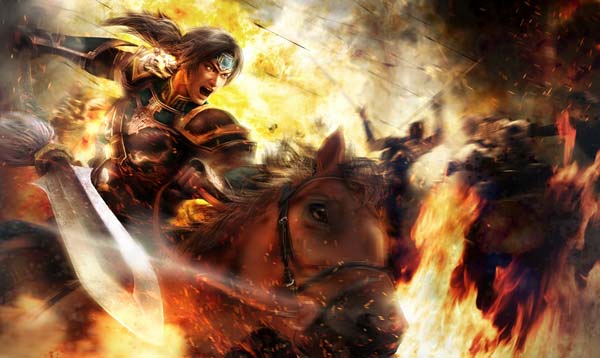
Spoiler commentary and discussion of Shin-Sangoku Musou 7 (7 Resshouden / 7Empires)
In Koei Tecmo Games' "Shin-Sangoku Musou" series, players control the warriors from "Sangokushi" to battle through numerous battlefields. This game is the seventh in the series. Later, "Shin Mikuni Musou 7 with Toushouden" was released as the first PS4 version of the series, which was bundled with "Shin Mikuni Musou 7 with Toushouden". The basic storyline is based on historical facts, but the main feature of this title is that players can advance to an IF route depending on their actions. The number of warriors in the game is 77, the most ever in the series.
Read Article
Spoiler commentary and discussion of Shin-Sangoku Musou 8 (game)
Shin-Sangoku Musou 8" is the eighth title in the "Shin-Sangoku Musou" series, an action game in which players control the warriors from "Sangokushi" to develop the story. This is the first numbered title in five years. The main feature of this title is the adoption of an open world system, a first for the "Dynasty Warriors" series. With the addition of the new generals, the number of playable Musou generals finally exceeds 90. In the main mode, each warlord has a separate scenario, and the player follows the life of the warlord as he or she progresses through his or her own story.
Read Article
Spoiler commentary and discussion of Warriors Orochi 2 (Warriors Orochi 3)
Musou OROCHI 2" is an action game title released by Koei Tecmo Games on December 22, 2011. It is a sequel to "Musou OROCHI". The main feature of this game is that not only characters from "Sangoku & Sengoku Musou" but also characters from other works by Koei Tecmo and other manufacturers participate in the game. The setting is an alternate world where several years have passed since the previous game. The world is on the verge of extinction when a monster, the "Yokeserpent," appears out of nowhere. The surviving heroes face a battle that transcends time and space in order to regain their lost friends and save the world.
Read Article
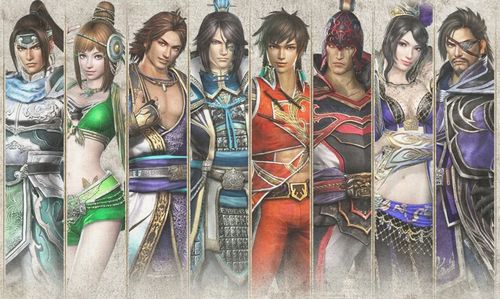
Spoiler commentary and discussion of Shin-Sangoku Musou 6 (6 Resshouden / 6Empires)
Shin-Sangoku Musou 6" is the sixth title in the "Shin-Sangoku Musou" series released by Koei Tecmo Games in March 2011. Up until now, the story has focused on the three kingdoms of Wei, Shu, and Wu, but this title finally introduces the fourth country, Jin, which ended the Three Kingdoms period in historical fact. With this, the story of the latter half of the "Romance of the Three Kingdoms," which has not been depicted much in past works, is also focused on in this work. The number of generals has also been greatly increased, with a record number of 62 generals participating in the game.
Read Article
Fire Emblem Warriors: Fuuka Yukigetsu (game) spoiler commentary and discussion.
Fire Emblem Musou: Fuuka Yukigetsu" is an action simulation game released by Koei Tecmo Games for the Nitendo Switch. The game allows players to enjoy exhilarating action while controlling the main character and his companions, who are original characters in the game. The main character is a mercenary who, together with his friends, must fight a battle for Fodora in order to defeat his sworn enemy, the "Gray Devil".
Read Article
Spoiler commentary and discussion of Shin-Sangoku Musou 5 (5Special / 5Empires)
Shin-Sangoku Musou 5" is the fifth title in the "Shin-Sangoku Musou" series of games based on "The Legend of the Three Kingdoms" released by Koei (now Koei Tecmo Games) in November 2007. It was the first game in the series for the PS3. The new medium brought about unprecedented attempts at character visuals, a drastically revamped action system, and enhanced strategic elements. It can be said that this was a turning point for the series, with various experiments being conducted in all aspects.
Read Article
Spoiler commentary and discussion of Shin Mikuni Warriors 4 (4 Resshouden / 4Empires)
Shin-Sangoku Musou 4" is the fourth title in the "Shin-Sangoku Musou" series of action games in which players control the generals from "Sangokushi" to lead their armies to victory. There are 48 generals available, and each general has his own Musou mode. The introduction of a new graphical engine has greatly improved the stealth and processing lag that have long been a problem, allowing the player to experience the thrill of the "one-hit warslayer" experience.
Read Article
Spoiler commentary and discussion of Shin-Sangoku Musou 3 (3 Resshouden / 3Empires)
Shin-Sangoku Musou 3" is a video game released by Koei (now Koei Tecmo Games) in February 2003, and is the third title in the "Shin-Sangoku Musou" series. The player assumes the role of a general and aims for victory in his own army. There are 42 generals available. While the previous game's Musou mode was based on generals, this game's Musou mode is based on forces, and a major feature of this game is that the player can change generals midway through the game.
Read Article
Spoiler commentary and discussion of Sword Warriors (Tousou Musou, Tourabu Musou).
Toukendanbu Musou" is a tactical action game based on the sword training simulation game "Toukendanbu". It is also a collaboration between the "Musou" game series and "Sword Dance". The story takes place in the year 2205 AD. The story depicts the battles of "Toushi," 15 mourning gods of swords who have lost their masters, who are sent by the government to investigate a plot by "historical revisionists" to change the history of Japan.
Read Article
Zelda Warriors: Apocalypse of Evil (game) spoiler commentary and discussion.
Zelda Warriors: Apocalypse of Evil" is an action game developed by Koei Tecmo Games and released in 2020, and is a collaboration between "The Legend of Zelda" and the "Warriors" series. The game is based on the "Great Disaster" that occurred 100 years before "The Legend of Zelda: Breath of the Wild," and allows players to enjoy the exhilarating action that only the "Warriors" series can provide. The ability to control not only Link, but also other familiar characters from "The Legend of Zelda: Breath of the Wild" is one of the charms of this game.
Read Article
Spoiler commentary and discussion of Muso☆Stars (game)
Musou Stars" is a game title released by Koei Tecmo Games in March 2017. It is also an all-star game in which characters from the company's brand titles fight together. The setting is a certain other world. One day, the heroes are suddenly summoned to another world, where they meet three royal families, each of whom begs for their cooperation. The heroes are then caught up in a three-way struggle in a strange world. One of the major features of this title is that the story's development and ending depend on the player's choices, as it adopts a multiple ending system.
Read Article
Spoiler commentary and discussion of Shin-Sangoku Musou (the game).
Shin-Sangoku Musou (Dynasty Warriors 2) is a video game released by Koei (now Koei Tecmo Games) in August 2000, and is the first title in the Shin-Sangoku Musou series. The genre of the game is an action game. The main feature and appeal of the game is its "one-man warriors" action, in which a single player can defeat multiple enemies.
Read Article
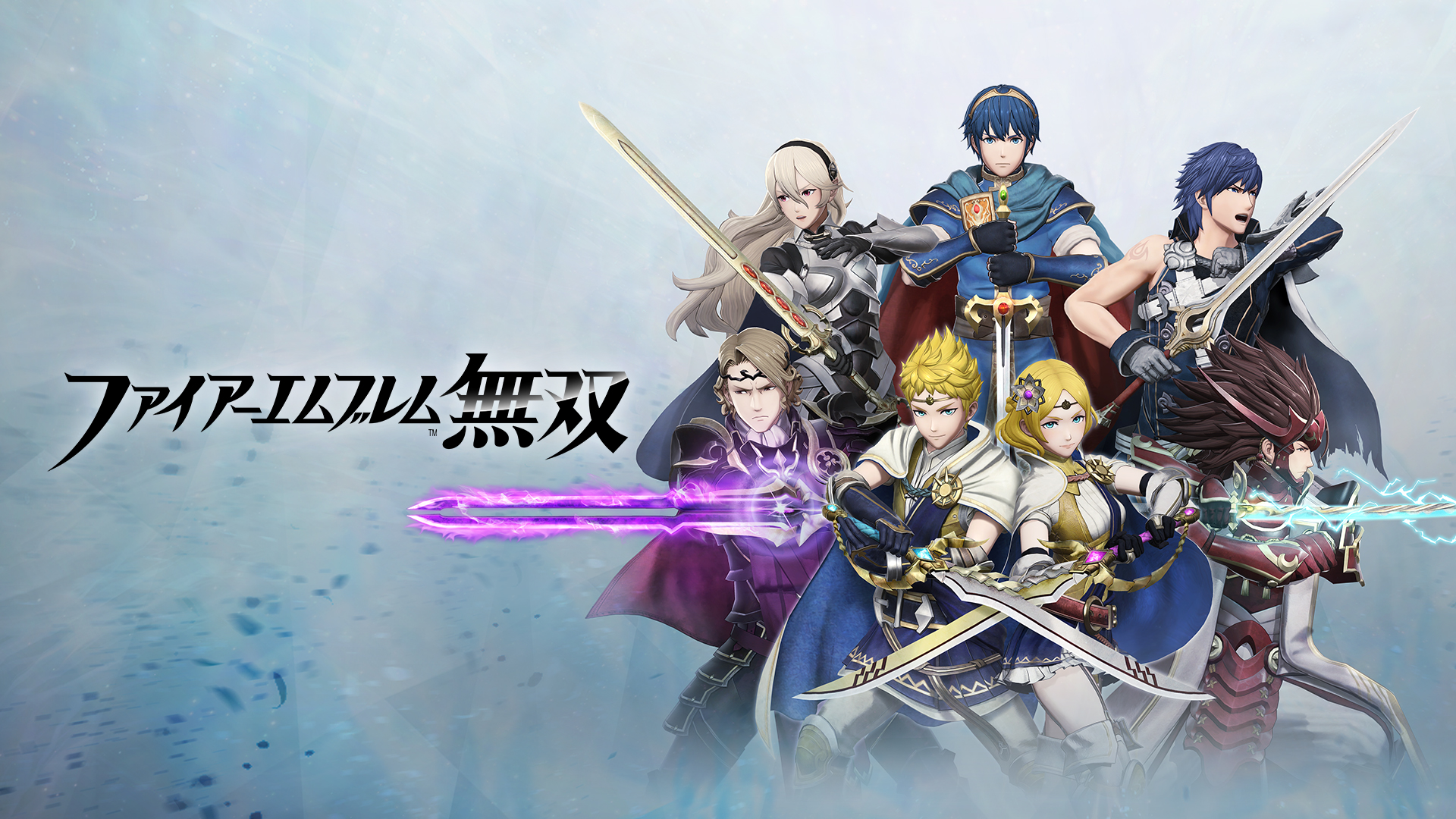
Fire Emblem Warriors (game) spoiler commentary and discussion.
Fire Emblem Warriors" is an action game released by Koei Tecmo Games in 2017. Players can enjoy exhilarating action by controlling characters from previous "Fire Emblem" games. There are also elements that allow players to develop their characters and deepen their friendship with other characters, and all of the game is fully voiced. The kingdom of Aitolis has been plunged into darkness after the castle fell due to demons that appeared from the gates of the Otherworld. Theon and Lian, the children of the previous king, who succeeded in escaping from the castle, travel with the successive protagonists to confront the mighty darkness.
Read Article
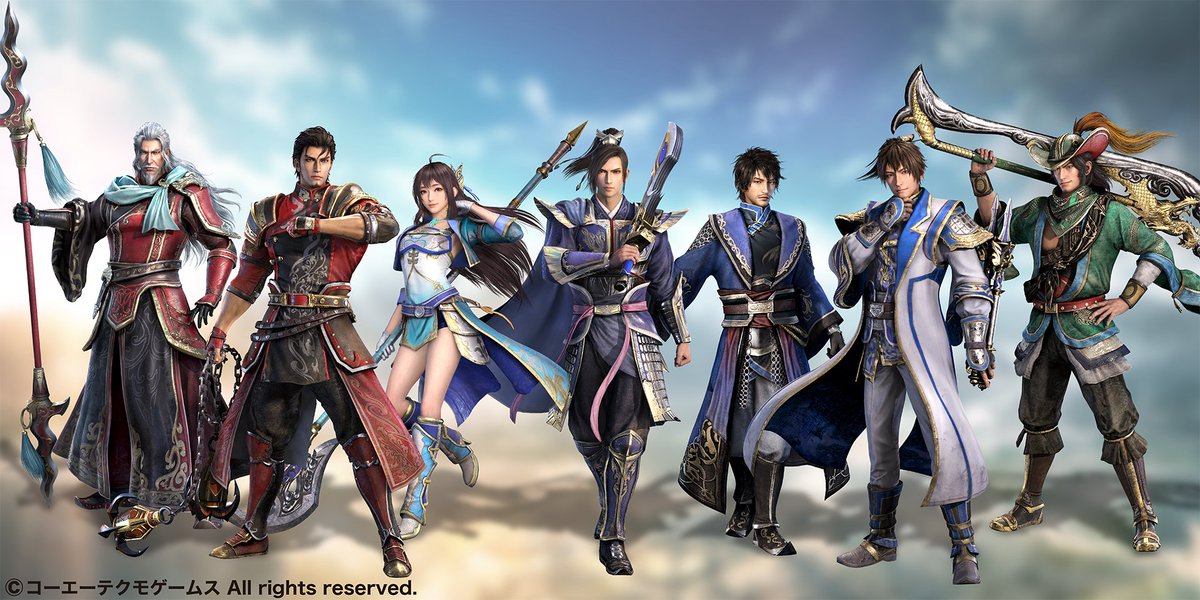
Which character is your favorite? Summary of Sengoku Warlords in Shin-Sangoku Musou 8
Shin-Sangoku Musou 8 is an open-world game set in mainland China, released in 2018. The characters in the game are inspired by the Three Kingdoms, and each of them has a different performance. This article will introduce the characters in "Shin-Sangoku Musou 8", including their performance and usability, along with images.
Read Article
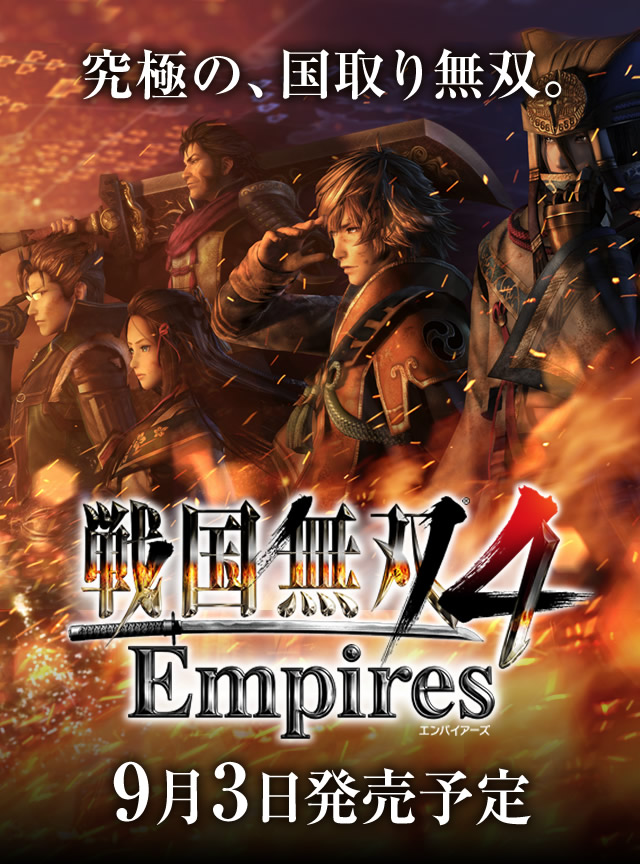
The Definitive Edition of Empires! Summary of basic information on "Sengoku Musou 4 Empires".
Basic information about "Sengoku Warriors 4 Empires," scheduled for release on September 3, 2015.
Read Article
![Sengoku Musou] Summary of derivative works of the hit title, "Musou" series [Sengoku Musou].](https://renote.net/files/blobs/proxy/eyJfcmFpbHMiOnsiZGF0YSI6Mjg1ODAsInB1ciI6ImJsb2JfaWQifX0=--86b3ceb2ca5c6e5bca104a5556fad5232300897f/img59268495.jpg)
Sengoku Musou] Summary of derivative works of the hit title, "Musou" series [Sengoku Musou].
This is a compilation of derivative works of the "Shin-Sangoku Musou" series, a popular work that was a big hit for Koei and established the "Musou action" genre. From "Shin-Sangoku Musou", which started it all, to "TROY Musou" released on PS3, "Hokuto Musou" and "Zelda Musou", which are collaborations with popular manga, are introduced.
Read Article
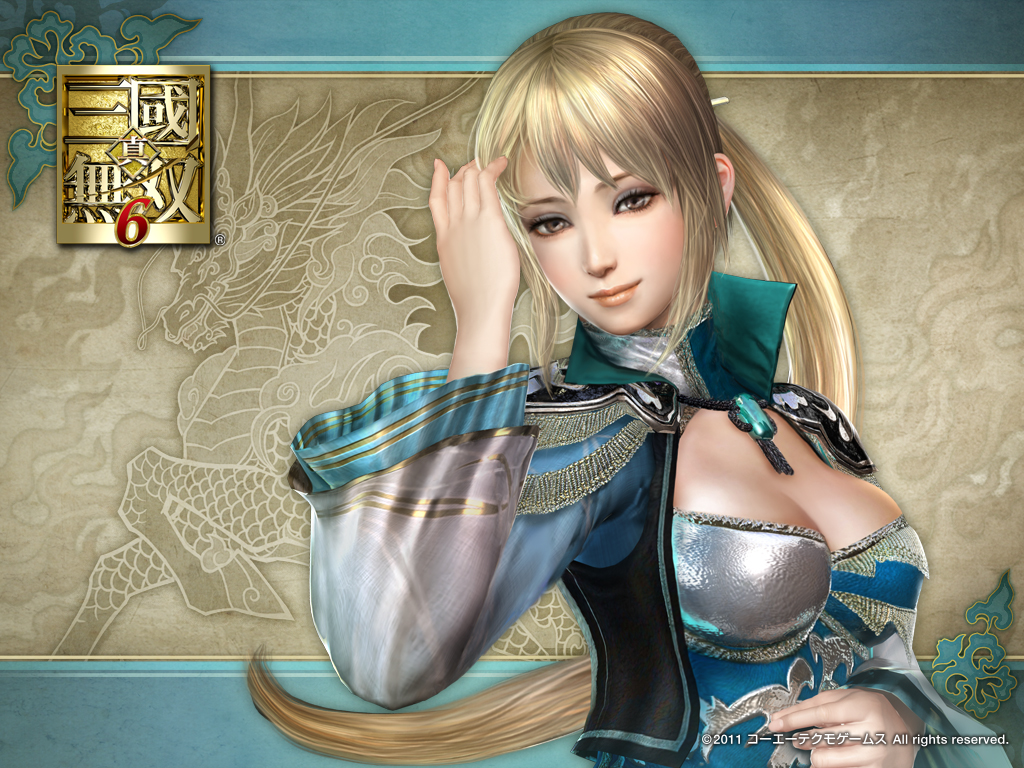
Collection of images of female characters from the Musou series [Shin Mikuni Musou/Sengoku Musou
Shin-Sangoku Musou" depicts the Three Kingdoms period in China, and "Sengoku Musou" depicts the Sengoku period in Japan, both of which feature a number of female generals. The only one who is said to have actually appeared on the battlefield is Wang Yi of Wei in the Three Kingdoms period, but the series has added glamour by using princesses and original characters as generals. Here we have compiled a list of female characters and characters from "Shin-Sangoku Musou" and "Sengoku Musou.
Read Article
The first title in the "Dynasty Warriors" series was a fighting game! About the weapon fighting action "Warriors of the Three Kingdoms
The first game in the Warriors series, "Samurai Warriors", was a "gaming" game. The game that started the Ikkitousen action series was a "gaming" game.
Read Article
Summary of Warlord Characters in the Sengoku Musou Series [Includes Weapons, Two Names, and Voice Actors!
The Sengoku Musou series is an action game set in Japan's Warring States period. There are more than 50 playable characters that have appeared in the series so far, but some of them have been restructured depending on the numbered titles, so be careful if you want to use a particular warlord.
Read Article
Tragic woman! Summary of information on Hosokawa Garasha, a character in the Sengoku Warriors series.
The "Sengoku Musou" video game series is based on actual history. Hosokawa Garasha, who appears in the game, is a woman famous for her tragic end at the mercy of history. In this article, we will introduce Hosokawa Garasha in detail, comparing her life in the "Sengoku Musou" series with the historical facts.
Read Article
A collection of beautiful images from the "Sengoku Musou" series for your PC or smartphone wallpaper!
Here is a collection of beautiful images from the "Sengoku Musou" series. The popular images of Mitsunari Ishida, Yukimura Sanada, Garasha, Yoshitsugu Otani, Kunoichi, Nobunaga Oda, etc. are available for your PC or smartphone wallpaper.
Read Article
Summary of "Sengoku Musou 4-II" strategy sites and wikis
Here we have compiled a list of strategy sites and wikis for "Sengoku Musou 4-II" released by Koei Tecmo Games. It is a minor-changed version of "Sengoku Musou 4," with Ii Naomasa as a new character. It also sells scenarios focusing on each character.
Read Article
![Shin-Sangoku Musou 6] Images of beautiful women and beautiful characters [Shin-Sangoku Musou series].](https://renote.net/files/blobs/proxy/eyJfcmFpbHMiOnsiZGF0YSI6NTM5OTQ5LCJwdXIiOiJibG9iX2lkIn19--0416d05cfe6d4268d236489563c4a14297e1efac/a07fa07f.jpg)
Shin-Sangoku Musou 6] Images of beautiful women and beautiful characters [Shin-Sangoku Musou series].
Shin-Sangoku Musou 6" is the sixth game in the Shin-Sangoku Musou series. The game depicts the warfare of the Three Kingdoms period in China with additional game-like effects, and female warriors also appear in the game. Some of the characters are original to the game and do not appear in the historical facts, which adds a touch of elegance to the Shin-Sangoku Musou series. Here, we have compiled a list of these beautiful women who daintily dance on the battlefield.
Read Article

Human! Robot! An android that appeared at the Tokyo Game Show was so realistic that the audience panicked!
The Tokyo Game Show is widely recognized as one of the largest game events in Japan. Makuhari Messe, a well-established venue, is lined with the hottest new products from game companies and numerous game items using the latest technology. One android exhibited at a certain booth was so realistic that it caused a panic in the hall. In this article, we will introduce the "too-real android" in detail, including tweets from people who actually "met" the android.
Read Article
[MH] Similar atmosphere? Summary of games recommended for MonHun players [MonHun Double Cross and others].
The "Monster Hunter" series of games allows players to enjoy hunts together with other players from around the world. In addition to elements of monster hunts, this work also includes elements of fishing games and "mission games" in which players clear missions one after another. This article will recommend to players of the "Monster Hunter" series a collection of works with similar worldviews and elements.
Read Article
A collection of strategy information and wikis for Shin-Sangoku Musou 7 Empires!
This is a collection of strategy information and wikis for "Shin-Sangoku Musou 7 Empires". This title is a version of "Shin-Sangoku Musou 7 Empires" that replaces the "Musou Mode (Story Mode)" of "Shin-Sangoku Musou 7" and includes the "Contention Mode" in which you create your own original character and aim for heaven with the forces you belong to. A new general, Yuyu, and new weapon systems have been added.
Read Article
Tags
Contents
- Outline of "Sengoku Musou 1
- thirteen orphans (mahjong)
- Sengoku Musou: Takeru Shouden
- Synopsis and story of "Sengoku Musou 1
- thirteen orphans (mahjong)
- Sengoku Musou: Takeru Shouden
- Game System of "Sengoku Musou 1
- unlimited castle
- mission
- battle(s) of a castle
- Weapons System
- growth system
- secret of a concealed information
- two-person play
- New Warlord Edit
- MIX JOY (Takeruden)
- Acquisition of Knowledge (Ressho Den)
- Sengoku Jiten (Biography of the Raging Generals)
- Special NPCs
- Characters in "Sengoku Musou
- initial character
- Yukimura Sanada
- Keiji Maeda
- Nobunaga Oda
- Mitsuhide Akechi
- Ishikawa Goemon
- Kenshin Uesugi
- Oichi.
- Okuni
- female ninja
- Magoichi Saika
- Shingen Takeda
- Masamune Date
- Princess Nohime
- Hattori Hanzo
- Ranmaru Mori
- Characters added to Sengoku Musou Takeshouden
- Hideyoshi Hashiba
- Yoshimoto Imagawa
- Tadakatsu Honda
- Inahime
- Special NPCs (non-playable characters)
- Nagamasa Asai
- Tokugawa Ieyasu
- Kennyo Honganji
- Terms of "Sengoku Musou 1
- distinguished services
- warrior of matchless valor
- ability
- special move (e.g. in martial arts)
- secret path of perseverance
- Bonus Costumes
- branch of an army
- Items from "Sengoku Musou 1
- Normal Items
- Proficiency Items
- Backstories, trivia, subplots/episodes, and anecdotes from "Sengoku Musou 1" (Warriors of the Warring States 1)
- pod
- Differentiation from the "Shin-Sangoku Musou" series
- Why Yukimura was chosen for the leading role
- Names of new generals
- General warlords who stand out from the crowd