9
Never kill, but always let live. A story of one man's faith and courage
[Summary.
A war film directed by actor Mel Gibson.
This film depicts the true story of Desmond T. Doss, a medic who saved many lives in Okinawa during the Pacific War. The opening scene of Steven Spielberg's "Private Ryan" has the same or even greater impact as the "Normandy Landing," which was even called "the most memorable battle scene in movie history. It is a graphic and realistic depiction of the battle that is just as shocking, if not more so, than the "Normandy Landing," which has been called "the most memorable battle scene in movie history.
Mel Gibson himself starred in "Once and Forever," which depicted the Vietnam War, so he must have the know-how and strong commitment to war movies, and as a director, his "Passion," which depicted the end of Jesus Christ, was an unprecedented hit and a shock to the public. As a director, I had high expectations for his war films even before I saw them.
However, as someone who was going to see the film as a war movie, I was more shocked by the strong message contained in the film than by the gruesome battle scenes.
While intense battle scenes are the best part of war films, the main character in this film is a medic who does not carry a gun and does not kill any of his enemies throughout the film.
While this film is unique in a sense as a war film, the great thing about this film is that it not only shows the carnage, but it also makes it a war film by depicting the "fight" of the protagonist who continues to save the lives of both friend and foe alike in the struggle for life that is war.
I would like to give my own review of this film, which has given me the impression that war films should not just be about shooting and being shot, but also about a man who saves lives without regard for the risks involved.
[Story.
Desmond was born in a town in Virginia, U.S.A., where nature is abundant. He lives with his older brother who runs around the mountains with him, his father who was traumatized by his involvement in World War I, and his mother who suffers nightly from his father's violence.
One day, Desmond nearly took his brother's life in a quarrel, an incident that made him vow to follow Moses' Ten Commandments "Thou shalt not kill" for the rest of his life.
Many years later, as a young man, Desmond was attending church as a devout Seventh-day Aventist.
While helping out at church that day, Desmond saw a man outside who had been seriously injured in an accident, gave him first aid, and took him to the hospital. At the hospital he had a fateful encounter with Dorothy, a nurse in charge of blood donations, and from then on he continued to go to the hospital to ask her out on dates, eventually proposing to her.
Meanwhile, World War II continued to intensify, and finally Desmond's brother volunteered for the army. Desmond also decided to volunteer for the army to save many lives as a medic.
Desmond and his fellow soldiers endure the rigorous training of Sergeant Howell, whom they meet at boot camp, but during target practice, it is discovered that he has a fatal problem for a soldier: he cannot hold a gun because of his beliefs.
Branded a "conscientious objector" by his superior, Captain Clover, Desmond becomes a problem child and is subjected to insidious harassment by the military high command.
He was also subjected to violent bullying by his peers, but Desmond remained undeterred and continued to live out his days in the army, never wavering from his belief that he would never kill anyone. However, when Desmond was about to hold a wedding ceremony with Dorothy during his leave, he was told by the military high command that he could not be granted leave because he was not trained to use a rifle.
Desmond was also court-martialed for refusing to obey orders, and he was unable to attend his wedding to Dorothy.
When Dorothy learns what happened, she asks Desmond's father, a former military man, for help to save Desmond.
Desmond was in trouble at the court-martial, but at the last minute he was able to get his father's help, and Desmond's insistence that he go off to war without a gun was accepted.
Then, in May 1945. Desmond lands in Okinawa as a medic.
His unit was assigned to "Hacksaw Ridge," a fierce battleground, where they were assigned to fight off the Japanese forces that had taken up positions there.
After a fierce battle, the Japanese forces are temporarily repulsed, but are again heavily repulsed and the unit retreats.
Desmond, who had lost a friend in the battle, stood in grief, but then he heard the voices of his friends who had been left behind calling for help.
Hearing their voices, he decides to return to the battlefield and begin a solitary battle to save the lives of his friends left behind.
[Realistic Combat
The title of the movie, "Hacksaw Ridge," refers to a Japanese military position in Okinawa called "Maeda Plateau," so named by the Americans because the northern side was a sheer cliff like a bow saw.
Many Japanese, including myself, may have learned about this battle for the first time after watching the movie.
As one of the soldiers in the movie said, "I climbed up six times and was repulsed six times." In the movie, the battle unfolded with tremendous intensity, and there were scenes in which the American soldiers developed an extraordinary fear of the Japanese soldiers.
The battlefield where the film takes place is completely destroyed by heavy artillery fire from American battleships, and is so devastated that it makes one think, "This is what hell looks like.
Despite this, the Japanese army survives by hiding in vast underground positions and using guerrilla and manpower tactics to drive the Americans back.
Although the film may have been adapted to some extent, the scenes in the latter half of the film, where the Japanese forces charge in to repel the American troops, were still very gripping, and even the same Japanese people were horrified by them.
Desmond's beliefs.
In addition to the battle scenes, this film also depicts a religious message, love for family, and the preciousness and hardship of holding on to one's beliefs.
The protagonist, Desmond, is a devout Protestant Christian who has been plagued by the violence of his father, Thomas, since childhood. Thomas is also mentally ill from his service in World War I, and is depicted as suffering from the fact that he cannot forgive himself for being alive and does not understand why he is the only one who survived, as his mother Bertha says, "My father hates himself.
Later in the film, we learn that Desmond's reason for not carrying a gun is not simply to observe the Ten Commandments of Moses, but also has to do with his father's violence, but until we learn this, Desmond may seem like a mere idealist to some viewers.
War is a justified act of killing people, which is incompatible with the religious views that Desmond adheres to.
Desmond's act of still trying to serve is contradictory, and some people may be disgusted by him.
However, Desmond was not simply a man of ideals who did not face the reality of war; he had his own convictions.
In the scene where Desmond is being court-martialed and meets Dorothy in his cell, he utters the line, "If you bend your convictions, you cannot live. For him, belief is who he is, and Dorothy realizes that she has fallen in love with Desmond's beliefs.
For Desmond, not having a gun is not important, but his desire to be the only one who saves lives in the struggle for life that is war.
And it becomes clear later in the film that Desmond's beliefs are not just about not wanting to kill people.
[Saving lives amidst the carnage].
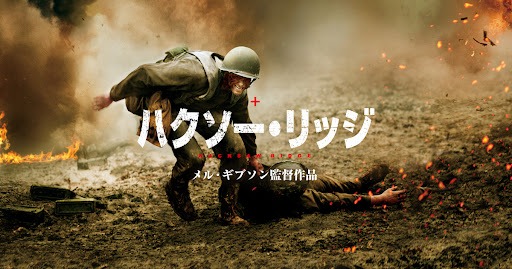
At Hacksaw Ridge, as the Japanese continue their relentless attack, Desmond, unarmed, walks through a hail of bullets to rescue his wounded comrades. Desmond is not the timid, idealistic Desmond who had been bullied before, but the Desmond who is determined to save his comrades at all costs.
After the fierce counterattack by the Japanese, Desmond loses Smitty, a fellow soldier with whom he has come to know so well, and asks God, "What do you want me to do with you? He asks God, "What do you want me to do to you? Desmond despairs, but when a cry for help rings out behind him, he understands his mission.
From there, he continues to advance single-handedly, hiding in the midst of Japanese soldiers, to save his wounded comrades. Exhausted and battered, he continued to save not only his allies but also wounded Japanese soldiers throughout the night, as if possessed, praying, "Please let me save just one more person.
Clover, Howell, and their friends, who until then had not recognized Desmond, were moved by Desmond's extraordinary courage and his actions, and apologized.
After this development, it is clear that the deeds of the man Desmond and his convictions are precious things that no ordinary man could ever accomplish.
The description of Desmond being carried away on a stretcher in the last scene is more than divine; it gives the impression that he has been recognized by God as a saint.
It was as if Desmond's soul was finally allowed to rest here.
[Finally.
This is a movie based on a true story.
There really was a man who went into battle unarmed and saved the lives of many, both friend and foe, without regard for his own life.
This is a story of one man's extraordinary faith and courage, and the hell of war and the lives that unfolded in it.
Desmond did not just hold on to his beliefs, he actually acted on them, and as a result, achieved a feat that no one had ever accomplished before.
His actions leave us with one word.
We will never know human nature until we see it through to the end.
As a film fan, I hope that many people will see this unique war film.