6
Russell Crowe as a mathematician? Spoiler review of the movie A Beautiful Mind.
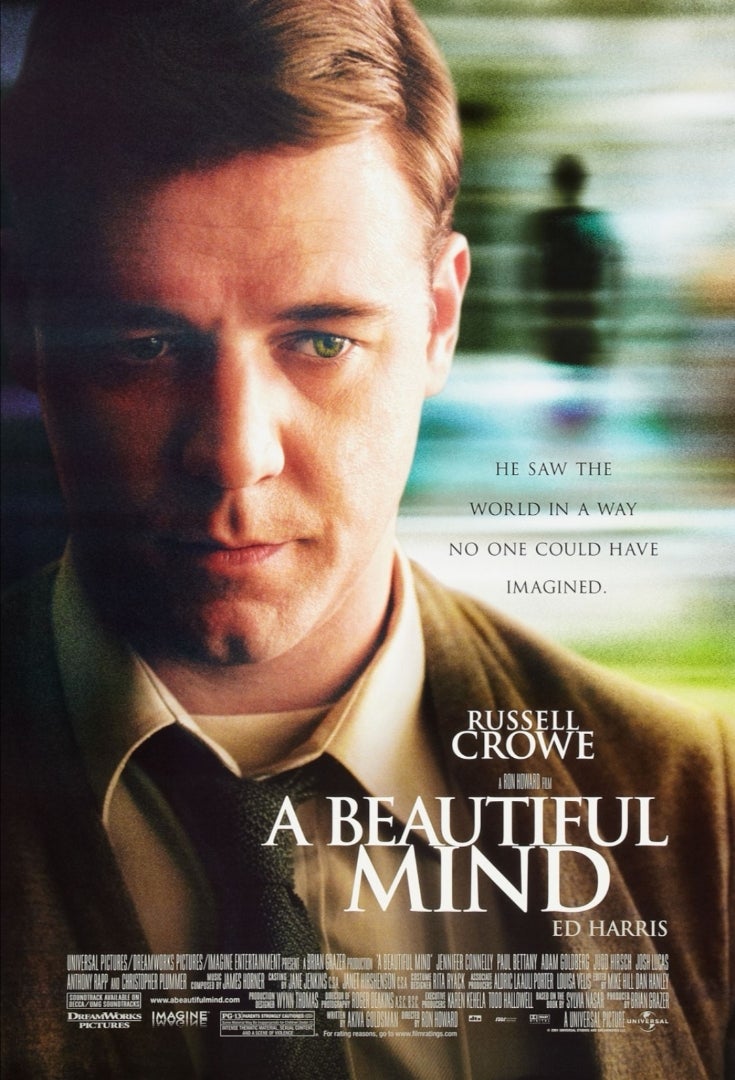
The movie "A Beautiful Mind" stars Russell Crowe, an Academy Award winning and successful Hollywood actor.
Russell Crowe plays John Nash, a real-life mathematical genius who won the Nobel Prize in Economics in 1994. It is based on the documentary of the same name by an author named Sylvia Nassar.
The main feature of the original book is that it depicts Nash, a young and talented mathematician who eventually began to suffer from schizophrenia and was forced to fight the disease, the suffering of those around him, and his miraculous recovery and the Nobel Prize he received in recognition of his youthful achievements. The difference from the original story is that the story is about the suffering of the people around him.
One notable difference from the original is the way Nash's talents are portrayed. The original (i.e., actual) Nash was truly a genius, and his mathematical achievements were recognized by those around him as early as his youth, before his illness. He was also so proud of his talent that he looked down on others.
On the other hand, Nash in the movie is considered a "genius," but he does not try to publish papers, even with mediocre results, because he wants to make innovative achievements. When he was a student, he did not produce a single paper while other young people of his generation were producing results, and he does not seem to be well accepted by his professors at the university.
It is precisely because these struggles are depicted in the film that one day a sudden flash of inspiration leads him to a mathematical principle in economics that would later be worthy of a Nobel Prize, and the scene was very heartwarming.
Another major feature of the film is the incorporation of "hallucinations," a symptom of schizophrenia, into the story.
Nash, a young researcher out of college, becomes involved in a top-secret mission to decipher enemy codes. He was not allowed to tell anyone about this "work" and eventually married and kept it a secret from his wife, Alicia. However, when the enemy country learns of Nash's existence, he eventually becomes the target of an attempt on his life, and suddenly a car chase-like scene begins, which is as thrilling as if it were a movie of a different genre. Alicia is very worried because without any explanation, she has been holed up in her room, scared of something.
These scenes about the "mission" are very impressive, but they are actually hallucinations of Nash, and after this area, he begins his struggle in a mental hospital and at home. In fact, even the enemy who is trying to kill him and the person who has been working with Nash since he came to invite him to this mission are just images created by his hallucination.
Thus, the content of the film shifts from this point to Nash's struggle with the disease.
From the scene where Nash withdraws into his house because of a hallucination that threatens his life, to his battle with schizophrenia after being diagnosed, Jennifer Connelly's performance as Alicia well portrayed the pain of those around her who support her in her fight against the disease.
Toward the end of the film, Nash, now an old man, is told that he has won the Nobel Prize and is praised by his professors at the university. In his acceptance speech, he thanks his wife for her support during his long battle with the disease, which continues to this day. This was the answer that the genius, who had to devote himself to his research in solitude, must have arrived at over a long period of time.
Even his hallucinatory "friends," whom Nash could only see, seemed to smile kindly at him.
Overall, due to the weight of the theme and the fact that "hallucination" is the axis of expression, some people may not feel completely refreshed even after watching the film to the end. Nevertheless, the final scene, in which young Nash's loneliness and efforts are eventually rewarded and he realizes something even more important, is very moving and encouraging, and I highly recommend this film.