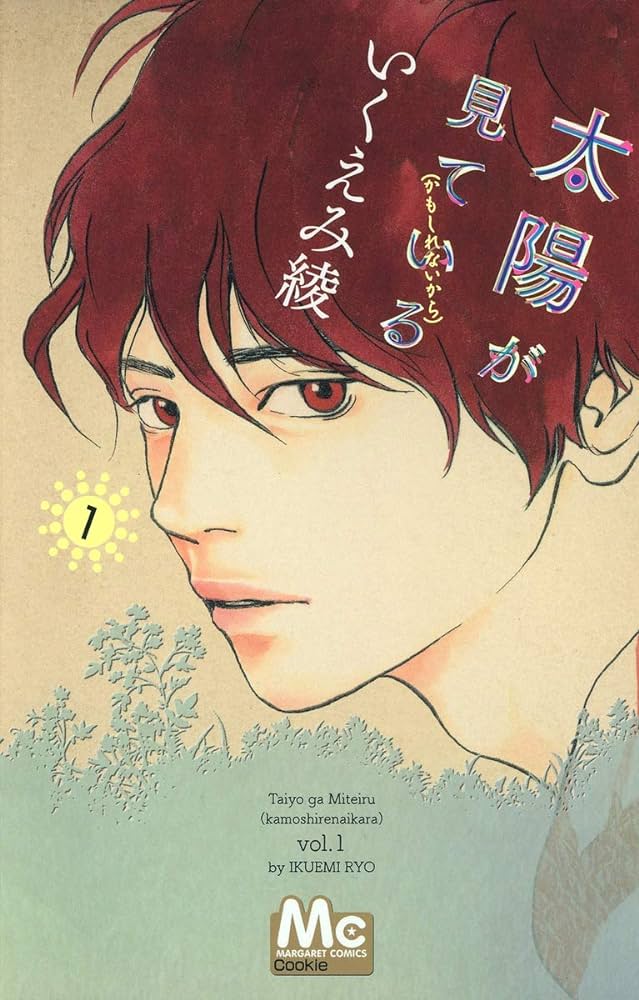
太陽が見ている(かもしれないから)

太陽が見ている(かもしれないから)

The Sun is Watching (Because It Might Be) is a manga work by Aya Ikuemi.
It was published from September 2014 to May 2018 in eight volumes. It was published in "Cookie" from the May 2014 to July 2018 issues.
A junior high school student, Misaki, is unable to express her feelings and is unable to get along with her classmates. She feels she doesn't belong, but she becomes friends with Yulu, who is in the same class, and is able to spend time in front of Yulu without pretending to be someone she is not.
The two become high school students and start living together in a house that Yulu's father buys for them.
Cape's parents had divorced and she lived with her mother and her mother's boyfriend, so she had no place at home either. For her, living with Yasuyuki became an important place to be.
One day, she met Hifo, a childhood friend of Yasuyuki's who had been estranged from her after an incident in their childhood, and the three quickly became good friends. What will become of the relationship between Cape, Nyu and Hifo?
The film depicts the friendship between the three men and women and their wavering feelings in a heart-wrenching love triangle rather than a faint romance. The subtleties of the heart, such as discord with family members and the unstable and painful emotions unique to adolescence, are delicately portrayed in this work, and even after the couple is formed, it is not a simple matter.
Although there are many heavy and graphic plot twists and turns, the work ends with everyone walking forward, leaving the viewer with a refreshed feeling.

Reviews, Ratings and Comments on 太陽が見ている(かもしれないから)

太陽が見ている(かもしれないから)
10

Aya Ikuemi's manga masterpiece depicting sad love and growth

This work was serialized in the shoujo manga magazine "Cookie" since 2014 by manga artist Aya Ikuemi, who has written the original stories for popular dramas such as "Kimi no Koto Sore" and "You and Me on the G Line". The comic is complete in eight volumes.
The main character "Misaki," who lives with her mother and her mother's lover, starts a shared house with "Yulu," a girl she befriended in junior high school, when she enters high school. The relationship between the three of them begins to change little by little when they meet again with Yulu's former childhood friend "Nippo". ......
The story carefully depicts the emotions of the three as they change from high school students to adults, and it is captivating to the reader. In particular, the frustrations and loneliness unique to adolescence are expressed in a very realistic manner, and reading the book will take you back in time to your school days. You will not be able to take your eyes off the three, who are tossed about by their complicated family environment, but grow up facing themselves and each other until the very end.
I was a junior high school student when the series began, but even now, as I have grown older, the fun of the story has not faded. One of the charms of this book is that it can be enjoyed by people of all ages, from children to adults.
This work is divided into two parts, but the first part consistently depicts "unrequited love. You will surely sympathize with the main characters, Misaki and Nippo, who face the jealousy and conflicts unique to unrequited love. If you have a one-sided love, this is a work that you should definitely read, cry, and feel refreshed.

太陽が見ている(かもしれないから)
10

I recommend this manga to those who are not good at socializing and find it "hard to live".

Aya Ikuemi's "Because the Sun Might Be Watching" was completed in July!
The girls in Ikuemi's works are never sparkling shoujo manga girls, but rather girls who try to live their lives in a very realistic situation, such as changing schools because they don't fit in in class, and yet they struggle to stay strong, which makes me want to cheer for them very much.
The main character in "Because the Sun May Be Watching", Misaki, is also worse at socializing than anyone else, and lives in a very cramped environment. She has a hard time adjusting to the environment that surrounds her anyway, such as when girls in her class argue with each other on a school trip, start crying, and then hug and comfort each other, looking coldly at such girlish interactions, or when she chooses her high school because it "doesn't have uniforms. Like Misaki, Yulu is also a floater in her class. This work depicts how these two, who met in junior high school, grow up to be adults.

The unstable psychology of adolescence is portrayed very well, and no matter how much you dislike the characters, you can't help but get emotionally involved with them, saying "I know how you feel", and you can't dislike them. I sympathize with the weak points of human beings, such as the feeling of "I can't get close to someone because I like them too much because I'm too dazzled" and "I talk to people I don't care about about about problems that I can't talk to the people I really like. I would like to encourage anyone who has similar feelings at school or at work to read this book.