悪の教典(映画)

悪の教典(映画)

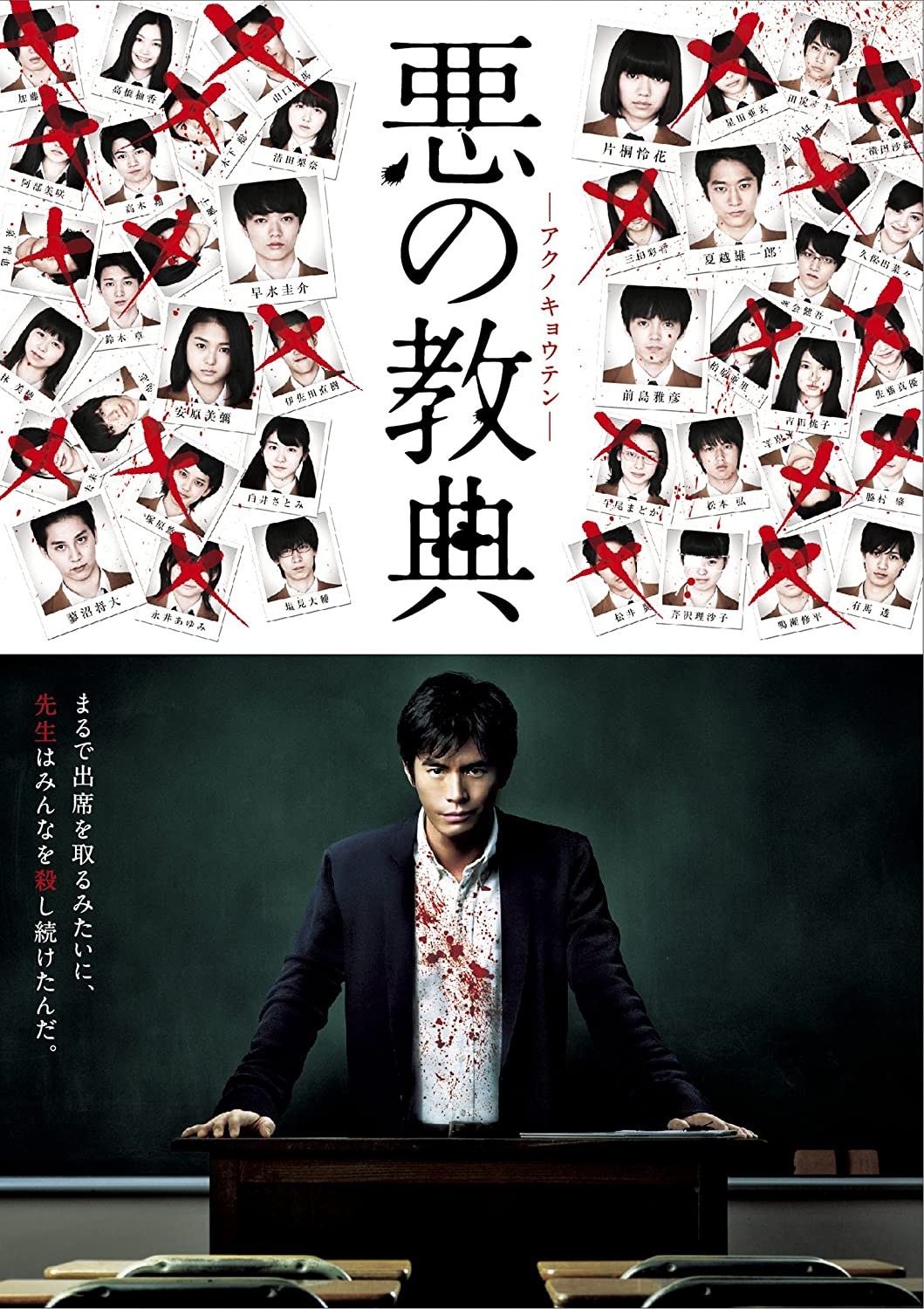
The Scripture of Evil" is a Japanese violent horror film released in 2012. Directed by Takashi Miike, the film is based on a novel by Yusuke Kishi. Seiji Hasumi, a high school teacher, is a cheerful and vivacious man who is relied upon by his colleagues and students. However, he is actually a psychopath who lacks empathy for others and has never hesitated to kill anyone who gets in his way. One day, his past crimes are about to be exposed, and Hasumi decides to eliminate everyone in the school. This film is a story of a psychopath named Hasumi and his life-threatening battle with the people around him.

Related Articles on 悪の教典(映画)

Spoiler alerts and discussion of The Scripture of Evil (novel, manga, and film).

Spoiler alerts and discussion of The Scripture of Evil (novel, manga, and film).

The Scripture of Evil" is a Japanese violent horror film released in 2012. Directed by Takashi Miike, the film is based on a novel by Yusuke Kishi. Seiji Hasumi, a high school teacher, is a cheerful and vivacious man who is relied upon by his colleagues and students. However, he is actually a psychopath who lacks empathy for others and has never hesitated to kill anyone who gets in his way. One day, his past crimes are about to be exposed, and Hasumi decides to eliminate everyone in the school. This film is a story of a psychopath named Hasumi and his life-threatening battle with the people around him.

Read Article

Yu Darvish's younger brother KENTA suffers from Cain complex! The intense dislike he has for his brother

Yu Darvish's younger brother KENTA suffers from Cain complex! The intense dislike he has for his brother

KENTA is the younger brother of major leaguer Yu Darvish, an actor who appeared in films such as "The Scripture of Evil" He was the star of the TV show "Odoru Odoru Odoru! Sanma Goten! he openly talked about his complex about his position as "Yu Darvish's younger brother," which drew a huge response from viewers. In technical terms, this psychological phenomenon is called the "Cain complex. In this article, we will introduce the psychology of the Cain complex.

Read Article

Bakuman. (Manga and Anime) Spoiler Commentary and Discussion Summary

Bakuman. (Manga and Anime) Spoiler Commentary and Discussion Summary

Bakuman. is an anime work based on the manga by Tsugumi Ohba and Takeshi Obata. The first three series, totaling 75 episodes, were broadcast on NHK Educational channel from 2010. The main characters are "Mashiro Supreme," a highly skilled artist, and "Takagi Akito," a gifted writer and a brilliant thinker, and the two boys team up to become manga artists. The work is oriented toward realism, with many manga-related proper nouns used with real names.

Read Article

Spoiler commentary and discussion of Boku no Yabai Tsuma (Drama)

Spoiler commentary and discussion of Boku no Yabai Tsuma (Drama)

Boku no Yabai Tsuma" is a suspense drama written by Tsutomu Kuroiwa and starring Hideaki Ito that aired on Fuji TV in 2016. Other cast members include Yoshino Kimura and Saki Aibu. Kohei Mochizuki, who runs a cafe, is fed up with his married life with his wife Mariya Mochizuki, but there are circumstances that prevent him from leaving her. One day, Kohei is approached by his mistress, Anami Kitazato, to murder his wife. Kohei tries to kill her by planting poison in the wine she drinks, but she is suddenly kidnapped. However, Maria has her own agenda behind the kidnapping.

Read Article

Spoiler alerts and discussion of Nobo no Shiro (The Castle of Nobo) (movie)

Spoiler alerts and discussion of Nobo no Shiro (The Castle of Nobo) (movie)

Nobo no Shiro" is a 2012 film based on the Japanese historical novel by Ryu Wada. It was co-directed by Isshin Inudo and Shinji Higuchi. The protagonist, Nagachika, is the son of the lord of Oshijo Castle. Oshijo Castle is under pressure to be opened by Mitsunari, a vassal of Hideyoshi Kanpaku. Nagachika, however, was determined to oppose Mitsunari head-on in order to fight against the unreasonableness of the world. With the help of those around him, Nagachika was finally able to defeat Mitsunari's army. This is a historical film that, while at times moving, will leave the viewer feeling refreshed by the devious plans of Nagachika, the "Dekubou".

Read Article

Spoiler commentary and discussion of VIVANT (Drama)

Spoiler commentary and discussion of VIVANT (Drama)

VIVANT" is an adventure drama that aired from July 2023 to September of the same year on TBS in the "Sunday Gekijo" slot. Yusuke Nogi, a businessman, travels to the Republic of Barca to clear his name from a false money transfer charge against him. A suicide bombing incident involving Nogi in Barka eventually leads to a dark international terrorist organization and Nogi's true identity. The film features a cast of star-studded actors from Japan and abroad, large-scale footage shot in Mongolia, and a storyline with a series of unexpected twists and turns.

Read Article

WOOD JOB! - Kamikaze Everyday Life (movie) spoiler commentary and discussion summary

WOOD JOB! - Kamikaze Everyday Life (movie) spoiler commentary and discussion summary

WOOD JOB!" is a coming-of-age movie based on Shion Miura's book "Kamikaze Everyday Life". Yuuki Hirano, who failed the university entrance exam, happens to find a pamphlet of a forestry training program called "Green Trainee". He comes to Kamisari Village, admiring the beautiful woman on the cover, only to find that the villagers are full of quirks. Yuuki tries to escape from the village many times, but he is gradually attracted to the charm of forestry. The film is a touching story about the beauty of the forest landscape and encounters with people, while making us laugh at many small jokes.

Read Article

Spoiler commentary and discussion of Kirin ga Kuru (The Kirin)

Spoiler commentary and discussion of Kirin ga Kuru (The Kirin)

Kirin ga Kuru" is the 59th NHK Taiga Drama that was broadcast from January 19, 2020 to February 7, 2021. The main character is Akechi Jubei Mitsuhide (明智十兵衛光秀), who has often been portrayed as a traitor and an evil person. The film depicts the life of Jubei as he tries to build a big country without war, serving Ashikaga Yoshiaki and Oda Nobunaga while looking for someone who can call "Kirin," which appears when the world is at peace. One of the highlights of the film is the portrayal of Jubei and the generals of the Warring States period from a side completely opposite to the popular belief.

Read Article

Summary of spoiler commentary and discussion of What to Do About Ieyasu (Taiga Drama)

Summary of spoiler commentary and discussion of What to Do About Ieyasu (Taiga Drama)

Douhou Ieyasu" is the 62nd NHK Taiga Drama to be broadcast in 2023. Screenwriter Ryota Furusawa portrays the life of the main character Tokugawa Ieyasu from a new perspective. The story takes place in Japan from the late Muromachi Period to the Edo Period. A boy who was separated from his parents and thought he would lead a solitary life as a hostage of Imagawa Yoshimoto, a feudal lord in Suruga Province, eventually becomes the lord of a weak country. The story is about a boy who makes various choices and plunges into a turbulent world, aiming for a world without warfare.

Read Article

The Monster Woodcutter (novel and film) spoiler alerts and discussion.

The Monster Woodcutter (novel and film) spoiler alerts and discussion.

The Monster Woodsman" is a thriller novel by Baysuke Kurai and a live-action film directed by Takashi Miike, based on the novel. A bizarre series of murders occur in which a man wearing a monster mask splits open the head with an axe and removes the brain. The man's next target is lawyer Akira Ninomiya, but Ninomiya is a cold-blooded psychopath. The purpose of the brain thief and Ninomiya's past are gradually revealed. The highlight of the film is the direct confrontation between the two, the brain thief and the psychopath.

Read Article

Spoiler commentary and discussion of The Devil of First Love (Drama)

Spoiler commentary and discussion of The Devil of First Love (Drama)

Hatsukoi no Devil" is an original TV drama written by Yuji Sakamoto and broadcast in 2022 in the "Saturday Drama" slot of Nippon Television Network Corporation. The film tells the story of Yuhi Mabuchi, who pursues the truth behind her brother's death, and unravels the case with a group of unique characters. It is a mysterious comedy that intersects various genres such as police, romance, and coming-of-age ensemble drama surrounding four people with no investigative authority. In addition to a cast full of unique personalities, Sakamoto's style is fully demonstrated in this highly acclaimed film, which won a number of awards including the Galaxy Award.

Read Article

Bakuman. Summary of stories, works, plays, and serials appearing in

Bakuman. Summary of stories, works, plays, and serials appearing in

Bakuman. Bakuman" is a boys' manga series written by Tsugumi Ohba and drawn by Takeshi Obata, which was adapted into an anime on NHK Educational TV in 2010. It is a success story in which a talented artist named Mashiro Moritaka, aka Saiko, and a gifted writer named Takagi Akito, aka Shujin, team up to become successful manga artists in the Weekly Shonen Jump magazine. In addition to the manga drawn by the main characters, the story features a wide variety of manga created by their many rivals and friends.

Read Article

Shinjuku Swan (Manga, Drama, Movie) Spoilers and Discussion Summary

Shinjuku Swan (Manga, Drama, Movie) Spoilers and Discussion Summary

Shinjuku Swan" is an underground Japanese manga. The author is Ken Wakui. It was serialized in Kodansha's Weekly Young Magazine from issue #20 in 2005 to issue #45 in 2013. It is a story about a scout, and was Wakui's debut work in the series. The main character is 19-year-old Tatsuhiko Shiratori, a.k.a. Tatsuhiko Tatsuhiko. He is faced with the death of a rival, a gang-related illegal drug deal, and the betrayal of a trusted colleague, all of which set in motion a grand plan of revenge without Tatsuhiko's knowledge. The film depicts Tatsuhiko's growth as he faces up to his many troubles without running away from them.

Read Article

It's Your Turn (Anaban) Spoiler Commentary and Discussion Summary

It's Your Turn (Anaban) Spoiler Commentary and Discussion Summary

It's Your Turn is a 20-episode mystery drama that aired on Nippon Television from April to September 2019. It is a mystery drama about a newlywed couple who move into an apartment called Kiunkue Kuramae and get caught up in an "exchange murder game," and was planned and written by Yasushi Akimoto. It was broadcast over a two-and-a-half-year period consisting of the first and second chapters, and a spin-off titled "Beyond the Door" was distributed exclusively on Hulu in conjunction with the TV broadcast.

Read Article

Spoiler alerts and discussion of Sinners for the Prosecution (film).

Spoiler alerts and discussion of Sinners for the Prosecution (film).

The Prosecution Sinners" is a Japanese suspense film based on a Japanese novel written by Shizukui Shunsuke. Takuya Kimura and Kazuya Ninomiya, a member of Arashi, star in this captivating suspense story. The film depicts the conflict between Mogami, who is obsessed with his own sense of justice, and Okino, who pursues justice for the truth of the case, triggered by the murder of an elderly couple and a case that has reached its statute of limitations. The supporting cast includes Yuriko Yoshitaka, Koji Okura, and Tomohito Yashima. The catchphrase for the film is "Crossing the Line.

Read Article

Summary of Spoiler Commentary and Discussion of Byakuya Gyo (Keigo Higashino)

Summary of Spoiler Commentary and Discussion of Byakuya Gyo (Keigo Higashino)

Byakuya Gyo" is a long mystery story by Keigo Higashino published in 1999. The number of copies in circulation exceeded 2 million as of December 2010. 1973, a murder takes place in Osaka. The murderer is Ryoji Kirihara, the son of the victim, a fifth grader, and Yukio Nishimoto, the daughter of the suspect. Time passes with the case unsolved. The two grown-up children begin to help each other in criminal activities, and a series of unexplainable incidents occur around them. The story was made into a TV drama in 2006 and a movie in 2011.

Read Article

Queen of Lunch (Drama) Spoiler Commentary and Discussion Summary

Queen of Lunch (Drama) Spoiler Commentary and Discussion Summary

Queen of Lunch" is a drama series that aired in 2002 in Fuji Television's Tsuki 9 slot. It starred Yuko Takeuchi. Other cast members include Satoshi Tsumabuki, Tomohisa Yamashita, and Takayuki Yamada. Natsumi Mugita visits a Western-style restaurant during lunch time, and by chance ends up working there as a live-in employee. This romantic comedy depicts the love story and interactions between Natsumi and her four male siblings at the Western-style restaurant. The screenplay was written by Omori Mika, who also wrote "Kabachitare" and "Aoten wo Sukuke". The film won Best Picture and Best Actress at the 34th The Television Drama Academy Awards.

Read Article

Spoiler alerts and discussion of Evil (film)

Spoiler alerts and discussion of Evil (film)

Heinous" is a 2013 social suspense film based on the nonfiction bestselling novel "Heinous -An Accusation of a Death Row Inmate-". Fujii (Fuji), a magazine reporter, is told by his boss to meet a death row inmate named Sudo. Sudo has been involved in a number of crimes. He also hears about a man named Kimura, who committed many crimes in conspiracy with Sudo and ultimately deceived him. As Fujii listens to the story, he becomes absorbed in the interview, without regard for his family. The film is a realistic depiction of a crime that could exist anywhere around us.

Read Article

WATER BOYS (Drama) Spoiler Commentary and Discussion Summary

WATER BOYS (Drama) Spoiler Commentary and Discussion Summary

WATER BOYS" is a drama series that aired on Fuji Television at 9:00 p.m. on Tuesdays in July 2003. It is based on the movie "Water Boys" and was written by Hiroshi Hashimoto and Mayumi Nakatani. It stars Takayuki Yamada, with Mirai Moriyama and Eita in other roles. Kankuro Shindo, who joined the swimming club of Tadano High School with a passion for synchronized swimming, is chosen as the leader of the synchronized performance at the school festival, but the synchronized performance is abruptly canceled. Kankuro then sets out to make the synchronized performance a reality. This coming-of-age drama depicts the friendship and romance between Kankuro and his friends.

Read Article

Reviews, Ratings and Comments on 悪の教典(映画)

悪の教典(映画)
7

Kill the "thought" and keep the "memory" alive. If you think about the reason for killing, you lose! The madness of the psycho killer Seiji Hasumi

The movie "The Scripture of Evil" is a Japanese film released in 2012.
The rating is "R15+" due to the depiction of violence to the point of gushing blood.
Please use caution when watching this film.

Seiji Hasumi, an English teacher at Chenko Gakuin High School and homeroom teacher of the 4th class of the 2nd grade, is a "good teacher" who is nicknamed "Hasmin" by his students and boasts of his immense popularity and trust.
He is even seen taking an interest in and trying to solve the problems that plague the school, such as the group cheating problem, the relationship between the school's backstage website and bullying, handling complaints from the fathers of students who are being bullied, and the issue of lewd behavior between teachers and students.
However, all these "good appearances" are just fakes for "conveniently committing murder.
He was a born "psycho killer" capable of committing murder without guilt in the winter of his 14th year, and long before that.
Never failing to take precautions, he steadily murders one person after another, so that no one will know that the murderer is Hasumi.
His "theme song" is "Mekky Messer's Molitato," a song from the play "Sanbun Opera.
A jazz-arranged version of this song, "Mack the Knife," is played at key points in the play, and Hasumi occasionally hums it.
Mecky Messer" has been killing people without anyone knowing about it.
One day, however, a female student finds out that Hasumi has killed a certain student due to a small mistake.
In order to erase this small breakdown, he decides to bury everyone who might have known about his crime.
Thus, the school at night, which is bustling with preparations for the school festival, becomes the stage for a blood-soaked tragedy that will not end until every last innocent sheep is hunted down.

Directed and written by Takashi Miike, whose works include "Chakushin Ari" (2004), the "Close" series of films (2007, 2009), and the "Uta the Dragon" series (2014, 2016, 2021).
Miike is sometimes called the "master of violence" for his films, which sometimes involve controversial and vivid expressions of violence.
His films also have a somewhat desolate, retro atmosphere, perhaps due to his involvement with many films depicting "out-of-fashion, snobbish characters" such as the yakuza and delinquents.
The film "Aku no Kyokyoku" introduced here is no exception to this rule, and is full of Miike's characteristic elements, such as cracked records, standard jazz numbers popular in the 1960s, and the carnage that takes place in a cumbersome festival hall reminiscent of a Hong Kong film.

Hideaki Ito plays Seiji Hasumi, a rare psycho killer.
Mr. Ito also appeared in "BRAVE HEARTS Umizaru," which was the number one live-action Japanese film at the box office in 2012, showing the gap between "a role where he risks his life to save lives" and "a role where he takes lives just for fun" in the same year.

This film is also based on the novel of the same title by Yusuke Kishi.
The novel "The Scripture of Evil" was nominated for the 144th Naoki Sanjuugo Award, nominated for the 2011 Honya Taisho Award, and won the first Yamada Futaro Award.
Many of Kishi's books have been made into films, including the movie "Blue Flame" (2003), directed and written by Yukio Ninagawa and starring Kazuya Ninomiya.
In many cases, Takashi has made cameo appearances in the film adaptations.
He also appeared in "ISOLA The Girl with Multiple Personalities" (2000, original novel title: The Thirteenth Personality ISOLA), "The Black House" (1999), and the Fuji TV drama series "The Locked Room" (2012, novel series name: Security Detective Enomoto series).
Of course, "The Scripture of Evil" is no exception.

In addition to cameo appearances by the original author, one of the highlights of the film is the appearance of many actors who were considered "young" in 2012 but are now considered "hot" in 2023, in the roles of students.
Fumi Nikaido plays Reika Katagiri, a girl who has doubts about Seiji Hasumi's true identity from beginning to end, and Shota Sometani plays Keisuke Hayami, a boy who uses a different route than Reika Katagiri to get to Hasumi's true identity.
Other young actors in the film include Kento Hayashi, Asuka Kudo, Sari Ito, Kodai Asaka, Mayu Matsuoka, and Yukino Kishii.
In addition to the students, a distinguished lineup includes Saki Takaoka, Takayuki Yamada, and Mitsuru Fukikoshi as teachers.
It is also fun to look for the original author Takashi and the actors who have continued to work in the film.

The most impressive aspect of the film is the "typical psychopath" behavior of the main character, Seiji Hasumi.
Combined with Hideaki Ito's overwhelming acting ability, his madness is irresistible.
The gap between the ostensibly "good guy" Hasumi and the "innocent man with malicious intent" Hasumi, who commits murder without anyone noticing, and the disastrous night of the school festival, when Hasumi, who was good and talkative in everyday school life, transforms into a ruthless and silent "hunter," is a sight to behold.

People with antisocial personality disorder, commonly called "psychopaths," lack "empathy," "morality," and "conscience," but also tend to "play the sensible person" to achieve their own ends.
On top of that, Hasumi is a "psycho killer" who repeatedly commits bizarre murders.
In other words, his main goal is to kill (or to create an environment in which he can continue to kill).
Even "playing the role of a teacher who is liked by his students" may be nothing more than a preparation for setting the stage for his convenient killings.
However, the true purpose of his killing is never explained in the play.
As mentioned above, he denies that it is not for pleasure, but other than that, nothing else is known.
It may be impossible for ordinary people to guess the purpose of a "born psycho-killer" like him.
This is perhaps best illustrated by the scene in which he compares the two crows that come near Hasumi's house every morning to Hugin and Munin, ravens in Norse mythology.

Huginn and Muninn are the servants of Odin, the god of war and death, who is regarded as the main god in Norse mythology.
Day by day, they fly around the world, seeing and hearing many things. They return at Odin's breakfast time to tell him all that they have seen and heard that day.
It is said that these two crows enabled Odin to know everything in the world.

As is mentioned in the play, "hughin" means "thought" and "munin" means "memory.
Hasumi will eventually kill the crow named "Hugin.
Of course, he tries to kill "Munin" as well, but he stops.
Hasumi killed "thoughts" and kept "memories" alive.
In the play, there are many scenes in which Hasumi wakes up after having a dream. The dreams are usually described as ruminations of his "memory of killing.
For him, "memories" are important and "thoughts" may be insignificant.
This description is effective in impressing upon the audience that "there is no special thought process for Seiji Hasumi to kill," and at the same time, that Hasumi's madness is "normal for him.
This portrayal of a "typical psychopath (psycho killer)" is cruel enough to make one want to look away while watching the play, but at the same time it is so fascinating that one cannot take one's eyes off of it.

On the other hand, there are some points that are depicted in the original novel but omitted in the film, which makes them seem insufficiently explained.
This is especially true of Hasumi's background.
There is no explanation as to why Hasumi was expelled from the U.S. for being a psycho killer, but returned to Japan and became a teacher almost immediately after returning to the U.S.
We do not know why Hasumi was hired as a teacher, nor do we know why he chose teaching as a career.
He also condemns the lewd acts of other teachers and students, but does not explain that Hasumi himself has also been having lewd and lascivious relationships with female students.
It may not be unnatural to think of Hasumi as a "psychopath who puts his own interests first and is willing to humiliate others," but this description is more natural in the original novel, which describes not only why Hasumi became a teacher but also how he "attracted good-looking female students" to the class he was in charge of.
Therefore, it is difficult to recommend this film to those who want to enjoy the story from the clear backgrounds and psychological descriptions of the characters.
It should also be noted that the portrayal of the characters in the original novel and the movie are very different.
Several of the characters from the original novel do not appear in the film, and some of their roles have been merged with those of other characters.
Masanobu Tsurii, the key character in the film, is a "math teacher" in the original novel who wears a gloomy air, while "Katsuya Yagisawa," a "physics teacher and amateur radio club advisor" appears in the original novel. In the film, Yagisawa does not appear, but instead Tsurii takes on that role as well.
In addition, the story progresses very differently in the film, as Isao Sonoda, the teacher on duty during the "night of tragedy" in the original novel, does not appear in the film, but is replaced by Tetsuro Shibahara.
Therefore, it is difficult to recommend this film to those who seek a live-action film that is faithful to the original novel.
If you prefer a film that is not just a work of violence or psychological horror, but also contains plenty of mystery elements, you will probably enjoy reading the original novel instead of watching this film.

Nevertheless, the film version is also full of detailed foreshadowing.
The foreshadowing is sad and tragic, but it is also a part of the everyday life of an innocent high school student who does not know the true identity of Hasumi.
This foreshadowing is sadly recovered on the night of the tragedy, adding to the "bad aftertaste" of the script.
I can highly recommend this film to those who like this "unpleasant feeling peculiar to psycho horror".

The film also includes a somewhat juvenile comedic element in addition to the flashy depiction of violence typical of Miike's works, and even the scene on the night of the tragedy has moments when the viewer's shoulders relax.
If you think about the psycho killer's thought process, you lose.
The unforgettable charm of "The Scripture of Evil," a violent film with a bad aftertaste that leaves nothing to be desired, is well worth a look.

悪の教典(映画)
4

For those who read the original, it remains a blur.

I saw this movie after reading the original novel.
In the original novel, what kind of thinking led Hasumi to kill and what kind of actions the students took were depicted, but I think that was largely cut out in the movie. Because of the lack of such drama, the film is just a horror movie about a psychopath named Hasumi who kills his students. I was a little disappointed because I liked the original work. For those who have not read the original work, Hasumi's motives and other aspects of the story may leave many questions unanswered.
However, because such a storyline is eliminated, people are killed at a tempo that is pleasant to watch. There is no "phenomenon that the main character doesn't die easily," which is typical of horror films, so I recommend this film to those who simply want to enjoy horror and psycho-thriller films.
The best part of this film is the casting.
Hideaki Ito, who plays the role of Hasumi, fits the image of the original work perfectly. He played the psychopath perfectly. The cast of very gorgeous actors includes Fumi Nikaido, Shota Sometani, Kento Hayashi, and Sari Ito as the students, and Takayuki Yamada and Mitsuru Fukikoshi as the teachers. The actors were all excellent and their performances were very impressive.

悪の教典(映画)
10

I recommend it with confidence!

This work, "The Scripture of Evil," is a film adaptation of a work of fiction by Yusuke Kishi.
It is a story about a high school teacher who has a secret face of a "psycho killer" who can only express himself through murder.
There is an introduction to "The Book of Evil," but if you haven't seen it yet, I recommend you to watch it from the introduction. The reason for this is that the film itself contains a lot of grotesque expressions, and I had the impression that the grotesque expressions in the first chapter are less grotesque than in the movie. I saw the movie with my friend at the theater, but my friend got sick and left the theater halfway through. It is that grotesque. If you think you can watch the film after seeing the introduction, please watch it.

The Scripture of Evil" is a psycho killer story about a high school English teacher, Seiji Hasumi, played by Hideaki Ito.
HASMINE is an excellent teacher who is admired not only by her students but also by other teachers, but her true identity is that of a "vicious murderer" who can only express himself through murder.

What I thought was wonderful about this film was the staff who cast Hideaki Ito. Hideaki Ito, who usually has a strong image of "gentle" and "good-looking" in dramas and movies, was cast as a terrifying murderer, which I felt further heightened the horror of this film.
And the story, of course, is fantastic!

Please watch it!

Parent Tags

Sibling Tags