はたらく細胞 / Cells at Work!

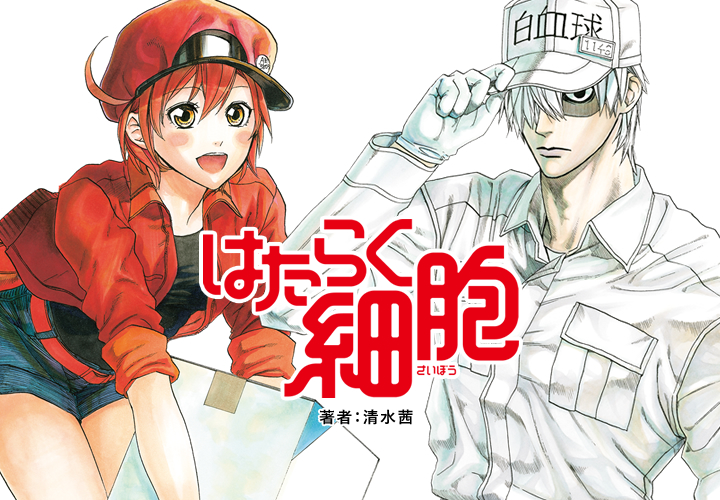
Hataraku Cell" is a Japanese manga by Akane Shimizu, serialized in Monthly Sirius from March 2015 to March 2021.
It is a comical work that anthropomorphizes "human" cellular tissue and comically depicts the workings of the body as "jobs.
The main characters include the clumsy and directionless "red blood cells," immune system cells centering on "white blood cells" that fight night and day against germs and viruses that have invaded the body, and "platelets" that work hard every day to repair the body's tissues.
The stories are complete in one or two episodes, and many familiar themes, such as "abrasions" and "influenza," are depicted in a way that makes it very easy to understand how cells work in the body when the body is in trouble. For this reason, the manga has been featured on TV programs as an educational manga and has also been used in school classes.
In 2018, it was adapted into an anime and aired through its second season.
In addition, a number of spin-off manga series have been developed under the supervision of the original author, including "Hataraku Bacteria" and "Hataraku Cell BLACK".

Related Articles on はたらく細胞 / Cells at Work!

Spoiler commentary and discussion of Hataraku Cell (manga and anime)

Spoiler commentary and discussion of Hataraku Cell (manga and anime)

Hataraku Cell" is a manga work by Akane Shimizu. In 2018, it was adapted into an anime produced by david production. The setting is inside the human body. The cells are depicted as anthropomorphic, and invading pathogens and other organisms are depicted as monstrous and monstrous. Red blood cells carry oxygen, and white blood cells fight bacteria. Platelets that close wounds, killer T cells that kill, and so on... The unfamiliar drama of about 60 trillion cells unfolds in this film.

Read Article

Spoiler commentary and discussion of Hataraku Cell BLACK (manga and anime)

Spoiler commentary and discussion of Hataraku Cell BLACK (manga and anime)

Hataraku Cell BLACK" is a manga series written by Shigemitsu Harada and drawn by Issei Hatsukaya that ran intermittently in "Morning" from issue 27, 2018 to issue 8, 2021, and an anime work based on it. It tells the story from the cellular perspective of health problems in the body that are eroded by smoking and drinking, with the main character being a red blood cell working in an inferior body like that of a black company. The struggle in a serious and bleak atmosphere, with anthropomorphic cells and robot-like drugs and antibiotics, is a dystopian work that sounds a warning bell to those who lead an indolent lifestyle.

Read Article

Surreal! A collection of slightly funny anthropomorphic images and tweets [Sanrio characters, Anpanman, etc.

Surreal! A collection of slightly funny anthropomorphic images and tweets [Sanrio characters, Anpanman, etc.

When you have nothing to do in your spare time, you have probably thought to yourself, "What would it be like if this were anthropomorphized? On Twitter, there are various stories about anthropomorphized prefectures, seasons, and daily necessities such as bedding. In some cases, the anime "Hataraku Cell," based on the theme of anthropomorphic cells, has become a big hit. In this article, we will introduce a collection of interesting "anthropomorphic" images posted on Twitter that are a bit surreal and funny.

Read Article

Reviews, Ratings and Comments on はたらく細胞 / Cells at Work!

はたらく細胞 / Cells at Work!
10

擬人化アニメの真骨頂!体の中の細胞たちは、毎日こんなに頑張っているんだと勉強になる!

このアニメの舞台は、私たちの体の中。
主人公は、体内の”細胞”だ。

24時間365日、絶え間なく働いているけれど、私たちの目には決して見ることのできない細胞たちが、日々どんな役割を持っていて、どんな活動をしているのか?体のしくみについて、楽しく学べるアニメとなってる。

細胞の話と聞くと「難しそうなアニメはちょっと…」と思う人もいるだろう。
でも安心してほしい!
細胞たちは、それぞれの特徴をつかんだ擬人化をされていて、とても魅力的でユニークなキャラクターがいっぱい登場する。
血の出るシーンはあるものの、ギャグシーンも多くとてもコミカルに描かれているので、子供も大人も満足でき、一緒に楽しめるはず。

ストーリーはほぼ1話完結型で、アニメはシーズン1・2を合わせても22話と比較的短めなので、すきま時間に気軽に見始められるのもオススメ!
風邪・すり傷などの誰しもが経験したことのある身近な病気やケガの話もあれば、熱中症・食中毒、はたまたガンなどの、命にかかわるような深刻な病気まで取り扱っている。

このアニメを見終わったあとは、日々休まず頑張っている細胞をねぎらい、自分の体を大切にしようと思わせてくれる。面白いだけでなく、とても勉強になり役に立つ作品なので、ぜひ一度見てみてほしい。

はたらく細胞 / Cells at Work!
10

現役看護師のわたしが教える、今から看護師を目指す人におすすめな漫画

現役看護師のわたしが読んで納得した、読みながら楽しく人間の体の中について学ぶことができる漫画である。
内容としては、細胞擬人化漫画にあたる。人間の体には1人あたりおよそ37兆個の細胞があり、そこには細胞の数だけ仕事(ドラマ)があり、毎回事件(風邪やアレルギー反応など)が起こるたびに細胞たちが人知れず活躍していくストーリーとなっている。
専門知識がなくても読みやすく、「赤血球」はかわいい女性のビジュアル、「白血球」はクールな男性のビジュアルなど細胞ごとに個性豊かなキャラクターになっているため誰が見てもわかりやすくまとまっている。
それぞれの細胞の働きがおもしろおかしく描かれているので、自分の身体の中で何が起きているのか楽しく知ることもできる。
個性豊かなキャラクターの中でも私の推しは「血小板」である。
なんといっても見た目が可愛く、言動に反してなかなかの行動をしているので笑ってしまうことが多くあり、このビジュアルで体の中ではなくてはならない存在なのが信じられない時も…。

全体的にインパクトのあるビジュアルで描かれているため自然に知識が身についていくため看護学校や医療の現場で参考書として用いられていることも多くある。
それだけわかりやすく書かれた漫画である。

はたらく細胞 / Cells at Work!
7

子どもが興味をもった!

理科の勉強、細胞、白血球、赤血球、こんなことに興味をもって自ら調べだす子供なんて少ないだろう。大人の私でも子供になにと聞かれたら困ってしまう。このアニメは、「人の細胞の数、およそ37兆個、 細胞たちは体という世界の中で元気に毎日働いている」、そんな体の中の世界の話である。もちろんここまで聞くとつまらなそうと感じるかもしれない。しかし、魅力的でかわいい主人公の赤血球、ちょっと手荒ではあるがかっこよく見える白血球、それぞれが生き生きとしていて体の中でどんな風に細胞たちが働いているかわかる、勉強になりながら楽しめるアニメなのだ。
子どもも興味を持ちやすそうなかわいらしいイラストで、わが子たちが今まで全く興味を示さなかった体の中に興味を持ったのであった。また男の子が好きな戦闘シーンも魅力である。毎回毎回何かの菌が体に入ってきて戦うのだが、そんなシーンも迫力がすごく、子どもたちは夢中で見入っていた。「本当に体の中で戦ってるの?」「僕の膝、擦りむいたけどいまみんな働いているんだね。体ってすごいね」そんなことを言い合いながら子どもと楽しく鑑賞できたアニメであった。親も勉強になる作品のため、ぜひ親子で一緒に観てほしい。

はたらく細胞 / Cells at Work!
7

生物が好きだと話の内容がよくわかります

このアニメを見始めたきっかけは、アニメ『はたらく細胞BLACK』を見たことでした。細胞の話なので、生物が好きだと話の内容がよくわかります。このアニメの第1話も見ましたが、その後は見ませんでした。その後、映画で『はたらく細胞』の実写版をやるということで、NHKで再放送をし始めたのがきっかけに第2話から見始めました。
赤血球役の花澤香菜さんはそのときはちょうど全盛期で、このアニメの主役をやっていてもおかしくなかったです。それから、レギュラーのヘルパーT細胞役の櫻井孝宏さんや制御性T細胞の早見沙織さんも全盛期のころで、お2人はその後『鬼滅の刃』などにも出ていました。また、ゲストの声優さんも豪華で、中村悠一さんや岡本信彦さんなどが出ています。特に一般細胞の役に混じっている石田彰さんに注目して欲しいです。石田さん演じる一般細胞が早めに出てくるので、それが何に変わるのかも見て欲しいところ。それから、モブの一般細胞の役をやっている人が小林千晃さんや梶原岳人さんであることも見逃せません。
第二期は2人の声優さんがレギュラーで入ってくるのですが、そのうちの1人が『Re:ゼロから始める異世界生活』でナツキ・スバル役の小林祐介さんなのです。声優陣の豪華さもたまらない作品です。

はたらく細胞 / Cells at Work!
10

Knowledge gained from "Hataraku Cell

You can learn how the cells in the human body function from the manga, and gain knowledge about living organisms. This popular work has also been broadcast as an anime.
The visuals of the characters in "Hataraku Cell" are very well done. Red blood cells carry a cardboard box marked "O2" because of their role in carrying oxygen, and wear red hunting caps and jackets because of their high hemoglobin content. Platelets are smaller in size than other cells, so they are depicted as children about the size of kindergartners, and so on, to give an idea of the characteristics of the cells from the visuals.
In the animation, narration explains the roles of the cells and other information about each cell, both through the eyes and the ears.

Another attraction is that there are not only "Hataraku Cycle" but also spin-offs such as "Hataraku Bacteria" and "Hataraku Platelet-chan" that focus on each cell.
Among the spin-offs, "Hataraku Cell BLACK" is a popular work that has been made into an anime.
The difference between "Hataraku Cell" and "Hataraku Bakugen" is that "Hataraku Cell BLACK" shows what happens to the cells of a human being when he or she drinks or is stressed, in the form of "overwork".
The impression of the characters is also different from that of "Hataraku Cell," with their emotionally unreadable facial expressions. I think this work will make you think about your own health.

はたらく細胞 / Cells at Work!
8

The Expanding World

Introduction to "Hataraku Cell.
The author is Akane Shimizu, and the manga was serialized in Monthly Shonen Sirius (Kodansha) from the March 2015 issue to the March 2021 issue. The comic is in six volumes (30 episodes).

The story anthropomorphizes the trillions of cells that work inside a person, and depicts the daily life of the red blood cells that run around the body and the white blood cells that kill bacteria An anime was produced in 2018.

The following is a spin-off manga.
Hataraku Bacteria" by Akane Shimizu (supervisor), illustrated by Haruyuki Yoshida, 7 volumes.
Hatarakunai Cells" by Akane Shimizu (supervisor) and Moe Sugimoto (drawing), 5 volumes.
Eight volumes of "Hataraku Cell BLACK" by Akane Shimizu (supervisor), Shigemitsu Harada (original story), and Issei Hatsukaya (artwork).
6 volumes of "Hataraku Cell Friend" by Akane Shimizu (supervisor), Kanna Kurono (original story), and Mio Izumi (artwork)
Four volumes of "Hataraku Platelet-chan" by Akane Shimizu (supervisor), Yuko Kakihara (original story), and author Yasu
Hatarake! Animation tour" by
Hataraku Cell LADY" by Akane Shimizu (supervisor), Shigemitsu Harada (original story), by Tou Otogawa
Hataraku Cell WHITE" by Akane Shimizu (Supervisor) and Tetsushi Kanie (Animation)
Hataraku Cell Illegal" by Akane Shimizu (supervisor), written by Kae Hashimoto (original story), drawn by Tsunekazu Tsugi

There are also novel versions, including "Hataraku Cell: A Novel" by author Yui Tokikai and Akane Shimizu (original story), and "Hataraku Cell: A Novel" by author Yui Tokikai and Akane Shimizu (original story).

The manga makes it very easy to understand what is happening inside the body, starting with the battle against bacteria that enter through wounds, how the cells are working inside the diseased body, and how the activities of the white blood cells to protect the body have conversely caused pain to the body.
In BLACK, there are some painful scenes that can be seen in the real world, so much so that some people say their children were frightened by them.

There are also spin-off works that have not yet been completed, and we look forward to their continuation.
Illegal" is particularly interesting because it deals with methamphetamine, a place close to the brain that we have not seen in other manga.

はたらく細胞 / Cells at Work!
8

Just watch the cartoons and your grades will go up!

Hataraku Cycle" is an animation that focuses on the cells in the human body and shows how they actually work.
It is a complete and easy-to-understand explanation of the cells' daily activities and how they work in response to illness and injury.
By anthropomorphizing the cells, the viewer can empathize with them, and at the same time, gain knowledge.

Red blood cells, white blood cells, platelets, and other blood cells are often seen in blood tests, but not many people understand what they actually do.
Even if you want to study, it is difficult to understand just by looking at textbooks, and if all you do is read words, it is hard to get into your head.
This anime is recommended for those who think so.

While attending medical school, I repeatedly watched this anime and enjoyed myself while studying, and my grades in biology improved dramatically.
This anime is a must-see for those who want to increase their knowledge while having fun.

Broadcast Period of "Hataraku Cell
First season broadcast period: July 8 - September 30, 2018
Special broadcast: December 27, 2018
Second season airing period: January 9 - February 27, 2021

Although "Hataraku Cell" is not currently on air, it is available on Amazon Prime, so if you have never seen it, please watch it once.

はたらく細胞 / Cells at Work!
10

Whoever sees it will be fine!

While listening to the radio, voice actor Akira Ishida was offered the role of a "cancer cell," but when he went to the recording studio, he was given the role of a "general cell (with only a word or two of dialogue)" and played the role without asking the staff anything. The surrounding cast members were wondering why Mr. Ishida was offered such a role, but it was a major foreshadowing that this general cell would later become a cancer cell. I was interested when I heard this episode.
When I looked at the movie, I was fascinated by the cute characters and the cells' hard-working appearance.
The red blood cells wore a cassock with a little hollow on the top of their heads that imitated the shape of red blood cells, and the white blood cells wore everything from their faces to their clothes. The white blood cells are easy to recognize: everything from their faces to their clothes is white.
The red blood cells are girls and are voiced by Kana Hanazawa, and the white blood cells are voiced by Tomoaki Maeno.
It is a strange thing to learn about what is going on inside your own body, and it makes you want to give your body a little extra care.
The cancer cells played by Mr. Ishida were a highlight of the episode. Daisuke Ono, who plays the killer cell, also said that the battle with Mr. Ishida was really tough and formidable.
Although there are depictions of killing recently, it does not seem horrifying.
It is an animation that can be enjoyed not only by adults, but also by young children and the elderly.

はたらく細胞 / Cells at Work!
10

I wanted to read it as a textbook.

I thought it would be a medical comic, so it would be a bit stiff, but I was surprised when I opened the cover.
It is a medical gag manga that kills two birds with one stone: it is a manga where you can learn about cells and laugh at the same time.
This Hataraku Cell is a manga that anthropomorphizes the cells in the human body and follows how they work against various diseases.
The main characters are the red blood cells of a delivery girl and the white blood cells of a man who exterminates pathogens from outside the body.
Each of these cells has its own personality, and one of the charms of this work is that it is structured in such a way that it never bores the audience to tears with laughter and tears in their interactions.
The most wonderful thing about this work is that it is easy to understand the names of the many cells, their functions, and the phenomena occurring in the body.
Many people may have learned about the human body and the functions of internal organs in class, but not everyone can understand them at once.
However, in "Hataraku Cell," the cells live and work as ordinary people in a residential area, and the story is based directly on our daily lives, so it is very easy to imagine and hard to forget.
Also, there are no grotesque depictions of organs in the film, such as those found in textbooks, so the viewer can watch the film with peace of mind.

はたらく細胞 / Cells at Work!
10

Hataraku Cell is very tame!

The anime "Hataraku Cell" is a personification of the red blood cells, white blood cells, and other cells that are active in the human body.
It is said that there are approximately 37 trillion cells in the human body, and these cells work vigorously 24 hours a day without rest in the world of the body. The main part of the story depicts the activities of red blood cells, which are responsible for carrying oxygen, and white blood cells, which fight viruses and bacteria that have infiltrated the body.
In the first season of "Hataraku Cells," the activities of cells fighting "Staphylococcus," "Streptococcus pneumoniae," and "Cedar pollinosis" are actively depicted. In the "Abrasions" episode, you can't take your eyes off the activities of the platelets.
Also, in the special episode, the activities of white blood cells and other immune cells fighting against viruses in "Cold Syndrome" are depicted actively.
And in the second season of "Hataraku Cell! depicts how "bumps" form, what happens when a person contracts "dengue fever," and what happens to the inside of the human intestines when "bad bacteria" increase. It also depicts how they confront "cancer cells," which were also depicted in the first season. Cancer cells are a disease that, once formed, has a high probability of recurrence, so the activities of immune cells, including white blood cells, that fight against cancer cells are a must-see.
Please check it out if you are interested or curious.

はたらく細胞 / Cells at Work!
8

My thoughts on reading "Hataraku Cell."

Just by being alive, we are exposed to a variety of dangers every day of our lives. For example, from a minor cut to cedar pollen allergy or influenza, we are exposed to numerous threats that can attack our bodies. But when we are attacked, what kind of battle is being waged inside our bodies against these threats? I had such casual doubts until I read this manga, but after seeing it, those doubts were cleared up at once. The body has an immune system that protects the body from various threats, including red blood cells, white blood cells, and platelets, which work 24 hours a day, 365 days a year without a break. In this manga, these cells are depicted as attractive characters, and it is easy to understand that cells have different roles just as human beings have their own personalities. For example, in a scene where they fight against bacteria invading from the outside, you can't help but root for them. As the story progressed, I felt as if each cell had a consciousness, which made me wonder. Whether you are interested in the inner workings of the human body or not, once you read this manga, you will be enveloped by its mysterious charms, and the more you read, the more you will feel and understand the mysteries of the human body and realize how precious life is.

はたらく細胞 / Cells at Work!
10

Hataraku Cell Review

I would like to review Hataraku Cell. The author is Akane Shimizu, the publisher is Kodansha, and the manga was serialized in Monthly Shōnen Sirius from March 2015 to March 2021; an anime has been in production since 2018. This work is Shimizu's debut and won the Grand Prize of the 27th Shonen Sirius Newcomer Award. The content is a story about the personification of the trillions of cells that work 24/7 in the human body. The story depicts the daily lives of cells like a crowd-pleaser, including "AE3803," a new red blood cell, and "U-1146," a white blood cell. The anthropomorphic characters are depicted with cells being humanized and pathogens and other organisms being monstrous or monstrous. In the case of representations based on the actions of actual cells, for example, white blood cells are immune cells, and as soon as they discover a pathogen, they are depicted working as if they are bloodthirsty. There are no basic unique names for the characters, as they are all unified by their cellular or bacterial names. When calling other cells, cell names are used, but when calling each other with cells of the same species, the second person is used? In the case of white blood cells, individual identification numbers are used; in the case of red blood cells, killer T cells, etc., titles such as senior, junior, or group leader are used. Platelets have nicknames for each other. It is often instructive to learn if this happens in one's own body. In the work, the various functions of the cells in the body are expressed as occupations and skills, and the cells are described as people who work in those occupations. Even the same kind of cells have different appearances and personalities, especially red blood cells and white blood cells (also called neutrophils), which have individual identification numbers. Erythrocytes are like courier characters, carrying oxygen, carbon dioxide, and food (nutrients) to general cells, moving rapidly in the arteries and slowly in the veins. Since they do not have mitochondria as a source of energy, they are represented as ingesting glucose with ice cream, for example. Other unique cells and bacteria are also represented in an easy-to-understand manner, and the work is enjoyable for people of all ages because it is charming and can be enjoyed and studied at the same time without being boring to watch.

はたらく細胞 / Cells at Work!
8

This is a fun, sometimes harrowing, and easy-to-understand animation that teaches you how the body works!

Have you ever heard of the anime "Hataraku Cell"?
This anime explains the functions of blood, white blood cells, bone marrow, and other organs in the body in an easy-to-understand human-like form.
For example, when you fall and get an abrasion, you can learn how the body repairs itself and what is happening inside the body in the process.
Of course, there are also bacteria that try to enter the body when a wound occurs, and such detailed settings are also well represented.

Also, since the story progresses through various scenes, such as bacterial colds, viral colds, and allergic problems, you can continue watching without getting bored, or you can watch the scenes you are interested in first without feeling any discomfort.

There is a manga as well as an anime.
The manga is not only for children, but it is also very interesting for adults.

Some may find the scenes in which the cells inside the body fight bacteria and pathogens a little scary.
(There is some blood).
Still, throughout the whole, it can be said to be a relatively heartwarming anime.

I myself have studied a little about the body, and the reactions of the body are so faithfully written that I wish I had encountered them when I was still studying.

はたらく細胞 / Cells at Work!
10

I thought, "Is this a typical anthropomorphic manga," until I read it.

There is a question that appears with high frequency in high school and college entrance exam questions that asks about the number and size of blood cells. Have you ever had the headache of "Which is it? Have you ever had a headache? This cartoon will help.
The fact that red blood cells are larger than white blood cells is obvious from the picture, and the fact that platelets are smaller than white blood cells is understandable because the white blood cells are personified as an adult male and the platelets as an infant.
The manga is divided into sections for each disease. Many people may understand the symptoms of "bumps" or "influenza," but have never thought about what is happening inside the body. Even though it is easy to get bored when trying to explain things in words, we are drawn to manga and its characters, and we tend to read the next story and the next and the next.
I've told you this much, "Is it for adults to a certain extent?" But since it is a story about the human body, I think it is perfect for educating young children who are curious about dinosaurs, plants, insects, and so on. It is a fun way to learn while having fun, which I think is the original form of study.
The other day, "Hataraku Cell" was ranked No. 5 in the "Top 20 Manga by University of Tokyo Students. I heard that some professors have included it in their university lectures, and it is a work that is so faithful to the facts. If you enjoy reading it, please introduce it to the people around you.

はたらく細胞 / Cells at Work!
9

Fun for adults and children alike!

This is a TV anime of Akane Shimizu's popular comic "Hataraku Cell.

It is a story about the cells that work in our bodies every day.
Through the main character's red blood cells, you can learn about the body's immune system and other mechanisms while having fun.

Although it may seem difficult to learn about biology, cells, medicine, etc., the stories are about the daily lives of anthropomorphic "cells," so I think everyone from young children to adults can enjoy them together.
For example, in episode 11, "Heat Stroke," you can get a general idea of what kind of reactions occur when a person gets heat stroke, what happens inside the body, what is needed to cure the disease, and how it progresses, without it becoming too difficult.

The main character's red blood cells are carriers that work hard to deliver oxygen to every corner of the body, but they are clumsy and directionless, and often get lost.
The white blood cell who always helps the main character is a cool and cool character, but he has a little quirk: when he finds a recent invasion of a virus or virus that has invaded his body, he mercilessly defeats it as if he has changed his personality.
Other fun characters include the cute child platelets, the killer cells, and the graceful and kind sister macrophages.

Personally, I was impressed by the cuteness of the platelets and their friends, and the gentle atmosphere of the macrophage sister who defeats her enemies with a smile.
I'm really looking forward to the second season!

はたらく細胞 / Cells at Work!
10

Cartoon to enjoy while gaining knowledge

This work is a manga that personifies the cells in our bodies.
The cells that we do not put much emphasis on in our daily lives.
The manga depicts the cells in a cute, cool, comical, and sometimes even tearful way.
Through the manga, you can learn the names of the cells that appear and what they are doing in the body.
From the top of your head to the tips of your toes, you can learn about what is going on inside your body with the characters who appear in the book.
I think that students, especially those studying biology, and junior and senior high school students can enjoy this manga as part of their studies.
The characters are also very popular, and there are now many cosplayers who cosplay these characters.
In addition, infectious diseases and viruses have become a problem in recent years. I also realize the real horror of infectious diseases and viruses that have become a problem in recent years.
Viruses are so scary that you can no longer say, "I don't get them, so I'm fine.
This manga also tells such a story.
I believe that this manga is a manga that you can enjoy while gaining knowledge.
In addition, "Hataraku Seibutsu" is part of a series that also includes "Hataraku Bacteria" and "Hataraku Seibutsu Black," both of which focus on bacteria, as well as other works that specialize in adult body issues.
If you are interested, I recommend reading those as well.

はたらく細胞 / Cells at Work!
10

Children and adults alike can better understand what's going on inside their own bodies.

In a word, it is a manga that could be a textbook. It is a manga that is so specialized in its content that it makes you think it could be used as a textbook.
However, that does not mean that it is a hard-core manga.
It has serious parts, but it is also homey and has a sporty feel to it.
The manga explains the names and functions of cells in the body and the functions of each organ.
It is often difficult to understand in a normal text-only book, but it is a strange thing that when the book is illustrated with pictures and movement, it becomes instantly easier to understand.
Moreover, this manga is very easy to understand because it represents the body as a city, each organ as a building or facility, and each cell as a personification.
The body's disorders are represented as incidents, and the storyline is also designed to attract the reader's interest.
It is also very easy to understand what is going on in the body at any given time.
Whenever a new cell is introduced, the name of the cell and a comment on its function are included so that the reader can understand its detailed function.
This is a fun way for children to learn, and it is more memorable than reading books that only contain text, so they can acquire knowledge.
Of course, not only children but also adults can learn how the cells in their bodies work and when they are under strain, so it will be a good opportunity for them to review their attitude toward life.
What do cells mean by "working"? You may wonder at first, "What do cells do?

はたらく細胞 / Cells at Work!
9

You'll learn about your body, in a way that's easy to understand!

The inside of the human body seems complicated and hard to understand, and I don't want to study it all over again....
For those of you who are not so inclined, I would like you to read a work titled "Hataraku Cycle"!
This is a work in which cells are personified, and red blood cells, white blood cells, and other cells are doing their "jobs" 24 hours a day, 365 days a year without a break. Why don't you enjoy a peek into their daily lives?
Watching these cells deal with not only their normal work, but also with abnormal situations that suddenly arise, you will surely empathize with their work flow and responses, just as we do in our daily lives! You will enjoy learning about your own body with laughter and tears.
You will learn about your own body in a fun way with laughter and tears. You will learn more and more about your body as you watch each episode. You will also learn how to prevent and cope with the disease, which will definitely make you a healthier person!
You can learn about the functions of cells that you didn't know existed and the characteristics of cells that you didn't know about in an easy-to-understand way, so it is recommended for those who want to learn about the mechanisms of the body again or for those who want to learn together with their children!

はたらく細胞 / Cells at Work!
8

An animation about the human body in a fun way

Hataraku Cell" is an anime that should be seen by adults and children alike. You may think you know something about your body, but you do not. Our cells are fighting a battle inside our bodies 24 hours a day, every day. This animation is suitable for learning about these cells. Red blood cells, white blood cells, and other cells are personified, and they fight bacteria from the outside and bad cells that have been created inside one after another. However, it is only with good health that the cells are able to fight in this way. They cannot fight with a disordered life, disordered diet, disordered sleep, disordered bowel movements, or disordered mind. What is amazing is that the animation clearly shows how cells that were thought to be good until a few moments ago are eroded and become violent like monsters, as well as the complicated scenes that are unique to cells. The importance of immunity, strength, justice, righteousness, as well as tenderness, gentleness, and emotion are woven into this work, and after watching it, you cannot help but be grateful to your own body. It is easy to understand why this happens and why cells fight, and it is easy for children to understand the unique personalities of the cells on the anthropomorphic characters. I think this is a valuable animation that provides a good opportunity to learn about what is going on inside our own bodies.

はたらく細胞 / Cells at Work!
8

A work that reminds me to take care of myself.

I have suffered from hay fever since childhood.
I was having a very hard time taking medication and did not feel any relief.
My doctor told me about countermeasures against hay fever and about medications, but I could not ask him in detail about the mechanism of why I had allergic reactions.
It was then that I came across the anime "Hataraku Cycle. You may have heard of it because it is also in the manga.
I have only seen it in anime, but in this anime, cells are personified and the pictures are cute.
The inside of the body is shown in detail and in a comical way so that the viewer does not get bored.
Thanks to this animation, I was able to learn and understand the mechanism of hay fever.
I think it is also important to note that school textbooks are often written in text, but the animation is very easy to understand, so it is easy to get into your head.
Basically, there is a theme for each episode, but sometimes the story continues, so you can feel the excitement of wondering what will happen next...! You can also feel a sense of excitement.
After watching this work, you will be able to rethink about your own body, and you will be inspired to think about it and take care of it.

はたらく細胞 / Cells at Work!
10

What is an interesting book to study?

Hataraku Cell" is a manga by Akane Shimizu that was serialized in Monthly Shonen Sirius and has been adapted into an anime twice, which shows how popular it is.
The content focuses on the "cells" that exist in our body in large numbers and types, and introduces their roles and what kind of functions they perform. The cells are anthropomorphized and each one has its own personality, making them differentiated and very easy to understand.
The book describes how the anthropomorphic cells work in the body and how each cell works against diseases and injuries that occur in daily life in an easy-to-understand and interesting manner. This makes it easy for children to read and learn a lot about the cells in the body. I bought the book for my child to try it out, and he seemed to enjoy it so much that he read it over and over again, sharing his knowledge from the book with others and receiving comments such as, "You know a lot. There are also "Hataraku CytoBlack," "Hataraku CytoBaby," and "Hataraku CytoLady" as derivative works, and even though they work in the same way, they have different ways of thinking and doing things.

はたらく細胞 / Cells at Work!
9

New Focus

Recommended by a friend who knows a lot about anime, my mother and I, who do not usually watch anime, got hooked on this anime.
It is a work where you can enjoy learning about the mechanisms of the human body, and the cells and bacteria are personified to your specifications. Even difficult cell names such as "staphylococcus aureus" and "macrophage," which I had never heard of before, come out smoothly (laugh). (Laughs). Each of these cells, bacteria, and tissues are narrated and introduced one by one in each lesson, so you will gradually learn more and more.
The internal tissues of the body are described as in the human world, and the "anti-reflux valve in the stomach" is compared to a "one-way ticket gate" at a train station, and the story is easy to understand and humorous. As each episode progresses, you will become more and more attached to the cells that make up each character, and you will naturally learn more about how the body is made and how it works.
There is a red blood cell girl who is a little dangerous, but every time she gets into a pinch, a handsome white blood cell rescues her, and there are little platelet girls who are the helpers behind the scenes, and all the characters make you want to cheer for them.
The voice actors are gorgeous and make my ears happy. Also, after watching this anime, I feel like I should "work harder" than before when my body is overworked or injured.

はたらく細胞 / Cells at Work!
10

All mankind should see it!

This piece is really great. It gives you a great insight into the human body. The cells work 24 hours a day, 7 days a week, without a break. Cells work 24 hours a day, 7 days a week, which is relevant to all of us living in this world. If we understand how the blood, immune system, and various other systems work to maintain our daily lives, we will be more conscious of our health. This work is substantial enough to be used in school classes. It is written in a way that is easy and interesting enough for children to understand. If children see this, I bet they will want to study medicine, become a nurse, become a researcher, etc.! The immune system, in particular, seems very complicated and difficult in school classes and reference books. There are many types of cells involved in the immune system, and their names are difficult to remember. However, when it comes to the characters, some of them are cute, some are cool, and some of them are my favorite characters, so I can remember them naturally without feeling like I am studying. From the first time I saw this work, I was hooked. It is a wonderful work that I hope everyone will have a chance to see.

はたらく細胞 / Cells at Work!
10

Adults get hooked along with the kids? Animation to learn about the human "body".

It is an animation that begins each episode with the narration, "In the human body, about 37.2 trillion cells are working vigorously today," and personifies human cells. Is it for children's education? I watched it casually, thinking it was for children's education, but even adults got into it beautifully!
Each episode depicts a battle against bacteria and viruses, the origin and work of each cell, mainly the "red blood cell," a girl with red hair, and the "white blood cell (neutrophil)," a handsome man who kills bacteria and viruses. In particular, the "hemorrhagic shock" episodes in the 12th and 13th consecutive episodes keep the viewers on the edge of their seats. The peaceful "inside of the body" suddenly collapses, red blood cells are disappearing, oxygen cannot be carried... I was struck by the sight of the cells desperately working hard in the "inside" of the human body as death looms. After watching this animation, when I cut my finger on a piece of paper and it bleeds," or "It's so hot...I'm going to get heat stroke...," I think to myself, "Oh, I wonder if platelets are covering the wound with fibrin right now," or "My body is in a warming state.... I have to drink water". It helps both adults and children learn how their bodies work and at the same time makes them feel like they should take care of themselves. The cells struggling to fulfill their tasks are also valuable as a "work animation.
I highly recommend this anime for parents and children to watch together!

Parent Tags

Sibling Tags