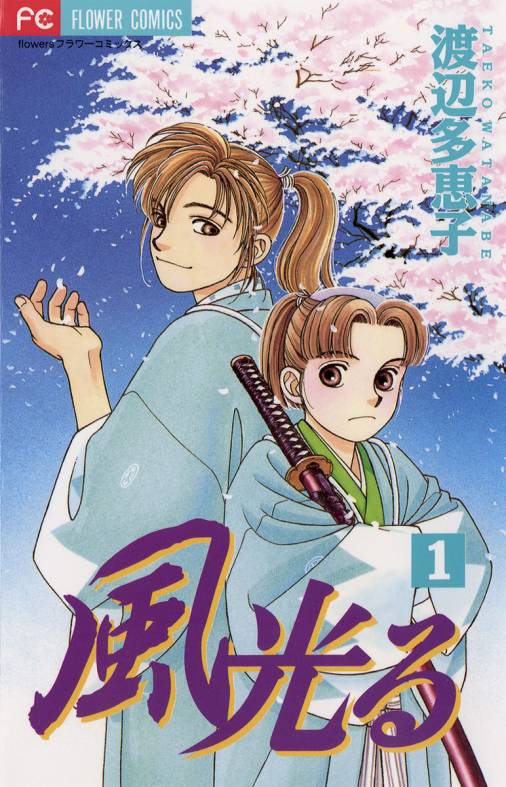
風光る

風光る

『風光る』(かぜひかる)とは、渡辺多恵子による漫画作品である。『別冊少女コミック』(小学館)にて1997年から連載を開始。その後掲載誌を『月刊フラワーズ』(同社)に移し2020年7月号まで連載された。本作は第48回小学館漫画賞を受賞している。
父と兄の仇を討つため、壬生浪士組(後の新選組)に入隊志願した主人公・神谷清三郎。実は神谷清三郎は富永セイ(とみなが せい)という女子が男装している姿であった。武士として師である沖田総司を敬う気持ちと、少女として恋する気持ちの間で揺れ動く姿や、幕末の動乱を生きる力を身につけていく姿、母として強く生きる姿など、主人公が人生をかけて奮闘する日々が描かれる。新選組をテーマとした幕末青春ストーリーである。

Reviews, Ratings and Comments on 風光る

風光る
7

Shinsengumi works with a good balance of historical fact and fiction

A girls' manga about the Shinsengumi.
The main character "Sei" pretends to be a man in order to avenge her family's death and joins the Shinsengumi, and grows up to be a full-fledged samurai while hiding the fact that she is a woman.
There are many manga dealing with the Shinsengumi, but "Fuhikaru" is a work that is at the level of a historical study, as the author has studied the historical facts and the culture of the time well before drawing the work.
For example, Okita is often portrayed as a handsome man, but in this work, the "flounder face" of historical fact is retained.
For example, Okita is often portrayed as a handsome man, but in this work, the "flounder face" of historical fact is retained, while the full-length hair is left in place to give the character a shoujo manga feel.

The main shoujo manga elements are Sei, Okita Soji, who knows her secret, and Saito Hajime, who thinks Sei is a man but still has feelings for her.
Both Sei and Okita are insensitive to each other's feelings, and they remain in a state of unrequited love for quite a long period of time, which makes the reader feel antsy.
It's itchy, I want them to get together, but the distance between them is also adorable! This is the real thrill of shoujo manga.

However, since the work is relatively faithful to historical facts, the latter half of the story focuses more on politics and social conditions of the time, and less on shoujo manga elements.
Also, there are some grotesque scenes, such as heads flying off and blood spurting out, which is unusual for a shoujo manga, so those who are not fond of such scenes should be warned.

風光る
8

Even those who dislike history will enjoy reading it.

Even if you don't like history, you can enjoy this work separately from it. It is a manga that kills two birds with one stone: even if you do not know history, you can learn about it as you read it. The setting is the end of the Edo period, and the main character is a girl whose family is killed in front of her eyes by the Choshu loyalists, which is a very shocking beginning. It is then that she meets Okita Soji. From that point on, the development of the story feels free. The main character, Sei, lies about her gender and joins the Shinsengumi. But she is a girl after all, and she is in love with Okita-san and shows a lot of her maidenly side. Okita-san's character is also a natural but very strong one, easy to approach but hard to get close to, which is a mysterious charm that is popular with girls. What he was really like is a mystery. People's way of thinking and values back then were so different from those of today, but their stubborn but straightforward attitude, and their willingness to protect their loyalty even at the cost of their own lives when they swore an oath of allegiance, is very moving. Although I sometimes think that they did not have to go to such lengths, I am reminded that this history is the reason for Japan's current status. The film is humorous and funny, but at the same time it is a wonderful work that makes you think. It is a bit long, but that is one of its strong points because of the history involved. It can't happen in real life, but I feel that's why I can enjoy it.

風光る
3

The last one is....

It is a manga with a long history as a historical girls' manga, but it is a little disappointing that the last scene was so bad. It's a shame that they had to force the story to take that turn! Considering the relationship between Soji and Sei up to now, and the fact that they became husband and wife in the previous volume, albeit in secret, it would have been better without forcing that last scene. I can understand why Sei does not want to live in a world without Soji and seeks a place to die. But that doesn't mean that she didn't have to have a child with him in order to give him hope to live. Personally, I think it would have been better if the last scene had a letter from Soji to Sei, as a way of recovering the foreshadowing of the first scene. Perhaps the author was doubtful whether Sei would be convinced by the letter, so he couldn't go through with it and ended up with that scene, which is a little off. In any case, the last scene is one that many readers will either wonder about or be appalled by. However, the list of references at the end of the book is remarkable. Frankly speaking, no other manga artist but Mr. Watanabe would read that many references in the creation of a historical manga. No college student would probably go through that amount of literature when writing a graduation thesis. The work is truly a blockbuster with a solid historical background. I only wish the last part of the story had been changed.

風光る
8

Cartoons as Textbooks

Shinsengumi. It is very popular among history buffs and is one of the subjects of not only novels but also TV dramas, manga, anime, and video games. However, when it comes to studying Japanese history, many people may have trouble getting the details of the subject into their heads.
For such people, we recommend "Kaze Hikaru" (Wind Light), originally written by Taeko Watanabe.
The storyline is quite ordinary, as is often the case in girls' manga, in which Sei Tominaga, a daughter of a clinic, disguises herself as a man and calls herself Seizaburo Kamiya to avenge her father and brother who were killed by anti-Shogunate ronin and joins the Mibu Roshigumi, the predecessor of the Shinsengumi.
However, what makes the story unique is the detailed historical background, the tools used in those days, the realistic scenes of killing and wounding, and the detailed depiction of shudo (male-on-male romance) and oma (menstrual phenomena) that were popular at the time.
In particular, the manga is based on period research, including the toothbrushes used daily and the public toilets of the time, so that the characters' breathing is not only very familiar, but the manga becomes a textbook.
Not only this, but any manga that is well-researched is a good reference for study. If you can learn about history while getting emotionally involved with the characters and enjoying their stories, you will not have to worry about your parents getting mad at you for reading manga.

風光る
8

Kaze Hikaru" is a manga recommended for girls who like Shinsengumi!

Kaze Hikaru" is a girls' manga set in the Shinsengumi. The main character is a girl who falsely claims to be a man and joins the Shinsengumi. Under the guidance of Soji Okita, one of the most popular swordsmen in the Shinsengumi, she grows both physically and mentally and becomes a splendid warrior. The main character, a beautiful girl who hides her female identity and wears men's clothes, strives to master swordsmanship while harboring a faint love for Okita Soji, her mentor in the Shinsengumi, and eventually grows to earn the trust of Kondo Isamu, the chief of the Shinsengumi, and Hijikata Toshizo, the second-in-command. Kaze Hikaru is not just a mere love story, as is often the case with girls' manga, but also a historical manga with careful historical research, carefully depicting the late Edo period in a way that gives a clear picture of the situation. In addition, there are many Shinsengumi and rival Restorationists who appear in the manga, and each of them is portrayed in a fascinating way. Most of the characters, with the exception of the main character, are historical and real people, so this is a manga that should be read through by those who like Japanese history, especially those who like the end of the Edo period. It is a must-read manga for women who love the Shinsengumi. The Shinsengumi suffered a tragic fate in history, but since the manga is serialized as of 2020, we can still keep an eye on it to see how it will end up in the end.

風光る
8

A small high school baseball player, an all-time substitute, aims for the Koshien National High School Baseball Championship through monomaniacal baseball.

Yutaka Nonaka is a member of the baseball team at Tamagawa High School. She is a perennial substitute and her specialty is mimicking famous players, but when new manager Kimishima discovers her talent, she is selected as the fourth pitcher in a practice game. The players around him also improve their technical skills thanks to Yutaka's observational advice. With increased confidence, Tamagawa continues to make rapid progress in the preliminary tournament, and in the fifth round, they win a game against Keihin High School, a school that is a regular participant in the Koshien tournament, and then win the final game to make their long-awaited appearance in the Koshien tournament. In the second round, the team lost a hard-fought game against Sekidai Yodogawa, a potential winner with Akai and Yamaguchi in its lineup, 13-14. In the end, Yutaka, who had grown taller, became the captain of the team and set his sights on Koshien. Yutaka's imitations include Nomo, a pioneer to the major leagues; the PL Gakuen KK duo of pitcher Kuwata and hitter Kiyohara in the Keihin High School game; and Godzilla Matsui's home run in Koshien. Of course, Ichiro is also eligible. And the list includes major players such as Randy Johnson, Ochiai and other players of yesteryear, and even Kimishima, who was a college coach. These are not mere ape imitations, but are the result of Yutaka's genuine love of baseball. If there is an athlete you love, not only baseball, you have probably imitated his or her form and gestures at least once.