9
A film to enjoy Julianne Moore's stunning performance as the embodiment of heavenly love.
The End of Things is a film to be enjoyed for Julianne Moore's superb performance as the embodiment of heavenly love.
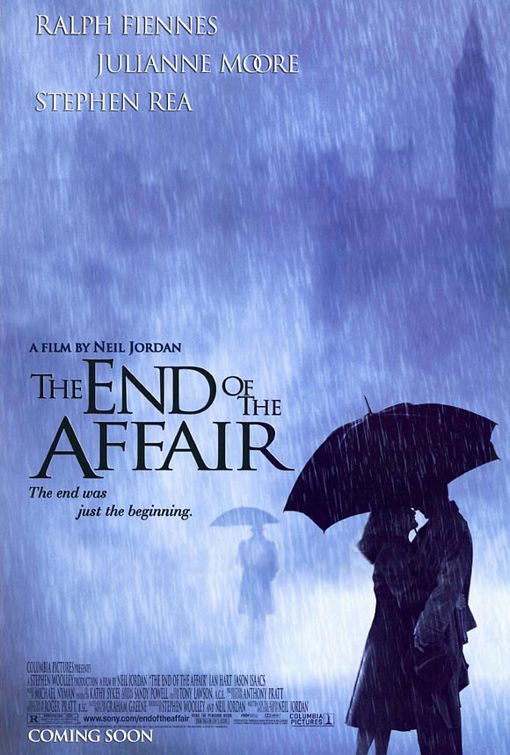
The movie "The End of Things" is based on the novel by Graham Greene, an English Catholic author and a master of spy novels.
He wrote the screenplay for "The Third Man," one of the most immortal works in film history, and he is also famous for his spy novels such as "The Human Factor," and he used to be a British MI6 spy.
The original title of this movie is "The End of The Affair," and the English word "affair" has a hidden meaning of "cheating.
The film is also an adaptation of a novel based on the real-life experiences of the author, Graham Greene, and is directed by Neil Jordan, who has always been at the forefront of depicting the Irish conflict issues in "The Clinging Game" and "Michael Collins".
The film stars Rafe Fiennes of "Schindler's List" fame as the protagonist, writer Bendrix, Julianne Moore of "As Alice Was" fame as the protagonist's friend Sarah, and Stephen Ray, a regular in Neil Jordan's films and his ally in "The Klinging Game," as Henry, a high-ranking bureaucrat and friend of the protagonist. As a moviegoer, my expectations for the film were high even before I saw it, as the mere thought of it brought together such an exciting group of people.
Writer Bendrix has an intense and crazy affair with Sarah, the wife of a high-ranking bureaucrat friend, but during the course of their affair, an air raid occurs and Sarah abruptly and abruptly leaves him.
Two years later, when she meets Henry, Sarah's husband, Bendrix is told by Henry that Sarah has been acting strangely and seems to be seeing someone else. He is curious about the existence of this "third man" who may be the reason why she left him.
The suspenseful, mystery-like storytelling in the beginning of the film, in which the past of Bendrix and Sarah and the "third man" (----) that Sarah may have secretly met are intertwined, is a masterful performance by director Neil Jordan that keeps the viewer hooked and intrigued.
The skillful use of flashbacks is also very effective, and as the truth is eventually revealed, along with the enjoyment of solving the mystery, the earnest and sincere "ultimate form of love" resonates deep in our hearts with a solid and solid response.
Michael Nyman's music, which quietly yet frenetically plays the atmosphere of the film in general with a moist and wet feeling, also enhances the mood of the film.
Sarah's separation from Bendrix is based on her "promise of faith" to God, as she desperately pleads with him to revive her from a state of suspended animation after an air raid.
This encounter between Sarah and her faith should be the "core" of Catholic author Graham Greene's original story.
It may be that people who live in love need "something to hold them back from drowning in the storms of lust" that transcend human understanding.
Since it is "faith in God" that ultimately separates Sarah from Vendrix, Vendrix can only be jealous of "God" and hate "God.
Sarah, too, is torn between comfort and anguish by her faith.
Here, the film, which was once thought to be an ordinary love triangle drama, suddenly takes on an overwhelming depth when "God" intervenes at the center of the story.
The miraculous episode at the end of the film is nothing short of amazing.
Sarah's sublime love is purified to the heavens, and we feel our hearts are healed.
In other words, this film is not a film that appeals to the senses, but to the intellect.
The worldly form of Bendrix, who is tormented by jealousy, is objectively foolish, and we do not want to admit it, but it may be true that jealousy and love are two sides of the same coin, and in a sense, that is the truth of life.
That is why Sarah's figure shines so brightly, and as "the embodiment of heavenly love," she could be a divine, beautiful, and luminous being.
As usual, Rafe Fiennes made an impact on me with his sensitive and profound performance as Bendrix, who is very self-conscious and wavers between jealousy and anguish, but in this film, I was most impressed by Julianne Moore's bewitching and fragrant beauty.
Even in the sensual love scenes, she was full of grace and elegance, and her failure to keep her "religious promise to God" made me feel the depths of being human. I was overwhelmed by the amazing performance of Julianne Moore.
The film won the 1999 British Academy Award for Best Adapted Screenplay for Neil Jordan.