
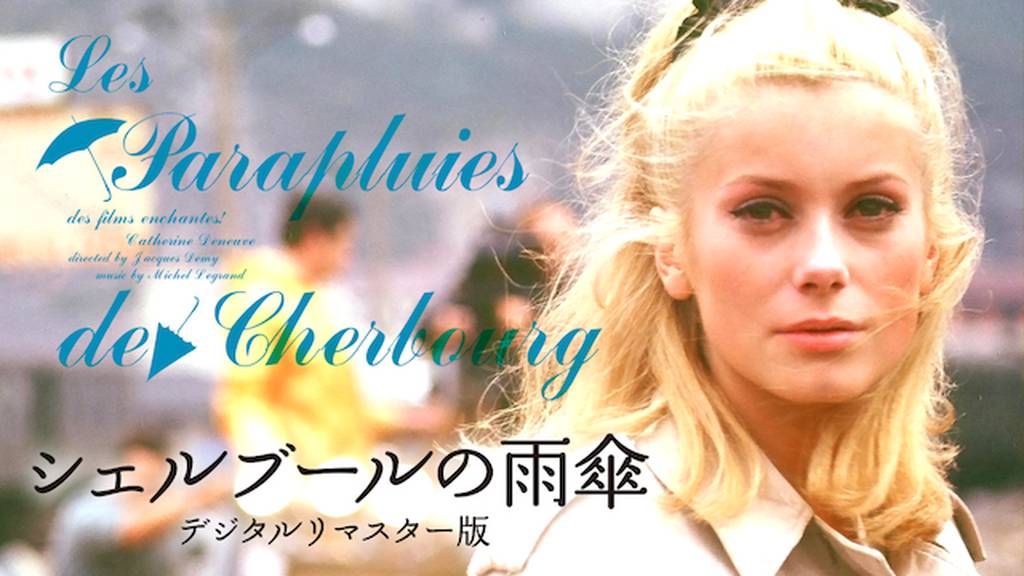

A sad but beautiful farewell story of an overly young man and woman, told entirely in song.
The Umbrellas of Cherbourg is a 1964 French film starring Catherine Deneuve.
It is a musical film in which all the dialogue is expressed in song, and won the Grand Prix at the 17th Cannes International Film Festival.
Consisting of three parts and an epilogue, the film is also known as a "fashionable film" for its colorful images and 1960s fashion.
The film takes place in Cherbourg, a French port town at the height of the Algerian War.
Geneviève (Catherine Deneuve), the daughter of an umbrella shop owner, and Guy (Nino Castelnuovo), an auto mechanic, spend their happy days dreaming of the future.
Geneviève's mother, however, is concerned about their young age and is opposed to their marriage.
One day, Guy receives a summons. Amidst the sadness of being separated, the two are united on the eve of Guy's departure for war.
After Guy goes off to war, Geneviève discovers she is pregnant.
Geneviève is lonely and anxious, receiving only one letter every two months, but she eventually marries Cathart, a jeweler to whom her mother owes a debt of gratitude.
She responded to his good faith by accepting a child that was not her own.
The following year, unaware of Geneviève's marriage, Guy returns to Cherbourg after being discharged from the army due to injury, but the umbrella shop is gone.
When Guy hears from his aunt about his former lover's marriage, he is convinced that his love is over and becomes desperate, but Madeleine, who was taking care of his ailing aunt, scolds him and he starts running a gas station.
Later, Guy marries Madeleine, who gave him the chance to recover, and they have a child together.
Time passed, winter came, and on Christmas Eve, Geneviève came to Guy's gas station and asked, "Are you happy?
"Are you happy? This was the last conversation they ever had, and they parted and went on with their lives.
The vivid colors of this film are so vivid that it is hard to believe that it was made almost 60 years ago, and Michel Legrand's sad and famous music.
Every scene is as beautiful as a postcard, but this is more than just a fashionable film.
All the characters have a human charm, and the fact that there is no one who could be considered a villain is also a good thing about this film.
Even Geneviève's mother, who was opposed to her daughter's marriage to Guy, never throws away Guy's letter, showing her kindness and consideration for her daughter.
And Guy's child is a boy and his name is François. Geneviève's child is a girl and her name is Françoise.
Both names are names that the two once talked about wanting to give to their own children.
I feel that even though time has passed, they must have continued to think of each other somewhere, and I am sure that they will never truly forget each other.
If we focus only on Genevieve and Guy, it might be a "sad goodbye."
However, the presence of the family around them makes us feel that they have happiness as well, and this is a very profound work.