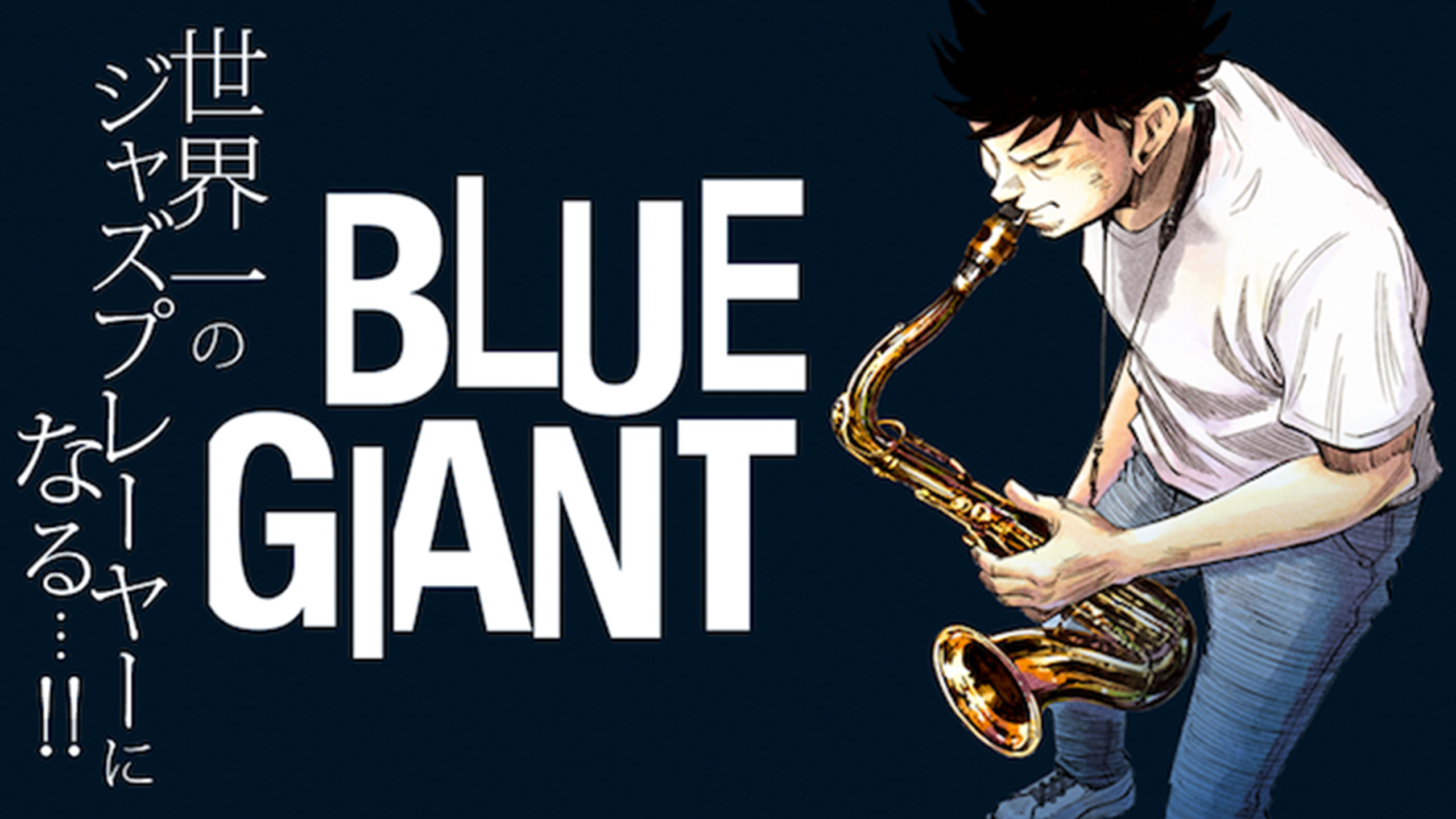
BLUE GIANT / ブルージャイアント

BLUE GIANT / ブルージャイアント

BLUE GIANT" is a manga by Shinichi Ishizuka that has been serialized in "Big Comic Spirits" since 2013. The story is about Dai Miyamoto, a high school student who aspires to become the world's best saxophone player, and how he moves from Sendai to Tokyo to Germany, climbing up the ladder one step at a time. The story was serialized under a different title, BLUE GIANT SUPREME.

Reviews, Ratings and Comments on BLUE GIANT / ブルージャイアント

BLUE GIANT / ブルージャイアント
9

A work that makes you want to talk passionately about it even if you have not read the original work & have no knowledge of jazz

Based on a manga work about jazz from "Big Comic". I was drawn into the film by the storyline and the young people's passion for music. I was moved by the way the protagonist's straightforward and passionate feelings involved those around him, and his dreams and hopes grew even bigger. The characters were appealing and easy to empathize with.
I thought it was just a cartoon and watched it with an easygoing attitude, but I was taken aback. The film's music was composed by Hiromi Uehara, a world-renowned jazz musician. The film music was created by the best performers by auditioning leading players from all over the world. The film seems to have proceeded in the style of recording the performance and then creating the film.
Although there were some scenes where the sound and movements were a bit disconcerting, the visual power, music, and power of the images were more than enough to make the film a success.
It is worth seeing for jazz musicians and people in the music industry, as well as for those who aspire to be musicians. Young people can relate to this film in light of their current selves, and older people can also fully enjoy this film by thinking back to their former youthful days. Some songs were written for this film, and the soundtrack is available for sale. Since the original story has a lot of development after this, I have great expectations for the sequel and subsequent installments to be released. As for the subsequent developments, I plan to read the manga, the original work, as I am too anxious to see what happens next.

BLUE GIANT / ブルージャイアント
10

A story of challenge and growth in jazz

This manga follows the growth of the main character, Dai, who is passionate about jazz.
When he was in high school, his older brother bought him a saxophone, and he spends his days practicing every day on the riverbank, dreaming of becoming the best player in the world. He eventually graduates from high school and moves to Tokyo, where he encounters many different people, and the first part of the story, "BLUE GIANT," takes place as he sets out on the path of music. The first part was made into a movie and received a great response.

The second part, "BLUE GIANT SUPREME," depicts Dai's move to Europe and his growth as a jazz musician. The third part, "BLUE GIANT EXPLORER," is the American version, and the fourth part, "BLUE GIANT MOMENTUM," is the New York version.

Not only are we moved by the way Dai pursues his dreams and grows up, but the various types of musicians he encounters are also wonderful. The personalities and backgrounds of each of them, as well as their struggles with music, are also heartwarming. Incidentally, according to the author, Shinichi Ishizuka, Dai is actually modeled after Shohei Otani, the famous Japanese baseball player.

I feel that the book is well supervised in terms of musical stories, so even if musicians read the book, there are probably many things in it that will strike a chord with them.
It is a manga that gives hints on how to live through music, and will greatly touch the hearts of those who are working hard at something other than music, those who are striving for their dreams, or those who are longing to make their dreams come true.

BLUE GIANT / ブルージャイアント
10

Best Movie Experience

Jazz-themed music . A coming-of-age ensemble drama. It is easy to approach for those who are not interested in jazz or who are not familiar with the original work.
The visual expressions move so fast that it is difficult to verbalize, and Hiromi Uehara, a first-rate pianist, is in charge of the music, and her performance is remarkably convincing.

The jazz team consists of the main character, a genius saxophone player, an elite pianist who has worked hard for years, and a novice drummer; the goal of the three is to perform at the Jazz Hall of Fame "So Blue" in their teens, and they struggle with all their might to reach this stage, which is like Koshien for baseball boys.

The main character continues to practice on his own on the riverbank, unchanged under any circumstances. Although he has only been playing the saxophone for about three years, he attracts others with his enthusiasm and expressiveness.
Tamada, a novice drummer, is indebted to the two other members of his team for their godlike playing ability, and feels that he is always lagging behind. In the final performance, the solo part explodes with all that he has built up over the past year.
The pianist is the real protagonist of the film. Unlike the protagonist, who is superhumanly successful, the pianist is a person who has been steadily and unrewardingly studying for many years. He has literally devoted his entire life to music, and his muddled walk to frustration and glory is in some ways the most emotionally involving.

BLUE GIANT / ブルージャイアント
10

It is a work of art with a haunting sound!

As this was BLUE GIANT's first animated film, I felt that it was a very spirited work.
The performance scenes were especially powerful and well worth seeing.
Dai's powerful and mighty saxophone, Yukihira's prodigious technique and beautiful piano, and Tamada's drums, which he bites into desperately even though he is a beginner.
These sounds blended together to create a wonderful mixture reminiscent of the heyday of Jazz in the 1950s and 1960s.
You feel as if you are actually listening to the performance live, not in a movie theater.
As for the scenario, I also liked the fact that it was based on the original manga, but with some original developments added.
In the original, the last performance scene was just Dai and Tamada, but an encore was added, and the scene where Yukimasa appeared at that time was very moving.
The scene where Yukinori appeared on stage was very moving. Although she had been in a car accident and could only use her left hand, the beautiful piano sound she played was very moving.
Tamada's first drum solo in response to Yukinori's desperate efforts was also great.
The movie corresponds to volumes 4-10 of the original manga.
The contents of volumes 1-3 are also briefly introduced at the beginning of the film, so even those who have not read the original manga will be able to enjoy it.

BLUE GIANT / ブルージャイアント
9

A manga that you can read even if you don't know jazz, and that makes you want to listen to jazz.

What do you think of when you hear the words "jazz cartoon?"
Fashionable? Cool? Not sure?
This "BLUE GIANT" manga literally "blows away" such a slightly skewed image.
Of course, there is no sound, but you can feel the heat and pressure from the main character and other characters.
The spirit and passion are depicted in high concentration.
Although there is no sound, you are under the illusion that you can sense the sound.
There are few technical terms, and even if you don't know anything about jazz, this is a manga you can get absorbed in.

The main character "Dai Miyamoto" started playing the saxophone in high school.
It is not the "usual manga pattern" of "Dai has a special talent...".
Of course, he is lucky to have a teacher, but he keeps on playing. He really does blow all the time.
It's a cartoon, so he can keep blowing forever, but he really keeps blowing every day, even when he's in pain or in distress.
He is unbelievably stoic. The amount of practice is overwhelming. He practices so much that it feels real.

Of course, he makes a lot of mistakes and has been in a tight spot many times.
But even in the midst of all that, jazz is the only thing on his mind at all times.
This is what it means to be a professional.
It is refreshing to see how he overcomes difficulties, like driving a 4WD-like vehicle over rough roads.
And yet, it is different from what is called "sporty.
The words "sincere" and "likeable" come close to describing it.
It is too pure to be called "hot and bothered" and too crazy to be called "guts.

However, this is a manga that keeps on blowing, and there is not much of a daily life part to catch your breath.
Some may find that painful.

The main character, who stands up again and again even after being crushed many times, gives us courage, excitement, and interest in jazz.
I recommend this manga.

BLUE GIANT / ブルージャイアント
10

Jazz is hot.

I have loved rock and roll since I was in high school and played in a band, especially in the 70's and 80's. Since then, I have always listened to the Rolling Stones, Led Zeppelin, and other rock bands of the time.
Naturally, I had no interest in jazz music, only hearing it played on the streets, but after reading "Blue Giant," I started listening to jazz music all the time.
In today's world, where most people are not interested in jazz like me, the story is about the main character, Dai Miyamoto, who rides alone to Tokyo with a saxophone in his hand and aims to become a jazz musician without wavering.
In the midst of this, he meets a genius pianist who has also aspired to be a jazz musician since he was a child, and forms a trio band with a drummer who is a classmate of the main character and who is experiencing the instrument for the first time in his life. The pianist is impatient with the prospect of becoming a professional, while the drummer, a novice, is determined to catch up with the two players as quickly as possible.
The growth of the three main characters and the paths they take, as well as the refreshing descriptions of their performances that move those who listen to them one after another, are very exciting.

BLUE GIANT / ブルージャイアント
9

BLUE GIANT

The main character is Dai Miyamoto, who aspires to be the best jazz player in the world.
It was the saxophone that he played. He does not rise to the top by his sense or technical ability, but rather by his overwhelming effort and amount of practice.
The performance is about the band's straight, unpretentious sound, which they use as a weapon to advance from their hometown of Sendai to Tokyo, and then to the world.
In the process, he meets many people, forms a team, and spreads his wings to the world in this music-related manga.
The main character, Dai Miyamoto, is an honest and passionate person who never misses a practice session even when he is busy or tired, and his efforts are described to an extraordinary degree.
You can clearly see how much he loves jazz and how straight-forward he is in his approach to jazz.
He gets yelled at and made fun of along the way, but there are people who recognize him in the midst of it, and above all, his spirit of never giving up in pursuit of his dream is portrayed.
It is often depicted that they take everything positively and use it as food to move on to the next step.
Onomatopoeia tends to be used in music-related manga, but instead of onomatopoeia, it is expressed through focused lines and facial expressions of the characters.
Therefore, even those who do not know jazz or have no interest in music can feel the atmosphere and live performance, and there are many carefully drawn expressions that allow the reader to understand the content just by looking at the pictures.
The main character's never-giving-up attitude toward his dream is very passionate, and the pictures draw you into it, so if you have a goal to challenge or continue from manga, I think you can learn from Blue Giant.

BLUE GIANT / ブルージャイアント
8

JAZZ manga without shortcuts

It is a Jazz manga in which the main character "Dai Miyamoto", a high school senior in Miyagi Prefecture, aspires to become a Bleu Giant (the world's most brilliant Jazz player).
Inspired by the intensity and passion of a live Jazz session he saw with a friend in junior high school, he fell in love with Jazz until he played it himself. His passionate way of practicing and his passionate heart led him to meet various people, which made "Dai" grow up.
The charm of "BLUE GIANT" lies in "Dai's dogged and indomitable attitude," which keeps him playing every day without fail, and "the depiction of scenery with a LIVE feeling," in which you can feel the sound, the atmosphere outside, and the gentle breeze from the pictures. The way "Dai" strives every day to pursue his dreams looks very powerful to those who have found their dreams and fulfillment, and I believe that it pushes such readers to keep going. In addition, the more readers immerse themselves in the manga, the more they feel the sound of "Dai" playing, the sense of season and the brightness of the outside from the scenery, and I think they will feel a sense of wonder that they do not find in other manga.
This manga is recommended not only for those who pursue their dreams and love Jazz, but also for those who have somehow listened to Jazz and felt its quality. It is true that JAZZ has an aspect of "highbrow music" that is enjoyed while understanding improvisation and chord progressions, but as the main character says that he came to like JAZZ by feeling from this manga, I think it teaches us that it is also good to enjoy JAZZ as a sensation. It is a wonderful manga that shows the author's care in softening such an impression of JAZZ. In addition to reading the manga, you can also enjoy the manga as a Jazz CD album, as the titles of each manga episode are the names of Jazz songs.
I would be happy if you could enjoy the fascinating world of JAZZ with "Dai" and feel the wonder of steady efforts.

BLUE GIANT / ブルージャイアント
9

One saxophone to the world

The story follows Dai Miyamoto, a high school student living in Tohoku (at the time of its start), as he grows up and meets various people in various places in his quest to become the world's best player. The first half of the story can be said to be the domestic part of the manga, and it has reached its end at volume 10. Currently, "BLUE GIANT SUPREME," in which the main character is active overseas, is in progress up to volume 9. I started reading this manga because I had never read many jazz-themed manga before and because I play the saxophone myself. I was a college student when I started reading it, so I got more and more hooked on the story of the main character, who is close to my age, and who is active in the same hobby as me, and eventually it made me think that if I were a little younger, I would have wanted to become a musician. I have read other works by the author, Shinichi Ishizuka, such as "Gaku," and I found that the main character, Sanpo Shimazaki, in "Gaku" and Dai Miyamoto in this work are somewhat similar (even their faces are similar?). They are both a little passionate, and when they form a band, for example, they sometimes clash with the other members, but they always find a solution, and in many cases, the band improves as a whole through friendly rivalry. SUPREME" is set in Europe, mainly in Germany, and I am impressed by the well-reported descriptions, so I can recommend it to those who like the scenery and life in this region. Of course, if you like jazz music, I highly recommend this book as it depicts scenes of performances at live music clubs and outdoor festivals, which gives the reader a sense of the realism of a live performance even though it is a manga.

BLUE GIANT / ブルージャイアント
8

Review of "BLUE GIANT" and "BLUE GIANT SUPREME" by Dr. Shinichi Ishizuka

I would like to write about my impressions of "BLUE GIANT" and its sequel, "BLUE GIANT SUPREME," which were serialized in Big Comic.
This is the third serialized work by "Shinichi Ishizuka" in Big Comic, following "Gaku Minna no Yama" and "Tokyo Check-in".
The general impression of the work is a story of a young man's growth.
The story begins with Dai Miyamoto, a third-year junior high school student in Sendai, who is suddenly exposed to jazz and teaches himself to play the saxophone.
He played the saxophone gamely, but with the support of those around him, he formed a trio in Tokyo, and the story of "BLUE GIANT" ends with the breakup of the trio. BLUE GIANT SUPREME" is the story after Dai went to Europe.
The following is my impression of the manga, but rather than being a manga that fascinates with its storyline, I was often drawn in by the short cuts in the manga that made me unable to take my eyes off the story.
For this reason, the impressive parts often remain in my memory as images until later, and it is fun to read them again.
One of the most memorable parts is when Dai starts playing the saxophone on the street at a street jazz festival, and a girl with her mother turns around as if drawn by the sound, and then a crowd gathers.
There were other times when he drew a whole episode without dialogue, so I have the impression that the author put a lot of effort into the cut section.
When I buy Big Comic, the first thing I read is BLUE GIANT SUPREME.
Dai is overcoming hardships and is striving toward further goals.
I can't take my eyes off of Dai's growth story.

BLUE GIANT / ブルージャイアント
8

The size of your ambition x the effort you put into it = you are close to your dream.

The manga begins with the main character Dai (Dai), a high school boy living in Miyagi Prefecture, who practices the saxophone daily with the aim of becoming the world's best jazz musician.
At the beginning, he had no instructor and was self-taught on the saxophone, so although he has many technical problems, he is able to produce an extremely powerful sound due to the amount of practice and the lung capacity he was born with, and his overwhelming sound quality fascinates those around him.
He sometimes has setbacks in sessions with piano and vocals, as he is unable to play along with others, but his natural cheerfulness and his ambition to become the best jazzman in the world enable him to overcome various obstacles with the help of his failures.

My personal feeling from these stories is that when people take on a new challenge, they always start out as beginners, but by setting their goals high and being determined to overcome the hurdles, they often come very close to achieving their goals.
While it is very important to listen to the evaluations and opinions of those around you, for example, the scene where he repeatedly says, "I will be the best jazzman in the world," in order to trust himself when those around him tell him that he cannot be the best jazzman in the world, was particularly memorable and also left a strong impression on me. I believe that what I do not believe in will never come true, and that what I believe I can do will bring me closer to that realization, even if it is only a little at a time.

BLUE GIANT / ブルージャイアント
10

Hot story of a young saxophone player on a jazz kick!

It is the most exciting and thrilling manga. Every time I finish a volume, I can't wait for the next one.
The setting is Sendai. The main character is Dai Miyamoto, a junior high school student who belongs to a basketball club. He is so impressed by a jazz performance his friend takes him to that he starts practicing tenor saxophone by himself. He dreams of becoming the best jazz player in the world.
On the way to his dream, Dai goes through many encounters, partings, setbacks, and glories. He is booed for the first time, trains hard with his teacher, and meets friends who fight with him. Each of these scenes will touch the reader's heart. The reason for this is that the characters' expressions are so vivid and vivid! We are captivated by the joy, anger, sorrow, and happiness that burst forth in the panels as they spill sweat and tears.
It is not only the facial expressions that are lively. The realism of the performance scenes that take place repeatedly throughout the film is beyond compare! It is extraordinary! Of course, since the performance takes place in a comic book, no sound can be heard. But when you actually read the manga, it was as if you were there listening to the performance. Back hunched, mouth agape, and standing on your dignity. You are drawn in by the players playing desperately.
I can confidently recommend this manga not only to those who love music, but also to those who are not interested in music. I think it is easy to read with only ten volumes. By all means! Read it!