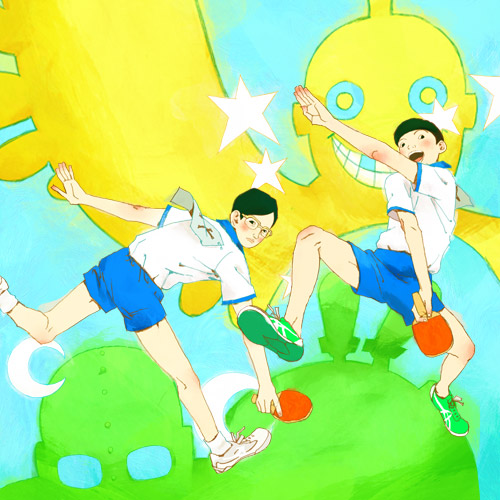
ピンポン / Ping Pong

ピンポン / Ping Pong

Ping Pong is a table tennis manga by Taiyo Matsumoto, as well as a live-action film and anime work derived from it.
It is a coming-of-age story about friendship and growth of the characters based on table tennis, and is set in Fujisawa City, Kanagawa Prefecture.
It was serialized in Weekly Big Comic Spirits (published by Shogakukan) from 1996 to 1997. There were five volumes.
A live-action movie was released in theaters in July 2002.
The anime aired from April to June 2014. 11 episodes.

Reviews, Ratings and Comments on ピンポン / Ping Pong

ピンポン / Ping Pong
9

This is not just a ping-pong anime.

Ping Pong" is an animated film based on the manga by Taiyo Matsumoto. Taiyo Matsumoto is known for his works depicting friendship, and "Ping Pong" is no exception.
The setting is a high school ping-pong club, and the drawings with a unique touch are impressive. The animation also incorporates cutaways from the manga, and the voice actors' performances, which are comfortable, make it easy for manga readers to accept.

The main character, Yutaka Hoshino (a.k.a. Peco), is a charming character who, despite his talent, continues to play ping-pong idly at his old "ping-pong hall, Tamura". Peco's friend Makoto Tsukimoto (a.k.a. Smile) seemed to look at him coldly.
However, as you watch the work, you will realize that he was not serious when he said, "Table tennis is just a way to pass the time until I die.

Smile used to be bullied with the nickname "Robot," but he was always saved by the cool Peco, who used to snatch trophies and medals at ping-pong tournaments. Smile seemed to consider Peco a hero.
In the game between Peco and Smile, Smile's heart is melted by the hero Peco. The scene where the nursery rhyme "Palm of the Hand to the Sun" was played was very moving.

ピンポン / Ping Pong
10

An exhilarating sports humanistic anime with a maximum of exhilaration

Peco (real name: Yutaka Hoshino), a genius and egotist who has played table tennis together since elementary school, and Smile (real name: Makoto Tsukimoto), a solid and emotionless player, belong to the same table tennis club after entering high school. The humanistic drama revolving around these two is delivered through the game of ping-pong, which is also known as "the fastest sport.

The most significant feature of this anime is that the drama progresses through the use of table tennis.
Usually, sports anime is about how to win, and the inner lives of the characters are not depicted, especially during the sport.
Only the character's status is depicted during the sport, and what kind of human richness the character possesses is only depicted after or before the sporting match.
Ping pong, however, is different. In ping pong, we get to know the inner life of the character when it comes to the game. The reason for this is that emotions and feelings begin to rally. The characters in Ping Pong put their emotions on the ping pong ball.
There is a pure enjoyment of ping pong and even very human and raw emotions.
Since it is a sport, there are wins and losses, and through the matches, there are scenes in which we feel the barrier of talent, or wonder what the future holds for those who have lost, and other sad and unfulfilling emotions are described. However, you can certainly feel the all-out effort there.
Both the good and the bad that we experience in such adolescence are exhilaratingly depicted.
Even embarrassing opinions can look cool if you really mean them.
It was the kind of work that passes by in a blink of an eye with no aftermath.

ピンポン / Ping Pong
10

The most rewatched movie of my life.

This is a story of youth and growth that is too mature to be simply categorized as a sports-controlled coming-of-age film.
It is a work that combines freshness and bitterness, focusing on the hot and blue days of high school students who aim for the top in table tennis, the setbacks and resurrections of their heroes, and even the ordinary people who are consumed in the shadows of their success.
The blossoming of the best friend's talent that kicks off the hero Peco's lazy beginnings and the accompanying first setback and resurrection are spectacular, and of course, the friendship that seems to go on forever between Peco and Smile, which does not allow the intervention of other companies, is fascinating.
On the other hand, I think the key to the story is the way it redeems the outcasts who were not able to ride the rails, such as the genius Dragon who wastes his time on ping-pong and the ordinary Akuma who could not blossom from the ping-pong game he had devoted his life to.
In particular, Akuma, who was beaten to a pulp by his childhood friend Smile, exclaims on the side of the road, "Where do I have to look to get a compliment?
It is common to think of coming-of-age as being adolescent and hot and bothered, and that is what is good about it, but I think Ping Pong is a coming-of-age movie that is somewhat downer, but still a hero movie that brings relief to the viewer by completely sweeping him or her off their feet.

ピンポン / Ping Pong
8

Burning for Table Tennis! Painful Coming-of-Age Drama

I was very impressed by the various characters of the high school students, all of whom are dedicated to table tennis.
Each character has a strong personality, and the film is full of comedy, but the story is very serious in a sense, and you can feel the passion that each character has for table tennis.
The combination of the two characters, Peco (Yosuke Kubozuka), who is a genius, bold, and vivacious, and Smile (Arata Iura), who is sober, timid, and taciturn, is exquisite and well-balanced, even though they seem to be disproportionate to each other. Although they are different in their approach to ping-pong, their single-minded devotion to the sport, good rivalry, and deep friendship are the essence of adolescence.
Peco is desperately trying to reach the final game with a broken leg while Smile is waiting for him, and Smile is quietly waiting for Peco to trust him.
In the ping-pong game scene, the players' movements and the speed of the ball are full of power. The music is also a part of the film that should be listened to often, as it is innovative, fast, fresh, and vivacious.

ピンポン / Ping Pong
10

On the reasons for the loneliness of the smile.

The first work by Taiyo Matsumoto that I read was "Ping Pong. I often read manga by the touch of the pictures, but when I saw this picture, I was shocked to see that it looked like a woodblock print. The contrast between black and white is so strong that I think it is quite like it or not. However, Taiyo Matsumoto's manga are so addictive that once you get into them, you can't stop. The themes he depicts are so grand and philosophical, but the characters' actions and dialogues are so surreal that you can't help but laugh at them. This is a ping-pong manga about Hoshino (Peco), a genius who is a born hero, and Tsukimoto (Smile), a brilliant genius who is so stoic that he keeps admiring Hoshino. Table tennis is only a measure in expressing the greatness of the two. Hoshino is the righteous one who instantly saved Tsukimoto from being bullied as a child. And Hoshino who gave the nickname "Smile" to Tsukimoto, who never laughed at all. That is the root and everything of the story. Smile is showing more and more his high potential in ping-pong while Peco is eating only candy instead of practicing. Smile completely surpasses Peco in ability. It is a reality that Smile is most saddened by and does not want to admit. Smile just, just waits for Peco to appear as a hero in front of him again. It's not that I'm playing ping-pong to win. The more he wins against strong opponents, the lonelier Smile feels. Finally, Peco appears in front of Smile as his opponent in the final match. As the hero who once saved him.

ピンポン / Ping Pong
10

Until a smiley face smiles.

This was the first manga I read by Taiyo Matsumoto. The impact was just so strong. It was in black and white with a dark touch like a print. I thought this solid coloring was bad.
In short, it is a story about Peco (Hoshino), the eternal hero in Smile's (Tsukimoto) mind, up to his full recovery. Smile started playing ping-pong because he admired Peco. He soon overtakes Peco, who does not practice at all and only eats sweets, in terms of ability. Smile's feelings are very complicated. But the hero (savior) in Smile's memory must be Peco. Smile never smiles and continues to wait for Peco's return. Peko was the type of person who won by his talent alone. A genius, so to speak. Smile, on the other hand, is a genius who repeats the same basic exercises to the point of stupidity. He is at a level that can no longer be described simply by the word "earnest. A certain conflict arises within Smile. I have surpassed Peko. A reality that he absolutely does not want to admit. The only thing that could inspire the despairing smiley was a being stronger than himself. Neither China nor Akuma can stand up to Smile. He wants to lose quickly, but he wins. Feeling such a contradiction, Smile longed for the appearance of a being stronger than himself. After defeating the strongest enemy, the dragon, Peco would return as a hero before Smile. And the story is completed when Peco, the absolute hero, defeats the strongest Smile. Smile returns to Smile.

ピンポン / Ping Pong
9

A story about how each of us faces the other.

This work depicts the way four characters face table tennis.
Although it is a sports manga, it is a story about one's talent and how to face the obstacles, a story that even those who have never played sports can relate to.

There are four characters who are very different in terms of their table tennis talents. In the end, the story depicts Peco, the protagonist of the story, winning the game, but the dragon who faces his talent head-on, Akuma who feels inferior to the talent around him but cannot stay away from table tennis, and Smile who is aware of his talent but has kept it hidden, each has their own merits, and readers are sure to feel a strong sense of empathy for any one of the four characters. I am sure that readers will feel sympathy for any of the four characters.
In the end, Peko is depicted as winning, so I think it is best to enjoy everything, but I felt while reading that there is no right way to deal with talent.

Unlike so-called "sport manga," there are no special abilities in this manga, so it may not be a work that will shock you once you read it. However, the human side of the story is strongly depicted, and there were many things that I noticed as I read it for the second or third time.
I think everyone has trouble with inferiority complexes and how to deal with things, whether at work, in sports, or in everyday life. I think this is such a gourmet work that gives hints to such things that anyone can be troubled with.