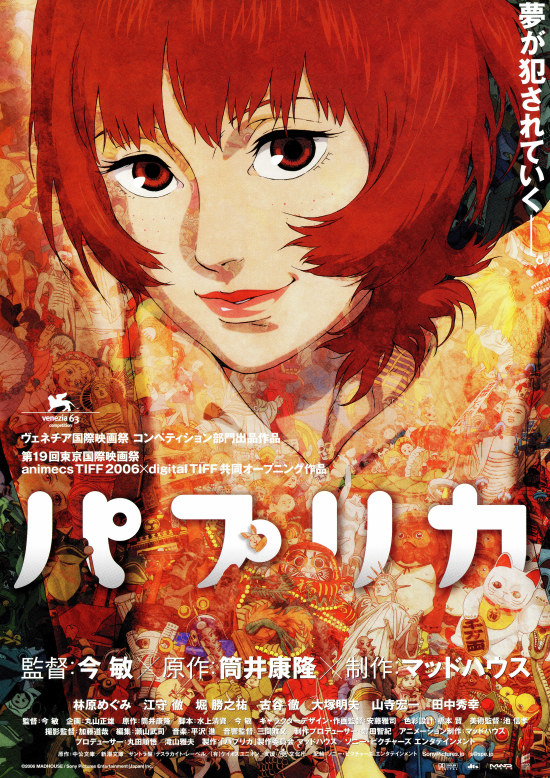
パプリカ / Paprika

パプリカ / Paprika

Paprika is an animated film directed by Satoshi Kon. Based on the novel "Paprika" by Yasutaka Tsutsui, it was released in theaters on November 25, 2006.
Atsuko Chiba is a psychotherapist who takes on the role of "Paprika," another personality in the DC Mini, a device that allows people to share their dreams. One day, an incident occurs in which DC Mini is stolen from the laboratory and misused. Atsuko and her friends at the institute try to find a solution to the problem, but the dreams begin to affect the real world as a result of the incident.

Reviews, Ratings and Comments on パプリカ / Paprika

パプリカ / Paprika
8

Crushed by dreams, madness, visual pressure

Paprika" is a Japanese animated film released in 2006. It was written and directed by manga artist and animation director Satoshi Kon. It is based on the 1993 novel of the same title written by Yasutaka Tsutsui.
The synopsis is that someone has stolen a "DC Mini," a machine that allows people to share their dreams with others, and in order to track down the culprit, the main character, Atsuko Chiba, transforms herself into the dream detective "Paprika" and sets out to investigate into people's dreams.

The most amazing thing about this animated film is the visual pressure. The depiction of dreams, which is too crazy and chaotic to be called "visual beauty," is truly breathtaking. The chaos, which is almost crushing, is visually overwhelming. However, the images are not unpleasant. It is not understandable, it is not orderly, it is not beautiful in the general sense of the word, but it is very addictive. I find myself wanting to watch this chaos and disorder all the time.
In addition, the background music by musician Susumu Hirasawa adds the perfect flavor to the images. It is truly a dreamy experience.

Although I'm only describing the dream, the story is also very interesting, as it is based on the search for the culprit of a DC mini-theft, and the main story progresses without any interruptions while also describing the backgrounds and feelings of the characters.

The only problem is that, although the final part of the story is well organized, the final battle, which is the climax of the story, tends to be chaotic and "what the heck is this? A huge naked woman appears. It is not particularly disgusting, but when I saw it with my acquaintance, it made me feel awkward.

If you like the chaos in this movie, you will probably like the final battle as well, but I am not sure if I would recommend this movie to everyone. I wonder if they will like the chaos and feel the pressure that accompanies this pleasant sensation. I am too worried about this to recommend it to others. If you are interested in this film, I recommend that you watch it alone first.

パプリカ / Paprika
8

A work of contemporary art created by a genius

This is a film that brings together the geniuses known to those in the know: Susumu Hirasawa for the music, Yasutaka Tsutsui for the original story, and Satoshi Kon for the film direction.

The story begins when a DC Mini, a machine that treats psychotic patients, is stolen.

The highlight of the film is that it is a work of contemporary art.
The film surprises the viewer with a combination of creative visual effects, colors, and psychedelic music. The fantastical yet meaningful scenes and depictions are reminiscent of contemporary art, which can be viewed in different ways depending on the viewer's opinion.
Through its story and unique animation, the film depicts the complexity of the characters' psyches, the delicacy of their relationships, and their desires, which are expressed through beautiful yet somehow unsettling animation and music.

The art and colors in "Paprika" have a fresh and bright touch similar to those in "What is your name? The art and colors in "Paprika" are different from the fresh and bright touch of "Kimi no na wa" (What is your name?), and the gaudy but beautifully crafted colors stand out.
The use of color in "Paprika" creates the illusion of being lost in a dream and immerses the viewer in the film. This is a technique of expression unique to the animation and colors of "Paprika," and it is a work that has expanded the possibilities of animated films.
It is a wonderful film that allows the viewer to experience contemporary art in the comfort of his or her own home, and I urge everyone to see it at least once.

パプリカ / Paprika
8

Ride the wave of overwhelming images.

Animated feature film directed by Satoshi Kon. A suspense film set in a dream world. The highlight of the film is the surreal world that only dreams can create and the images that depict a world that could never exist in reality. In particular, the scene in which the main character chases after a certain person in a hotel is so perfect that later director Christopher Nolan paid homage to it in "Inception".
The story is a bit confusing, and in some places it is not clear whether the story is coherent or not, but the momentum of the film as a whole is so overwhelming that this is not a problem.
The dream world is also symbolic, and it is fun to reflect on it after viewing. The film visually expresses various phenomena that occur in the mind, such as hidden desires, trauma, and mental confusion, in a way that is easy to understand and interesting.
The scenario also refers to the theme of human duality, which can be seen in other Satoshi Kon works (Deep Blue). The front face and the back face, the pretense and the true intention, the calm face and the chaos lurking behind the calm face.... The hidden inner self that cannot be shown to others is unknowingly revealed in the world of dreams. What would happen if someone else were to step into that dream world? Director Satoshi Kon takes full advantage of animation to depict a fantasy world that everyone has imagined at one time or another, and has even reassured themselves that it is impossible!

パプリカ / Paprika
9

It's not a cartoon after all.

Paprika is an anime film with the catchphrases "My dream is being raped" and "My dream is being raped. The director is the genius Satoshi Kon. It is true that there are a certain number of people who have the impression that animation films are for children or are made for pleasure. It is precisely for such people that I want you to see this film.
The main character, Paprika, is a psychotherapist who uses a dream-sharing device called "DC Mini" to penetrate into the dreams of her clients and probe their deepest psyche. At one point, the target is shown nightmares by the "DC Mini," and incidents of mental breakdowns begin to occur. Who is the culprit and what is his purpose? Paprika takes up the challenge of fighting an unseen enemy in order to end the nightmares.
As you can see from the story, this work deals with dreams and the depths of the psyche. They are usually incoherent, unintelligible, and incomprehensible. We may vaguely understand the meaning of the words, but the reality of the words may always seem to be in a wavering blur, like a shallow dream.
I feel, however, that this work succeeds brilliantly in visualizing the thoughts and intricate images that exist unconsciously. The wonderful images and Susumu Hirasawa's music are highly harmonized, and the tranquility and frenzy within the human psyche are clearly shown. It would not have been possible to express this without using an animated film rather than live-action or 3DCG. The entire incident and how it ends is surprisingly simple, which also stirs a strange sense of reality. It is a film that cannot be overlooked when talking about cinema.