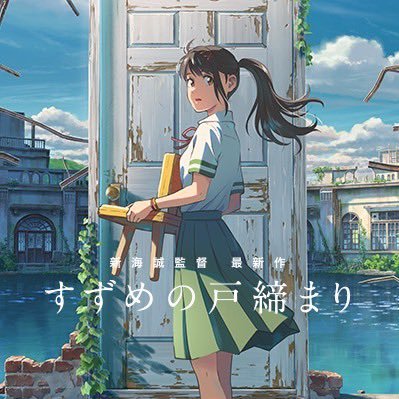
すずめの戸締まり / Suzume

すずめの戸締まり / Suzume

Suzume no tozume" is a Japanese animated film released in 2022, written and directed by Makoto Shinkai. The film is a road movie about the growth and adventures of Suzume, a young girl who travels around Japan as a "closers" of exits called "doors" scattered throughout the country.
The protagonist of the film is a 17-year-old high school girl named Suzume Iwato, who lost her mother early in life and cherishes a chair missing a piece, a memento of her mother. Other characters include Munakata Sota, a young man on a journey to close doors as a "closers," and Daizin, a divine beast in the form of a white cat.
The film's music is featured on the album "Suzume no tojimari" by RADWIMPS and Kazuma Jinnai, which includes 25 songs, including the play and the theme song.
In its Japanese release, the film drew an audience of 1,331,081 and earned 1,884,215,620 yen at the box office, making it the highest-grossing film ever directed by Makoto Shinkai.
The film is set in Kyushu, Shikoku, Chugoku, and Tokyo, and the model locations actually exist in various parts of the country. Pilgrimages to sacred places to visit those locations became a hot topic.

Reviews, Ratings and Comments on すずめの戸締まり / Suzume

すずめの戸締まり / Suzume
9

新海誠作品の中で一番すき

新海誠の3作品目の映画である。
「君の名は」「天気の子」に続き上映された「すずめの戸締り」。3作品共に映画館で拝見したが、どれも涙なしでは見ていられなかった。
その中でも「すずめの戸締り」はグッとくるものがあった。
閉じ師の宗像 草太(むなかた そうた)と主人公の岩戸 鈴芽(いわと すずめ)が扉を閉じていく物語。
災いを閉じ込めるため扉を閉めていく草太が生贄(要石)となるシーンは何度見ても苦しくてたまらない。
草太を助けるためあの世に行こうとする鈴芽は叔母の岩戸 環(いわと たまき)と言い合いになってしまうシーンがある。
草太を要石にした元要石ダイジンの片割れ「サダイジン」が環に本音を言わせてしまったシーン。
育ての親からの言われてしまうあの言葉は声を出して泣いた。
上映中には流されなかったが主題歌を歌ったRADWIMPSのTamakiという曲は映画をみた後に聞くと作品をもう一度見たくなる。
災害の怖さも人と人の関係も、死ぬことへの怖さも映画1本で完成されていたのが新海誠の魅力なのだろう。
そしてダイジンとサダイジンが要石に戻るシーン。
ダイジンの「すずめの子になれなかった」
冒頭の鈴芽が言った「うちの子になる?」への返答だった。
草太が要石となって死んでしまうのも嫌でダイジンがまた長い間要石に戻ってしまうのも苦しく重いシーンだ。
災害を防ぐために要石が必要だが鈴芽と一緒に居たかったダイジンの気持ちもとてつもなく複雑だ。
泣けるシーンはたくさんあるが故にハンカチなしでは見れない作品。

すずめの戸締まり / Suzume
10

家と心の扉を閉める物語

映画『すずめの戸締まり』は、日本のアニメ映画監督である新海誠の作品で、彼特有の感動的なストーリーテリングと美しいビジュアルで観客を再び魅了しています。この物語は、自然と人間の関係、そして個人の内面的成長を繊細に描いた作品です。

主人公の少女・すずめは、災害によって失われた故郷を背景に、自らの運命を受け入れ、過去のトラウマと向き合っていく過程を描いています。彼女の旅は、文字通りと比喩的にも、閉じられた扉を開く試みであり、それが彼女自身の心の扉を開くことにつながっています。

映画は、驚くほど美しい風景と細部にわたるアートワークで知られる新海誠のスタイルを忠実に守りつつ、より深い感情的なレベルでの挑戦を試みています。ビジュアルは、この感動的な物語を完璧に補完しており、登場するキャラクターたちの感情が視覚的にも表現されています。

物語の核心にあるのは、自己発見と自己受容のテーマです。すずめが直面する数々の困難は、彼女が自己のアイデンティティを探求し、内面の力を見つけるための障害となっています。彼女の成長は、家族や友人との関係を通じても描かれ、これらの人間関係が彼女の旅にどのように影響を与えるかが見事に表現されています。

全体として、『すずめの戸締まり』は、新海誠の作品群の中でも特に感動的で思索的な一作となっています。家と心の扉を閉めることで、すずめがどのように自分自身と向き合い、過去を超えて新たな未来へと歩み始めるのかを描いており、多くの観客にとって共感とインスピレーションの源となるでしょう。

すずめの戸締まり / Suzume
9

About the film "Suzume no Dokkomari

This work is a story about a high school girl "Suzume," the main character, and "Mr. Sota," who works as a closure artist.
In the town where Suzume lives, a huge cloud-like object called a "worm" that causes earthquakes appears through the door of an abandoned place. The door can only be closed by using a special key that only the closing master has. In this story, Suzume and Sota join forces to prevent earthquakes by closing doors all over the country, and then go to find a certain huge door to close it.

To begin with, we are drawn into the film from the very beginning. A girl and a woman appear in the opening scene, but they were actually the main characters of the past and present. The title of the film was different from other films, and it was a very powerful performance. Each sound effect is very loud and powerful, making it easy to get into the film.
The film contains scenes depicting the Great East Japan Earthquake in the middle of the film, so those who do not like trauma, tsunami, the sound of earthquake early warning, etc., need to be careful.

The songs used in the film are nostalgic old songs, so this film can be enjoyed by both adults and children. Also, there are scenes depicting the feelings of both the child and the mother-in-law, so you can empathize with them.
It is a movie that can be enjoyed with family and friends, so please try to watch "Suzume no Dokkomari".

すずめの戸締まり / Suzume
9

A work depicting human warmth and growth through travel

Suzume no Dokkomari" is a charming animated film directed by Makoto Shinkai that all generations can relate to. The film combines Shinkai's signature beautiful visuals with emotionally resonant storytelling, particularly as it depicts a young man's journey of growth and self-discovery.

The film's protagonist, Suzume, is a young girl whose mission is to escape her mundane life and close the mysterious doors that appear throughout the country. Her journey is not just an adventure story, but symbolizes growth in self-understanding and in relationships with others. The story has elements of empathy for the struggles faced by adolescent high school students and the importance of self-exploration.

As a film directed by Makoto Shinkai, it should be noted that the film is not only beautifully visual, but also highly detailed and accurate in its depiction. The realism and artistic quality of even a single landscape depiction is mesmerizing to the viewer.
Furthermore, the music by RADWIMPS enhances the emotional scenes and enriches the film experience.

The voice actors voicing the characters are also superb and do a wonderful job of portraying the personalities and inner lives of each character. The emotional ups and downs of the characters are conveyed so realistically that the viewer can relate to them deeply.

This film strongly appeals to students and adults alike, not only for its visual beauty, but also for the depth of its story and the richness of its emotions. Through the various emotions and experiences faced in the process of growing up, viewers will learn important life lessons.

すずめの戸締まり / Suzume
9

A fantasy film that only the Japanese can create.

The main visual is mysterious and beautiful, as if it were a work by Makoto Shinkai. The content of the film is an adventure fantasy that incorporates a lot of religious beliefs and beliefs that have been rooted in Japan since ancient times, just like his masterpieces "Kimi no na wa. and "The Weather Child," his masterpiece, is an adventure fantasy that incorporates many of the religious beliefs and beliefs that have taken root in the Japanese people since ancient times.

Suzume, a high school girl living in the quiet countryside of Miyazaki Prefecture, and Sota, who works as a "closure master" and is responsible for quelling the "worms" that cause earthquakes and locking them in doors, meet by chance. This is an adventure story about growing up with the kindness of people, visiting abandoned buildings around Japan, and closing the doors.

The fact that the story is not a mere fantasy, but rather a story that makes one believe that something like this may actually exist in the real world, even if one is unaware of it, may be due to the unique religious view of God that is deeply rooted in the Japanese people, which holds that all things and phenomena have a God, and the view of life and death that the other world exists as a counterpart to this world. The other world exists as a counterpart to this world.

The story is fast-paced and easy to watch, with some funny scenes. However, I think that the way foreign viewers and Japanese, who have their own religions and values to worship only one God, would enjoy this film completely differently.

Nanoha Hara as Suzume and Hokuto Matsumura as Kusata, the main characters, are so well suited to their roles that it is hard to believe that this is their first attempt at voice acting, and the supporting cast is also gorgeous, so I was able to enjoy the film without any discomfort until the end.

すずめの戸締まり / Suzume
10

What is the film "Suzume no Dokkomari"?

An animated film directed by Makoto Shinkai, "Suzume no tokimari," was released in theaters on November 11, 2022.

The main character, Suzume, is a 17-year-old girl living with her aunt in a port town in Kyushu. One day, she follows a mysterious young man who says he is looking for a door, and arrives at an abandoned house in the mountains. However, what she finds there is an old door standing alone.
As if drawn by something, Suzume reaches for the door. The door is called the "back door," and it leads to the "everlasting world.

The film is filled with scenes of the main character traveling around Japan, interacting with people and, of course, stopping the "worms" that come out of the back door!
Although there are comical scenes, a rapid development is prepared for the climax of the film, and the immersion is very high.
It is a work that makes one feel the importance of life.

Based on Japanese mythology, this film is a reminder of the Great East Japan Earthquake. Although the film did not win any awards at the 73rd Berlin International Film Festival, it was the first Japanese animated film to be selected for the festival in 21 years since Studio Ghibli's "Spirited Away," indicating that the film is highly regarded overseas as well.

The music for the film is "Kimi no na wa. The music for the film is by RADWIMPS, as in "Kimi no na wa. We hope you will experience the overwhelmingly beautiful artwork and music, which are well-known in Makoto Shinkai's films.

すずめの戸締まり / Suzume
8

A work about the Great East Japan Earthquake, but not only gloomy, but also a work that encourages us to look forward to the future.

The animated film work "Suzume no Dokkiri" was released in theaters in November 2022, and is directed by Makoto Shinkai, who also directed such well-known films as "Kimi no na wa. and "Weather Child," as well as other famous works by director Makoto Shinkai. The main character, a high school girl named Suzume, lost her parents in the Great East Japan Earthquake and has been raised by her aunt. One day, she has a chance encounter with a man named Sota. The story begins to take off. In the past, Makoto Shinkai's works have always blurred the fact that they were based on the Great East Japan Earthquake, even though they have disaster as their theme. However, even before the screening of "Suzume no Dokkiri," the director clearly announced to the audience through social networking services that an earthquake early warning sound would be heard in the film. This is different from past films in that those who have been traumatized by the Great East Japan Earthquake and those who suffer from panic disorder or other mental illnesses can choose not to see the film in advance. In the film, there are scenes in which earthquakes actually occur, and there are also scenes in which earthquake alarms sound. Even those of us who were not affected by the earthquake were thrilled to see such scenes. Those who actually suffered from the earthquake may feel even more fear. Even so, director Makoto Shinkai wanted to depict this "Suzume no Dokkiri". On the day of the earthquake. Many people who greeted their families, "I'm off," and headed for work, school, kindergarten, etc. died without being able to say "I'm home. Director Makoto Shinkai, realizing the regret, asks the main character Suzume to say "I'm home" on behalf of the many victims of the disaster. It is a work that can never be seen without tears and sadness. But it is also a film that makes you think positively, "Let's cherish every day of our lives. I hope that those who have not been affected by the disaster and those who live far away from the Tohoku region will watch this film.

すずめの戸締まり / Suzume
8

What it means to watch because of the Corona Disaster, and what it means to live tomorrow.

The story is about Suzume Iwato, a high school girl who is a victim of the 3.11 disaster, who one day meets Souta Munakata, a magnificent young man, and they work as buddies to close the "doors" in various places in Japan.
The story takes place in Miyazaki, Kyushu, Ehime, Hyogo, Tokyo, and Suzume's birthplace, Tohoku, as she follows the mysterious cat, Daijin, and is sometimes guided by him. In the lingering heat of summer, Suzume and Souta, who are facing the memories of people and lands and thinking of forgotten places in less than a week's time, remind us of the important things that we tend to forget.

The overwhelmingly beautiful images by director Makoto Shinkai, combined with the music by Yojiro Noda of Rad Wimps, create an incomparable world.
The characters in the film are carefully portrayed, and the honesty with which Suzume and Sota deal with each other reminds us of the warmth of human relationships that seems to have been forgotten in the wake of the Corona disaster.
This film reminds us that we have a past that we must not forget, and that we will live tomorrow that will continue into the future.
I thought this work was exactly what Director Shinkai said it was, the culmination of his work. I don't think you can understand all the meanings and foreshadowing just by watching it once, but I think it is very valuable to watch this work again and again.

すずめの戸締まり / Suzume
9

A Story of Saving Ourselves

I felt that this film is a story about the main character, Suzume, saving herself.
As in Shinkai's past works, there is of course a boy meets girl element, but I would have liked to have seen a little more depth in this element, so I have given it a rating of 9.
I guess it is unavoidable in part because of the short length of the film.
However, other than that, I think the content of the film is very moving for those of us who live in Japan, a country that is known for its earthquakes.
I felt the positive message that no matter how hard and painful an event may be, we can always overcome it, and that there is a future where we can smile.
When the Great East Japan Earthquake hit, the area where I lived was not so severe that the city collapsed, but I remember that it was the biggest quake I have ever lived through.
Still, it was a pretty impressive event, and I am sure that people who lived in Tohoku have even greater feelings about the disaster.
I don't know how these people will feel when they see this film, but I think this film is filled with the hope that some of them will be encouraged, even if only a little.
I was moved to tears in the theater when Suzume as a child, who was in the midst of helpless grief, was saved by Suzume in the future.
I felt that the film depicted that it was thanks to the encounters with people that she was able to do this, which made me think that the connections between people can overcome despair.

すずめの戸締まり / Suzume
8

Review of viewing Sparrow's Closet.

A 17-year-old girl (Suzume) living with her aunt in a quiet town in Kyushu, Japan, meets a young man (Kusata) on her way to high school. Suzume, curious about Kusata, follows him to an abandoned house, where she finds a door. She reaches out her hand and inside the door is... thus begins the film.
The 2016 blockbuster movie "Kimi no na wa. by director Makoto Shinkai, who also created "Your Name." The film has been showing since November 2022.
The good part is that the film is about Suzume, an earthquake orphan who experienced the Great East Japan Earthquake, and grows up through her journey. I was worried that it would be too serious because of the earthquake, but the characters are cute and there are many comical scenes in the film, so it is a well-balanced film.
The bad part was that the reason why Suzume fell in love with Sota was not well expressed in the play. Even though it was Suzume's love at first sight, I wondered if she could cooperate for a long time to help a young man she just met.
After watching the movie, it was painful to think that there are many people who actually suffered from the earthquake in the Tohoku region and suddenly lost their loved ones, but I hoped that time has healed their hearts, if only a little.
Finally, although the film deals with the difficult theme of earthquakes, it is fantastical, easy to understand, and has many enjoyable scenes, so I hope that young people will watch this film and give it a lot of thought.

すずめの戸締まり / Suzume
10

Quite an inspiring & spectacular world!

The world of the work was quite spectacular and the story was excellent, surpassing the previous work.
Both the characters and the cat were brought to life as important individuals, and the music was perfectly matched and enhanced the quality of the piece.
It was quite moving, contained some laughs, and was more interesting than I expected.
From the beginning to the end of the film, I was able to watch it with excitement and a sense of joy, anger, and sadness, without pausing for breath.
I was able to experience a lot of things that can only be experienced on the big screen of a movie theater.
Each voice actor's voice was also very tasteful. Overall, I felt a kind of worldview that transcended the boundaries of animation.
I was immersed in the world all the way to the ending, and even after watching the movie, I was still immersed in the long afterglow.
Tears even spilled out near the end, and I felt like I was fully immersed in the world of "Suzume no Domekomari" & the world of director Shinkai.
The images are beautiful and the power of the worms was quite amazing.
I enjoyed the flight scene and the closing of the door as if it were science fiction.
I felt that the film had an interesting flavor, with various things mixed together and various elements inserted here and there.
It made me think again about the importance of being alive, the importance of casual life, the importance of time, and the fact that we are living in a limited time.
It was a wonderful work.

すずめの戸締まり / Suzume
3

A sparrow's-eye view of closing a door

55 out of 100 points. This is the second film I've seen by director Fukami. The development of the film is easy to watch and fast without getting bored, and the likability of the sparrows is ideal without being obnoxious. As Suzume moves from place to place, the audience's hometowns and famous sweets appear, and it is predicted that local communities will be enlivened by pilgrimages to this film's sacred places, which is to be applauded. However, the key characters (Daijin and Sadaijin) are handled in a crude manner, and the audience is left a little behind. Daizin can be considered the other main character, but he suddenly becomes too attached to the sparrows and his emotions do not follow. It is understandable that the director wanted to keep Sadaijin in a gray state for dramatic purposes, but it would have been better if he had been depicted more carefully. Also, I cannot deny that the theme of the film is a bit premature. The goal of "it would be nice if it became like this" is a good direction, but I think it could have been more carefully crafted. Also, the relationship between Suzume and Kusata was not realistic and I could not get into it, but it might be very appealing to those who are longing for love. Although the points that made me cry were not common, the dialogue was good, and I think the film was a hit with its target audience. I think that is why the film is highly rated.