
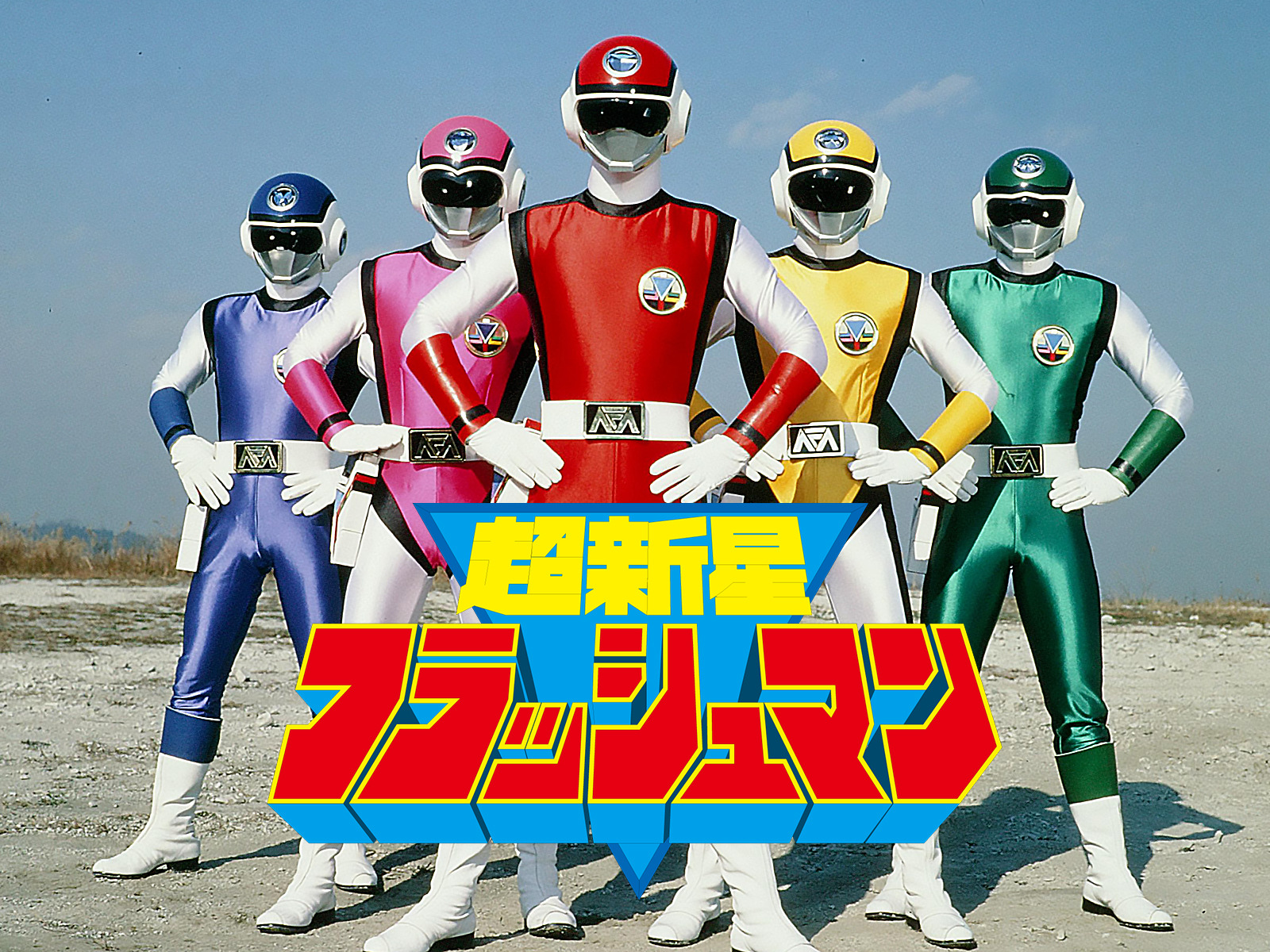

Entering a period of lost time
The Sentai series, which had reached its zenith with the previous "Changeman," a masterpiece of the Showa era, attempted to move in a new direction, but was sunk.
The theme of this work is "Chinese orphans," and it seems that the series went in the direction of making the "big drama of flesh and blood" that "Bioman" had, stronger. The interesting thing about this work is that the heroes have a different objective than fighting the enemy organization, which is to search for their relatives.
Nowadays, it is not unusual to see Sentai with a "purpose other than fighting," but at the time, it was a novel idea in itself (although this was done in robot animation in the 1970s), and it is a very important turning point for the series.
In addition, this work incorporated the setting of a modified human for the first time since "Jacker Blitzkrieg Squad," and it took the form of prism energy, a star power (Earth Force in the previous work) that was incorporated into the body as a pledge of revenge against the female.
However, it is not as if these elements were successful.
First of all, the search for relatives only took place in the first few episodes and a few episodes towards the end of the series, and the rest of the episodes were not so different from those in the previous Sentai series, which were all one-part episodes.
The fact that Kefren is a former Earthling, which is revealed toward the end of the episode, is nothing more than a rehash of Dr. Man from "Bioman," and I thought it would have a significant impact on the overall story, but it didn't, so I was left wondering what the point of it was.
The theme of searching for one's relatives is only partially inherited by Sarah and Dr. Tokimura, who are both in yellow, and they are not even able to meet again, and the real enemy is prismatic energy itself rather than females, as they are unable to stay on earth due to the anti-flash phenomenon that becomes a problem toward the end of the story. The real enemy is prismatic energy itself, rather than the female, and the series, despite its innovative attempts, fails to reach fruition as a whole.
Therefore, I personally do not recommend it, and although there are some good parts, overall, it is still a disappointing performance.
The Sentai series would go into a period of limbo for a while from here, and this work was the first turning point in the series.