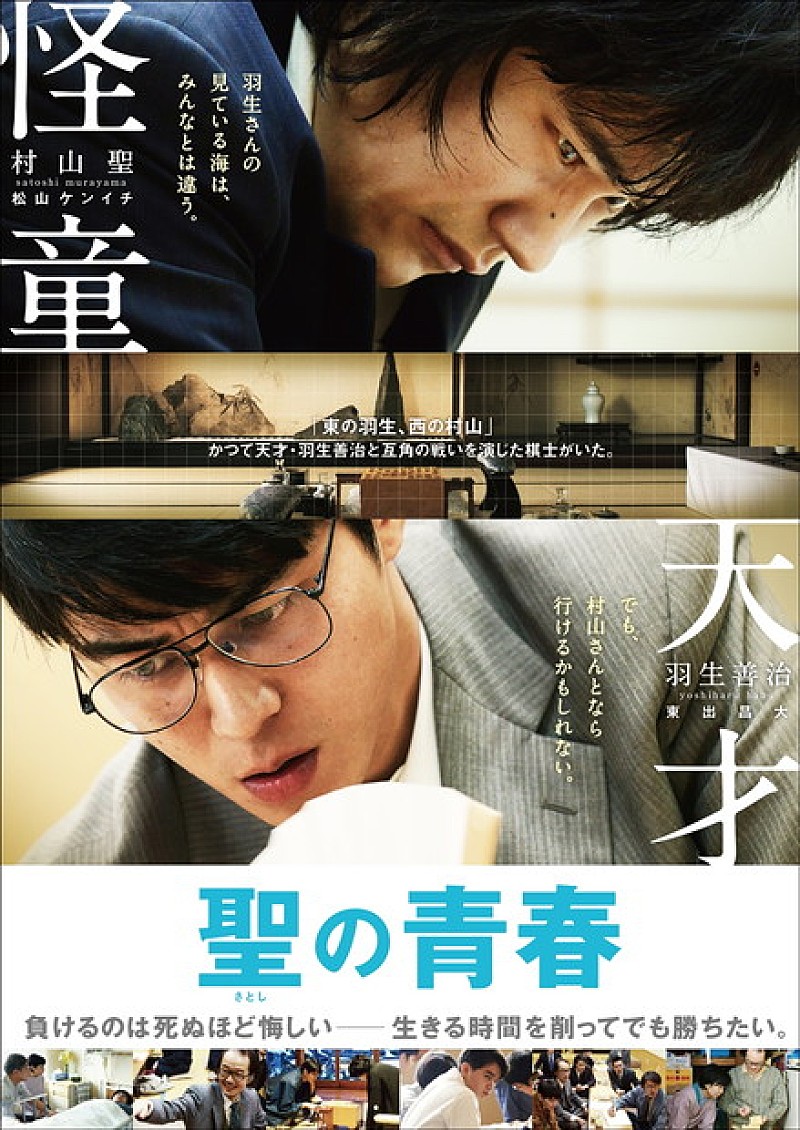
聖の青春

聖の青春

『聖の青春』(さとしのせいしゅん)とは、将棋棋士・村山聖の生涯を描いた大崎善生による2000年のノンフィクション小説、およびそれを原作とする映像化・舞台化作品である。幼少期よりネフローゼ症候群という難病と闘いながら、名人に登り詰めるべく純粋に将棋へ情熱を注ぎ、29歳の若さで早世した村山聖の生き様を丹念に追っている。
著者の大崎善生にとって本作がデビュー作であり、第13回新潮学芸賞や第12回将棋ペンクラブ大賞、2012年には第2回広島本大賞を受賞するなど非常に高い評価を受けた。当時、日本将棋連盟の出版部に勤務していた大崎が、急逝したノンフィクションライターの遺志を継ぐ形で執筆を引き受けた経緯を持つ。
本作は多角的なメディアミックスが展開されており、2001年には中国放送(RCC)、TBS、テレビマンユニオンの共同制作により、新春スペシャルドラマとしてテレビドラマ化された。また、2016年には森義隆監督、松山ケンイチ主演で実写映画化された。映画では村山聖役の松山が徹底した役作りで大幅な体重増量を行ったことや、ライバルである羽生善治役を務めた東出昌大が羽生の所作や佇まいを精緻に再現したことが大きな話題となった。映画版は第29回東京国際映画祭のクロージング作品に選ばれたほか、第40回日本アカデミー賞優秀主演男優賞や第59回ブルーリボン賞主演男優賞をはじめとする数々の映画賞を受賞している。

Reviews, Ratings and Comments on 聖の青春

聖の青春
7

People who have their own

I am not that familiar with Shogi, but I like Mr. Hanyu and Mr. Watanabe, and I knew about Mr. Murayama before the movie. But I did not know the details of the disease, and when I saw the movie, I was surprised to know that he had been suffering from the disease for such a long time. I think it must have been very difficult for him to have so many restrictions when he was a child. And the part where his mother was angry with the doctor was very hard. It's hard to notice something like that. I guess the doctor was frustrated and wished she had come a little earlier, but I thought it was a very bad thing to say.
After that, Mr. Murayama became a professional Go player, and he broke his own restrictions. He valued his own self and would have been considered an eccentric, but even those around him recognized him because he was like that, and I think they really liked him. Mr. Murayama had the absolute presence of Mr. Hanyu at the same time, and I thought a lot about whether he was happy or unhappy about that. Even though he could not win, I felt that he was very happy because he was able to study Shogi to the death. I think he is indeed a chameleon actor.

聖の青春
9

In 1994, professional chess player Satoshi Murayama 6-dan was about to leave his master Mori, whom he had apprenticed to and lived with for 10 years since he was 15 years old, to move to Tokyo to become a Meijin, the highest title in the shogi world. His parents in Hiroshima strongly opposed his move to Tokyo. This was because he had been suffering from nephrosis, an intractable kidney disease, since his childhood. He was always living side by side with death. Why did he devote so much of his life to his obsession with Shogi? This work can be said to be the story of one person's life, Sei Murayama.

It was also a work that expressed the joy of life and the brightness of the soul through Shogi, and it was also a life story of one person.
Kenichi Matsuyama played the passionate life testimony of Sei Murayama, a real prodigy chess player who was fascinated by Shogi even though he was suffering from an incurable disease.

His overwhelming passion for Shogi and the way he poured his passion into the game made me feel as if he was teaching the audience the importance of life.

When he is not playing Shogi, he is a little charming, and his lack of interest in anything other than Shogi and his human nature also make him a great personality.
I was made to laugh at the many scenes that made me think that he is a great personality as well as a human being.

When it came time to get into chess mode, his expression changed dramatically and he gave off an aura of unapproachability...

What a fascinating and attractive person he is!

It's enough to make you forget that he has an incurable disease...

Playing against the genius Zenji Hanyu...
I could feel the burning passion of both players in the tense atmosphere.

The final game with Zenji Hanyu and the conversation in the cafeteria...
I was moved by the many conversations that can only be understood between two players who have reached the top of their game.

Through the game of Shogi, he taught me the warmth of human beings and the joy of life.
and the joy of life through the game of Shogi.

I was moved by the grandeur of one person's life, Sei Murayama, and his passion and belief in "living".
I felt that I could not help but sympathize with his passion and belief in life and his short and dense life.
I hope that you will be able to empathize with his way of life.
I hope you can share in his life.

What was the footprint he left behind?
I don't know the answer, but I can tell you one thing for sure.
It is the joy of being able to appreciate life every day.
This is what I felt through the world of Shogi.