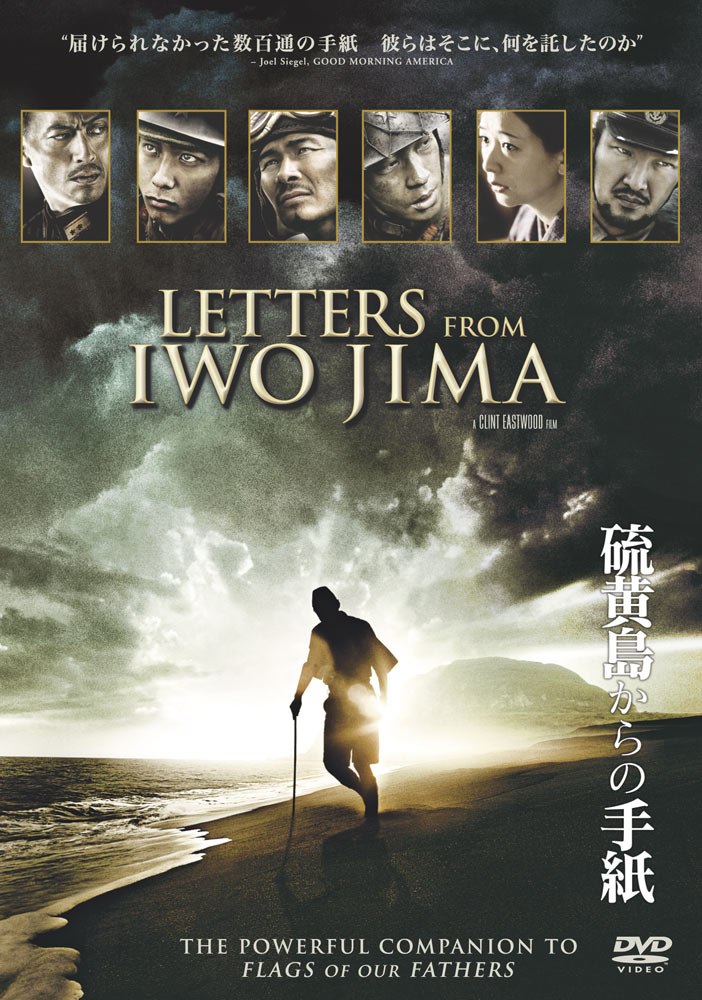
硫黄島からの手紙 / Letters from Iwo Jima

硫黄島からの手紙 / Letters from Iwo Jima

Letters from Iwo Jima" is a war film produced in the United States. The film is based on the "Gyokusai Soukai Soukou no Shoukan" ("Letter from Iwo Jima") sent by Tadamichi Kuribayashi, a commander of the Japanese Army, to his family at the end of the Pacific War. The Japanese side of the "Iwo Jima Diptych," the counterpart to "The Star-Spangled Banner of the Fathers," which depicts the battle of Iwo Jima from the U.S. side in the first film, the film begins with the soldiers' letters discovered in 2006 and depicts the days leading up to the crushing of Iwo Jima in 1944 from the perspective of Army Private Saigo and Lieutenant General Kuribayashi, the commander of the garrison.

Reviews, Ratings and Comments on 硫黄島からの手紙 / Letters from Iwo Jima

硫黄島からの手紙 / Letters from Iwo Jima
8

Letters from Iwo Jima" depicts the fierce battle of Iwo Jima in 1945 from the Japanese point of view.

Letters from Iwo Jima" is a 2006 American war film (Japanese is spoken throughout the film), directed and co-produced by Clint Eastwood and starring Ken Watanabe and others. The film depicts the battle of Iwo Jima from the perspective of Japanese soldiers, and is a sister film to "The Star-Spangled Banner of Our Fathers," which was made from the American perspective. Almost all of the actors in "Letters from Iwo Jima" are Japanese, but the production company is American (DreamWork Pictures, Malpaso Productions, and Amblin Entertainment). After the commercial success of "The Star Spangled Banner of Our Fathers," Paramount Pictures sold the U.S. distribution rights to Warner Bros. Pictures. The film was released in Japan on December 9, 2006, and had a limited release in the U.S. on December 20, 2006, with the 79th Academy Awards in mind. The film was nominated for four Academy Awards, including Best Picture, and won Best Sound. On January 12, 2008, the film's U.S. release area was expanded, and on January 19, it opened in the U.S. The English dubbed version was released in April 2008. The English dubbed version premiered on April 7, 2008. The film received positive reviews from critics and achieved slightly better box office performance than its sister film.
In 2006, a Japanese archaeologist discovered something in the rubble while exploring a cave on Iwo Jima. When the scene turns to Iwo Jima in 1944, Private Saigo and his platoon are digging a shelter on the island's shore. When Lieutenant General Tadamichi Kuribayashi arrived on the island to take command of the troops stationed on Iwo Jima, he immediately began inspecting the island's defensive facilities.

硫黄島からの手紙 / Letters from Iwo Jima
7

War is scary.

I did feel that it was a bit long.
But it was easy to watch because it focused on Ken Watanabe, Mr. Ninomiya, and each of them. I could understand how the higher-ups felt this way and how the people on the scene felt this way. Ken Watanabe, who is active in Hollywood, is an excellent actor, and above all, he has a good face. He has the face of a Japanese samurai. I was surprised that Mr. Ninomiya is also a very good actor. He showed us all kinds of tears. He played the part of a soldier who is not that serious and you could see why he was like this, but I thought that was the reaction of a normal person. The soldier that Shido Nakamura played is more abnormal. I don't know much about the war, but it was good because it was made by an American director, so it was less sentimental than other war movies, but not an exaggerated portrayal of the Japanese by an American.
I thought that war is really terrible, because you are expected to kill people even though you have no grudge against them, and you don't know when you will die. I think every soldier had a belief he believed in at that time and acted according to it. The suicide scene was very shocking. I really hope that war will never happen again.

硫黄島からの手紙 / Letters from Iwo Jima
8

War film from a Japanese perspective directed by Clint Eastwood (American)

At first glance, it looks like a movie produced by a Japanese director, but in fact it was made by an American director, Clint Eastwood.
Iwo Jima is known for the fierce battles of World War II, and I don't think it is too much to say that "Iwo Jima" has become well known thanks to this film. The storyline is based on historical facts, and the film successfully expresses the ruthlessness, sadness, and humanistic feelings for family members that are unique to war. It is not surprising that the film is portrayed in an American light since it was made by an American director, but in fact, this is not the case. The cruelty that war brings to the surface is expressed regardless of nationality or race, such as Japanese or American.
The cast is also gorgeous, with Ken Watanabe in the lead role and Kazuya Ninomiya, Tsuyoshi Ihara, Ryo Kase, and Shidou Nakamura of Arashi fame in the cast. In addition, "Letters from Iwo Jima" was produced in a two-part set with the film "The Star-Spangled Banner of the Fathers," which depicts the battle of Iwo Jima from the American perspective, so it is recommended to see both "Letters from Iwo Jima" and "The Star-Spangled Banner of the Fathers.
This year marks the 77th anniversary of the end of World War II, and "Letters from Iwo Jima" is a recommended movie because the number of generations who knew about the war is decreasing. I believe that this is a movie where we can learn about human emotions through a war movie. I would like young people to see this movie.