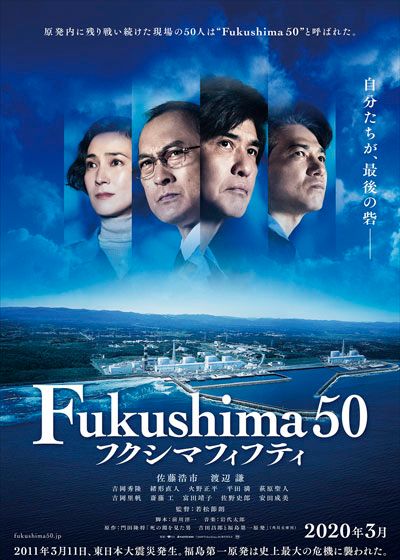
Fukushima 50

Fukushima 50

『Fukushima 50』(フクシマ フィフティ)とは、2020年に公開された日本の社会派ドラマ映画。門田隆将のノンフィクション『死の淵を見た男 吉田昌郎と福島第一原発』を原作とし、若松節朗が監督、前川洋一が脚本を担当。物語の舞台は、2011年3月11日午後2時46分、巨大地震と津波に襲われた福島第一原子力発電所。自身の家族の安否すら不明な中、現場に留まり刻一刻と悪くなる状況に立ち向かった作業員たちの姿を描いている。第44回日本アカデミー賞では最優秀監督賞、最優秀助演男優賞など複数部門で受賞・優秀賞選出となったほか、第63回ブルーリボン賞では作品賞を受賞するなど、作品として非常に高い評価を受けた。
作品のタイトルとなっている『Fukushima 50』は、事故発生後に福島第一原発へ残って対応にあたった作業員たちを称え、海外メディアが「Fukushima 50」と呼んだことに由来する。

Reviews, Ratings and Comments on Fukushima 50

Fukushima 50
9

Thank you to the men who saved Japan.

March 11, 2011, 2:46 pm.
The Great East Japan Earthquake struck, the largest earthquake in Japan's recorded history.
Soon after, a massive tsunami hits the Fukushima Daiichi Nuclear Power Plant.
The plant loses all power, causing a blackout, the reactors cannot be cooled, and the reactor buildings explode with hydrogen.
The reactor buildings exploded with hydrogen, meltdowns began in the reactors, and the reactors exploded, leaving the eastern part of Japan uninhabitable in the worst possible condition.
The nuclear reactor building explodes, the reactor begins to melt down, the reactor explodes, and in the worst case scenario, eastern Japan faces an unprecedented crisis in which no one can live.
Toshio Izaki, the onsite duty director, works hard in the darkness with the workers on site to do what he can to deal with the unforeseen situation.
The director, Masao Yoshida, continues to give the best possible instructions to the workers while dealing with the chaos at the site and the head office.
While dealing with the cooling of the reactor core, support from the Self-Defense Forces and fire departments, the Prime Minister's response, and the evacuation of the workers, the critical situation is steadily approaching.
The only way out of the situation was to organize a suicide squad and open the pressure valves manually.
However, this is dangerous work that involves tremendous exposure to radiation.
Toshio Izaki, who was on site, called for those who wished to join the death squad and sent them on an assault, but they failed.
The team rushes in again, finally opening the pressure valve and preventing the reactor from exploding.
This is a film adaptation of a real-life story of people who saved Eastern Japan from a crisis.
KADOKAWA put all their energy and huge production costs into making this movie.
The buildings, the inside of the power plant, the earthquake, and the post-tsunami situation were all beautifully recreated.
The cast was also superb, with Koichi Sato, Ken Watanabe, Hidetaka Yoshioka, Naoto Ogata, Shohei Hino, Mitsuru Hirata, and others in leading roles.
I was impressed by the lavish use of leading actors.
The film faithfully reproduces the original story "The Man Who Saw the Edge of Death" by Takamasa Kadota, and is a non-fiction film.
I thought it was a work that expressed a serious theme that someone has to tackle head-on, as it was the 10th year since the earthquake and tsunami.
Rather than evaluating this film, I am thankful to have been told that such a thing was happening on the scene.
I also want to thank the people on site for saving Japan.
I watched the entire film with tears in my eyes, and all I can say is thank you to the people on site.

Fukushima 50
10

A film to thank those who struggled at the Fukushima nuclear power plant

I remember the Great East Japan Earthquake as a very scary experience that I had myself.
However, compared to Fukushima, which suffered the most damage, I realized that it was much worse and scarier than what I had seen on TV.
I had thought that a tsunami of 10 meters or more would never come, but I realized that buildings and people could easily be swallowed up by such a tsunami.
I learned that mankind cannot resist the threat of nature.
I was angry at the 50 workers who risked their lives to prevent secondary damage at the most dangerous nuclear power plant in Fukushima, and at the emergency response office that supported them, as if the government and the head office did not feel the pain they were going through.
I felt like punishing myself for not knowing that such a thing had actually happened, and for living a carefree, peaceful life after the disaster.
However, I was really proud of the director who endured all the reckless behavior.
And I was very moved by the efforts of the warden and the workers at the site.
I cried many times.
The scene that made me cry the most was the scene in which the director's letter to Izaki at the end of the day was written.
I really want to thank the workers who fought that day for saving eastern Japan, and I would like to visit Fukushima again to express my gratitude.
It was a great movie.

Fukushima 50
9

Learn the horror of nuclear power plants and how to relate to your family.

Watching this film "Fukushima 50" made me feel that I should cherish the way I relate to my family and live my life in a casual, everyday way.

If the workers inside the nuclear power plant had not risked their lives at that time, the plant would have exploded and we would have been exposed to a large amount of radiation. Furthermore, I believe that many people would have been harmed by something other than the tsunami.
This film made me realize the horror of nuclear power plants and the need to change the way we deal with them.

After the 3.11 earthquake, the power in the plant went out, and while working to restore the power, the workers, who did not know the cause, learned that seawater had accumulated in the underground.
Since they had not anticipated that a tsunami would hit the plant, they did not know that a tsunami had hit until they saw the seawater.
They learned that a major earthquake of that magnitude had occurred.
The government intervened at the site, saying, "We have to do something as soon as possible. The government and the frontline were in a state of panic because communication between the government and the frontline was not going well. The government did not know what was going on in the field and made many careless comments, which confused the field.
It was a hopeless situation, but through a combination of various miracles, the Unit 2 reactor escaped exploding.
I think the workers were relieved when they succeeded in minimizing the damage and were able to return home to their families.

I learned the importance of family and at the same time, I learned the horror of nuclear power plants and the need for the Japanese government to change its response.
I felt that this movie should be seen at least once.