
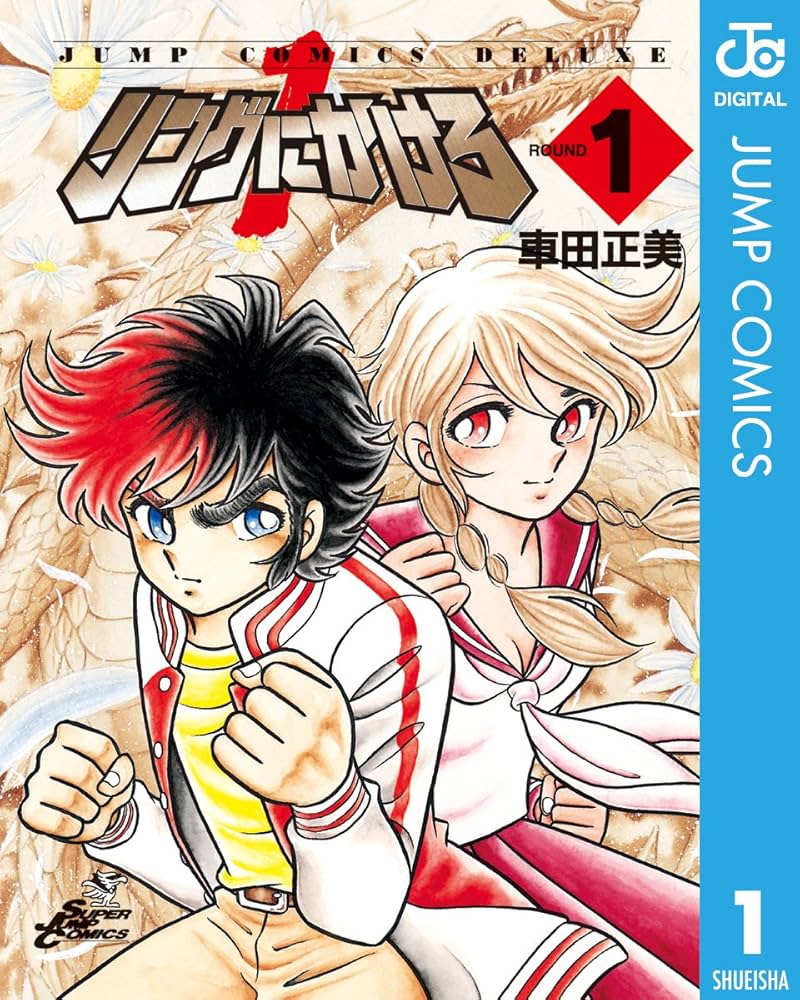

Review of Ring ni Kakero, a boxing manga about a newly built Shueisha building.
Friendship, hard work, and victory.
This phrase is famous as the motto of Weekly Shonen Jump, which set a Guinness record in 1994 with a circulation of 6.53 million copies.
The work that quickly established this motto at the end of the 1970s and became the cornerstone of Jump's golden era was "Ring ni Kakero (1977-1981)" by Masami Kurumada.
At first, the manga had a strong aspect of a passionate humanistic story influenced by the sport manga that was very popular from the 1960s to the 1970s, but in the Japan-U.S. Jr. championship episode, the main character Ryuji Takamine refined his signature hook, which he had developed through intense training, and used a super blow called the "boomerang hook" (each special punch was called a "boomerang" in the manga). The direction of the work deviates greatly when the main character, Ryuji Takamine, starts using a super blow called the "boomerang hook" (each special punch is referred to as such in the work).
The work went off the rails when he began to use the "boomerang hook" super blow (as he called it in the work), which was a major departure from his previous works.
After that, the work became a "group tournament," "a strong enemy who fought once becomes a friend," "an ally who was supposed to have died comes back to life in the next episode," "a team fights in a tournament," and "a team fights in a tournament.
The "explanation using literature and pseudo-scientific theories that do not actually exist," and "training and then defeating the enemy with flashy new special moves acquired through training" were patterns developed and established that would later be used in many battle manga, and the series became overwhelmingly popular among the juvenile readers of the time.
The young Mr. Kurumada prioritized surprising readers over storytelling consistency, and ran with the energy that gushed from his ideas.
The culmination of his efforts can be seen in the world title challenge by Jun Kenzaki, a fated rival of Ryuji.
Toward the end of the story, Kenzaki makes his professional debut ahead of Ryuji.
He is the reigning bantamweight champion, Jesus Christ, and is suddenly set for a title match with him.
In the world match, the champion Jesus Christ landed his super-blow "Neo Bible" against the backdrop of a Creation-like cut and a Genesis narration, and Kenzaki was knocked down more than six times in the first round.
Kenzaki was beaten up so badly in one round that it took him three minutes to get back to his feet, and he was even forced into cardiopulmonary arrest.
Ryuji, who was watching from ringside, rushes over to him and, with tears in his eyes, delivers a super blow called "Boomerang Terios" right into Kenzaki's heart.
Kenzaki was revived by the passionate friendship between the two men, and in the second round, he unleashed his biggest super blow "Galactica Phantom," sending Jesus home on the scoreboard at Korakuen, the venue of the tournament, for a stunning victory.
This boxing manga revolutionized boxing manga, which at the time was dominated by realistic gekiga-style works such as "Ashita no Joe" and "Ganbare Genki," and created the golden method of JUMP that continued into the 1980s with a single title.
The legend of the rebuilding of the new Shueisha building is still talked about today, and "Ring ni Kakero" is an extremely important work in the history of manga.