
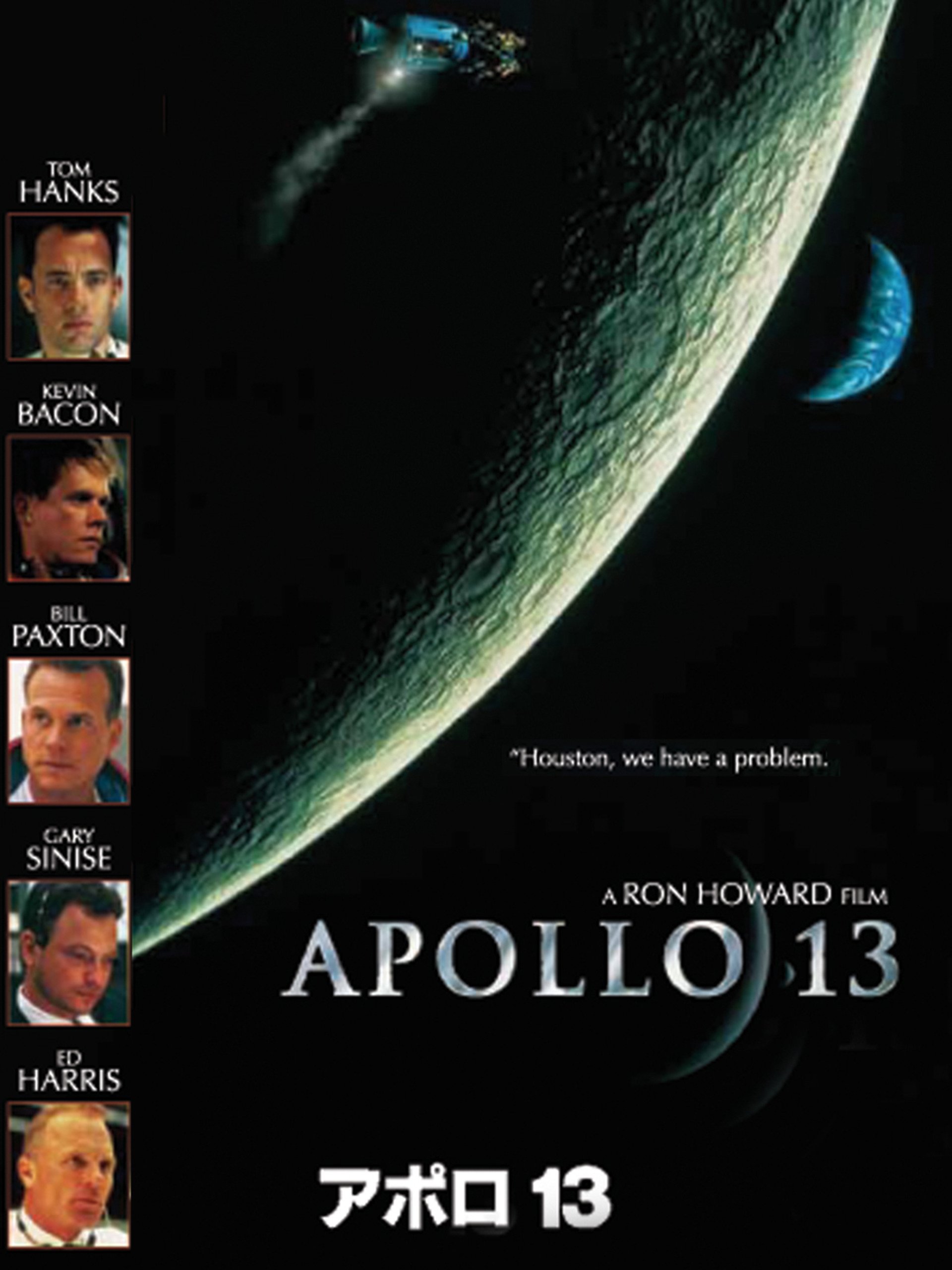

An ironic drama about the miraculous survival of a space program that went horribly wrong.
The film "Apollo 13" is an ironic portrayal of a catastrophically failed space program as a miraculous survival drama.
It was July 1969 when astronauts Neil Armstrong and Buzz Aldrin landed on the moon for the first time in history.
Apollo 11" is a landmark in the history of space exploration.
Four months later, in November, Apollo 12 landed on the moon for the second time.
The third was Apollo 14 in February 1971.
In July of that year, Apollo 15 landed. The following April, 1972, Apollo 16 landed.
The "Apollo Program" initiated by President John F. Kennedy came to an end with the successful landing of Apollo 17 in December of that year.
Apollo 13 was the only spacecraft during this period that failed to land on the Moon.
However, it shattered the "lunar travel mannerism" that had kept people from landing on the Moon, and it would lead to a dramatic upheaval in the years that followed.
The actor-director Ron Howard's epic "Apollo 13" is a film that portrays this situation with a great deal of irony.
And I think it also pays homage to "Escape From Outer Space" (directed by John Sturges), which was the first movie about this kind of situation.
The Apollo 13 crew was to include Captain Jim Lovell (Tom Hanks), Ken Mattingly (Gary Sinise), and Fred Hayes (Bill Paxton), but just before launch, it was discovered that Ken Mattingly was at risk of contracting rubella. Jack Swygert (Kevin Bacon) will take his place.
This is the first disturbing opening that foreshadows the rest of the film.
The launch time is April 11 at 13:13 --------.
The combination of these unlucky numbers is also eerie, but just as I had predicted, the oxygen tank explodes on the 13th, putting the crew in the worst possible situation, threatening not only the moon landing but also the return to the earth.
However, the NASA staff, including Chief Flight Controller Gene Kranz (Ed Harris), rallied all their strength and succeeded in returning the spacecraft safely to the earth.
The process of returning the spacecraft to Earth is portrayed in a very dynamic and large-scale manner, which is very cinematic and tense, and well worth watching.
However, the film lacks excitement because the images of the interior of the spaceship and the Houston Control Center are not very impressive, and the "suspense of the blockage situation," in which the air inside the spaceship becomes murkier and murkier every moment, is familiar from other submarine stranding movies, so I did not feel much impact from the film.
The authenticity and tension of the dokyumemento (sense of urgency) were lost in the face of the real power of the original story "Apollo 13" (Shincho Bunko) written by Captain Jim Lovell.
However, the only point in which the film was superior to the original was in its depiction of the media frenzy, which I think was full of the fun that only a movie can have.
The moon landing was not televised because it was no longer possible to get ratings, but as soon as the astronauts' lives were in danger due to the accident, there were repeated reports on the TV broadcast that could be called a frenzy.
It is a strange story when you think about it, since the space flight program, which was a disaster, turned out to be a "miracle survival drama.
After the successful Apollo 17 landing on the moon in December 1972, mankind has not been to the moon.
No lunar base or space station has been built, as in "2001: A Space Odyssey" (Stanley Kubrick).
Although they loudly advocated technological progress, it was essentially the same as military expansion, which was probably brought about by the sense of political competition with the Soviet Union during the Cold War.
Director Ron Howard seems to have depicted these subtle nuances with plenty of irony.
The film won the Best Sound and Best Editing awards at the 68th Academy Awards in 1995, as well as the Special Visual Effects and Production Design awards at the British Academy Awards in the same year.