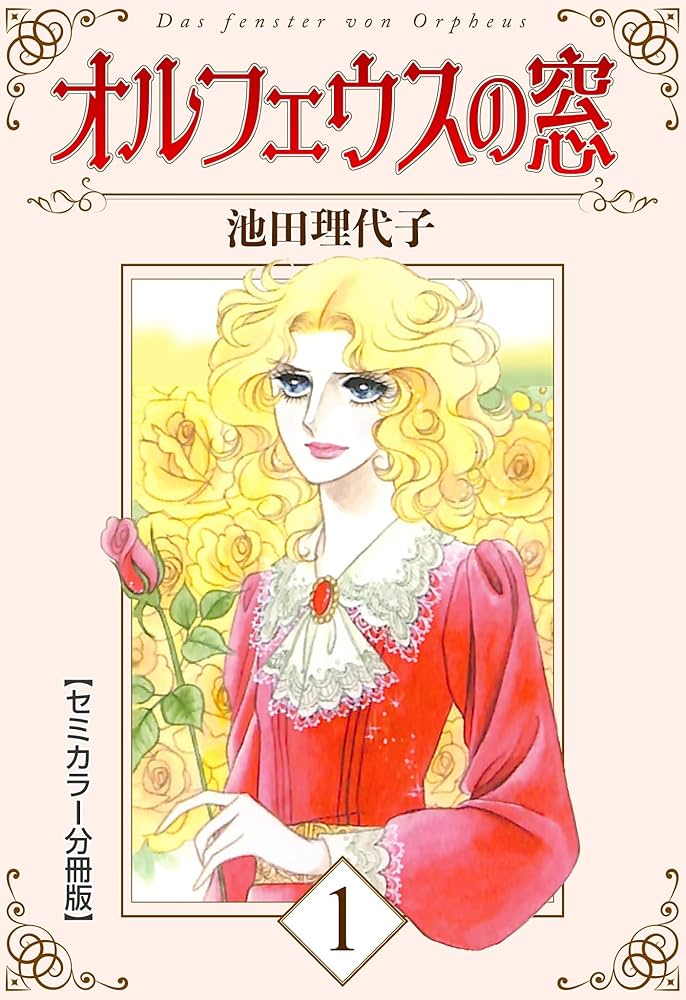
オルフェウスの窓

オルフェウスの窓

『オルフェウスの窓』(オルフェウスのまど)とは、池田理代子作の長編漫画。20世紀初頭のヨーロッパを舞台に、第一次世界大戦やロシア革命といった史実を織り交ぜて、ドイツ・レーゲンスブルクの音楽学校で出会った3人の若者の運命を描く。物語は大きく4部から構成され、舞台もレーゲンスブルクからオーストリアのウィーン、ロシアのサンクト・ペテルブルク、レーゲンスブルクへと変転する。第1部は『週刊マーガレット』1975年(昭和50年)第4・5号から1976年(昭和51年)第32号に掲載され、その後『月刊セブンティーン』1977年(昭和52年)1月号から1981年(昭和56年)8月号に掲載された。
1980年(昭和55年)に第9回日本漫画家協会賞優秀賞を受賞している。1983年(昭和58年)には、宝塚歌劇団星組で舞台化された。

Reviews, Ratings and Comments on オルフェウスの窓

オルフェウスの窓
9

Dramatic shoujo manga

This manga is by Riyoko Ikeda, famous for "The Rose of Versailles" and is 30 volumes long, so it is quite interesting that the characters' faces are quite different from the early days to the latter half of the story. The story begins at a music school in Germany. The main character, Julius Leonhard von Ahrensmeyer, is actually a woman, but is raised as a man because he is the son of his mistress. This is the author's specialty. In the music school where the story first takes place, there is a window called the Orpheus Window, and legend has it that if a man and woman meet through the window and fall in love, it will end in tragedy. Klaus Friedrich Sommerschmidt, whose real name was Alexei Mikhailov, was a Russian who met Julius through that window and later returned to Russia and threw himself into the revolution. The next person they met at the window was Isak Gottfilf Weissheit, who, after his sister died of tuberculosis, became a musician in Vienna, the capital of music, only to suffer the tragic loss of the use of his fingers. Julius and Klaus meet again in Russia during the Revolution, and Julius is pregnant with Klaus' child, but Klaus dies. The manga is a very long drama, but it is an interesting manga with its own unique highlights. It is a pity that it has not been adapted into an animated cartoon, but this may be due to the sheer length of the content.

オルフェウスの窓
8

A masterpiece set during the Russian Revolution

This is a work by Riyoko Ikeda, the famous author of "The Rose of Versailles. It is set in Germany, Austria, and Russia from the eve of the Russian Revolution to around the time of the first Russian Revolution.
The first part is set in Germany, the second part in Austria, the third part in Russia, and the fourth part again in Germany. For me, Part III is my favorite.
It depicts the tragic love of the main character, Julius Leonhard von Ahrensmeyer, in contrast to Alexei Mikhailov, who was born into a marquis's family but threw himself into the revolution as a revolutionary, and Prince Leonid Yusupov, the young leader of the same family who remained loyal to the Romanov dynasty until his last days and met a spectacular end. The story is about the tragic love of the hero, Julius Leonhard von Ahrensmeyer.
It is a magnificent story that beautifully blends the tragic love legend of Orpheus in Greek mythology and the historical fact of the Russian Revolution. Even if you are not interested in history, this manga will naturally make you interested in the history of Europe during World War I, when the Russian Revolution took place.
A slight complaint may be that the protagonist of the first part, Julius Leonhard von Ahrensmeyer, is too irredeemable.
He marries Alexei Mikhailov, whom he has loved for a long time, but Alexei Mikhailov dies at the end, and the fruit of his love with Alexei is stillborn. I thought it was too bad that Julius Leonhard von Ahrensmeyer also got amnesia and was killed.