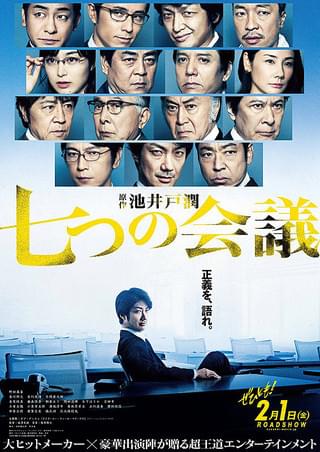
七つの会議

七つの会議

『七つの会議』(ななつのかいぎ)とは、池井戸潤による小説およびそれを原作としたメディアミックス作品である。
一部上場の大手電機メーカー・ソニックの子会社である中堅電機メーカー・東京建電。この会社で起こった不祥事に社員たちが巻き込まれていく様子が描かれる群像劇である。
原作である小説は2011年5月から2012年5月にかけて「日本経済新聞電子版」にて連載され、2012年11月に書き下ろしの1話を追加して8話構成の連作短編集として単行本化された。2013年にはNHK総合の「土曜ドラマ」枠で実写ドラマ化。主演は東山紀之であった。2019年には野村萬斎を主演として映画化されており、監督は『半沢直樹』『陸王』など数々の池井戸作品を手掛けてきた福澤克雄が務めている。

Reviews, Ratings and Comments on 七つの会議

七つの会議
8

Gorgeous cast

It was very interesting. I think that the works of Jun Ikeido are suited to overacting and direction.
Mansai Nomura and Teruyuki Kagawa's facial expressions and overacting were very effective.
I thought it was interesting that Mansai Nomura was a lazy employee.
The reason why is a mystery at first, but even if there is no secret, I thought it was hard to pay attention to Mansai Nomura's appearance.
I don't know what it is about him, but he seems like a big shot.
Also, Mitsuhiro Oikawa's shyness was nice, and the cast was gorgeous.
It might be worth seeing just to see all those actors at once.
The story is a bit like a comedy, but I wonder if Japanese companies are really like this.
I feel like it's a lot of work, and I'm a little disillusioned. I don't really want to belong to a company.
But, of course, it would be a problem if I were forced to quit the company, and even if I find something wrongdoing, I can't tell them about it, or something.
But it's cool to see people who are determined to say, "No! It's cool to see people who are determined to do so.
I was moved by the main character's line at the end roll that injustice will never go away.
That's why I hope that people will correct such injustice and that society will become a place where such injustice can be normalized.

七つの会議
9

The colors of Ikeido are in full bloom! Mansai Nomura breaks down the darkness that big companies are facing!

This movie is based on the original story by Jun Ikeido.
As is typical of his films, it is a mystery that fights against the darkness of a large corporation.

It is a film that makes sense of today's "results are everything".
After the viewing, it made me think about what work is all about....

Now that we are entering the age of 100 years of life.
This film is an opportunity for us to rethink the way we work in the future.

The overall atmosphere of the film is dark, as it is a mystery.
Although the atmosphere is somber, the film has a good balance, so you will not get bored watching it.

It has an original storyline that you would never have thought of, and a well-crafted screenplay.
And the splendid actors who provide the supporting cast.

The lead actor, Mansai Nomura, is of course wonderful, but the supporting actors are all very talented.
Every scene is thrilling.

The original story and screenplay are excellent, but the tension is so exquisitely balanced that it would not be possible to create it with just one actor.

You will be drawn into the overwhelming worldview.

What particularly impressed me was the end roll.

I have never seen an end roll like that before.

Usually, the end roll of a movie is a time to soak in the afterglow of the film.
Depending on the film, it can often feel long and boring.

However, the end roll of "The Conference of Seven" turned the conventional wisdom of end rolls upside down.

Is this really an end roll? Is this the end roll? You will be taken aback.
But this novel end roll is the truth of this work.

I recommend that you watch this film and confront your own thoughts about your work.

七つの会議
5

Common features of Ikeido's works

I feel that a common feature of Jun Ikeido's works is the protagonist's belief in justice, and this was the story of Hakkaku, a lazy company employee who pursues only sales and profit, and is unafraid to attend meetings at a company that is like a military force. The storyline unfolded as I tried to figure out why such things were allowed, and I arrived at a significant truth.
At first, as I watched the story, the characterization of Hakkaku was that of an eccentric company employee, but as the story unfolded, such a character went away, and I wondered what kind of personality this character had? What type of person is he? What type of person is he? I felt like he had a personality that I didn't understand, and I didn't feel comfortable watching him.
The story was not so different from Ikeido's works that are usually shown on TV, so I wondered if it was worth seeing on the big screen in a movie theater, and I would have preferred to see it on DVD. However, I think that Hakkaku's opinion in the ending of the film was very clear and spoke about the true feelings of the company and Japanese society, not just a pretty story.