
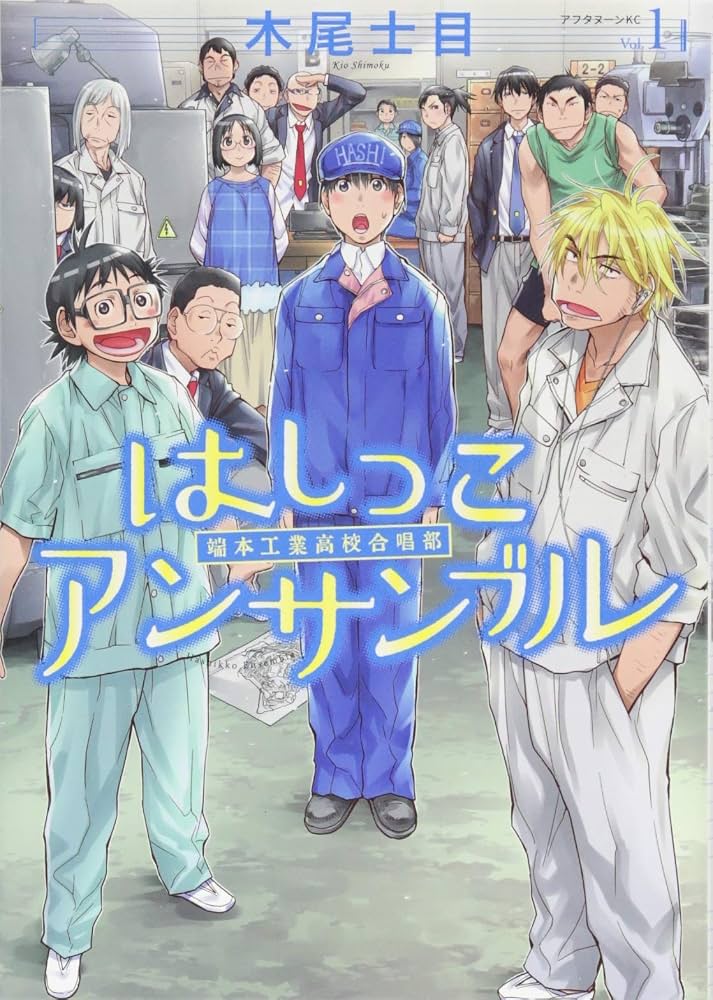

Not a kiwamono, but an authentic school manga.
This is a work by Shime Kio, who once gained popularity with "Genshiken. His style has always had a strong image of taking a niche approach and bringing it to a unique worldview, but I felt that this work was a proper coming-of-age manga. The story begins with an encounter between the two main characters, Kimura, a science-minded chorus nerd who cannot read the air, and Fujikichi, who is shy and has a complex about his low voice.
In the beginning, the story focuses on the strong characters. Kimura is at the top of the list, followed by Orihara, a yankee, Kurata, a failed pianist, and Hasegawa, a member of a judo family... To be honest, I felt that the setting of a typical industrial high school was a bit too much for the story, but the story moves along at a brisk pace.
Still, the story progressed at a good pace, and it was a pleasant read as a work about a school. I also appreciated that each character is explored in the story, making it easy to get emotionally involved in the story.
The author has a tendency to describe the inner lives of the characters to a rather harsh degree, but this work was not so unpleasant, and the descriptions were convincing enough to strike a very good balance.
Another appealing aspect of this work is the depiction of "chorus" scenes. I think it is difficult to describe sounds and songs on paper, but the description of the "chorus" scene in this work was really wonderful. I felt that all possible attempts at description were made, such as the use of many spreads, the use of musical notes, and the placement of written text, and that it was all done at a high level. I also liked the way you used not only choral music but also more J-POP songs as the subject matter, which made it easier for the reader to empathize with the music.
The storyline has some cartoonish and unorthodox developments, but I was able to read it in one sitting thanks to the good tempo. I have read all of this author's works, and as a fan, I am pleased that he has drawn a good work.