
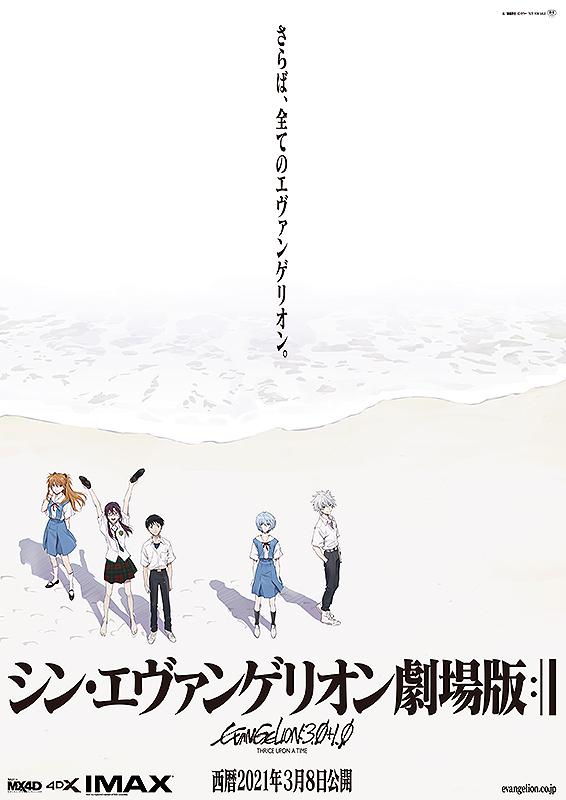

Why you should always watch "Shin Evangelion the Movie𝄇" last in the entire series.
The Evangelion series includes the following series, all of which have different endings
TV version
Comic book version
The first movie version (the so-called "old movie version"), "Neon Genesis Evangelion: Air/Magokoro wo Kimini ni".
The first four films (the first, second, third, and fourth films) were Neon Genesis Evangelion: Air/Magokoro wo Kimi ni.
Too many, too much work! If you're like me, you can get the gist of it all by looking at the Shin Evangelion Movie Quadrilogy.
But first, I think I must explain what precedes this tetralogy.
I'll start with the Evangelion series, with a few spoilers below.
First, I will explain the one why the series was made in this way with different endings.
The history of the series originally started with the TV version.
Shinji Ikari, an ordinary 14-year-old boy, is called by his father, who lives far away from him on business, and goes to see him.
He is forced to ride a big robot (Evangelion) to defeat the monster, and gets involved in a battle that engulfs the world.
He is forced to ride a big robot (Evangelion) to defeat the monster and gets involved in a battle that engulfs the world....
This is a brief summary of the story, but it is a very different story from the so-called "robot" series, which carefully depicts the unique psychology of teenagers, and has a fan base that has reached a fever pitch in some quarters.
It is not a robot animation for children, so it is not a children's robot animation at all. Because it is not a robot animation for children at all, it has many female fans as well.
It is not a robot animation for children, so there are many female fans as well. (It also contains grotesque depictions that are not appropriate for robot animation.)
The final episode of the TV version ended with a depressive ending, and the final episode was a "What? The TV version will end with "What?
When an Eva comedian was on the TV program Ametalk before, he mentioned this final episode.
Did it really become troublesome in the middle? The end of the TV version is not "this one" by anyone's standards.
The ending was so bad that some fans even sent death threats to Director Anno.
Evangelion has become so popular that it has surpassed the mere enthusiasm for TV animation.
If that were the case, I would make the final episode right.
The film is a reworking of the last episode of Evangelion.
The two parts of the old theatrical version "Neon Genesis Evangelion: The Movie Air/Magokoro wo Kimini ni" will be presented.
It is a reworking of episodes 25 and 26 of the 26 episodes of the TV version, and is considered to be complete.
It is a different ending that branches off from the TV version episode 24.
However, Evangelion was not completed even with this movie version.
The reason is that this movie version ends with a very bad ending.
In fact, three Evangelion films were completed before the release of "Shin Evangelion the Movie: ||," the conclusion of all Evangelion films.
I think that my impression of each conclusion is as follows.
The TV version...?
The old movie version... (Superb bad ending.) Was this really the right thing to do...?
Comic book version...(not a bad ending) but maybe not this one.
The four-part movie version was decided to be released in the midst of such a situation.
It's like this is really and truly the end of the story.
The contents of the first and second parts, which generally follow the entire series, are depicted with overwhelmingly beautiful images.
The introduction is up to "Operation Yashima" (almost the same as the entire TV series).
The "Rupture" follows the TV version and reconstructed the contents (in the previous series, this person is sacrificed, but in the "Rupture," someone else is sacrificed, etc.).
And then Q takes a completely different turn, a really rapid development.
Q" is set in a devastated world 14 years after "Rupture.
Although it is supposed to take place 14 years later, the main character, Shinji Ikari, is still 14 years old.
Shinji Ikari, who caused the world-destroying "something" that happened at the end of "Evangelion.
The story begins when he awakens from his long sleep, having been asleep in Evangelion for 14 years.
Certain things that happened 14 years ago, various things that have changed, people that have happened over the past 14 years....
The story unfolds as he is confused and gets involved in the battle again.
I'm sorry for the long preamble, but here is finally the content of "Shin Evangelion the Movie:||"!
This ending may be controversial, but at least it is not a bad ending.
It is a boys' magazine-style development in which the characters come to understand each other during the battle with their father, who is positioned as the last boss.
The emotional growth of Shinji Ikari from an unstable 14-year-old boy.
A resolution to everything that is worthy of the catchphrase, "Farewell, All Evangelion.
I think that the above was neatly folded into the story.
I think the main reason for the controversy was the "heroine to be united".
In Evangelion, the two heroines that divide the popularity are Ayanami Rei and Soryu (Shikinami) Asuka Langley.
Who will be united with Shinji? I think this was one of the themes in Evangelion.
As it turns out, he will not be united with these two.
In the end, Shinji will be united with Makinami Mari Illustrious, who has appeared in the film tetralogy (broken).
Shinji has ended his relationship with his father and all the messengers.
Mari comes to pick up Shinji, who waits alone in the closed world of the battlefield.
(Rei and Asuka will say goodbye to each other in many ways during the course of the battle.)
The final scene depicts Shinji and Mari as adults on a station platform, and ends with a description of a world with a future.
This is the entire Evangelion outline.
If you want to watch the whole movie from beginning to end without any doubts, you can understand the contents of Evangelion by watching the four movie parts.
However, I am sure that you should have seen how it came to this conclusion.
I think the true way to enjoy Evangelion is to watch the new movie tetralogy with your questions about the TV version and the old movie, and with this in mind.
Perhaps even if you watch the theater version tetralogy once, I am sure you will not understand the meaning.
Watch it once, see what others have to say about it, and watch the film tetralogy again.
After that, this is an anime that you can complete with your own interpretation.
That is the Evangelion series.