
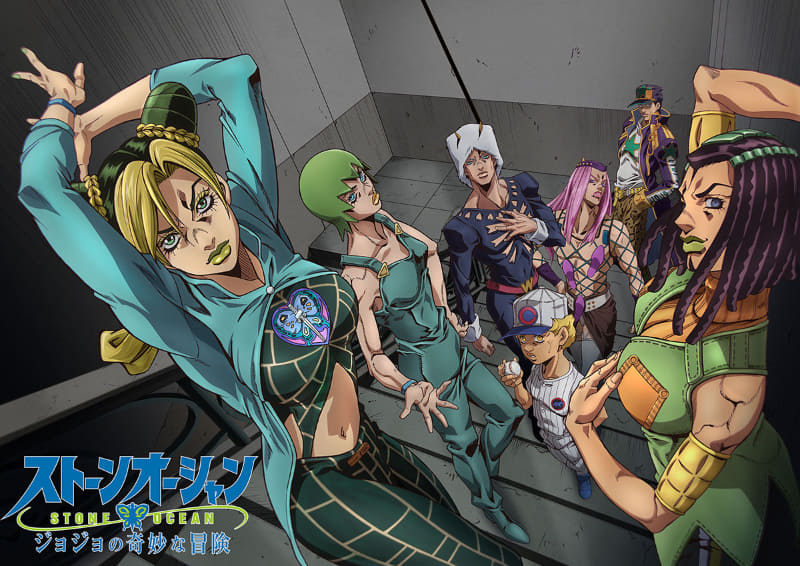

Part 3: Main character is the daughter of the main character Sorajo Jotaro, and the setting is a prison.
Although this work contains titles from the Jojo series, it has the strong color of a "separate work in the same series" in which the book volumes are reset and the series begins from the first volume.
The heroine, Kuujo Jirin, is the daughter of Jotaro, the protagonist of the third part of the series, but she does not feel good about him because they divorced when she was young and she never had anything to do with her father. However, there is also Jotaro's love for his family hidden there.
Jotaro insists that it is dangerous for Xurin to stay in this prison and tries to break her out, but during the attempt, Father Pucci's stand "White Snake," which he used to protect Xurin, took away his stand ability and memory disk, and he was temporarily crippled.
Xurin learns of his love and decides to retrieve his disk and pursue Father Pucci in prison, even if he misses the chance to escape, and aims to retrieve the disk and overthrow Father Pucci while defeating the assassins sent by the priest.
The names of the stands in this work are also based on stories related to the author's favorite foreign musicians.
The selection of "Manhattan Transfer," "Goo Goo Dolls," "Kiss," and "Stone Free," etc., is very cool, whether you know the original story or not.
The Stone Free's ability gives a sense of the concept of 2-D to 3-D, "When lines come together, they become 3-D," but Father Pucci's "Accelerate Time" after the evolution of his stand ability is a setting that is often used as a 4-D concept, and considering that the world came full circle in the last episode, I still think that this work is It made me think that this work was drawn with the intention of being the end point of the Jojo series.
In fact, the next work, Steel Ball Run, was treated as a substantial sequel to Jojo, and then JoJoRion was serialized further, showing how eagerly the world of Jojo is being cherished by its fans.