
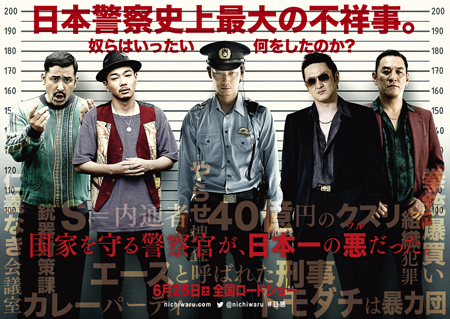

Go Ayano's masterpiece film, a true story of the biggest scandal in police history, depicting a life of falling from the peak of his career.
This film exposes the cozy relationship between the police and the yakuza community, inspired by the "Inaba Incident" that occurred in Hokkaido in 2002 and has been called "the biggest scandal in the history of Japanese police. The film depicts the 26 years leading up to the arrest of a Hokkaido police inspector, dubbed the "black inspector," who was arrested for violating the Stimulants Control Law and other charges. The protagonist, Yoichi Morohoshi (Go Ayano), became a detective of the Hokkaido Police Department because of his judo skills he developed during his college years. Morohoshi is innocent and has a strong sense of justice, but he is unable to achieve much as a police officer. He is taught by senior detective Murai (Pierre Taki) that "detectives score points, and to score points, you have to go into the underworld and make an "S" (spy)." While maintaining close ties to the nightlife district and gangs, he engages in all kinds of nefarious activities such as staged arrests, sting operations, gun purchases, and methamphetamine smuggling, and solves one difficult problem after another from his superiors. While solving his boss's difficult problems one after another, he also gets involved in methamphetamine himself, and he quickly falls from his peak. The film is flanked by such individualistic and talented actors as Pierre Taki (the boss) and Nakamura Shido (the gangster), and will draw you in with Ayano's spectacular performance, in which he loses 10 kg of weight and swells up with alcohol on his face. The film won the Rising Star Award at the 15th New York Asian Film Festival and the Outstanding Performance by an Actor in a Leading Role at the 40th Japan Academy Awards, and has become one of Ayano's best-known works.