
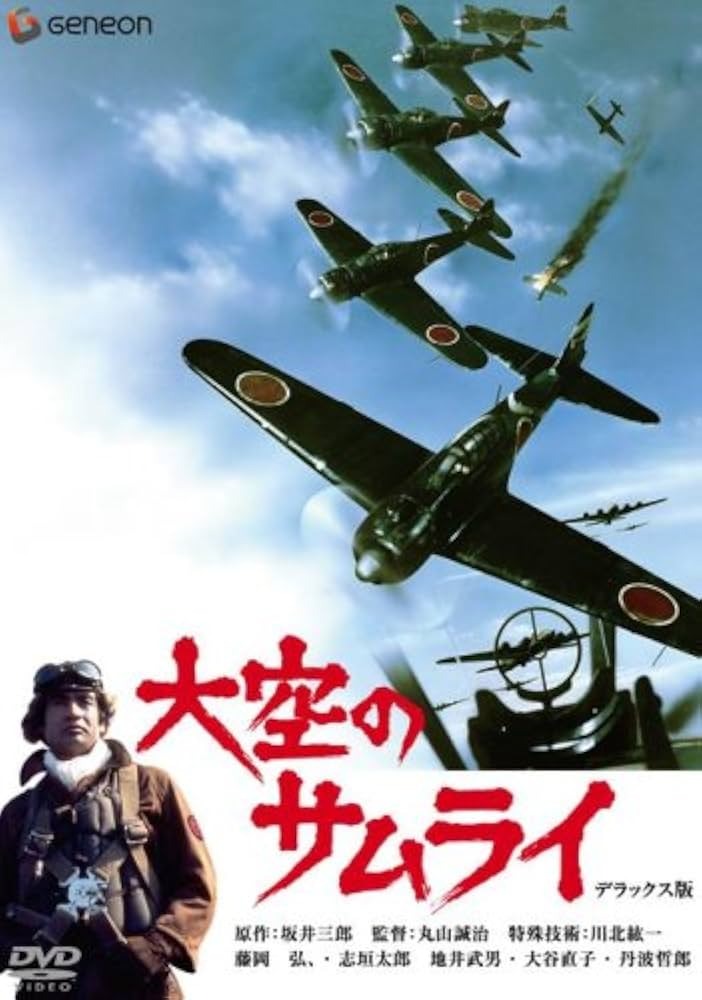

Live and let live, fight your way through!
This movie, "Samurai in the Sky," was written by Saburo Sakai, a former Zero Fighter pilot.
The lead role is played by Hiroshi Fujioka, who of course plays Saburo Sakai (Hitobiso).
The highlight of this film is that it begins in 1942, when the Imperial Japanese Navy Air Forces advanced to "Rabaul. The Zero Squadron is achieving great results in daily air battles, and "Jyunichi Sasai" (Lieutenant) (played by Taro Shigaki) is newly appointed as a lieutenant there. This is where the "famous duo of Sasai and Sakai" was born. Then comes the appearance of the crew of the ill-fated Ichiku Rikugou... The captain is played by "Takeo Jii" (late), and the darkness of the Japanese Navy's tradition can be seen. And then, the Rabaul Air Force, worn out by the daily air battles... a skilled aircrew member dies, a young aircrew member dies, and this young aircrew member falls in love with a nurse at a hospital in Rabaul. In the meantime, on August 7, 1942, the U.S. forces came in droves to the place where our construction team was building an airfield on Guadalcanal Island. In order to create a stir, the Zero Squadron of the Rabaul Air Force and the Land Offensive Squadron's War Bombing Coalition rushed to Gadarkanal Island. Saburo Sakai shot down four planes in this aerial battle. However, in his carelessness, Sakai was hit by enemy bullets in his right eye and right skull. While stopping the bleeding and conserving fuel, and without any allied aircraft to guide him, he managed to return to Rabaul using his experience and sense of battle. I think I learned a lot as a "man" from watching this movie.
Friendship, the darkness of tradition, love, the death of a comrade-in-arms, the glamour of aerial combat, and in exchange for all of these, the way they take their wounds and reach their destination without giving up their belief in "living" is truly "Samurai".