
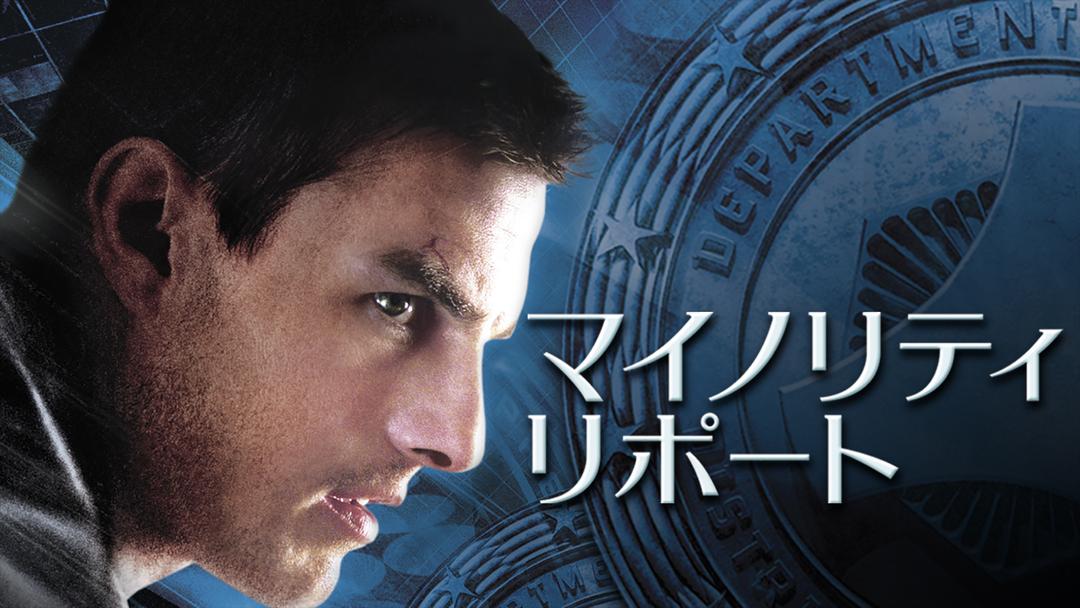

A near-future sci-fi action epic directed by Steven Spielberg and starring Tom Cruise, based on Philip D. Dick's short story of the same title.
I believe this film is a near-future sci-fi action epic that depicts the free will of a futurist to confront his fate, which he has no way to resist.
Minority Report" is a "near-future science fiction action epic" directed by Steven Spielberg and starring Tom Cruise, based on the short story of the same title by Philip D. Dick.
In the year 2054 in Washington, D.C., John Anderton (Tom Cruise), the chief of the Crime Prevention Bureau, is working tirelessly to promote a system that allows him to apprehend murderers in advance using future images obtained by three precogs (precog), including Agatha (Samantha Morton).
One day, however, he is shocked when he is told that he will shoot a stranger to death within 36 hours.
He is then pursued by Whitwer (Colin Farrell) of the Justice Department and others, who confront the mystery in order to prove his innocence. ----------
The plot, in which the protagonist is pursued for a crime he does not remember, follows the thriller style that Alfred Hitchcock was known for, and Spielberg himself once said that he wanted to make a film like "North by Northwest" or "The Man Who Knew Too Much". Spielberg himself once said that he wanted to make a film like "North by Northwest" or "The Man Who Knew Too Much.
In support of this, there are scenes that may have been taken from Hitchcock's films.
In the first murder scene, the murder weapon is a pair of scissors, the same as in "Turn the Dial M! and the escape under an umbrella is reminiscent of "Foreign Correspondent.
When setting the scene, Hitchcock first considered what was available in the area.
In this film, the production line of a fully automated automobile factory is set to showcase the action.
Perhaps Spielberg, following Hitchcock's lead, wondered what the future might hold.
On the other hand, the humor inserted in the midst of the tension is also very Hitchcockian.
Spielberg, the eternal movie geek youth, must actually enjoy making movies more than anyone else while thinking about pleasing us movie fans.
That is why he can make good movies.
Once again, Spielberg has proven himself to be a genius filmmaker in creating a "picture-perfect vision of the future.
I think that the appeal of Spielberg's science fiction films lies in the fact that they show us that "the future society that everyone dreams of" is not out of reach. I feel that the appeal of Spielberg's science fiction films was that they showed us that "the future society that everyone dreams of" is not out of reach.
However, if there are merits and demerits in the future society created by human beings, he has extracted the merits up to that point, whereas in this film, I think he is confronting the sins in earnest.
I think it can be said that there is a difference between this film and the Spielberg films of the past.
In the near future depicted in this film, people are controlled not by fingerprints but by "eyes.
Those who get on and off the subway, those who traverse the shopping streets, those who go in and out of the office, etc. -------
The shadows of the watchers lurking behind the convenience are horrifying.
One cannot help but shudder at the thought that the future will be a society in which privacy is increasingly lost.
This is where the Crime Prevention Bureau has developed this system.
In the opening episode, a husband who is upset by his wife's infidelity and wants to kill her is arrested without mercy.
The purpose of inserting this episode is not only to show how the system detects violent crimes in advance with a simple example.
It is intended to suddenly bring to light the "absurdity" of this system.
Is it jurisprudentially and humanely permissible to take a person into custody before he or she commits a murder because he or she will do so in a few hours?
The mere thought of it sends chills down my spine.
The drama has a two-stage structure, with the first part of the drama being John Anderton's attempt to figure out whether he really commits murder, and the second part of the drama being the conspiracy behind the precog's defect.
What is this precog flaw really?
If the precogs are split 2:1 between the three precogs, the precognitive image seen by only one of them will be dismissed as a "minority report.
In other words, if the dismissed one was the true future, there would be a person falsely accused of the crime.
Thus, after the meaning of the title is revealed, the story suddenly gains weight.
The IT society is developing at a pace far faster than we can imagine.
However, this development maintains momentum only to the extent that bugs are allowed.
No system created by human beings can be perfect. However, cracks are absolutely unacceptable in a system that deals with human rights and human life.
This film depicts the pitfalls of a system-controlled society, and its vision for the future is extremely clear.
Spielberg's interaction with Stanley Kubrick and the production of "A.I." may have had some influence on his decision to delve into this area.
Good science fiction is, after all, good social drama.
The idea of gathering think tanks from various fields in a room, having them discuss what the future will look like half a century from now, and then reflecting the results in a film is really interesting.
What is more innovative, however, is the attempt to incorporate product advertisements directly into the storyline.
In this film, we see the commercials of the future, which are networked to the extent that they are an evolution of Internet advertising, which is currently undergoing rapid development.
Brands featured include Toyota's Lexus luxury car, Pepsi, Reebok, Guinness Beer, American Express, and GAP casual wear.
Some of the companies are said to have paid for these commercials. In addition, all of the companies are said to have surrendered the initiative regarding the production of the ads to the film companies.
At first glance, this approach may seem to be a beacon for the future of filmmaking, but in reality, it is not that simple.
I think it all depends on the name value of "Spielberg," and above all, on the credibility of his skills.
This film is sometimes described as a "future noir," and I think it is very interesting for fans of "film noir" as it is called.
First of all, in order to bring the tradition of film noir to the future society, all scenes are unified by bluish gray tones, rough metallic textures, and high-contrast pictures.
And while the greatest characteristic of film noir is that it depicts the dark side of human beings who are tossed about by a fate they have no way of resisting and end up committing crimes, I believe that this film entrusts the free will to confront such a fate to the figure of the future man.
The essence of Spielberg's work is here! I think this is the quintessence of Spielberg's work.