
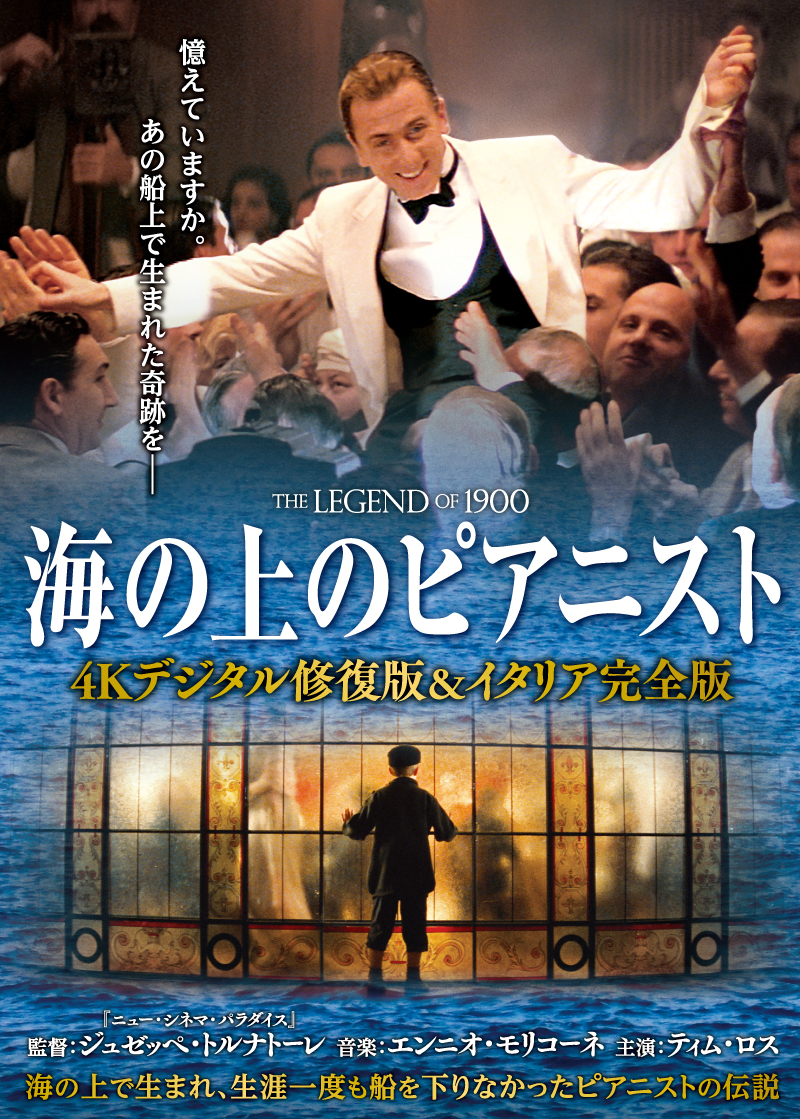

An epic tale of a genius pianist's strange fate, told as the memoir of his only close friend.
This gem of a film, "The Pianist on the Sea," directed by Giuseppe Tornatore ("New Cinema Paradise"), based on the famous one-man show by Alessandro Baricco, is another unforgettable impression for those who, like me, truly love movies.
The film is a sweeping epic that recounts the strange fate of a genius pianist who was born and raised on a ship and never got off the ship in his life, as told in the memoirs of his only close friend.
The film opens with a scene in which the immigrants are so excited to see the Statue of Liberty looming over the cruise ship that they shout, "America! I knew I was going to love this movie when I saw the scene at the beginning of the film, when the immigrants shout "America!
I knew that this scene was the gateway to such a "wonderful fable.
And so the moving story unfolds as Max (Pruitt Taylor Vince), now a fallen trumpet player, tells the story to the owner of the music store.
The child, named 1900 (Nineteen Hundred) after his birth year, was raised in a ship's hold.
At the age of eight, he first encounters the piano, sneaking into a first-class cabin and playing the grand piano in the dance hall to the amazement of the ship's staff.
The Nineteen Hundred (Tim Roth), who grew up on a ship, was inspired by the scenery of the land world and the way of life on the faces of the people aboard the ship, and he put his "dreams and longings" on the keyboard. The keyboard is the keyboard of the boat.
The music is so pure and beautiful that it is the very essence of the innocent Nineteen Hundred itself.
The powerful piano playing in response to the challenge from Jazz founder Jelly Roll Morton is also very rewarding to listen to, and the humorous atmosphere helps to make this an unforgettable scene, I truly believe.
He talks about the beauty of the ocean as seen from land, meets a man who has left for America to start his life over, and during his first and last recorded performance, he has a faint crush on a beautiful girl he sees through the window.
And then he makes up his mind to get off the ship.
But when he comes face to face with the endless skyscrapers, he turns back to the ship...
Is he really a cowardly loser of a life that we cannot sympathize with, who chooses to stay in his own world?
No, I think not. We do not want him to be exposed to the "insecurities and poisons" of the modern outside world.
We want the fable to be a fable, and we want it to end beautifully.
I love the scene of Max's meeting and parting with Nineteen Hundred, sitting side by side with Max in front of the piano with the stopper removed, on a stormy night in a violently rocking ship, and Nineteen Hundred playing the piano as it spins and spins. ---.
What a fantastic, dreamy, and intoxicating time.
And at the last moment of seeing Max off the ship before it explodes, Ninety-one Hundred calls out to him once or twice, as if regretting his last words.
I couldn't help but feel his somewhat weak and human nature, which made my eyes burn.
Anyway, I think Tim Roth, who played the legendary pianist Nineteen Hundred, gave the performance of a lifetime.
His calm expression, with a hint of "anxiety about the uncertain future of life," was nothing short of brilliant.
Ennio Morricone's original score, which reflects Nineteen Hundred's sad feelings, is also wonderful.
The music, which captures a single moment, a moment that will never happen again, showed me various expressions and immersed me in the lingering emotion.
And the narration, "As long as there is a good story and someone to tell it, life is not abandoned," is exactly the way director Giuseppe Tornatore approaches his films.
The director Tornatore's skillful storytelling, which hits all the right emotional points, has reached the level of a virtuoso, and is filled with "warmth and tenderness" from the director who wants to tell a good story. The last scene, in which the music shop owner returns Max's precious trumpet to him, was also very heartwarming, and the emotion I felt after watching the masterpiece lingered in my heart as a refreshing aftertaste.