
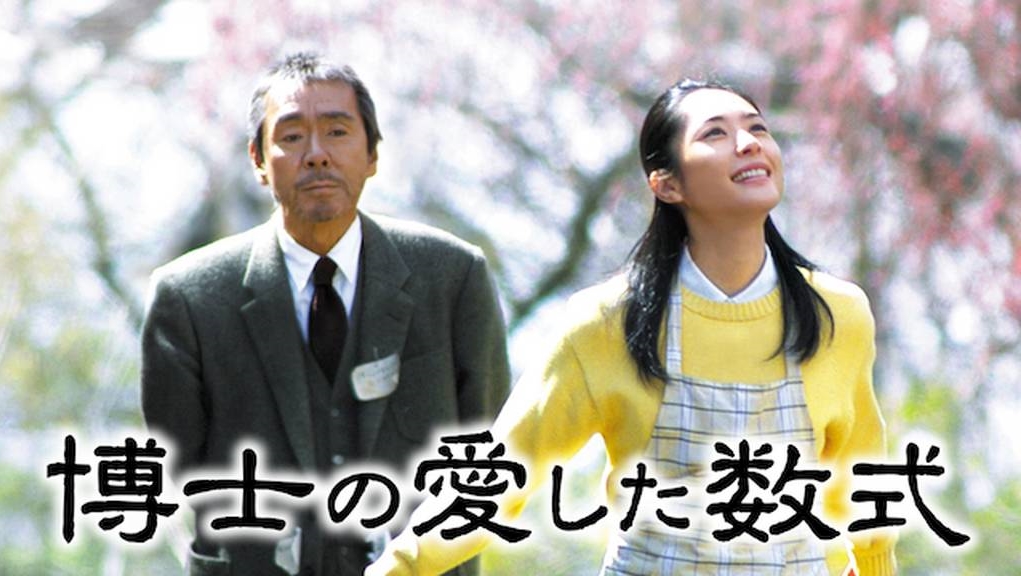

No over-the-top excitement or twists and turns, and two hours before you know it, it's over.
Screenings began in January 2006.
The film is based on the novel of the same title written by Yoko Ogawa.
First of all, I would like to tell you all that it is very difficult to make a live-action movie from a novel that has become a big hit. This is because it is impossible to convince readers of the novel if there is a big difference between the image they imagine from the novel and the representation in the movie.
In this respect, what readers absolutely expected was an indescribably warm atmosphere.
In this film, the interaction between the doctor, who has a memory of only 80 minutes, his housekeeper, Kyoko, and his son, Root, is depicted in a routine and warm atmosphere from start to finish, which is difficult to imagine for ordinary people, and the content is convincing not only to those who do not know the novel but also to readers of the novel.
However, what I felt from the perspective of a reader who liked the original work was that the anomaly of Dr. Math was not enough. He is indifferent to his own life, his body is emaciated, his room is in shambles, and he owns only a few clothes. Such is the doctor, but in mathematics alone he is a genius who can solve even the most difficult problems in the world's most prestigious magazines.
Dr. Akira Terao's character seems to have a more put-together appearance than I had imagined, and the gap between the indifferent Dr. Terao and the genius Dr. Math is smaller than I had imagined, leaving me with the impression that the characters lacked a three-dimensional sense of their own charm.