
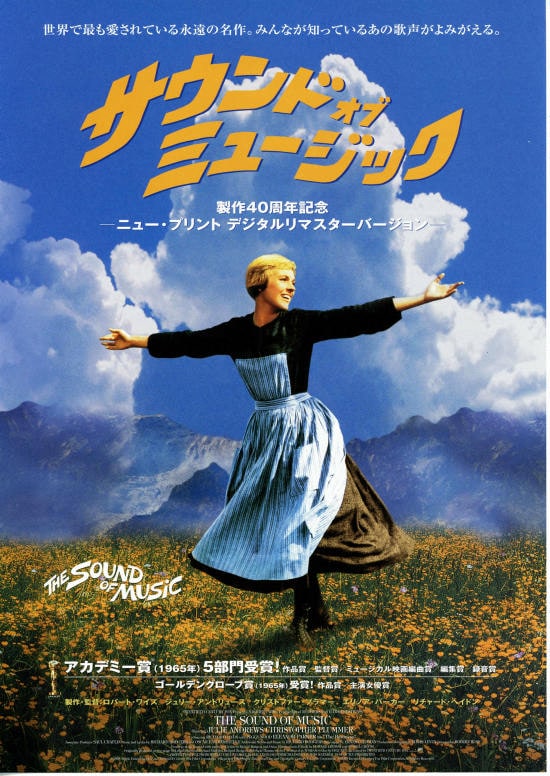

A masterpiece of musical film. The children express the joy of music with their whole bodies in "The Song of Do Remi," which will move your heart.
It is a musical film about a family and a nun in Austria during the rise of Nazi Germany.
Maria, a nun, comes as a governess to the children of Colonel Trapp, a retired navy officer.
The seven children, who had been subjected to a military-like discipline by their strict father, quickly open up to her musical approach to education.
Maria and the children sing the "Song of Do Re Mi," a song that everyone has heard at least once, as they run through the fields, mountains, and towns.
Not only are we dazzled by the beauty of the harmonies and images, but we are also moved by the sight of the children, whose natural liveliness has been suppressed, singing in the great outdoors.
The Japanese translations of the famous songs sung in the film are all beautiful.
In particular, "My Favorite" is a lighthearted song about one of Maria's favorite everyday scenes, and the beautiful expressions such as "Snow on the eyelashes" and "Bird flying in the valley of the moon" are a revelation.
Toward the end of the film, the Nazi invasion of Salzburg is finally imminent, and Colonel Trapp is ordered to report to the army.
The story ends with the family fleeing into exile in Switzerland, evading pursuit.
The family proudly sings "Edelweiss," one of the most famous songs in the film, in the midst of a serious social situation.
The family sings "Edelweiss" with dignity in the midst of a serious social situation, and it is one of the most famous songs in the film.
You will wonder if it is possible to hold on to one's identity without being influenced by one's surroundings.
It is a masterpiece that you will want to watch again and again.